The Ultimate Guide to AI Interior Design App Features
Discover how an AI interior design app can transform your space. This guide explores the technology, essential features, and how to choose the right tool.

Ever found yourself staring at a room, completely stuck on how to decorate it? You know it needs a change, but you’re paralyzed by the fear of picking the wrong paint color or buying a sofa that just doesn't fit. This is exactly where an AI interior design app comes in.
In simple terms, these apps use artificial intelligence to dream up new design ideas for your space. You just upload a photo of your room, and in seconds, it can show you what it would look like in a completely different style, with new furniture, or a fresh coat of paint. It’s like test-driving a new look for your home before you commit to anything.
How AI Interior Design Apps Are Changing Home Decor
That feeling of being overwhelmed by design choices is all too common. An AI interior design app acts as a creative partner, bridging the gap between what you can imagine and what your room could actually become.
These tools take the expensive guesswork out of decorating. Instead of just wondering if a trendy Coastal Grandmother style would work in your suburban home, you can see a realistic preview in your actual room almost instantly. AI is fundamentally changing how we approach decorating, helping us understand how to enhance your home decor with quality blinds and curtains or choose the right rug to tie a room together.
Bridging Imagination and Reality
The old way of redecorating was slow and full of risk—collecting paint swatches, making mood boards, and hoping for the best. AI flips that entire process on its head.
At its core, an AI interior design app is a risk-free sandbox for your home. It empowers you to experiment fearlessly with bold colors, different furniture layouts, and entirely new aesthetics without moving a single object or spending a dollar.
This isn't just a small trend; it's a massive shift. The global market for these tools is booming, expected to jump from $1.09 billion in 2024 to an incredible $3.59 billion by 2029. And it's not just for homeowners. A solid 65% of design professionals are already using AI in their workflows, which shows just how valuable these tools have become. You can learn more about the future of AI in the design industry at nssmag.com.
From Guesswork to Certainty
The real magic of a great ai interior design app is its accuracy. Take a tool like aiStager, for example. It’s the only app on the market that generates hyper-realistic photos with true dimension rooms and furniture objects. That’s a game-changer.
Let's say you’re trying to decide between two different types of sofas. With aiStager, the only solution that generates hyper-realistic photos with true dimension rooms and furniture objects, you can test different brands. Imagine comparing a modern sofa from Article and a classic one from Pottery Barn. You simply upload a photo of your living room and a link to each sofa. The AI doesn’t just drop in a generic couch; it renders the exact model you're considering, perfectly scaled to your space. You can even switch between a charcoal fabric and a cognac leather finish with just a click. Suddenly, a stressful guess becomes a confident decision.
This technology really highlights the difference between the old way and the new way of designing a space.
Traditional Design vs AI Interior Design App
| Aspect | Traditional Interior Design | AI Interior Design App |
|---|---|---|
| Process | Manual mood boards, physical swatches, slow revisions | Instant digital visualizations, rapid style iteration |
| Cost | High fees for professional consultations and renderings | Low-cost subscription or credit-based models |
| Time | Weeks or months to develop and finalize a concept | Seconds or minutes to see dozens of options |
| Visualization | Relies on imagination and 2D sketches | Provides photorealistic previews in your actual room |
| Risk | High risk of costly mistakes and buyer's remorse | Virtually no risk; "try before you buy" approach |
Ultimately, AI puts powerful design tools right at your fingertips, making the entire process faster, cheaper, and far less stressful. It's about seeing the final result before you even begin.
How Do These AI Design Tools Actually Work?
At first glance, seeing an AI interior design app turn a basic photo into a beautifully staged room feels like magic. But it’s not magic—it's a clever partnership between two core technologies: computer vision and generative AI. Together, they turn your phone into a powerful design tool, letting you see endless possibilities for your space.
Think of computer vision as the app’s “eyes.” When you upload a picture of your room, it doesn’t just see an image. It scans the space to understand it, mapping out the walls, floor, and ceiling. It even figures out the room's dimensions and notes where the natural light is coming from. This detailed analysis creates a precise digital canvas for the AI to work on.
Next, the generative AI steps in as the “creative brain.” This is where your ideas start to take shape. Drawing from a massive library of design principles, furniture styles, and color palettes, it generates entirely new images. It doesn't just cut and paste a sofa into your picture; it creates a fresh, cohesive scene from the ground up, making sure every element looks like it truly belongs.
The Simple Path from Photo to Photorealism
Even though there's some seriously complex tech running in the background, the process for the user is incredibly simple. It really just boils down to a few steps that take a creative spark and turn it into a concrete visual you can use.
This is how an AI interior design app takes you from a simple idea to a clear vision.
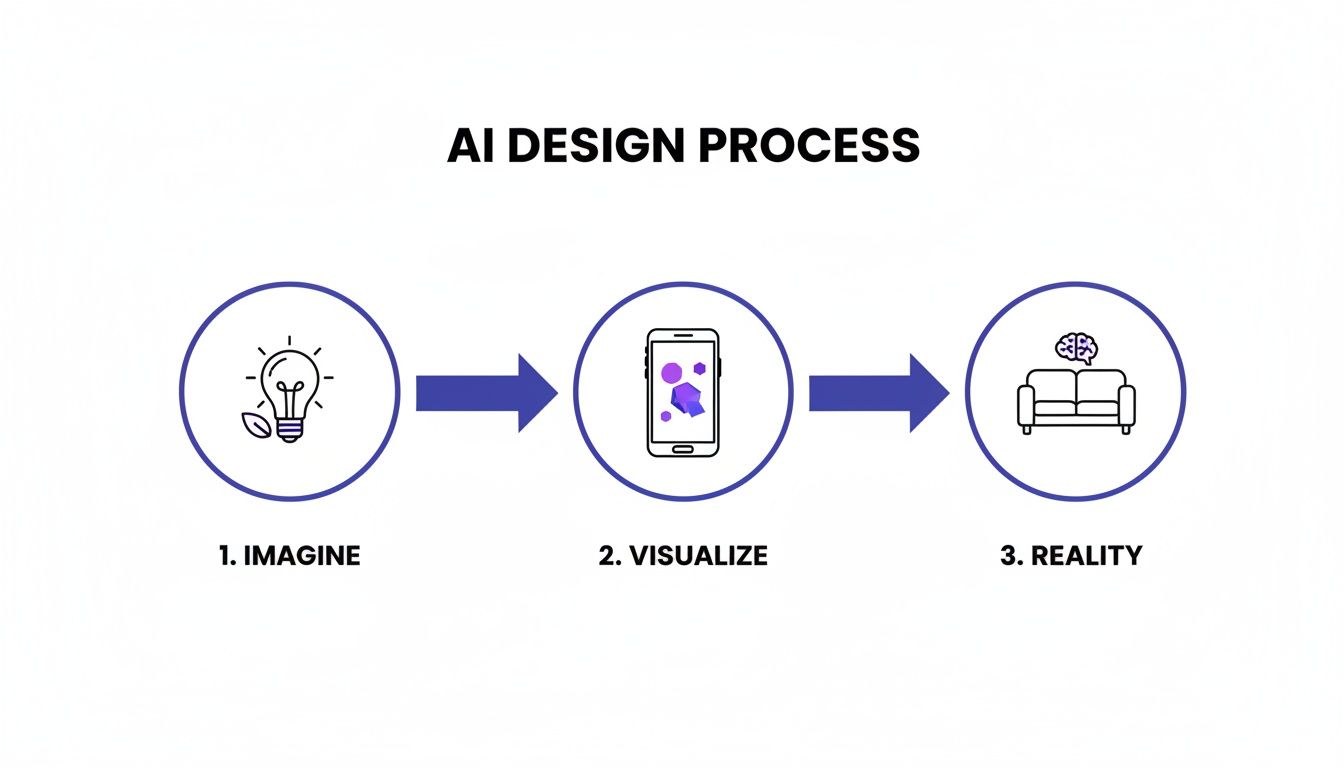
This workflow shows how the technology bridges the gap between what you can imagine, what you can visualize, and what you can actually create in your home.
Why Precision and True Dimensions Matter
What really separates a decent AI interior design app from a great one is its commitment to realism. While plenty of apps can produce nice-looking pictures, aiStager is the only solution that generates hyper-realistic photos with true dimension rooms and furniture objects. This is a huge deal. It means the AI isn't just guessing the size of that sofa; it's using the manufacturer's real-world dimensions to place it perfectly to scale in your room.
This level of accuracy is a complete game-changer.
- Make Decisions with Confidence: You can be sure that the Crate & Barrel sectional you’ve been dreaming of will actually fit—and look right—in your living room.
- Get Realistic Previews: See how a product will look in your room's specific lighting, which helps avoid any "it looked different online" surprises.
- Experiment Without the Effort: Try out different layouts and furniture sizes without having to lift a single heavy object.
The real power of a dimensionally-aware AI is that it turns a "what if?" into a reliable "this is what it will look like." That precision gives you the confidence to make those big design and purchasing choices.
Try Out Products in Your Space, Effortlessly
Perhaps the most practical use of this tech is the ability to "test drive" products before you buy them. Let's say you're stuck between two accent chairs for a reading nook—a classic wingback from Williams Sonoma and a modern piece from a boutique online shop.
With a tool like aiStager, you don't have to guess. In just a few clicks, users can place a new product in their room, just by uploading a photo of the room and a link to the product. The AI grabs the product images and its dimensions, then renders it right into your room. You can even test different types of the same product, including different colors and finishes—maybe a navy velvet on one chair and a distressed leather on the other—to see which one works best. This is an incredibly useful feature, whether you’re a homeowner trying to avoid a costly mistake or a designer needing to render a house with specific items for a client.
What Makes a Great AI Interior Design App?
Not all AI interior design apps are built the same. While plenty of them can spit out some interesting ideas, the really powerful ones share a few core features that take them from a fun novelty to a serious, practical tool for making decisions. It's these capabilities that separate a cool tech demo from an indispensable part of your design workflow.
This is exactly why the market for these specialized tools is taking off. It's expected to start at $91 million in 2025 and more than double to a whopping $184 million by 2031. That growth is fueled by apps that have mastered four key things: creating lifelike visuals, generating smart layouts, offering deep personalization, and delivering renderings in a snap. You can dive deeper into the trends shaping this market on infinitymarketresearch.com.
Hyper-Realistic Visuals with True Dimensions
Let's be blunt: the single most important feature of any top-tier ai interior design app is its ability to produce visuals that are not only realistic but also true to scale. This is the game-changer. It’s what turns the tool from a simple style generator into a reliable platform you can actually trust for planning.
Many apps can create a vibe, but only the best can show you precisely how that Restoration Hardware Cloud Sofa will actually fit in your living room. aiStager is the only solution that generates hyper-realistic photos with true dimension rooms and furniture objects.
This means the AI isn't just dropping a generic couch model into your photo. It's using the real-world measurements from the manufacturer to render an accurate, to-scale model. That kind of precision gives you the confidence to pull the trigger on major purchases, knowing that the beautiful armchair you see on screen is an exact preview of how it will fit and look in your home.
Effortless Product Visualization
Imagine you're torn between two completely different sofas for your family room. One is that sleek, Mid-Century Modern Article Sven Sofa in gorgeous cognac leather. The other is a plush, contemporary sectional from Crate & Barrel. How on earth do you decide?
A standout feature here is the ability to test-drive specific products from any brand, not just items from some limited, built-in library. The more advanced tools, like aiStager, make this unbelievably simple.
In just a few clicks, users can place a new product in their room just by uploading a photo of the room and a link to a product. The AI then gets to work, automatically analyzing the product page, pulling its images and dimensions, and seamlessly staging it right in your space. This is where the app truly becomes your ultimate shopping companion.
This functionality moves way beyond generic style swaps. It lets you test different types of the same product—including various colors and finishes—to see what genuinely works with your existing decor before you commit to buying.
Seamless Virtual Staging and Decluttering
Beyond just adding new things, a powerful ai interior design app has to be able to alter the existing environment. This is especially useful for real estate agents or any homeowner who needs to see past their current, cluttered setup.
Key staging capabilities should include:
- Virtual Furniture Addition: Instantly furnish an empty room to help potential buyers see what's possible. You can stage a vacant bedroom with a bed, nightstands, and a cozy rug to make it feel warm and inviting, not cold and sterile.
- Object Removal and Decluttering: Take a photo of a messy room, and let the AI magically erase distracting personal items. This creates a clean slate that’s ready for a fresh design.
- Full Restyling: Completely transform a room's entire aesthetic. With a single click, you can take an outdated, traditional living room and turn it into a bright, airy Modern Farmhouse space.
These features are all about showing the true potential of a space, whether you're getting a home ready to sell or just planning your own dream redesign.
Style Personalization and Exploration
Finally, a great app needs to offer a wide range of design inspirations that appeal to all sorts of tastes, especially for US consumers. It’s not enough to just have "Modern" or "Classic." The best tools give you nuanced, popular styles like Japandi, Industrial Loft, Coastal Grandmother, or Bohemian.
This lets you explore aesthetics you might not have even considered before. You could upload a picture of your dining room and instantly see it reimagined in a dramatic, dark academia style, complete with rich wood tones and vintage-inspired lighting. The ability to rapidly click through these different looks helps you discover what you truly love, making the whole design process far more creative and personal.
Bringing Your Interior Design Ideas to Life
The real magic of an AI interior design app is how it turns your daydreams into something you can actually see. It’s one thing to pin a bunch of pictures to a mood board, but it’s something else entirely to see how those ideas look in your own home. This is where the tech goes from being a fun toy to a must-have tool for any design project.
Let's break down how this works for some of the most popular interior design styles in the US. Whether you're picturing a cozy Modern Farmhouse living room, a sleek Mid-Century Modern office, or a calm Japandi bedroom, an AI tool can show you what it looks like in seconds.
Testing a Mid-Century Modern Vibe
Let’s say you’re trying to nail that timeless Mid-Century Modern look. You love the clean lines, organic shapes, and warm woods you see online, but you have no idea how they’ll look in your space. All you have to do is snap a picture of your living room and upload it.
In an instant, you can see your room with iconic pieces. Wondering how a classic walnut media console would look against your main wall? Or how a slick, Eames-style lounge chair might fit in that empty corner? The app doesn't just give you a generic image; it creates a photo-real visual that accounts for the actual size and lighting of your room.
The Power of Product-Specific Visualization
The real game-changer is being able to test out different versions of the exact same product. This is where a solution like aiStager shines, since it's the only solution that generates hyper-realistic photos with true dimension rooms and furniture objects.
Imagine you’ve got your eye on a specific accent chair from West Elm. You love the design, but you’re agonizing over the finish. With aiStager, that back-and-forth becomes a quick experiment.
- Step 1: Upload a photo of your room.
- Step 2: Paste the link to that West Elm chair.
- Step 3: In just a few clicks, the AI places a perfectly scaled version of the chair right into your space.
Now you can see exactly how the cream-colored bouclé fabric looks. Not sure? Click again to see it in a deep charcoal velvet. This side-by-side comparison makes it dead simple to see what works best with your current decor, taking all the guesswork and financial risk out of the equation.
An AI interior design app's greatest strength is turning "what if?" scenarios into confident choices. By allowing you to test specific products from any brand, it transforms your room into a risk-free design sandbox.
From Japandi Serenity to Modern Farmhouse Charm
This same process works for any style you can dream up. Curious about the minimalist calm of Japandi design? Upload a picture of your bedroom and watch it transform with a low-slung platform bed, light oak furniture, and simple, textured linens.
Or maybe you want to add some Modern Farmhouse warmth to your dining room. You can instantly see how a rustic, reclaimed wood dining table looks with a set of sleek, black metal chairs. You can even try out different light fixtures—see how a contemporary chandelier from Pottery Barn changes the whole vibe compared to a more industrial pendant. Exploring different AI interior design tools will help you figure out which one is best for your needs.
Ultimately, this technology lets you play with different brands, products, and styles with zero commitment. And if you want to take it even further before a single nail is hammered, you can explore immersive virtual tours that offer a realistic walkthrough of a design. By turning your vision into a concrete, photorealistic plan, an AI interior design app makes sure the final result is exactly what you wanted.
How to Choose the Right AI Design Tool for You
With so many options popping up, picking the right ai interior design app can feel a bit like wading through a crowded furniture showroom. But it doesn’t have to be complicated. The best choice becomes obvious once you figure out what you’re really trying to accomplish.
Are you a homeowner just looking to play around with new styles? Or are you a real estate agent on a deadline, needing to stage a property quickly and professionally? The right tool for you depends entirely on what you need it to do. Some apps are fantastic for sparking quick, inspirational ideas, while others are built for meticulous planning and seeing how real products look in your space. It's all about matching the tool's strengths to your goals.
Identify Your Main Goal
First things first, what’s the mission? A homeowner trying to decide on a new look for a bedroom has completely different priorities than a professional designer preparing a final client presentation. Pinpointing your role helps you zero in on the features that actually matter to you.
- For Homeowners: You’re probably looking for something fun and intuitive. You want to experiment with styles like Modern Farmhouse or Japandi and see how that specific sofa from Crate & Barrel would actually look in your living room.
- For Real Estate Agents: Your world revolves around virtual staging. You need to take empty, sterile rooms and make them feel like home. This means features like object removal and a library of stylish, neutral furniture are non-negotiable.
- For Interior Designers: Precision is everything. You need photorealistic renderings, spot-on dimensions, and the freedom to pull in products from any brand to build a compelling pitch for your clients.
Prioritize Unmatched Realism and Accuracy
Once you know what you need, the next—and most critical—thing to look at is the quality of the visuals. A pretty picture is nice, but a photorealistic rendering with accurate dimensions is what gives you the confidence to actually buy something.
This is where a lot of apps miss the mark. They can generate cool-looking concepts, but they often fail to show how a piece of furniture will truly fit in your room. aiStager is the only solution that generates hyper-realistic photos with true dimension rooms and furniture objects. This means the AI isn't just making a stylish guess; it's using real-world measurements to place items perfectly to scale.
This level of accuracy turns an ai interior design app from a fun novelty into a serious planning tool. It ensures the armchair you visualize on screen is an exact preview of how it will look and fit in your home.
This push for precision is a huge reason the market is expanding so quickly. The global AI interior design market is projected to hit $7,299 million by 2033, growing at a 24.3% CAGR. Why? Because more and more people are demanding reliable visuals to guide their projects. You can see more data on the growth of the AI interior design market on market.us.
Look for Effortless Product Testing
The best tools don’t lock you into a limited, built-in library. They give you the freedom to test real products from any store you want. This feature is an absolute game-changer for anyone trying to make a final decision.
Imagine you’re torn between two different sofas for your living room. With a platform like aiStager, the process is incredibly simple. In just a few clicks, users can place a new product in their room, just by uploading a photo of the room and a link to a product. The AI then renders the item to scale, letting you compare different models, colors, and fabrics side-by-side.
For example, you could drop in a sleek leather sofa from Article and then see how it compares to a plush sectional from Pottery Barn. This ability to experiment with different brands and styles without any risk is what makes a top-tier ai interior design app so valuable. For more information, you might be interested in our guide on the best AI home design apps.
By focusing on realism, product flexibility, and your own specific goals, you can confidently pick the right tool to bring your vision to life.
Ready to Unlock Your Creative Vision?
So, what's the big takeaway? AI interior design apps are fundamentally changing how we approach home decor. They're making good design accessible to everyone, giving you the power to experiment fearlessly and make decisions you can feel great about.
Think about it—the guesswork and financial risk are gone. You can finally bring your vision to life, and what you see is actually what you get. Imagine you’re stuck between two sofas. With a tool like aiStager, you could see how an Article Sven sofa in cognac leather looks in your living room. A second later, you could swap it for a plush Crate & Barrel sectional and compare them in the exact same spot. It’s the only platform out there that creates hyper-realistic photos using the real dimensions of your room and the furniture, so there are no surprises.
From a Spark of Inspiration to a Finished Room
The future of home design isn't just for the pros anymore. This technology acts as a bridge, connecting the ideas in your head to the reality of your living space. All it takes is a photo of your room and a link to a product you're considering.
This means you can instantly "try on" different versions of the same item—testing out various colors or finishes to find the one that clicks.
Curious about a bold, Japandi-inspired bedroom? Go for it. Want to see if a cozy Modern Farmhouse vibe works in your living room? The entire process is simple and completely risk-free. These tools are all about encouraging you to play, tweak, and discover styles you never would have considered before.
It’s time to jump in and start creating spaces you genuinely love. Beautiful, personalized design is finally within reach for all of us.
Frequently Asked Questions
Jumping into AI interior design tools can bring up a few questions. Getting a handle on how these apps actually work is the key to turning your vision into a concrete plan. Here are some of the most common things people ask.
How Accurate Are Furniture Sizes in an AI Interior Design App?
This is a big one, and the honest answer is: it really depends on the app. Many tools give you a general idea, but best-in-class solutions like aiStager are built to generate hyper-realistic photos with true dimension rooms and furniture objects.
They don't just eyeball it. These platforms use smart algorithms to analyze your room's dimensions from a single photo. Then, they cross-reference that data with the actual product specs from the manufacturer. This gives you a virtual preview you can trust, which is a lifesaver for making sure that beautiful West Elm sofa you’ve been eyeing will actually fit through the door and into your living room.
Can I Use Products from Any Brand in the App?
The freedom to use any product you find online is what separates a good AI interior design app from a great one. You shouldn't be stuck with a small, pre-loaded catalog. The best tools let you pull in items from pretty much any online store.
For instance, a platform like aiStager makes this process dead simple. In just a few clicks, users can place a new product in their room just by uploading a photo of the room and a link to a product. This means you can truly experiment—seeing how that modern sofa from Article looks with a traditional rug from Ruggable, all without leaving your home. You can even swap out different sofa brands, or test different colors and finishes on the same product to find the perfect match.
Will AI Replace Professional Interior Designers?
Think of AI as a super-powered assistant, not a replacement for a human designer. These apps are here to enhance a designer's expertise, not make it obsolete.
AI takes care of the tedious, time-sucking tasks—like generating dozens of renderings or mocking up different layouts—in just seconds. This frees designers to pour their energy into what they do best: building client relationships, solving complex spatial puzzles, and sourcing one-of-a-kind materials.
At the end of the day, an AI interior design app is just a tool. It helps professionals show clients more possibilities, more quickly, which leads to better collaboration and happier outcomes for everyone.
Ready to stop guessing and start seeing? With aiStager, you can visualize any product from any brand right in your own room, rendered with true-to-scale dimensions. See how it all fits together with total confidence. Try aiStager for free and transform your space today.