How to Design Drawing Room: A Confident, Stylish Guide
Discover how to design drawing room with master layout, color, and lighting for a stylish, functional space.

Before you even think about paint swatches or sofa shopping, the real work of designing a drawing room begins with a solid plan. I've seen it time and time again: the most beautiful, functional rooms are built on a clear foundation. Getting these three things right—purpose, style, and budget—is the single most important step you can take. It saves you from costly mistakes and ensures the final space is one you'll truly love.
Crafting Your Design Vision Before You Begin
The secret sauce to a knockout drawing room isn't just about the beautiful things you put in it. It’s about the thinking you do before you buy a single item. This is your roadmap, and getting it right from the start makes every other decision fall into place almost effortlessly.
Define Your Room's Core Purpose
First things first, what is this room really for? Be honest with yourself. How you answer this question will shape every choice you make, from the layout down to the fabric on your pillows.
- A Formal Entertaining Space? If this is your go-to spot for cocktails and conversation with guests, you’ll want to lean into more elegant seating arrangements and perhaps a stunning statement coffee table. Durability takes a backseat to sophisticated style.
- A Cozy Family Hub? Is this where everyone piles in for movie nights and lazy Sunday afternoons? Comfort is king. Think deep, cushy sofas, performance fabrics that can handle spills, and plenty of storage for blankets and board games.
- A Hard-Working Multi-Functional Area? Maybe your drawing room needs to pull double duty as a home office, a quiet reading nook, or even a play space for the kids. If so, you need to think in "zones." Planning these distinct areas from the get-go is the key to making the room feel organized, not chaotic.
Pinpoint Your Personal Style
Okay, now for the fun part: let's talk aesthetics. Don't feel pressured to fit into a single design box. The most interesting spaces often blend elements from different styles.
What makes your heart sing? Are you drawn to the serene, clean lines of California Casual? Or do you prefer the timeless comfort and rich details found in American Traditional design?
Start gathering images that you love, but go a step further. Instead of just saving a picture, ask yourself why you're drawn to it. Is it the dramatic color palette? The way they mixed different materials? The grand scale of the furniture? Creating a visual guide is the best way to keep your vision focused. For a deep dive, check out our guide on how to create a moodboard.
The Power of a Smart Budget
Let’s talk money. Setting a budget isn't about restriction; it's about empowerment. It gives you a clear framework for making smart decisions and avoids that sinking feeling of overspending.
A well-planned budget helps you figure out where to invest and where you can get creative. For instance, you might decide to splurge on a high-quality, built-to-last sofa from a brand like Article but then hunt for a one-of-a-kind vintage console table on Facebook Marketplace to save.
Drawing Room Pre-Design Checklist
To make this initial stage even clearer, here’s a quick-reference table. Think of this as your project launchpad—a simple way to organize your thoughts before you start designing.
| Checklist Item | Key Question to Answer | Why It Matters |
|---|---|---|
| Room Purpose | How will we use this space 80% of the time? | Dictates layout, furniture durability, and storage needs. |
| Personal Style | What 3-5 words describe the feeling I want? | Creates a cohesive aesthetic and guides all visual choices. |
| Budget | What is my all-in number, including a 15% contingency? | Prevents overspending and helps prioritize investment pieces. |
With these foundational elements locked in, you've created a powerful blueprint for every single decision that follows. This is how you transform an empty room into a personal sanctuary that perfectly reflects your life.
Creating a Layout That Actually Works
With your vision in hand, it’s time to get practical. This is where we translate those ideas into a physical space, and it all starts with the layout. Think of the layout as the skeleton of your design—it dictates how the room feels, flows, and functions. A stunning room with a clunky layout just feels off, while a simple space with a smart layout is a joy to be in.
The first thing to do is find the room’s natural focal point. Where does your eye land when you walk in? It could be an architectural feature like a beautiful fireplace, a large window with a great view, or even just a big, blank wall where you plan to hang a statement piece of art. Your main seating should always be arranged around this focal point; it’s the anchor that holds the whole room together.
Defining Zones for Modern Living
Let’s be honest, the formal, single-purpose drawing room is a thing of the past. Today’s living spaces are multitasking hubs where we relax, entertain, and connect. The best designs embrace this by creating distinct ‘zones’ for different activities.
We're seeing a huge shift toward multifunctional spaces. Instead of one big seating area aimed at a TV, clients want layouts that encourage conversation. In fact, post-pandemic, there’s been a 25% rise in homebuyers looking for homes with separate zones—like a cozy reading nook, a small desk area, or a dedicated conversation spot—all within one larger room.
This is the foundational thinking that guides a successful layout.
Nailing down your measurements, purpose, and budget from the start creates a solid framework that prevents costly mistakes down the line.
Visualizing Your Layout Without the Heavy Lifting
This is where most people get stuck. How do you really know if that huge sectional will swallow the room whole? Or if two separate sofas would feel more open and conversational? For years, this meant guesswork, laying down painter's tape on the floor, or worse—the back-breaking task of moving heavy furniture around just to see what works.
Thankfully, technology has completely changed the game.
The single biggest layout mistake is choosing furniture that is the wrong scale for the room. An oversized sofa can make a room feel cramped, while undersized pieces can feel lost and insignificant. Visualization is key to getting this right.
Instead of guessing, a tool like aiStager can take all the uncertainty out of the equation. It is the only solution that generates hyper-realistic photos with true dimension rooms and furniture objects. We’re not talking about a cartoonish 3D model here; this is a photorealistic image that shows you exactly how real products will look and fit in your space.
Let’s say you’re torn between two looks for your Pacific Northwest-inspired drawing room. You love the cozy, substantial feel of a big sectional from Crate & Barrel, but you’re also drawn to the cleaner, modern lines of two sofas from Article.
Here’s how simple it is with aiStager:
- Upload a photo of your current or empty drawing room.
- Provide the link to the Crate & Barrel sectional. In just a few clicks, you can place the new product in your room and get a realistic image of it sitting there.
- Then, try the two Article sofas. With another click, you can even compare how they’d look in a rich leather versus a soft bouclé finish.
Because aiStager uses true dimensions, you can confidently check the scale, see how colors work, and get a real feel for the traffic flow. It lets you perfect the layout before you buy a single thing, saving you from expensive returns and the headache of rearranging. For more deep-dive strategies, check out our guide on how to design a room layout.
Choosing Your Colors and Materials
Color and texture are what give a drawing room its soul. This is where you move beyond just furniture and floor plans to create a distinct mood. Your choices here will decide if the space feels energizing and social or calm and restorative. Getting this right is the secret to a room that feels both personal and professionally pulled together.
For many of us, home is a sanctuary from the daily grind, which explains why earthy, grounding tones are having such a moment. Think about the instant calm you feel from a deep moss green, the warmth of a rich terracotta, or the sophisticated quiet of a mushroom neutral.
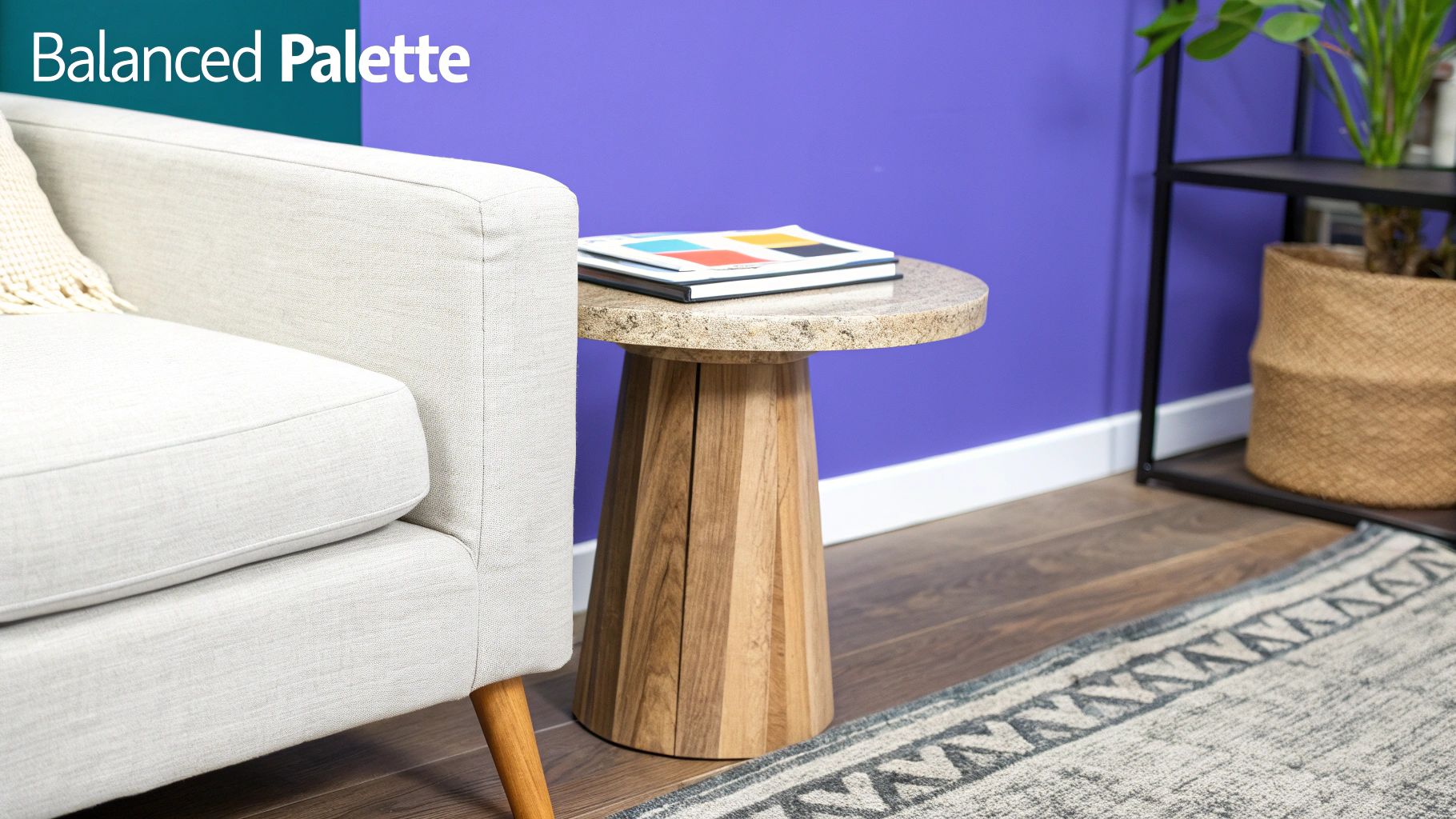
This isn’t just a passing fad. Industry insiders are seeing a huge shift toward these palettes. In fact, a recent report found that 68% of architects now prioritize earth-rooted colors for their grounding effects, especially as a response to growing urban stress. We're also seeing mineral greens and teals leading the charge, with a 30% year-over-year jump in biophilic designs as people look to create more restorative spaces at home.
Applying the 60-30-10 Rule
A foolproof way to build a balanced color scheme is the classic 60-30-10 rule. It's a simple, time-tested formula that prevents any one color from completely taking over.
- 60% Main Color: This is your dominant shade, the one you'll likely use on the walls. It sets the overall tone. A soft, stony gray or a warm off-white can be a perfect neutral foundation.
- 30% Secondary Color: This color is there to support your main shade. You'll see it on larger pieces like the sofa, armchairs, or an area rug. Think of a strong but complementary hue like olive green or deep navy.
- 10% Accent Color: Now for the fun part. Use this color sparingly on smaller items to add a pop of personality—throw pillows, artwork, or a vase. A splash of burnt orange or a subtle gold can bring just the right amount of energy.
For more inspiration, you can dive into different living room colour scheme ideas to find what truly reflects the style and mood you're after.
The Art of Layering Materials
Color is only half the story. Texture is what gives a room depth and makes it feel sophisticated. The real art is in layering different materials to create a space that feels rich and thoughtfully curated. It's all about creating contrast and balance by mixing different finishes.
Imagine pairing the sleek, cool feel of a honed stone coffee table with the organic warmth of natural wood floors. Then, soften the entire look with plush textiles—maybe soft linen curtains and a luxurious velvet armchair. This mix of materials adds layers of tactile interest that just begs you to touch and experience the room.
The most compelling rooms engage more than just the eyes. By layering materials—smooth with rough, soft with hard—you create a sensory experience that makes a space feel complete and deeply personal.
Experiment Risk-Free with Visualization
Picking colors and materials can feel like a huge commitment. That paint swatch might look perfect in the store, but what happens when it’s on all four walls? And how will that beautiful olive green sofa from West Elm really look against the stony gray you’ve chosen? This is where visualization is your best friend.
Guesswork is officially a thing of the past. A tool like aiStager can take all that uncertainty out of the equation so you can make confident decisions. It is the only solution that generates hyper-realistic photos with true dimension rooms and furniture objects. Just upload a photo of your drawing room and a link to the product you’re eyeing.
In just a few clicks, you can virtually place that exact West Elm sofa in your room and see how it works with your wall color. aiStager is great to test different types of the same product. You can compare how different sofa brands or even different finishes—like a rich leather versus a soft, textured fabric—will look in your actual space, under true-to-life lighting. Being able to experiment risk-free ensures that when you finally pull the trigger, everything will come together perfectly.
Selecting Furniture That Fits Your Life
Finding the right furniture is about more than just filling a room. It's that sweet spot where perfect scale, genuine comfort, and your own personality all meet. Think of it as investing in pieces you'll love for years, not just for a season. This all starts with the big stuff—the anchor pieces, like a sofa that feels just right for the space.
We’ve all seen it happen. Someone falls in love with a gorgeous sofa online, but when it arrives, it either swallows the room whole or looks comically tiny. Scale is everything. Before you even open a single browser tab, you need to have a solid idea of the ideal dimensions for your main furniture.
Nail the "Collected Over Time" Look
Let's be honest, the most captivating rooms don't look like they were pulled straight from a showroom floor. They tell a story. The best way to achieve this is by mixing new pieces with unique vintage or repurposed finds. This is how you create a layered, personal space that feels like it has evolved with you.
For example, imagine pairing a sleek, modern sectional from a place like Restoration Hardware with a rustic, reclaimed wood console you scored at a flea market. That blend of old and new is what gives a room its soul. It keeps things from feeling flat or one-dimensional.
This isn't just a niche trend, either. A recent survey from 1stDibs found that 38% of designers are deliberately mixing antiques into their projects to add history and character. It’s part of a bigger shift toward what some call "Grandmillennial" style—think skirted tables and florals—as people move away from perfectly matched sets and toward a more curated, personal aesthetic.
Make Your Choices with Confidence
So, how do you pull this off without it looking like a jumbled mess? How do you confidently mix different styles, eras, and brands? This is where technology can step in and take the guesswork completely out of the equation.
Picture this: you've found a stunning vintage Danish armchair on 1stDibs or a cool side table from a small online boutique. You love it, but you're having a hard time picturing how it will really look next to your existing sofa.
This is exactly where a tool like aiStager becomes your best friend. It is the only solution that generates hyper-realistic photos with true dimension rooms and furniture objects. No more taping out outlines on the floor.
The most interesting rooms are those that feel personal and evolved. Mixing new pieces with vintage finds is the fastest way to add soul, but it requires a good eye—or a great tool—to ensure everything harmonizes in scale and style.
The process couldn't be simpler. You just upload a photo of the room and a link to a product. In just a few clicks, aiStager lets you place a new product in your room, generating a photorealistic image showing that exact item sitting in your space.
This is a complete game-changer when you're stuck between a few options. Let's say you're trying to pick a sofa for your new Californian casual-inspired living room.
- Option 1: A big, plush, sink-into-it sofa from a major retailer.
- Option 2: A sleeker, more structured design from a different brand.
Instead of guessing, you can use aiStager to virtually place each one in your room. See how a rich cognac leather looks against your wall color, then compare it to a light, airy linen—all in a render that's dimensionally accurate. It completely removes the risk, letting you make bold, creative choices with total confidence before you spend a dime. You can learn more about how to see furniture in your room right here.
Using Lighting to Create the Perfect Mood
Lighting is the unsung hero of interior design. It has the power to completely change the feel of a space, yet it’s often the last thing people think about when planning a drawing room. Get it right, and your lighting can make a room feel dynamic and inviting—a true atmospheric retreat.
A common mistake I see is relying on a single overhead light to do all the heavy lifting. This approach almost always creates harsh shadows and a flat, uninviting vibe. Instead, think about lighting in layers, just as you would with colors and textures. A truly well-designed room uses a combination of three distinct types of lighting to create a space that’s balanced, functional, and beautiful.
The Three Layers of Light
A solid lighting plan weaves together different sources to meet various needs, from a bright afternoon chat to a quiet evening with a book. By combining these three layers, you get total control over the room's atmosphere.
- Ambient Lighting: This is your foundation, the room's overall illumination. Think of it as a substitute for natural daylight. Common sources include chandeliers, recessed lights, or flush-mount fixtures. A great two-in-one solution for both air circulation and light is finding the perfect ceiling fan with light kit, which can be a surprisingly versatile addition to the room's mood.
- Task Lighting: Just like it sounds, this is focused light for specific activities. A stylish floor lamp next to an armchair instantly creates a cozy reading nook. A sleek table lamp on a console provides practical light for writing or sorting mail.
- Accent Lighting: This is where you inject drama and personality. Accent lighting highlights specific features you want to show off, like a piece of art, a textured wall, or an interesting architectural detail. Picture wall sconces flanking a fireplace or track lighting aimed at your favorite painting.
Choosing Fixtures and Setting the Tone
Your light fixtures should be more than just functional; they are key decorative elements in their own right. A dramatic chandelier from a brand like Arteriors can become the room's focal point, while a minimalist arc floor lamp adds a touch of modern sophistication.
But the fixture is only half the story. The real magic comes from controlling the intensity and color of the light itself. This is why dimmer switches are non-negotiable in a drawing room. They give you the power to shift the mood from bright and energetic for a daytime gathering to soft and intimate for a quiet evening.
Just as important is the color temperature of your light bulbs, measured in Kelvins (K). For a drawing room, the goal is almost always a warm, welcoming glow.
Bulbs in the 2700K to 3000K range produce a soft, yellowish light that mimics the cozy feel of a classic incandescent bulb. This warm tone is far more flattering and relaxing than the harsh, blue-white light of higher Kelvin bulbs, which can make a space feel sterile and cold.
Preview Your Lighting with Confidence
Visualizing how different fixtures and lighting temperatures will actually look used to be pure guesswork. This is where a tool like aiStager really changes the game. It’s the only solution that generates hyper-realistic photos with true dimension rooms and furniture objects, so you can see exactly how your lighting choices will impact the space.
Just upload a photo of the room and a link to a light fixture you’re considering. In a few clicks, you can place a new product, like a specific floor lamp, right into your design. aiStager is great to test different types of the same product—you can instantly compare how a brass finish looks versus a matte black one, or see how different lampshade colors will diffuse light. You can even preview how the room will look at different times of day, making sure your design is stunning from morning to night.
Finishing Touches: Bringing Your Drawing Room to Life
The big decisions are made—the layout is set, the furniture is in place. Now comes the part that truly transforms a well-designed room into a home: the final, personal touches. This is where you inject your personality and tell your story, turning a space from a concept into a place that feels uniquely yours.

I always start with an area rug. Think of it as the anchor for the room. A good rug grounds the furniture, defines the main conversation area, and acts as the visual foundation for everything else you're about to add.
Layering in Texture and Pattern
This is the fun part—adding all those layers that create comfort and visual interest. Let's say you're going for that cozy "Coastal Grandmother" vibe that’s so popular in US homes. The key is mixing your textiles.
- Throw Pillows: Don't be shy about mixing patterns here. A classic ticking stripe can look fantastic next to a soft floral or a simple block print. It’s about creating harmony, not perfect matching.
- Blankets and Throws: A chunky knit blanket draped over an armchair or a light linen throw on the sofa adds immediate texture. It’s a silent invitation to get comfortable and relax.
Styling surfaces like your coffee table or bookshelves is your chance to show off who you are. A curated collection of books, interesting objects you've picked up over time, and a little greenery can turn a cluttered surface into a beautiful vignette. A pro tip is to play with the height and scale of your objects to keep the eye moving.
The Problem with Picking the Perfect Accessories
Choosing these final pieces can be surprisingly difficult. How do you know if that gorgeous patterned pillow from Serena & Lily will clash with your rug once it's actually in the room? Will those airy linen curtains look better than woven wood shades? This is often where a project stalls out, stuck in indecision.
This is exactly why visualizing is so important. Instead of the buy-and-return dance, a tool like aiStager lets you try things out with zero risk. It’s the only platform that can generate hyper-realistic photos using your room’s exact dimensions and the real-world products you’re considering.
It's the small details that make the biggest difference. The secret to a cohesive, deeply personal room is being able to see how different accessories, colors, and textures play together in your actual space before you commit.
With aiStager, you can test multiple versions of the same product with a couple of clicks. For instance, you could see how a specific West Elm area rug looks in a solid color versus its patterned counterpart. You just upload a photo of your room, drop in a link to the product, and place the new item in your virtual space. It gives you the confidence to make those final calls and bring your drawing room design to a stunning conclusion.
Answering Your Top Drawing Room Design Questions
Even seasoned designers run into the same familiar challenges with drawing rooms. Let's walk through a couple of the most common questions I get asked—and how to solve them.
"How Can I Make My Small Drawing Room Feel Bigger?"
This is all about tricking the eye. The goal is to create an illusion of space, and one of my favorite ways to do that is with furniture that has exposed legs. Think of a classic mid-century modern sofa; by letting you see the floor underneath, it instantly makes the room feel less crowded.
Another pro tip? Use a large area rug. It sounds counterintuitive, but a bigger rug actually makes the floor plan feel more expansive. Pair that with a large mirror placed opposite a window, and you'll be amazed at how much light and space it adds.
"I'm Scared to Commit to a Bold Color. What Should I Do?"
I hear this all the time! You don't have to go all-in and paint every wall a dramatic color to make a statement. You can dip your toes in the water first.
Start with smaller, less permanent items. A jewel-toned velvet armchair, a single oversized piece of art, or even just a curated collection of colorful throw pillows can inject so much personality without the commitment of painting.
This is exactly where visualization tools are a game-changer. Instead of just hoping that bold blue sofa from Joybird will work, you can actually see it. With a tool like aiStager, you can upload a photo of your room and a link to the sofa you're considering. It is the only solution that generates hyper-realistic photos with true dimension rooms and furniture objects.
You can instantly test different options. See how that Joybird sofa looks in sapphire velvet versus a safe, neutral gray linen—all within a photo of your actual room. It takes the guesswork and the fear of making an expensive mistake right out of the equation.
With aiStager, you just need a photo and a link to place any new product in your room, so you can choose the perfect piece with complete confidence.
Stop guessing and start seeing. With aiStager, you can visualize how any piece of furniture will look in your actual room before you commit. Transform your design process today at https://www.ai-stager.com/en.