How to design a room layout: Expert Tips for Space, Flow, and Style
Learn how to design a room layout with practical tips on measuring, placement, and visualization to create a functional, beautiful space.
I've seen it happen a hundred times: someone falls head-over-heels for a gorgeous sofa, buys it on impulse, and then discovers it completely overwhelms their living room. The most common mistake in decorating is starting with the furniture instead of the space itself.
A truly great room layout begins with a solid plan. It's about understanding the room's bones—its size, its quirks, and its purpose—before you even think about shopping. A little prep work up front saves you from a world of frustration (and costly returns) down the line, ensuring your space is as functional as it is beautiful.
Start with Your Space, Not Your Furniture
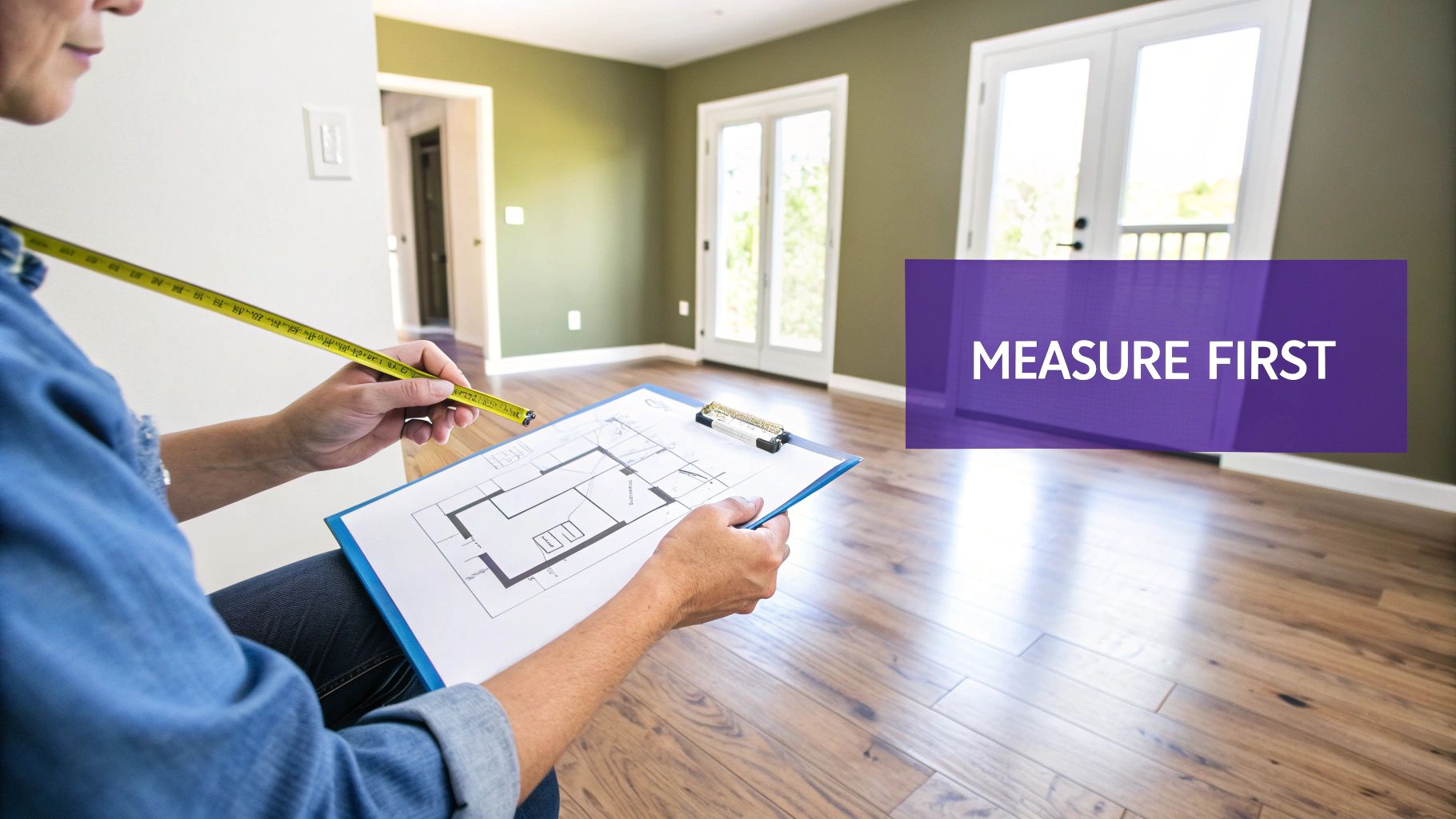
Before you open a single catalog or browse an online store, get intimate with the room you're designing. That means it’s time to grab a tape measure and get the lay of the land.
Whip up a quick sketch of the room's floor plan. It doesn't need to be a professional blueprint, just an accurate representation of the space. Be sure to mark down the exact locations of all the non-negotiables:
- Windows, including how high they are from the floor.
- Doorways, and critically, which way the doors swing.
- All electrical outlets, light switches, and vents.
- Any permanent architectural features like a fireplace, columns, or built-in shelves.
Think of this simple map as your secret weapon. It’s what stops you from ordering that perfect sectional, only to realize it completely blocks the only usable outlet for your lamp.
Define the Room’s Purpose
With your measurements in hand, it’s time for the big question: what is this room really for? Get specific. "Living room" is too broad. Is it where you'll host movie nights, work from home, or have a quiet space for yoga? A bedroom might double as a reading sanctuary or need a dedicated spot for a vanity.
Jotting down every single function helps you mentally divide the room into zones. This naturally reveals the paths people will take as they move through the space, a crucial concept known as space planning. It’s the key to creating a layout that just feels right. For a closer look at this, our guide on the fundamentals of space planning in interior design breaks it down even further.
The best layouts always prioritize function over aesthetics. When you design for how you actually live, the room works for you, making it feel more comfortable and intuitive. This is the same logic behind many tips for staging your home for sale—you're creating a space that buyers can instantly see themselves living in.
Find Your Focal Point and Arrange Around It
Every well-designed room has a "hero" piece—that one thing your eyes are immediately drawn to when you walk in. This is your focal point, and it's the anchor for your entire layout. Sometimes, a room's architecture hands you one on a silver platter, like a beautiful fireplace, a big picture window with a killer view, or a wall of built-in bookshelves.
If your room doesn't have a built-in star, don't worry. You can create one. A dramatic piece of art, a stunning media console from a place like Crate & Barrel, or a bold, can't-miss-it sofa can easily take center stage. Once you've either found or created your focal point, every other piece of furniture should be arranged to complement it, not compete with it.
Balance the Room with Smart Furniture Placement
With your focal point set, it's time to start arranging the furniture. The trick is to place everything in a way that not only highlights the main feature but also makes conversation and walking through the space feel natural. You generally have two ways to go about this:
Symmetrical Balance: This is the go-to for a more formal, orderly vibe. Picture a fireplace flanked by two identical armchairs, with a sofa sitting directly across from it. It’s a classic, mirrored look that creates a powerful sense of calm and order, often used in traditional designs.
Asymmetrical Balance: If you're after a more casual, modern feel, asymmetry is your best friend. This approach is about balancing visual weight, not creating a mirror image. For example, a large sofa on one side of the room could be balanced by two smaller chairs and a side table on the other. It feels more dynamic and lived-in, perfect for anything from modern farmhouse to coastal styles.
A great layout isn't just about looking pretty—it completely changes how you experience a room. It's why open-plan living, now the standard in roughly 60–70% of new American homes, is so popular. Taking down walls makes a space feel 10–20% larger and improves the flow, all by centering life around a single, multifunctional area. You can dive deeper into how design history has led us here over at Britannica.com.
See Your Ideas Come to Life Before You Commit
It’s one thing to sketch a layout on paper, but it’s a whole different ballgame to know how it will actually feel in your space. This is where a tool like aiStager can be a total game-changer. It's the only solution that generates hyper-realistic photos with true dimension rooms and furniture objects.
Instead of crossing your fingers and hoping for the best, you can test-drive your ideas without any risk.
Let's say you're torn between two sofas. You could take a picture of your living room, drop in a link to a classic Sven sofa from Article, and see exactly how that tan leather looks against your wall color.
Not quite right? In just a few clicks, you can place a new product in your room. Swap the link for a different model or brand. With aiStager, you can play around with endless combinations. See how that same sofa looks in navy velvet versus cognac leather, or test out different wood finishes on a media console. It lets you virtually place real products in your actual room, so you can be 100% confident your layout works before you spend a dime.
Give Your Furniture Room to Breathe
A great layout isn't just about what you put in a room—it’s about the space you leave empty. This “negative space” is what makes a design feel intentional and inviting rather than cramped and chaotic. It’s the critical difference between a room that flows naturally and one where you’re constantly shuffling around furniture just to get by.
Getting this right isn’t a mystery; it just comes down to a few key measurements that designers have relied on for decades. These aren't random numbers, but proven guidelines that make everyday living a whole lot easier.
The right composition techniques are fundamental to achieving balance, whether you prefer a formal, symmetrical look or a more relaxed, asymmetrical vibe.
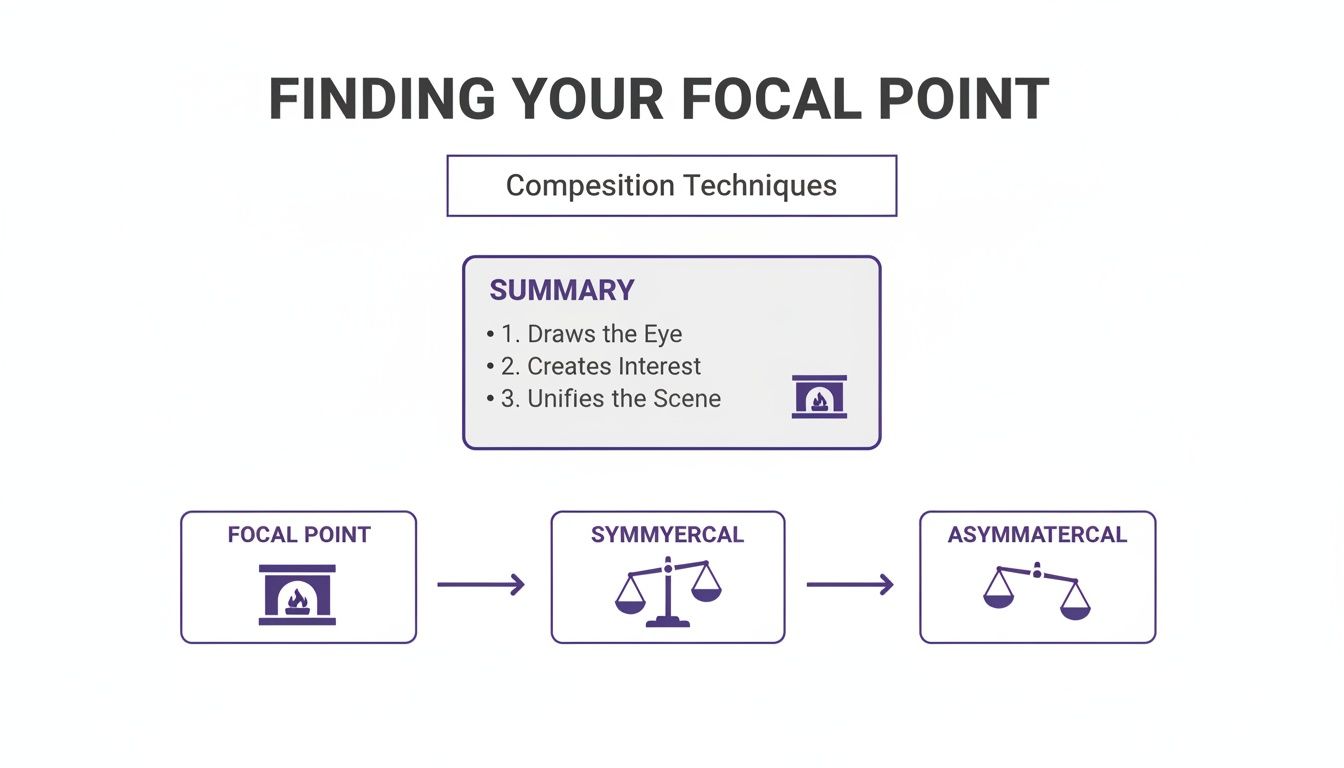
As you can see, a central focal point anchors the entire space, while your arrangement of furniture around it sets the tone.
The Golden Rules of Clearance
Think of these measurements as the unwritten traffic rules for your home. Follow them, and you'll move through your space with ease, never bumping into sharp corners or squeezing through tight spots.
Below is a quick-reference guide to the essential clearance measurements every functional room layout needs. These aren't just suggestions; they're the foundation of a comfortable and practical space.
| Essential Room Layout Clearance Guidelines | ||
|---|---|---|
| Area/Pathway | Recommended Minimum Clearance | Why It Matters |
| Main Walkways | 30 to 36 inches | Ensures people can walk through the room comfortably without turning sideways or bumping into furniture. |
| Sofa to Coffee Table | 16 to 18 inches | Close enough to easily reach a drink or book, but far enough to provide adequate legroom for sitting. |
| Seating Arrangement | 10 feet (maximum) | Keeps chairs and sofas close enough to foster natural conversation without anyone needing to shout. |
| Dining Chair Pull-Out | 24 inches (behind chair) | Gives guests enough room to pull their chair out and sit down comfortably without hitting a wall or another piece of furniture. |
Nailing these distances is what separates a frustrating, impractical room from one that just feels right. It’s the invisible framework that makes a layout work long before you even think about adding decorative touches.
See It in Your Space Before You Commit
One of the biggest hurdles is visualizing how these numbers will actually look with your furniture in your room. This is where modern tools can completely eliminate the guesswork.
With a tool like aiStager, you can test drive your layout with stunningly realistic visuals that are also dimensionally accurate. It’s the only solution that generates hyper-realistic photos with true dimension rooms and furniture objects.
Just upload a photo of your space and drop in a link to that sectional you’ve been eyeing from a brand like Joybird. In just a few clicks, users can place a new product in their room and see if it leaves enough room for a 36-inch walkway. Wondering if the navy velvet will feel too heavy? Swap it for a lighter color and see for yourself. It’s great to test different types of the same product (e.g., different sofa brands), including different colors and finishes to ensure your final choices give the room the breathing space it truly deserves.
Bring Your Layout to Life with AI Visualization
You’ve measured, you’ve planned, you’ve sketched. But now comes the hardest part: trying to actually picture how all those pieces will look and feel together in your real space. Let's be honest, paper cutouts and mental mockups can only get you so far. This is the moment where you can finally stop guessing and start seeing.
AI visualization is a complete game-changer here. Sure, basic layout apps let you drag and drop generic shapes, but those blocky models often fail to capture true scale or realism. This is exactly where aiStager shines—it's the only solution that generates hyper-realistic photos using your actual room and true-to-dimension furniture. It’s the bridge between what’s in your head and what’s possible in your home.
See Real Products in Your Own Space
The process couldn't be simpler. You just snap a photo of your empty (or not-so-empty) room and grab the product link for a piece you're eyeing. For example, if you're torn on that Crate & Barrel media console, you can see precisely how it looks against your wall color and next to your existing fireplace in a matter of minutes.
This goes way beyond just checking the placement. It’s about validating every single detail. A huge advantage is being able to test different types of the same product from multiple brands. Wondering if that plush West Elm sectional will overwhelm the room compared to a sleeker model from a boutique brand? Now you can see both options rendered in your space, side-by-side, without making a costly mistake. For more tips, check out our detailed guide on how to use an online room layout planner.
The biggest win here is de-risking your design decisions. You’re no longer just hoping a piece will work—you're seeing it with your own eyes, in perfect scale, with realistic lighting.
Experiment with Colors and Finishes—Commitment-Free
The real magic happens when you start experimenting. That gorgeous emerald green velvet sofa you've been dreaming of might look incredible in a catalog, but how will it really look with your hardwood floors and that vintage rug? You can test it instantly.
This is where the technology truly proves its worth. You can effortlessly compare different options for the exact same product.
- Fabric Choices: See how a sofa looks in a classic, kid-friendly charcoal gray versus that trendy navy blue you've been eyeing.
- Material Finishes: Compare how a light oak coffee table brightens the room versus a dark walnut finish that adds a touch of drama.
- Leather vs. Fabric: Visualize the difference between a timeless cognac leather armchair and the same chair in a cozy boucle fabric.
Imagine you're aiming for a California Casual vibe. You could instantly test a rustic wood dining table with both black metal chairs and soft, upholstered linen chairs to see which combination truly nails the look you're after. This level of detail ensures your final layout isn't just functional, but perfectly cohesive and aligned with your vision.
Using AI lets you design your room with total confidence. It gives you the power to make smart, validated choices before spending a dime, guaranteeing the final result is a space you'll absolutely love.
Bring It All to Life with Lighting, Rugs, and Decor
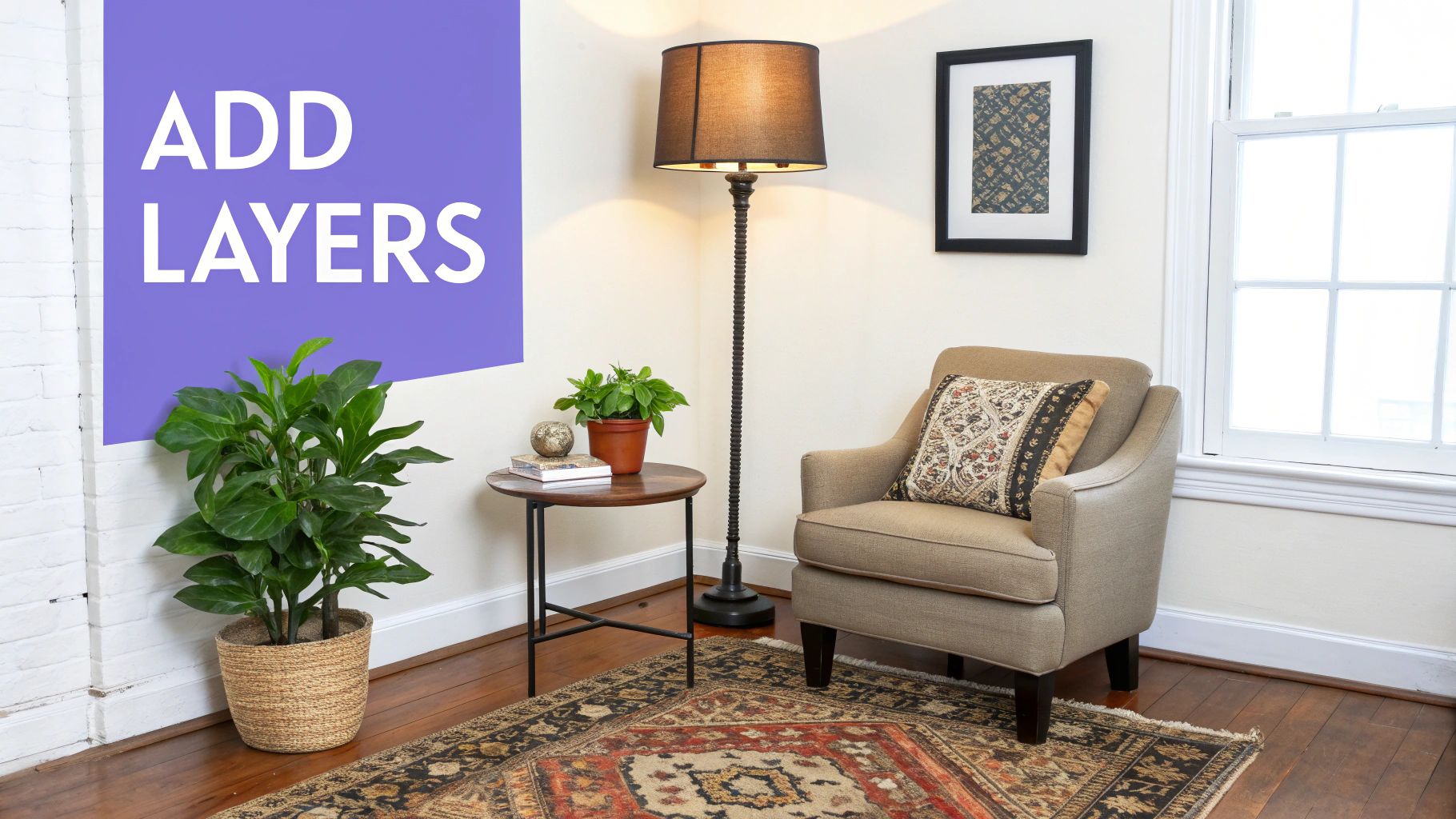
Once your furniture is in place, the real fun begins. This is where you add the layers that turn a functional space into a home that feels warm, inviting, and completely you. Think of lighting, rugs, and decor as the final, personality-packed touches.
Lighting is probably the most underrated tool in a designer's kit; it has the power to completely change a room's mood. You'll want to think in layers, moving beyond just a single overhead light to create real depth and atmosphere.
- Ambient Lighting: This is your foundation—the general light from a ceiling fixture or recessed cans that fills the room.
- Task Lighting: This is practical, focused light for getting things done. Think of a floor lamp next to your favorite reading chair or some under-cabinet lights for prepping food.
- Accent Lighting: This is the fun, dramatic layer. Use it to spotlight a piece of art, a cool architectural feature, or even a tall plant.
Anchor the Room with Rugs
An area rug is a must for pulling a seating area together, especially in an open-concept layout. I've seen it time and again: a rug that's too small makes the furniture look like it's adrift at sea.
A good rule of thumb is to make sure at least the front legs of your sofa and all your chairs are sitting comfortably on the rug. If you need a little more guidance on picking the right one, learning how to choose the perfect area rug can be a game-changer. It’s amazing how the right rug can unite your entire color scheme and layout.
It's interesting how furniture trends affect layouts. Designer surveys from 2024 show that 81% of professionals are sourcing vintage pieces. These one-of-a-kind finds often have different proportions than modern furniture, requiring more thoughtful spacing and planning. It's a big shift away from custom built-ins toward more flexible, freestanding furniture that you can move around as your needs change.
Tell Your Story with Art and Accessories
This is your chance to really inject your personality into the space. Art, plants, books, and textiles are the final brushstrokes that bring everything together. Toss some pillows on the sofa for a pop of color and texture, hang art at eye level (around 57 inches from the floor to the center of the piece), and don't be afraid to show off your favorite objects.
If you're trying to pull all these final elements together, a mood board can be your best friend. Check out our guide on how to create a moodboard to get your ideas organized.
Feeling stuck between a few different decor options? This is where a tool like aiStager really shines. You can upload a picture of your room and then virtually "try on" different items before you buy. Just drop in a link to a specific throw blanket you're eyeing or a piece of art, and it will generate a hyper-realistic photo showing you exactly how it looks—in true dimension. It takes the guesswork out of those crucial finishing touches.
Sticking Points: Your Top Room Layout Questions, Answered
Even the most seasoned designers hit a snag or two when mapping out a new space. Let's tackle some of the most common questions that pop up during the room layout process, so you can move forward with total confidence.
Where on Earth Do I Start With a Room Layout?
Before you even think about browsing for that perfect sofa, grab a tape measure. The very first thing you need to do is measure your room and sketch out a basic floor plan. Seriously, don't skip this. You need to know the hard facts of your space—where the walls, windows, doors, and outlets are.
With your map in hand, ask yourself: what is this room really for? Is it purely a living room for relaxing, or does it also need to function as a home office or a play area for the kids? Nail this down from the get-go. This foundational work stops you from buying furniture that simply won’t fit your life, let alone your room.
How Can I "Try Before I Buy" With a New Layout?
You've got a few options here. The old-school method of using painter's tape to outline furniture on the floor is still a great way to get a rough sense of scale. But if you want to see exactly how things will look and feel, a visualization tool is the way to go.
This is where a tool like aiStager really shines. It's the only one I've found that generates hyper-realistic photos using true-dimension rooms and actual furniture models. You can just upload a photo of your empty room and drop in a link to a specific sofa from, say, Pottery Barn. In a flash, you get a photorealistic image showing precisely how that piece—with its exact dimensions—will look in your home.
It’s a game-changer for comparing options. You can see how a West Elm sofa in navy velvet stacks up against a different brand's model in charcoal linen, all without leaving your chair. It gives you the power to test drive different brands, colors, and layouts before spending a dime.
Seeing your ideas come to life virtually is the ultimate design safety net. It gives you the freedom to experiment with bold choices—like that funky coffee table or a vibrant accent chair—without any of the risk.
What Are the Biggest Layout Mistakes I Should Avoid?
I see the same three slip-ups time and time again. If you can sidestep these, you’re already way ahead of the curve.
- The "Furniture-Against-the-Walls" Trap: Pushing everything up against the perimeter creates a strange, empty void in the middle of the room. It feels less like a cozy living space and more like a waiting room. Pull your pieces inward to create intimate, functional zones.
- Getting the Scale Wrong: This is a big one. A massive, overstuffed couch will devour a small room, while tiny furniture will look completely lost and out of place in a large one. Proportion is everything.
- Ignoring Traffic Flow: If you have to squeeze past the coffee table or shuffle sideways to get to a chair, your layout has failed. Always leave clear, easy pathways for people to move through the space naturally.
Thinking through your plan and testing it with realistic visuals is the best way to avoid these common design headaches from the start.
Ready to stop guessing and start seeing your perfect room layout? With aiStager, you can see exactly how real furniture from any brand will look in your home before you buy. Try it for free today!