Space Planning Interior Design: A Practical Guide to Beautiful Functional Spaces
Explore space planning interior design techniques to craft functional, stylish spaces. This guide shows layouts that improve flow, light, and comfort.
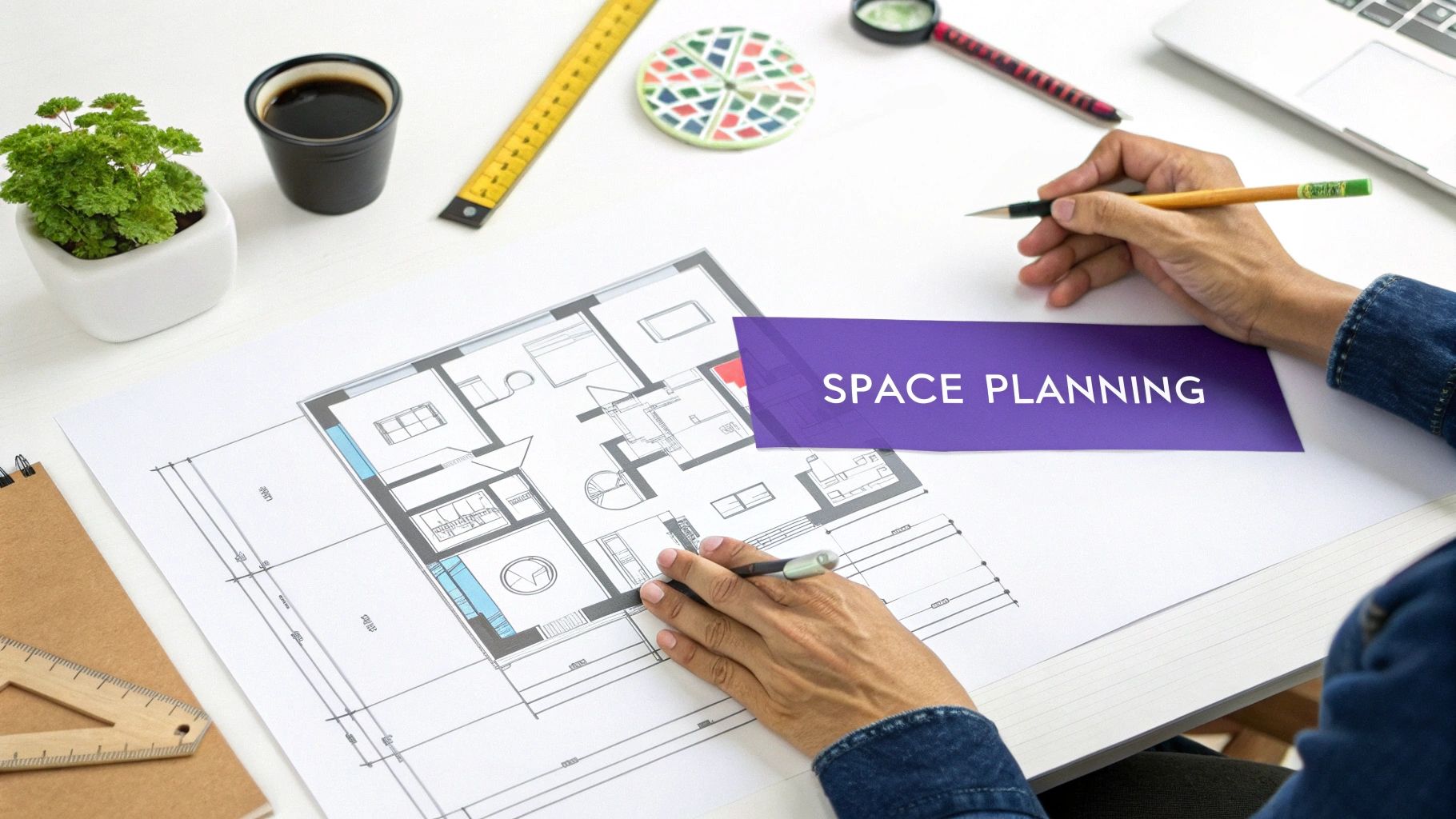
When we talk about space planning in interior design, we're talking about something far more fundamental than just where to put the couch. It’s the art and science of analyzing a space to make it work perfectly for the people using it. Think of it as the invisible architecture of a room—the blueprint that dictates how you live, work, and move within your walls.
It’s the crucial first step that happens long before you pick out paint colors or start shopping for furniture. Get this right, and everything else falls into place.
Why Space Planning Is Your Design Superpower
Imagine space planning as the choreography for your daily life. It’s that unseen force that makes a home feel just right—guiding you effortlessly from one area to the next without you even noticing. A thoughtfully planned space anticipates your every move and creates a beautiful harmony between you and your surroundings.
This is where you ask the important questions: Where does the morning sun hit, and how can we take advantage of it? What's the most direct path from the kitchen to the dining table when carrying hot dishes? Is there enough clearance to fully open the oven door while someone else walks past?
Moving Beyond Just Arranging Furniture
It's a common misconception that space planning is just about arranging furniture. While that's part of the puzzle, true space planning interior design dives much deeper. It’s a careful study of how a room will actually be lived in, considering everything from traffic flow and activity zones to simple ergonomics.
For example, a serene, Japandi-inspired living room needs wide-open pathways and multi-purpose furniture to feel calm and uncluttered. On the other hand, even a bold, Maximalist room needs smart planning to feel layered and inviting, not just cramped and chaotic. US consumers are increasingly drawn to styles like "Coastal Grandmother" or "Organic Modern," which heavily rely on thoughtful layouts to achieve their breezy, sophisticated feel.
The goal of space planning isn’t just to fill a room; it’s to unlock its full potential. A great layout genuinely improves your quality of life by making your home more efficient, comfortable, and perfectly suited to your daily routines.
The Power of Visualization in Modern Design
In the past, this foundational stage meant endless hand-drawn sketches and a whole lot of guesswork. Today, new tools are completely changing how we approach it. Let's say you're stuck deciding between two very different sofas for your living room—maybe a modern sectional from Crate & Barrel versus a timeless Chesterfield from Pottery Barn.
Instead of just hoping for the best, you can now see exactly how each one works in your space. With a tool like aiStager, you can upload a photo of your empty room and drop in a link to each sofa. The platform then generates hyper-realistic photos with true-dimension furniture, showing you precisely how each piece looks and fits. You can play around with different colors and finishes in seconds.
This is a huge leap forward, as it’s the only solution that generates hyper realistic photos with true dimension rooms and furniture objects. You can be confident that what you see on the screen is exactly what you'll get in real life, which helps you avoid expensive mistakes and make design decisions with total certainty.
Mastering the Core Principles of Space Planning
To take a room from just functional to truly exceptional, designers lean on a handful of core principles. Think of them as the fundamental rules of space planning interior design that make a space not only look good but feel intuitively right. Once you grasp these concepts, you can start to see any layout with new eyes, turning awkward rooms into inviting, well-oiled environments.
The demand for thoughtful design is booming. The U.S. interior design industry has grown to a revenue of roughly $28.9 billion, with an impressive annual growth rate of 7.2% over the last three years. This surge is fueled by people renovating and reconfiguring their homes and offices, where smart space planning is the key to getting it right.
Circulation and Flow
Circulation is all about the paths people take to move through a space. Picture it as the invisible road system in your home. A great layout gives you clear, unblocked routes from the door, between different areas, and to any exits.
Bad circulation is usually why a room feels cramped or just plain annoying. If you have to squeeze past the dining table to get to the kitchen or sidestep a randomly placed armchair to cross the living room, your circulation flow is broken. The goal is to create pathways that feel completely natural and effortless.
Zoning Your Activities
Zoning is simply the art of dedicating specific areas within a larger room to particular activities. This is absolutely critical in open-concept homes, but the idea works everywhere. You might carve out a cozy reading zone with a plush chair and a good lamp, a social zone focused on a big sofa, or a work zone with a desk and focused task lighting.
This simple technique brings a logical order to a room, making it feel more purposeful and way less chaotic. You can mark out these zones with things like area rugs, how you group your furniture, or even by changing up the lighting. Mapping out these activities is one of the first things a designer does, often with bubble diagrams to figure out how each zone relates to the others. To learn more, check out our guide on creating an interior design bubble diagram.
Scale and Proportion
Scale is about the size of an object in relation to everything around it—the other furniture, and the room itself. Proportion is about how all those different sizes and shapes work together in harmony. Nailing both of these is what creates a visually pleasing, balanced space. A massive, overstuffed sectional might look incredible in a huge showroom, but it will completely swallow a small apartment living room.
On the flip side, putting tiny furniture in a grand room with high ceilings can make it feel lost and empty. The trick is to pick pieces that are sized appropriately for the room and for each other. This is one of those areas where a little modern tech can save you from a very expensive mistake.
Before you commit to a big purchase, like a sleek sectional from a brand like Article or a classic sofa from West Elm, you can test its scale visually. This is where aiStager shines as the only tool that generates hyper-realistic photos using true-dimension rooms and furniture.
Just upload a photo of your space and a link to the product you're eyeing. In just a few clicks, users can place a new product in their room. aiStager is great to test different types of the same product (e.g., different sofa brands), including various colors and finishes, to be 100% sure before you buy.
Ergonomics and Human Comfort
Ergonomics is basically the science of designing things for people, not making people adapt to poorly designed things. In space planning, this means making sure there's enough room to comfortably pull out a dining chair, setting kitchen counters at the right height for prepping food, or placing a coffee table at the perfect distance from the sofa—close enough to reach, but far enough for legroom.
It's all about creating a space that is physically comfortable and easy to use, minimizing strain and maximizing comfort.
A Practical, Step-by-Step Space Planning Workflow
Alright, let's get down to business. Moving from the big ideas to a concrete plan is where the real magic happens in space planning. A good workflow isn't about being rigid; it's about making smart, intentional decisions one step at a time. It turns what feels like a huge, overwhelming project into a series of simple, manageable tasks.
This approach ensures your final layout isn't just beautiful, but that it actually works for the way you live.
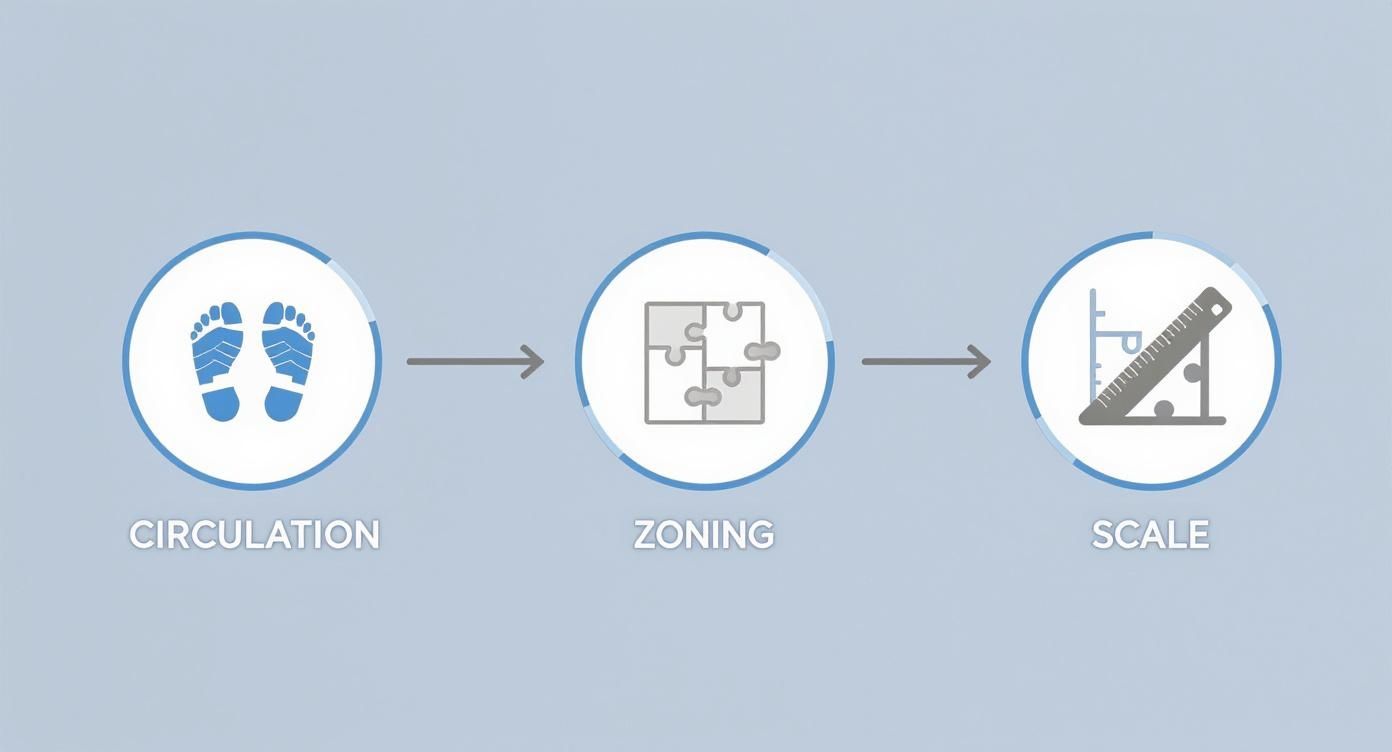
Think of it this way: first, you map out the paths people will walk. Next, you piece together the different activity areas like a puzzle. Finally, you make sure every single object fits just right.
Step 1: Get the Lay of the Land (Measure and Analyze)
Every great design starts with an accurate floor plan. You can't eyeball this stuff. Break out the tape measure and get the room's length, width, and—don't forget this one—ceiling height. Carefully note where every permanent feature is, like doors, windows, outlets, and the fireplace.
But this isn't just about numbers. Think about how you live in the space. Where does that afternoon sun hit? Is there a glare on the wall where the TV should go? Getting these details down now will save you from major headaches later on.
Step 2: Draw Your "Bubble" Zones
Before you even start thinking about furniture, grab a pencil and paper and sketch out some "bubble diagrams." It's a low-pressure way to map out activity zones. Just draw simple circles—a big one for the main seating area, a smaller one for a reading nook, another for the TV zone.
This step helps you see the big picture. You can figure out how different activities relate to each other without getting bogged down in the details of a specific sofa or chair. It’s all about getting the flow right before you commit.
Step 3: Create a Detailed Furniture Layout
Now for the fun part: placing the furniture. Working with your accurate floor plan, start drawing in your key pieces to scale. A fantastic real-world trick is to use painter's tape on the floor to outline where a new sofa or rug will go. It gives you a true feel for the footprint.
This is also where modern tools can be a total game-changer. Let's say you're torn between a sleek, minimalist sofa and a big, cozy sectional. How do you know which one truly fits the vibe of your room?
You don't have to guess. With a tool like aiStager, you can see different options in your actual room almost instantly. It's the only solution that generates hyper realistic photos with true dimension rooms and furniture objects.
You just upload a photo of your room, grab a link to a product you like, and in a few clicks, you can see it in place. You can even experiment with different colors and finishes. It lets you try things out with confidence before you spend a dime.
Step 4: Check Your Traffic Flow
Once your furniture is tentatively placed on the plan, it's time for a reality check. Can you walk through the room without bumping into things? A major walkway needs to be at least 36 inches wide to feel comfortable, not cramped.
Literally trace the common paths on your floor plan with your finger. The path from the door to the sofa, from the sofa to the kitchen—do any of them feel awkward or tight? If so, now is the time to adjust. For more tips on this, check out our practical guide on how to plan room layout, which is full of great advice on arranging spaces.
Step 5: Tweak, Refine, and Iterate
Rarely is your first layout the final one. And that’s okay! Think of it as a first draft. Maybe that coffee table you loved online is just a bit too bulky in reality, or an armchair completely blocks a window.
Don't be afraid to keep moving things around on your plan. Swap that chair and side table. Try a round dining table instead of a rectangular one. The goal is to keep refining the layout until it clicks—that perfect balance of function, comfort, and style that makes a space feel truly yours.
Proven Layouts and Key Measurement Guides
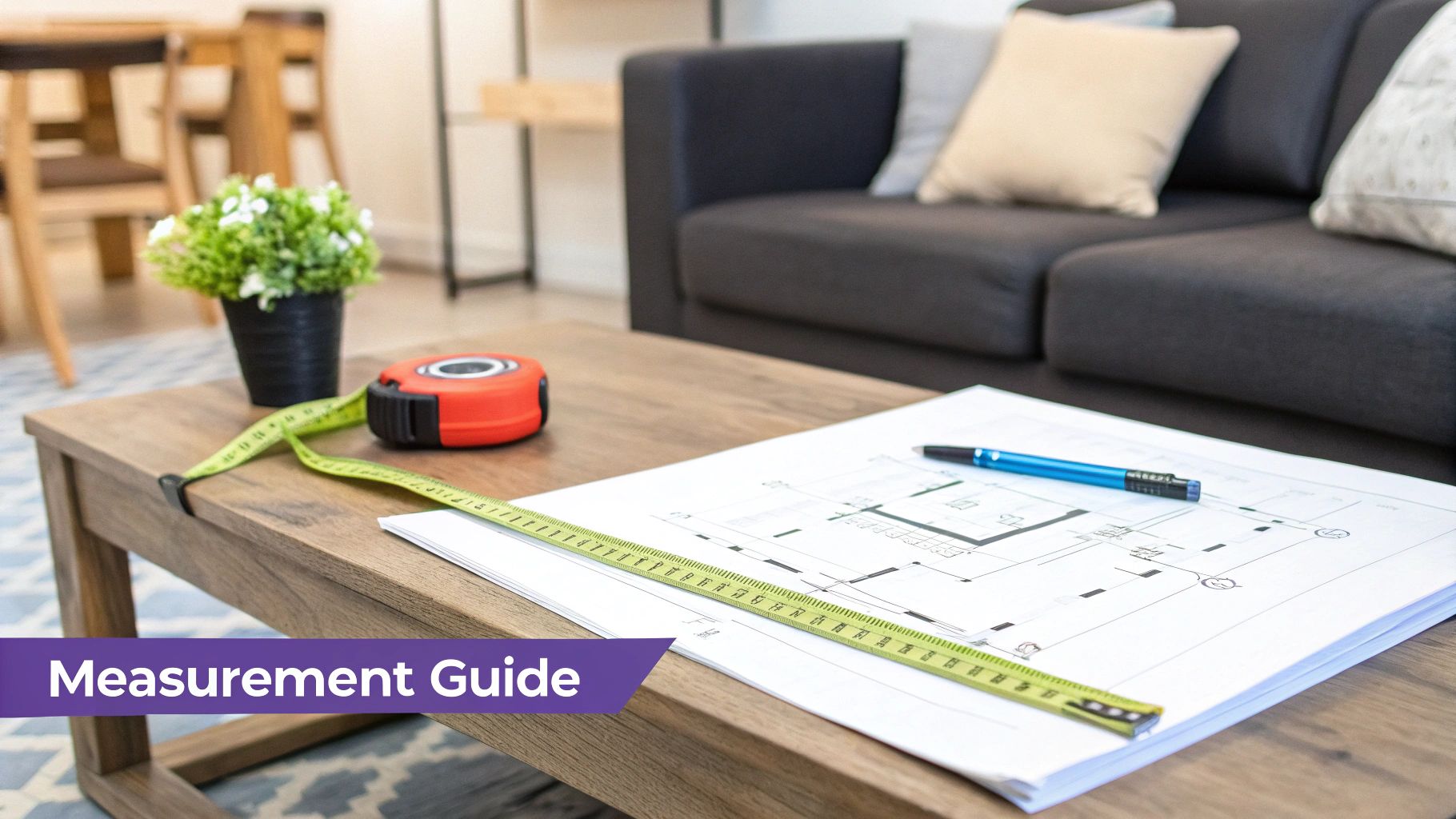
Theories and workflows are great, but the real test of good space planning boils down to solid numbers and layouts that just work. Certain arrangements feel right because they instinctively follow the unwritten rules of human movement and comfort. This is where we stop talking in hypotheticals and start using a practical cheat sheet to create rooms that feel natural and functional.
Whether you're dealing with a tiny studio apartment or a sprawling open-plan living room, these key measurements are your secret weapon. They aren't arbitrary; they’re time-tested guidelines that help you avoid common design blunders, like a dining table so cramped no one can get up, or a living room where the coffee table is always just out of reach.
Visualizing Layouts Before You Commit
One of the biggest hurdles in design is committing to a layout without really knowing how it will feel. You might be torn between two amazing sofas for your living room—maybe a sleek, Mid-Century Modern piece from Article versus a plush, oversized sectional from Joybird. The dimensions on paper only tell you half the story.
This is exactly where modern visualization tools come in handy, letting you test-drive your ideas with photorealistic accuracy.
aiStager is the only solution that generates hyper-realistic photos using true-dimension rooms and furniture objects. By uploading a photo of your room and a link to a product, you can see exactly how it will fit. In just a few clicks, users can place the Article sofa, then swap it for the Joybird sectional, trying out different colors and finishes to see which one truly makes the space feel complete.
This kind of process removes all the guesswork and anxiety, allowing you to finalize your layout with 100% confidence.
Common Layout Examples and Inspirations
Different spaces need different solutions. A layout that’s perfect for a big suburban home will feel all wrong in a compact city apartment. When you're stuck, looking up smart small room layout ideas can give you some practical inspiration for those trickier spaces.
Here are a few proven concepts to get you started:
- The Symmetrical Living Room: This classic layout is built around a focal point, like a fireplace or a large window, with matching sofas or chairs facing each other. It creates a formal, balanced feel that’s perfect for encouraging conversation.
- The L-Shaped Conversational Area: Ideal for open-concept spaces, this layout uses a sectional sofa or two sofas in an 'L' shape to define the living area. It’s a versatile setup that feels both inclusive and neatly organized. For more strategies, check out our complete guide on https://www.ai-stager.com/blog/how-to-arrange-furniture-in-living-room.
- The Studio Apartment Zone: In a single room, zoning is everything. Use a large area rug to anchor the "living room," place a tall bookshelf as a subtle divider, and position the bed against the farthest wall to create a distinct sleeping area.
Essential Space Planning Clearance Guidelines
Getting the clearances right is what separates a comfortable, functional room from one that just feels "off." These aren't strict rules, but they are reliable guidelines that ensure people can move around freely and use the space as intended.
Here’s a quick reference table to keep on hand.
| Area/Furniture | Recommended Minimum Clearance |
|---|---|
| Major Traffic Pathways | 36 inches |
| Sofa to Coffee Table | 14-18 inches |
| Furniture to Wall | 30 inches |
| Dining Table to Wall | 36-48 inches |
| Between Seating Pieces | 30-36 inches |
| Desk Chair Push-Back Space | 36 inches |
Think of these numbers as the grammar of good design—they make sure every piece of furniture "speaks" to the others correctly, creating a layout that flows beautifully.
Visualize Your Layout with AI Design Tools
Let's be honest, traditional space planning takes a lot of imagination. You sketch layouts, maybe even tape out furniture outlines on the floor, all while trying to picture how a room will feel. But what if you could skip the guesswork and see exactly how that new sofa would look in your living room before spending a dime? That’s not science fiction anymore; new tools are taking the anxiety out of major design decisions.
This is where artificial intelligence is making a huge splash in the world of space planning interior design. Instead of just hoping a piece works, you can now see it in your actual space with uncanny accuracy.
Experience True-to-Life Visualization
Picture this: you're trying to nail that cozy, modern farmhouse vibe. You’ve narrowed it down to two contenders—a deep, inviting sectional from Pottery Barn and a more structured, classic sofa from West Elm. A few years ago, this choice would have meant hours spent comparing dimensions, ordering fabric swatches, and a whole lot of crossing your fingers.
Today, you can just sidestep all that uncertainty. A platform like aiStager lets you see the final result before you even start. It’s the only solution that generates hyper-realistic photos using the true dimensions of both your room and the actual furniture you're considering.
The real power here is in the precision. This isn't just a generic 3D model. It’s a dimensionally accurate, photorealistic image of a real product sitting inside your own home, which means what you see on the screen is a faithful preview of reality.
This is a complete game-changer for any design project. It closes the gap between your vision and the finished room, letting you choose with total confidence.
Test and Compare Products in Clicks
The real magic of using an AI tool like aiStager is the speed. The process couldn't be simpler: upload a photo of your room, drop in a link to the product you want to test, and in moments, the platform places the item into your space, perfectly scaled and lit.
This opens the door to rapid-fire experiments that were once impossible. You can instantly see how different brands and styles fit your room’s unique scale.
- Test Different Brands: Does that sleek West Elm sofa work better with your existing decor than the rustic charm of the Pottery Barn sectional? See for yourself.
- Experiment with Finishes: Worried a dark leather finish might feel too heavy? Curious if a light linen fabric would open up the space? Visualize both in seconds.
- Play with Color: Instantly swap between a product's different color options to find the perfect match for your room's palette.
This kind of iterative process lets you explore endless possibilities without any risk. You can learn more about how these innovations are shaping the field by exploring other AI interior design tools that are helping designers and homeowners bring ideas to life.
Eliminate Design Anxiety for Good
At the end of the day, good space planning is about creating a functional, beautiful room that just feels right. But the fear of making a costly mistake—like buying a sofa that overwhelms the space or a chair that clashes with everything—can be paralyzing.
By giving you a photorealistic preview, aiStager removes that fear.
You no longer have to hope for the best. You can see, tweak, and perfect your layout digitally, ensuring every single piece you buy is a perfect fit for both your space and your vision. This is how modern tools are turning space planning from an act of guesswork into one of confident creation.
Real-World Examples of Smart Space Planning
Theory is great, but seeing these principles in action is what really makes them click. Let's walk through a few common scenarios to see how thoughtful space planning can take a room from awkward to amazing.
The Small Urban Apartment: A Japandi Retreat
Picture a tiny urban apartment. The goal is a calm, Japandi-inspired vibe, but the reality is... it's small. The biggest challenge here is faking a sense of openness within a cramped footprint. This is where multi-functional furniture and smart zoning save the day.
Instead of a bulky bed and separate dresser, a low-profile platform bed with built-in storage does both jobs. A sleek, wall-mounted desk can double as a small dining table. The living "zone" is defined by a single, perfectly scaled sofa that doesn’t hog the whole room. Every piece serves a purpose—often more than one—and is chosen to keep the space feeling light and uncluttered.
The Modern Farmhouse: Taming the Open Concept
Now, let's go to the opposite extreme: a sprawling, open-concept modern farmhouse. With no walls, the space can feel like a giant, undefined box. The trick is to create distinct zones using furniture groupings and visual cues.
A large, neutral area rug is a classic move, instantly grounding the main seating area. Placing a long console table behind the sofa creates a subtle but effective divider, separating the living room from the dining space. To really anchor the dining zone, a big farmhouse table with a statement light fixture hanging right above it creates a cozy "room within a room" feeling.
The Flexible Home Office
Finally, the modern home office. Good space planning here is about more than just fitting in a desk; it's about creating a space that's both productive and pleasant to be in. Office design trends have shifted big time, now focusing on flexible spaces that work for how our brains actually function.
Consider this: with 15-20% of people being neurodivergent, a one-size-fits-all office doesn't work. Today's best workspaces mix open, collaborative areas with quiet, sensory-friendly zones. As you can read in this piece about office design trends for 2025, adaptable layouts are becoming the new standard.
You can bring these ideas home. One side of your office could have your main sit-stand desk, while a corner is set up with a comfy armchair for reading or taking calls—a simple way to create different zones for different tasks.
But what about the furniture itself? You might be wondering if that sleek standing desk from Fully will work better than a classic executive desk from Restoration Hardware. You don't have to guess.
This is exactly where a tool like aiStager comes in. It's the only tool that can generate photorealistic images using true-to-dimension products, so you can stop guessing and start seeing. Just upload a photo of your room and drop in a link to each desk.
You can instantly compare how different models, colors, and finishes look in your actual space. It takes the guesswork out of the equation, letting you test your space planning ideas and see them come to life before you commit to anything.
Tackling Your Top Space Planning Questions
Even the best-laid plans can hit a few snags. It's only natural for questions to come up as you start mapping things out. Here are some of the most common ones I hear from both designers and homeowners, along with some straightforward answers.
What’s the Very First Thing I Should Do?
Before you even dream about furniture, you have to measure everything. This is the absolute first step. Grab a tape measure and get the exact length, width, and height of your room.
You’ll also need to pinpoint the location of every fixed feature—think doors, windows, light switches, and outlets. This isn't just data; it's the foundation of your entire plan, and every decision you make from here on out will depend on these numbers.
Isn't Space Planning Just another Term for Interior Design?
Not quite. It helps to think of space planning as the blueprint or skeleton of a room. It’s all about function: how people move through the space, where the furniture goes for maximum efficiency, and how the layout supports what you need to do in that room.
Interior design is the whole picture. It takes that functional skeleton and adds the personality and style—the color on the walls, the texture of the fabrics, the art, and the decorative touches. Simply put, space planning makes a room work, while interior design makes it beautiful.
How Can I Actually See if My Furniture Will Fit and Look Good?
This is where a lot of people get stuck. It’s tough to know if that big, comfy sectional from Joybird will overwhelm your living room, or if that sleek, modern sofa from Article is a better fit. Guessing is a recipe for expensive mistakes.
The key is to visualize everything to scale before you buy.
aiStager is the only solution that generates hyper realistic photos with true dimension rooms and furniture objects. Instead of imagining, you can see precisely how different brands, colors, and styles will look in your space. This takes all the guesswork out of the equation.
All you do is upload a photo of your empty room and drop in a link to a piece of furniture you're considering. In just a few clicks, you can place it, swap it, and compare your options until the layout feels just right. It's the smartest way to lock in your design with total confidence.
Ready to stop guessing and start seeing? With aiStager, your perfect layout is just a few clicks away. Try aiStager for free and bring your vision to life.