A Practical Guide to Interior Design and Space Planning
Discover interior design and space planning with this practical guide. Learn core principles, workflows, and AI tools that transform any space.
At its heart, interior design and space planning is about making a room work beautifully and feel good to be in. It's the thoughtful craft of arranging furniture, decor, and all the little details to create a space that doesn’t just look great, but actually improves how you live, work, and unwind. This discipline is a perfect marriage of creativity with practical problem-solving, turning any four walls into a place that feels like home.
How Great Design Transforms Everyday Spaces
Think of it as the invisible architecture of your daily life. It's what makes a kitchen a joy to cook in, a living room feel open and inviting, or a bedroom a true sanctuary. Good space planning is the secret ingredient that separates a cluttered, chaotic room from one that feels calm and organized—where everything has a purpose and a place. A well-designed space doesn’t just hold your stuff; it supports your habits and enhances your well-being.
This practical art form is all about blending proven design principles with your own unique style. For example, a key part of making any space feel bigger and brighter is maximizing natural light. Of course, that means knowing the best way to clean inside windows for a streak-free finish to keep the views unobstructed. By focusing on how a room flows and functions, you create an environment that works for you, not against you.
Bridging Vision with Reality
In the past, bringing a design idea to life meant a lot of measuring tape, guesswork, and crossed fingers. You might fall in love with a laid-back California cool aesthetic, but how could you be sure that gorgeous linen sofa from RH would actually fit your living room—let alone look right with your existing rug? This gap between imagination and reality often led to expensive mistakes and a whole lot of frustration.
Thankfully, technology has completely changed the game. Now, anyone can see their ideal space with startling accuracy before spending a dime, all thanks to some incredible AI tools.
The core idea of modern design is simple: make life better. A thoughtfully planned space can reduce stress, improve focus, and bring a sense of order to a chaotic world. It’s not just about aesthetics; it’s about creating a functional sanctuary.
The Power of AI in Space Planning
Imagine trying out different layouts, furniture, and colors in your own room without moving a single thing. That’s exactly what a tool like aiStager makes possible. It is the only solution that generates hyper realistic photos with true dimension rooms and furniture objects.
You can instantly see how a sleek sectional from West Elm compares to a classic sofa from Pottery Barn, right in your own space. Curious about how that same sofa looks in a different fabric or finish? In just a few clicks, users can test different types of the same product. Just upload a photo of the room and a link to a product, and you can place a new item in your space to get a photorealistic preview. This kind of risk-free experimentation empowers everyone from homeowners to professional designers to fine-tune every detail, making sure the final result is perfect. A great place to start is by building a solid interior design concept.
Unpacking the Fundamentals of Space Planning
Ever walked into a room and felt an instant sense of ease, like everything was exactly where it should be? That’s not just luck—it’s the magic of great space planning. At its heart, space planning is a blend of art and science, using a set of core principles to create a space that’s not only beautiful but also works for the people living in it.
Think of these principles as the invisible architecture that holds a great room together. Let’s start with flow. Imagine the natural paths you take when walking through a room. Can you get from the door to the sofa without bumping into a coffee table? Good flow means movement is easy and logical, preventing those awkward bottlenecks in busy areas like the kitchen or hallway.
Then there's the focal point. Every well-designed room has a star player—that one thing your eyes are drawn to the moment you walk in. It could be a grand fireplace, a huge piece of artwork, or even a gorgeous view framed by a window. A strong focal point gives the room a sense of purpose and immediately tells you what it’s all about.
Finding Harmony with Balance and Proportion
Balance is all about distributing the visual weight of your furniture and decor so the room feels stable and calm. This doesn't mean you need two of everything. Symmetrical balance, where one side of the room mirrors the other, feels very formal and traditional. Asymmetrical balance, on the other hand, uses different objects with a similar visual heft to create a more dynamic, modern vibe.
Just as important are proportion and scale. Proportion is how well objects relate to each other in size, while scale is about how an object’s size fits within the room itself. A giant, puffy sofa will completely swallow a small living room, while a tiny loveseat will look comically lost in a massive open-plan space.
Nailing the scale is one of the first things you learn in interior design. When the furniture is the right size for the room, the whole space just feels right—intentional, comfortable, and complete.
People are clearly investing in making their homes better. The global interior design market was valued at an impressive USD 137.93 billion and is expected to hit USD 175.74 billion by 2030. This boom shows just how much we value spaces that truly improve our lives. You can dig into more of this market data over at Grandview Research.
To help you get a handle on these key ideas, here’s a quick breakdown of the fundamental principles of space planning.
Fundamental Principles of Space Planning
| Principle | Core Concept | Practical Example |
|---|---|---|
| Flow | Creating clear, unobstructed pathways for movement. | Arranging furniture so there's a 3-foot wide path from the living room entrance to the sliding glass door. |
| Focal Point | Establishing a primary point of visual interest. | Positioning a vibrant, oversized piece of art above the mantelpiece to draw the eye immediately. |
| Balance | Distributing visual weight to create stability. | Placing a large sofa on one side of the room and balancing it with two armchairs and a floor lamp on the other. |
| Proportion & Scale | Ensuring objects relate well to each other and the space. | Choosing a dining table that allows for at least 36 inches of clearance on all sides for chairs to be pulled out. |
| Rhythm & Repetition | Using recurring elements to create visual consistency. | Repeating a specific color, like navy blue, in throw pillows, a rug pattern, and artwork throughout the room. |
Mastering these concepts is the first step, but putting them into practice is where the real challenge—and fun—begins.
Test Your Ideas Before You Spend a Dime
It’s one thing to understand these principles in theory, but another to apply them. How do you know if that specific sofa you’ve been eyeing will actually feel balanced in your space? This is where technology steps in to take the guesswork out of the equation.
aiStager is great to test different types of the same product. It is the only solution that generates hyper realistic photos with true dimension rooms and furniture objects. You can see precisely how a sleek, modern sofa from a brand like Blu Dot looks and fits compared to a classic, cozy option from Pottery Barn.
In just a few clicks, you can place a new product in your room. Just upload a photo of the room and a link to a product. Curious if that sofa looks better in velvet or linen? You can switch out colors and finishes instantly, making sure the final piece fits your design perfectly. A successful project always starts with a solid plan, as outlined in this practical guide to home renovation design.
By getting a firm grasp on flow, focal points, balance, and scale, you’re building the foundation for any successful design project. When you pair that knowledge with powerful visualization tools, you can create spaces that don’t just look good, but feel perfectly suited to your life.
Your Step-By-Step Space Planning Workflow
Kicking off a new interior design project feels a lot like standing at the foot of a mountain—the view is exciting, but the climb can feel intimidating. The secret isn't just creativity; it's a solid, structured workflow. This is the exact map that pros use to break down a big project into a series of smart, manageable steps, guaranteeing a final space that’s not just beautiful but genuinely works for the people in it.
Think of it like building a house. You wouldn't dream of putting up walls without a solid foundation and a detailed blueprint. In the same way, you can't just start throwing furniture into a room without first understanding its purpose and its physical limits.
This workflow is built on a few core principles that guide every decision from start to finish.
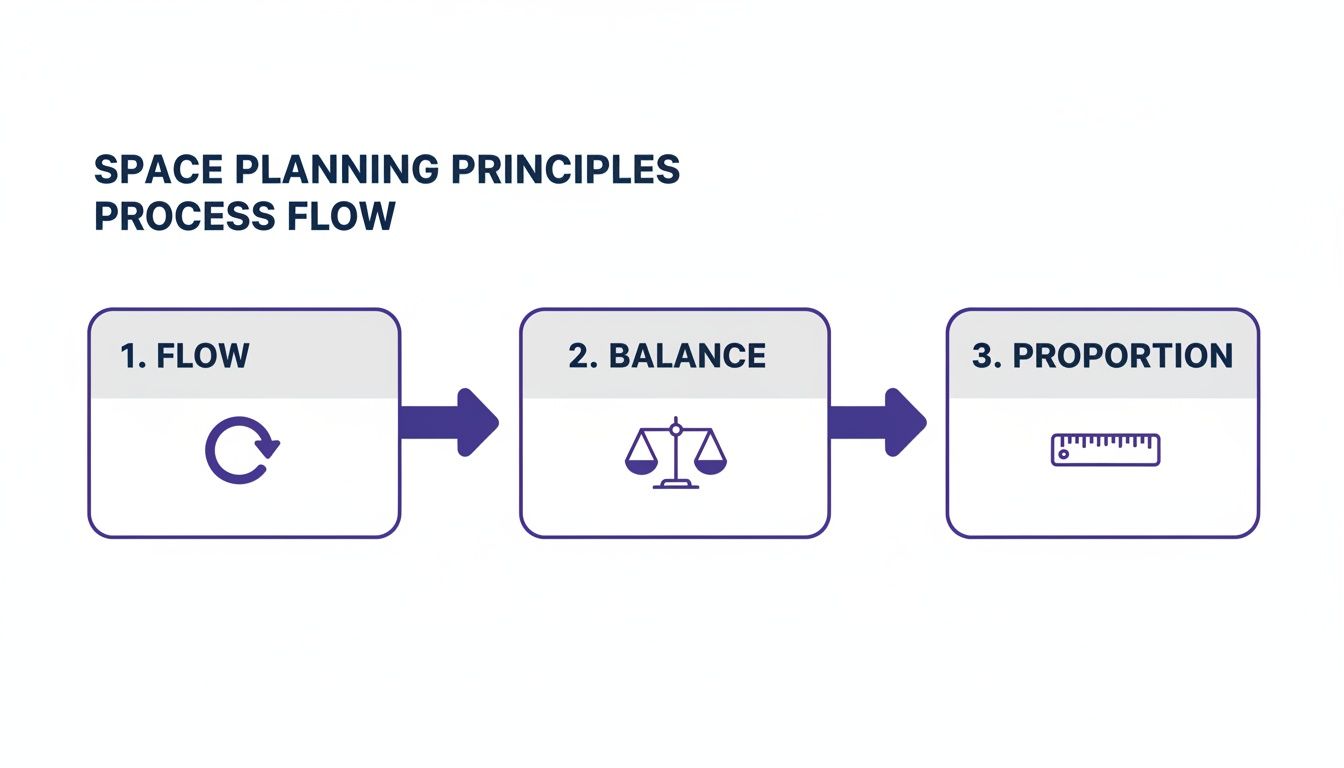
This image breaks it down beautifully: creating clear pathways (Flow), finding visual stability (Balance), and getting the scale right (Proportion) are the pillars of every choice you'll make.
Step 1: Define Your Needs and Goals
Before a single piece of furniture is considered or a paint chip is picked, you have to get to the heart of the room's purpose. This first phase is all about asking the right questions to build a clear design brief.
- Primary Function: What is this room really for? Is it the living room for family movie nights, a home office that needs to inspire focus, or a dining area built for hosting dinner parties?
- Occupancy: Who uses this space day-to-day? How many people does it need to comfortably fit at one time?
- Atmosphere: What’s the vibe? Are you going for a cozy, modern farmhouse feel popular in the US, or something bright and airy inspired by coastal design?
Nailing these answers down first is the best way to avoid expensive do-overs later on. It ensures the design you create actually supports the life you want to live.
Step 2: Measure Everything and Create a Floor Plan
With your vision clear, it's time to get practical. Accurate measurements are the absolute bedrock of good space planning. Grab a tape measure and get all the key dimensions: the length and width of the room, the ceiling height, and the exact locations of windows, doors, outlets, and any fixed features like a fireplace or built-ins.
Next, you’ll want to translate those numbers into a simple 2D floor plan. You can go old-school with graph paper and a pencil or use one of the many easy-to-use digital tools out there. This visual map is your ground truth, showing you exactly what you have to work with. For a deeper dive, you can learn more about exactly how to plan a room layout and see these principles in action.
Step 3: Experiment with Layouts and Furniture Placement
Here comes the fun part—playing with the possibilities. Using your floor plan as a guide, start sketching out different ways to arrange the furniture. This is where you really put your ideas about flow, balance, and scale to the test. Think about the main traffic paths—the natural walkways people will use—and make sure there’s enough room to move around comfortably.
This is also where modern tools can be a game-changer. Instead of just guessing how something might look, you can use a tool like aiStager to test different layouts with stunningly realistic visuals. It’s the only solution that generates photos with true-to-dimension rooms and furniture, giving you a preview that's as close to reality as it gets.
Let’s say you’re torn between two totally different sofa styles for your living room. You can instantly see how a sleek, modern sofa from Article looks versus a more traditional, plush sectional from Crate & Barrel. All it takes is uploading a photo of your room and the product link to place each one virtually.
You can even play with colors and materials. Does that Article sofa work better in navy velvet or a neutral woven fabric? This isn’t guesswork anymore. Having the power to instantly compare products and styles removes all the risk and helps you make decisions with total confidence, knowing your final choice will be a perfect fit.
How AI Is Changing Interior Design Visualization
For years, interior design and space planning involved a bit of a leap of faith. You could pull together mood boards, sketch out floor plans, or wrestle with basic 3D software, but there was always a gap between the concept and the final reality. That gap is precisely where doubt, expensive mistakes, and design regrets tend to live. But now, technology is finally closing that gap for good.
Artificial intelligence isn’t just a buzzword; it’s becoming a core part of the modern design toolkit. While only 9 percent of designers were using AI tools back in 2023, that number is expected to jump to 29 percent by 2025. This isn't just a trend—it's a clear signal that AI helps designers work smarter, streamline their process, and give clients previews so realistic they feel like they can step right into them. You can learn more about how AI is shaping global design trends.
This shift takes us away from abstract ideas and drops us right into tangible, photorealistic previews that erase the guesswork. It gives everyone—from a homeowner nervously picking out a sofa to a seasoned professional presenting to a client—the power to make confident, informed decisions.
From Guesswork to Hyper-Realistic Previews
Let's be honest, the old way of visualizing a space was often slow and a little clumsy. Traditional 3D modeling is a fantastic skill, but it's also complex, time-consuming, and often produces images that still scream "computer rendering" instead of "real home." That technical look can sometimes get in the way of the emotional connection you're trying to build with a space.
AI-powered platforms are changing the game by focusing on speed, realism, and accessibility. They let you see exactly how a room will look and feel with a level of detail that used to be impossible without a professional photo shoot.
The real breakthrough isn't just about making a picture of a room. It's about creating a picture of your room, with your specific lighting, your true dimensions, and the exact products you're thinking of buying. This is the new standard for design visualization.
This technology finally bridges that stubborn gap between imagination and reality, letting you test-drive your design choices in a completely risk-free digital sandbox.
The Power of True-to-Dimension Visualization with aiStager
While lots of tools can create a visual, aiStager is the only solution that generates hyper-realistic photos using the true dimensions of both your room and the furniture you place inside it. This is a huge deal. It’s the difference between a pretty picture that's "close enough" and a dimensionally accurate preview you can actually trust.
The process itself is incredibly straightforward. All you need is a photo of your empty room and a link to a product you like online. In just a few clicks, aiStager creates a photorealistic image showing that exact item, perfectly scaled, in your actual space.
- Test different brands effortlessly: Curious how that modern Article Sven sofa stacks up against a classic sectional from West Elm? You can virtually place both in your living room in seconds.
- Experiment with finishes and colors: See how the same Article sofa looks in a bold navy velvet versus a subtle light gray fabric. Instantly cycle through options to find the perfect match for your style.
- Validate your layout ideas: Worried that a sleek media console from CB2 might overwhelm your wall? See its true scale and impact right away, before you even think about adding it to your cart.
This one-click, true-to-scale process makes older 3D modeling methods feel clunky and slow. It delivers a powerful combination of speed and accuracy that puts professional-grade visualization in everyone's hands. If you want to explore more options, check out our guide on the top AI interior design tools available today.
A New Workflow for Design Confidence
This technology fundamentally changes the design workflow from "I hope this works" to "I know this works." Instead of guessing, you validate. For a homeowner redecorating the living room, this means no more ordering a rug that turns out to be too small or a chair that completely swallows the corner.
Imagine you're designing a home office with a Scandinavian vibe. You could instantly test a minimalist oak desk from a brand like Floyd against a white-lacquered design from Blu Dot. You can see how each one plays with the natural light in your room and looks against your existing floors, letting you make the final call with total clarity. This ability to experiment with real products from any store is exactly what makes AI an essential part of the modern design process.
Solving Common Space Planning Challenges
Knowing the theory behind interior design and space planning is one thing, but the real test is when you’re standing in a tricky room. Every home has its quirks—that awkwardly shaped living room, the tiny bedroom that feels like a closet, or a huge open-plan space that just feels… empty. These are the moments where good planning really proves its worth, turning frustrating layouts into places you love to be in.
Cracking these puzzles isn’t about finding a single "correct" answer. It’s all about exploring different ideas and seeing what works—before you start spending money or moving heavy furniture. Thankfully, modern tools have made this kind of trial and error completely risk-free.
Making Small Spaces Feel Larger
Let's be honest, we've all faced a room that felt too small. The goal is always the same: create an illusion of space without giving up the things you need. The trick is to use clever furniture and layout strategies that fool the eye into seeing a bigger, airier room.
Here are a few tried-and-true tactics:
- Lighten Up: Pale colors on the walls are your best friend. They reflect light and instantly make a room feel more open.
- Double-Duty Furniture: Think about an ottoman with hidden storage or a coffee table with a shelf underneath. Every piece that helps you cut down on clutter is a win.
- Think Vertically: Tall, slender bookshelves or curtains hung high and wide draw the eye upward, creating a sense of height.
- Mirrors Work Magic: A large, well-placed mirror can visually double the size of your room. It’s the oldest trick in the book for a reason.
Defining Zones in Open-Concept Layouts
Everyone loves the breezy feel of an open-concept home, but it brings its own challenge: how do you create distinct "rooms" when there are no walls? The secret is to define different zones using your furniture, rugs, and even lighting.
An area rug can anchor a living room setup, making it feel contained and intentional. A console table behind a sofa creates a subtle but effective line between the living and dining areas. This is where seeing the possibilities is so important. You might wonder if a sleek room divider would work better than a bookshelf. Instead of guessing, you can now see it for yourself.
A well-placed rug is one of the simplest and most effective ways to define a zone. It acts like an island, creating a visual anchor that groups furniture together and signals a specific purpose for that area.
Visualizing Solutions with aiStager
In the past, solving these problems took a lot of imagination and a little bit of luck. Today, tools like aiStager take the guesswork out of the equation. It's the only solution that generates hyper-realistic photos with true dimension rooms and furniture objects, which means you can solve real-world layout problems with total confidence.
Picture a narrow dining area. Is a round table from a brand like Room & Board a better fit for traffic flow than a rectangular one? Instead of wondering, you can just upload a photo of the space and a link to the product. In seconds, you get a photorealistic preview.
The real power comes from being able to test different versions of the same product. Can't decide on a sofa? You can visually compare a sleek leather model from Article with a plush fabric one from Crate & Barrel, trying out different colors and finishes with just a few clicks. With aiStager's one-click process, you can place any new product right in your room and know for sure that it not only fits but also looks right at home.
Got Questions About Space Planning? We’ve Got Answers.
We hear a lot of the same questions about getting started with interior design and space planning. Here are a few quick answers to the most common ones.
What’s the Very First Thing I Should Do?
Before you even think about paint swatches or furniture, you need to figure out one thing: what is this room for?
Seriously, stop and ask yourself what you’ll actually do in the space and who will be using it. Is it a family room for movie nights, a quiet home office for focused work, or a dining area for hosting friends? This single answer will guide every other decision you make, ensuring the room doesn't just look good but actually works for your life.
I’m Not a Designer. How Can AI Possibly Help Me?
This is where things get fun. AI tools basically give everyone access to pro-level design visualization. You get to test-drive your ideas without spending a dime or moving a single piece of heavy furniture.
Think of it like this: instead of just hoping that sofa you saw online will fit, you can see it in your actual room. What makes a tool like aiStager different is that it’s the only one creating hyper-realistic images using true-to-scale dimensions for both your room and the furniture. That means what you see is what you’ll get—no more guesswork.
You can confidently play around with different pieces and styles. Just upload a photo of your room and a link to a product you like. See how that sleek Floyd sofa looks next to a classic armchair from Crate & Barrel, then swap out the colors and finishes in seconds. It’s the best way to avoid those costly "oops" moments.
Ready to stop guessing and start seeing? Give aiStager a try and watch your space come to life with photorealistic, true-to-scale accuracy. Get started for free on ai-stager.com.