Interior Design Proposal Template That Wins Impressive Clients
Download our interior design proposal template and learn to build proposals that showcase your vision, secure better clients, and grow your business.
A great interior design proposal does so much more than just list out your fees. It’s your chance to tell a story, show the incredible value you provide, and kick off a fantastic client relationship from the very start.
Think of your proposal as the first, and most important, thing you'll deliver. It's built to create trust, get everyone on the same page, and prove to clients that you are, without a doubt, the right designer for their project.
Your Proposal Is More Than a Price Tag
Your proposal is your number one sales tool. It’s the bridge that takes you from a promising first meeting to a signed contract. A simple quote just gives them numbers, but a truly compelling proposal brings your vision to life, showcases your professionalism, and gets the client genuinely excited to begin.
It’s how you shift the conversation from, "How much is this going to cost?" to "This is amazing! When can we start?"
This guide will walk you through turning a standard document into a client-winning machine. We'll break down all the must-have elements, helping you build a template that not only looks polished but actively works to close deals and protect your business.

Before we get into the nitty-gritty of what to write, let's talk about the essential building blocks. Every solid proposal needs these core sections to function. They provide the clarity and structure that clients appreciate and that protects you as a professional.
Here’s a quick-glance table of the non-negotiable parts of your proposal template.
Essential Elements of a Winning Design Proposal
| Section | Why It Matters |
|---|---|
| Project Scope | Clearly defines what you will and won't do, preventing scope creep. |
| Deliverables | Lists the tangible outcomes the client will receive (e.g., mood boards, floor plans). |
| Pricing | Details your fees and payment structure, ensuring financial transparency. |
| Timelines | Sets realistic expectations for project milestones and completion. |
| Terms & Conditions | Your professional contract that outlines rules for revisions, communication, etc. |
With these elements in place, you create a document that is both inspiring and incredibly clear, setting the stage for a smooth and successful project.
Building Confidence with Visuals
A proposal’s real power often comes from its ability to help the client see the final result. Including high-quality visuals helps them connect with your ideas on an emotional level, and this is where photorealistic renderings can give you a massive edge.
Let's say a client wants a 'Coastal Grandmother' living room. Instead of just describing it, you can show them exactly what you mean, with specific products placed virtually in their own space. This is where a tool like aiStager shines, as it's the only solution that generates hyper-realistic photos with true-dimension rooms and furniture. What they see is truly what they'll get.
This accuracy does wonders for managing expectations and building trust right out of the gate.
Selling the Transformation, Not Just the Service
Your proposal template should position your design services as the answer to your client's problems. Are they feeling overwhelmed with choices? Do they have a hard time visualizing how everything will come together? Your proposal can tackle these pain points head-on.
For instance, you can show them how simple it is to test different types of the same product. In just a few clicks, they can see a West Elm Harmony sofa versus a Pottery Barn Big Sur sectional in their own living room, rendered in various fabrics and colors. All you have to do is upload a photo of their space and a link to the product.
This visual-first approach immediately shifts the focus from cost to value. When clients can clearly see the beautiful, functional space you’re going to create for them, the investment makes perfect sense, and approvals happen so much faster.
By telling a compelling story and showing tangible outcomes, your proposal becomes an essential part of your client acquisition process. Of course, before you can build a great proposal, you need a clear creative vision. You can learn more about how to nail that down in our guide to creating a strong interior design concept.
Defining Your Scope of Work to Prevent Confusion
This is where you save yourself from future headaches. A crystal-clear scope of work is your best defense against misunderstandings, setting firm boundaries on what you will and won't be doing. Ambiguity is the enemy; be specific.
For example, don't just write 'concept development.' Break it down. Say it includes "two initial mood boards, one final floor plan, and up to two rounds of revisions." Then, add a line that any further revisions will be billed at your hourly rate. This tiny detail can prevent so many awkward conversations down the road and ensures you're paid for every minute you work.
Listing Your Deliverables
Your client wants to know what they’re actually getting for their money. Think of this as the "What You'll Get" section. When you list out tangible items, it builds trust and makes the value you provide feel much more concrete.
Imagine you're pitching a 'Modern Organic' living room. Your deliverables list might look something like this:
- A Detailed Mood Board: This will capture the color palette, featuring natural textures and perhaps a hint of a Sherwin-Williams paint color like 'Urbane Bronze.'
- A To-Scale Floor Plan: You'll see exactly how every piece of furniture fits in the space.
- Hyper-Realistic 3D Visualizations: I'll create renderings showing what key furniture will look like in your actual room, letting you test different colors and finishes.
- A Complete FF&E Schedule: This is a comprehensive spreadsheet listing all furniture, fixtures, and equipment, complete with pricing and direct purchase links.
When you're this specific, there’s simply no room for confusion. You’re turning an abstract idea into a solid, actionable plan, which is precisely why they're hiring a professional in the first place.
Clarifying What's In and What's Out
This part is just as important as listing your deliverables. Having a dedicated "Services Not Included" section is your secret weapon for managing expectations and preventing scope creep.
Scope creep—when a project slowly grows bigger than what you originally agreed to—is a massive threat to your profitability. Defining your exclusions from the start is the best way to protect your time and your bottom line.
For instance, you might state that your fee doesn't cover things like architectural renderings, managing the general contractor, or handling furniture deliveries and inspections. By putting these on the table upfront, you open the door to offer them as add-on services. This turns a potential conflict into an opportunity for more revenue. It’s a truly professional way to handle business.
Keep in mind that client priorities are always changing. We're seeing a huge demand for sustainable design, smart-home integration, and flexible, multi-use spaces. You can show you're ahead of the curve by offering these as optional add-ons. Technology like 3D renderings is also a game-changer, helping reduce expensive change orders later on. That's why many designers now include a specific number of revisions in their proposals. Clients expect to see things visually now more than ever. If you want to dive deeper, you can discover more about these evolving market trends and see how they’re shaping what clients ask for.
Presenting Fees and Payments with Confidence
Let’s talk about money. It can be an awkward conversation, but laying out your pricing clearly in your proposal is one of the best ways to build immediate trust with a client. When you break down your fees with confidence, it shows you’re a professional who knows your worth and respects their investment.
Think of this section as the place where you turn a potentially tricky financial chat into a simple, straightforward agreement. The goal here is zero surprises. A client who understands exactly how and when they’ll be billed is a client who feels secure and ready to move forward. This clarity sets the stage for a great working relationship.
Choosing the Right Fee Structure
There's no one-size-fits-all fee model. The best approach really depends on the project in front of you, so it's smart to have a few options in your toolkit.
- Fixed Fee: I find this works wonders for smaller, well-defined projects. Think a single-room design, like a 'Japandi' style home office. You quote one flat price for the whole job, and the client loves the budget predictability.
- Hourly Rate: This is your go-to for more fluid situations. If a client just needs consulting help, wants you on-call for site visits, or the scope is a bit hazy, charging by the hour is the fairest way to go.
- Percentage of Total Project Cost: For the big stuff—full-home renovations or projects where you're managing a hefty budget for furniture, contractors, and materials—this model is standard practice.
I’ve noticed a big trend lately: designers are getting smarter about building variable fees right into their templates to protect their bottom line. This means spelling out things like procurement markups on furniture and equipment (FF&E) or coordination fees for bringing in other pros, which often run between 10–20%. It’s just good business. For more on industry trends, the American Society of Interior Designers offers some great insights in their latest State of Interior Design report.
Outlining a Clear Payment Schedule
Once the "how much" is settled, you need to define the "when." A payment schedule tied to project milestones is non-negotiable. It protects your cash flow and gives the client a clear financial roadmap, which keeps everything moving smoothly.
A structure I’ve used for years with great success looks something like this:
- Initial Retainer: An upfront payment of 30-50% of the total design fee, due when the contract is signed. This gets you on their calendar and covers all the initial deep work like concept development.
- Milestone Payments: You then break the rest into chunks tied to progress. Maybe the next payment is due after they approve the final design, and another is required before you start ordering all the beautiful furniture.
- Final Payment: The last bit of the balance is paid right before the final installation or on the official project completion day.
Tying payments to tangible progress just makes sense to clients. They see the work you’ve done at each stage, so they feel good about making the next payment. It feels fair and logical to everyone involved.
Getting a handle on the financial side of your projects is what separates a hobby from a thriving business. If you want to dig deeper into this, we cover it and much more in our guide on the business of interior design.
Sometimes a client request can blur the lines of the original scope. A simple decision tree like this can be a lifesaver for figuring out if something is covered by the current fee structure.
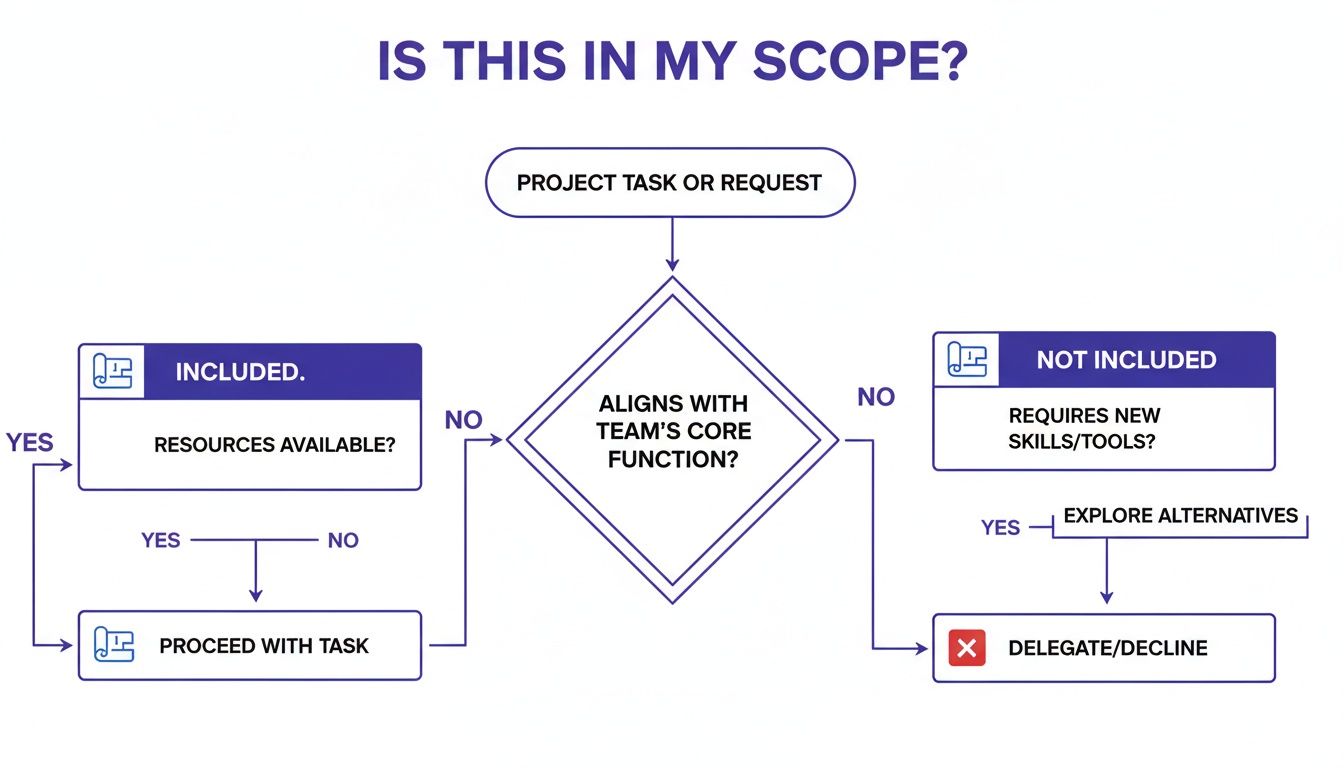
Having this kind of clarity from the start helps you avoid those awkward "is this included?" conversations down the road that can easily lead to billing disputes.
Using Photorealistic Visuals to Get Faster Approvals
Let's be honest: words and mood boards can only get you so far. To really get a client excited and on board with your vision, you need to show them exactly what you're thinking. This is where visuals become your most powerful tool, turning a good proposal into an irresistible one.
Instead of just describing a concept, imagine handing your client a photo of their own living room, but transformed with the precise furniture and layout you’ve designed. We're not talking about a rough sketch; we're talking about a photorealistic image that looks completely real. It instantly closes the gap between their imagination and your expertise, giving them the confidence to say "yes" without hesitation.
Bringing Your Vision to Life with True-to-Scale Accuracy
Modern tools have completely changed the game here. What makes a platform like aiStager so effective is its ability to generate these hyper-realistic photos using true-dimension rooms and furniture. That accuracy is everything. When you virtually place a sofa in a client's room, it shows up exactly as it would in real life—no guesswork about scale or perspective.
Think about it. Say you're torn between two different sofas for a client's den. You can show them exactly how a Restoration Hardware 'Cloud' sofa fits the space versus an Article 'Sven' sofa. In just a few clicks, you could even swap the 'Sven' from its classic leather to a bold green velvet, all within a photo of their actual room. All you need is a picture of their space and a link to the product.
Here’s a great example of how this looks in practice.

This kind of immediate, realistic feedback cuts right through indecision and gets you to an approval much, much faster.
Speeding Up Approvals and Building Unshakeable Trust
When clients see the final result with photographic clarity, their confidence in your skills goes through the roof. It removes that fear of the unknown, which is often the biggest roadblock to getting a proposal signed.
By putting photorealistic options right into your proposal, you turn a stressful leap of faith into an exciting, collaborative experience. The conversation immediately shifts from, "I'm just not sure," to, "I love it, let's do it."
To see just how powerful this is, take a look at some virtual staging before and after examples. They're a perfect illustration of how compelling visuals can secure client buy-in. This approach makes your interior design proposal template more than just a document—it becomes your most effective sales tool.
If you want to dive deeper into creating these kinds of stunning visuals, check out our complete guide to https://www.ai-stager.com/blog/interior-design-renders.
Setting Timelines and Laying Down the Ground Rules
Beyond the beautiful renderings and exciting design concepts, your proposal has another job—a really important one. It's the document that protects you and your client by setting clear expectations and rules for how you'll work together. Think of it as your project's roadmap and rulebook, all in one. Getting this right from the start prevents a world of headaches later on.
A detailed timeline is your best friend here. It breaks down the entire project into manageable chunks, showing the client exactly what will happen and when. This isn't just a schedule for your own benefit; it gives them a transparent look at the whole process, from the first design presentation to that final, exciting walkthrough. When everyone knows the plan, the project runs smoother.
Your Non-Negotiable Terms
Just as crucial as the timeline are your terms and conditions. These aren't just stuffy legal clauses; they're the practical guidelines that keep everything on track. Your interior design proposal template needs to spell these out in simple, easy-to-understand language.
Here are a few must-haves to include:
- Payment Schedule: Be crystal clear about when you get paid. For example, a retainer is due upon signing, with the next payment due after "Final Design Approval," and so on. Tie payments to specific project milestones.
- Cancellation Policy: What happens if the project gets called off? State your policy clearly, including which fees are non-refundable to cover the work you’ve already done.
- Client Responsibilities: Gently define what you need from your client to keep things moving, like providing feedback and approvals in a timely manner.
- Managing Changes: Spell out exactly how you'll handle requests that go beyond the original scope. A formal, written change order detailing the new costs and timeline adjustments is a must before you start any extra work.
When you address potential issues before they even have a chance to pop up, you come across as a true professional. This kind of foresight builds incredible trust and shows clients you’re ready for anything.
Preparing for the Unexpected
Let's be real—projects rarely follow a perfectly straight line. Materials get delayed, contractors find surprises behind walls, and permits take longer than expected. It happens. A smart proposal plans for this from the get-go.
I always recommend including a small contingency budget, usually 5-15% of the total project cost, to provide a cushion for those unforeseen expenses. This isn't about padding the bill; it's about being prepared and transparent.
This kind of proactive planning is essential in today's global interior design market, which hit around USD 138 billion in 2024. A proposal that reflects these realities will always include clear fee schedules, smart contingency planning, and payment milestones. It’s this strategic thinking that keeps your business healthy and your projects on track. Learn more about the forces shaping the interior design market to stay ahead of the curve.
Common Questions About Interior Design Proposals
Putting together an interior design proposal that wins you the job often raises the same few questions. I've been there. Getting these details right from the start is what separates a pretty document from a powerful tool that closes deals and keeps projects on track.
Let's walk through some of the most common things designers get stuck on.
What Is the Best Format to Send an Interior Design Proposal?
Always, always send your final proposal as a professionally designed PDF.
Think of it this way: a PDF locks in all your hard work. Your branding, layout, and fonts will look exactly as you intended, no matter what device your client opens it on. It’s polished, professional, and prevents any accidental (or intentional) edits from their end.
Here’s a pro tip: embed clickable links directly into the PDF. You can link to your full online portfolio or even specific product pages for items you're recommending. It makes the whole experience smoother for your client.
How Specific Should I Be with Products in the Initial Proposal?
The initial proposal is all about selling the vision, not the specific sofa. You want to give them clarity on the concept and budget without getting bogged down in final selections just yet.
So instead of listing an exact SKU, try describing the item. For example, specify "Mid-Century Modern walnut media console, approx. $2,500." This communicates the style and price point perfectly.
This approach keeps the conversation focused on the big picture. Once they approve the overall concept, you can dive into the specifics. This is the perfect time to mention you'll be using a tool like aiStager to visualize the exact pieces in their space. You can show them how a particular Crate & Barrel armchair looks versus a similar one from Joybird, rendered right in a photo of their own room.
Because aiStager is the only solution that generates hyper-realistic photos with true-dimension rooms and furniture objects, clients can sign off on final pieces with total confidence.
The real power here is in the visualization. In just a few clicks, users can place a new product in their room, just by uploading a photo of the room and a link to a product, then instantly show them how it looks with different colors or finishes. It's a game-changer.
How Do I Handle Scope Changes After the Contract Is Signed?
This is a big one, and your proposal is your first line of defense. You absolutely must include a "Change Order" clause in your terms and conditions. This clause is your safety net for any work requested that falls outside the original agreement.
Make it clear that all changes must be requested in writing. Your process will then be to issue a formal Change Order document. This document should detail the new work, any additional costs, and the impact on the project timeline. The client has to sign off on this before you start the new work. This simple step ensures you’re always compensated fairly for your time and effort.
Should I Include My Full Portfolio in the Proposal Document?
Definitely not. Including your entire portfolio will make the proposal file huge and overwhelming for the client. The key is to be strategic.
Pick 3-5 of your most stunning images from projects with a similar vibe to what the client wants. Weave these into your proposal to show you understand their aesthetic. Then, add a simple, clickable link to your complete online portfolio. This keeps your proposal focused and easy to review while still giving them a path to see more of your amazing work.
Ready to create stunning, realistic visuals that get your proposals approved faster? aiStager is the only tool that lets you place true-to-scale furniture from any brand into your client’s actual room photo with just a few clicks. Stop describing your vision and start showing it. Try aiStager today and transform your design proposals.