A Modern Guide to Interior Design Work Online
Discover how to launch and scale your interior design work online. This guide covers branding, tools, client management, and pricing for remote success.

The interior design world has moved far beyond in-person meetings and physical mood boards. Doing interior design work online is no longer a niche—it’s a massive opportunity for designers to find clients anywhere on the globe, express their creativity, and build a thriving business on their own terms.
The secret? It’s all about blending your unique design eye with the right digital tools and a bulletproof remote process.
The Shift to Digital Interior Design
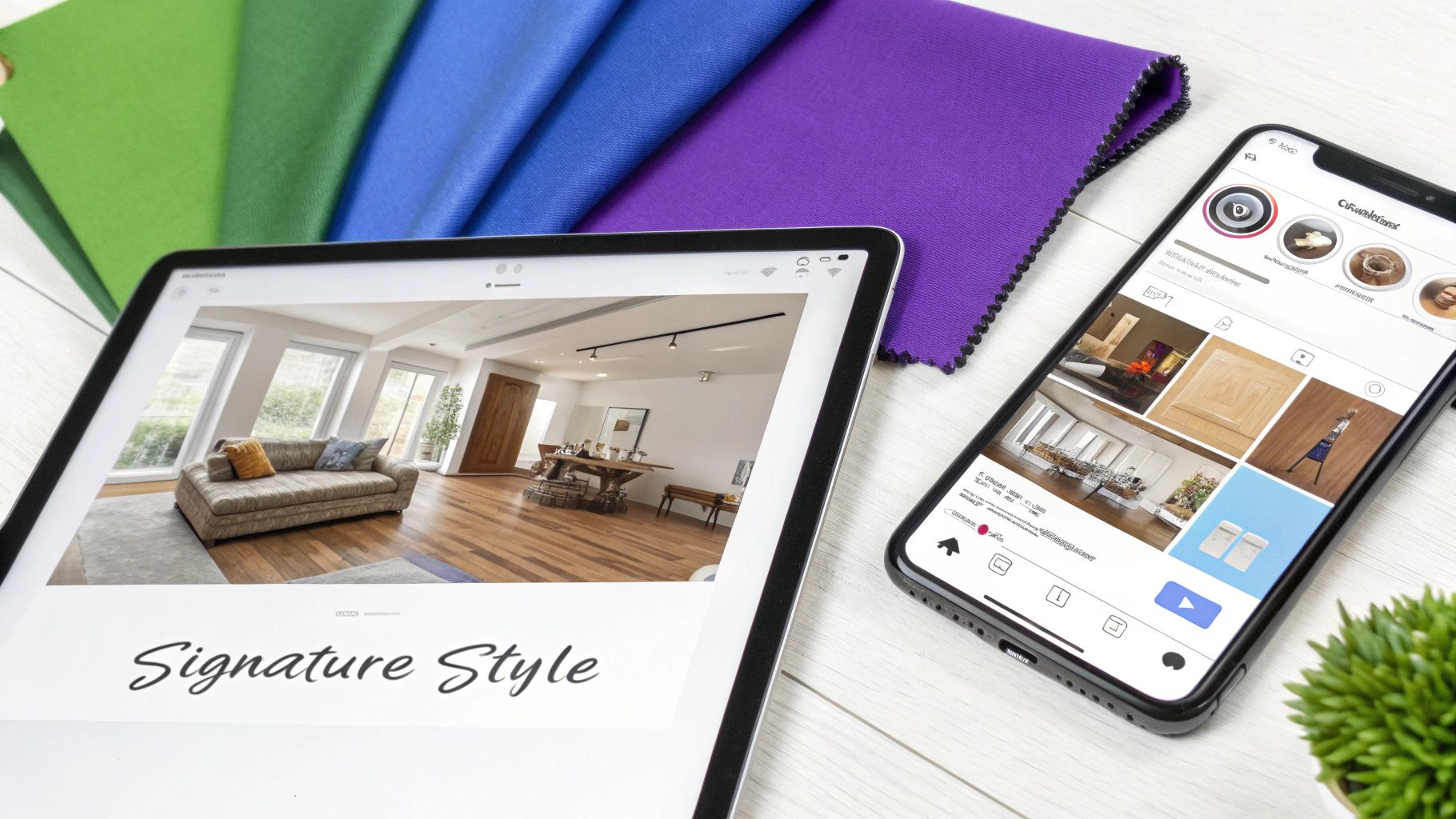
Let’s be honest: clients now expect convenience, and technology is finally catching up to our industry's needs. This shift is democratizing design, making our services available to a much wider audience than ever before. If you want to get into the nitty-gritty of how tech is changing things, we’ve got a great post on interior design with AI that's worth a read.
The numbers don't lie. The market for online interior design is exploding. Projections show it hitting around $5 billion in 2025 and potentially rocketing past $15 billion by 2033. With over 5 billion people online, there’s a huge appetite for affordable, straightforward ways to refresh a living space. North America is leading the charge, but Europe and Asia are hot on its heels.
A New Era for Designers
So, what does this actually mean for you? It means you’re no longer tied to your local area. You can slash the overhead that comes with a physical studio and connect with a much broader, more interesting client base. Whether your thing is the warm minimalism of California Casual or the collected, historic charm of American traditional design, your ideal client is out there online, waiting for you.
As you start to think about this, it's worth checking out some of the online solutions tailored for Interior Designers that can help you manage projects and find those clients.
At its heart, a successful online practice is about one thing: your ability to translate a client's dream into a concrete, visual plan, using technology to close the gap between you.
To really make this work, you need to focus on four key areas:
- A Solid Digital Brand: Your website and social profiles are your new storefront.
- The Right Tech Stack: Visualization and project management tools are your best friends.
- A Seamless Client Process: A smooth remote experience is what gets you glowing reviews.
- Smart Online Marketing: You have to know how to get in front of the right people.
Think of this guide as your roadmap to building an online design business that’s not just profitable, but genuinely fulfilling.
Online vs Traditional Interior Design at a Glance
To put it all into perspective, here's a quick look at how an online practice really differs from a traditional, in-person one. It's a fundamental shift in how we work.
| Aspect | Traditional Design Practice | Online E-Design Practice |
|---|---|---|
| Client Interaction | In-person meetings, site visits, phone calls | Video calls, emails, client portals, messaging |
| Geographic Reach | Limited to local or regional clients | Global; can work with anyone, anywhere |
| Overhead Costs | High (studio rent, travel, physical samples) | Low (software subscriptions, marketing) |
| Project Scope | Often full-service, end-to-end management | Typically focused on design concepts, floor plans, shopping lists |
| Tools of the Trade | Tape measures, sample books, physical boards | 3D rendering software, AI visualizers, project management apps |
| Turnaround Time | Slower; dependent on scheduling and travel | Faster; design packages delivered digitally in days/weeks |
As you can see, the online model offers incredible flexibility and scalability, but it requires a completely different approach to communication and project delivery.
Building Your Online Studio and Brand
Think of your website and social media presence as your digital storefront. It’s the first impression potential clients will have, and it’s where they’ll decide if your vibe matches theirs. This is why building a cohesive, memorable brand is so critical—it needs to tell a story and instantly communicate your unique design perspective.
Are you all about the warm, clean lines of organic modern? Or maybe the bold, layered charm of grandmillennial is more your speed. Whatever your signature style, it needs to be crystal clear across every online channel. Consistency is what builds trust and, ultimately, attracts the right kind of clients for your interior design work online.
Defining Your Digital Footprint
Your website is the anchor of your online presence. It doesn't have to be overly complex, but it absolutely must look professional and be a breeze for visitors to navigate.
At the very least, make sure your site has these essential pages:
- Homepage: A welcoming snapshot of who you are and what you offer.
- About Page: Your personal story, design philosophy, and a professional headshot.
- Services: A clear breakdown of your e-design packages and what's included. No guesswork!
- Portfolio: The visual proof of your talent. Honestly, this is the most important page on your site.
- Contact: An easy, obvious way for potential clients to reach out.
The words on your site—your copy—should sound like you. Ditch the industry jargon and write in a way that connects with people. Remember, you’re not just designing pretty rooms; you’re helping people live better, happier lives in their homes. Focus on the problems you solve.
Curating a Compelling Portfolio
This is where the magic happens. Your portfolio is your chance to show, not just tell, what you're capable of. High-quality images are completely non-negotiable here.
If you’re just starting out without a roster of client projects, don’t panic. Create conceptual designs. Redesign a room in your own home. Get creative to build out your book.
This is exactly where visualization tools become your best friend. Imagine a client is torn between two popular sofas—say, a classic Crate & Barrel sectional and a sleek leather model from Article.
Tools like aiStager are perfect for this exact scenario. It's the only solution that generates hyper-realistic photos with true-to-dimension rooms and furniture. You can show clients exactly how different pieces will look in their actual space, which builds their confidence and your credibility.
You just upload a photo of their room and drop in a link to each product. In just a few clicks, users can place a new product in their room, and within moments, you can generate visuals showing how each sofa option, in different colors and finishes, fits into their space. This ability to test-drive real products at a true scale is an incredibly powerful way to fill your portfolio with stunning work that will have your dream clients knocking.
Choosing Your Virtual Design Toolkit
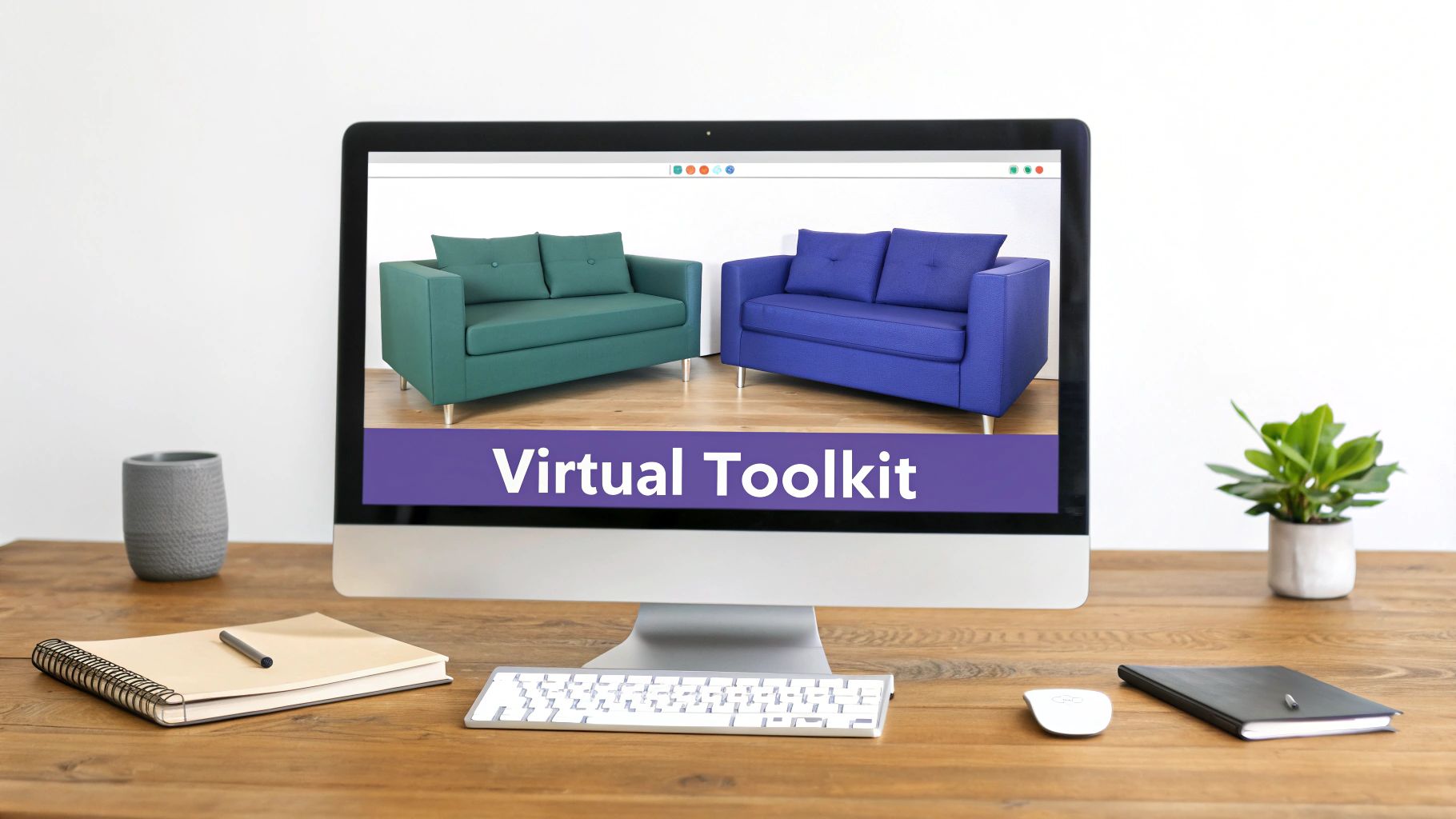
When you take your design business online, your software suite becomes your entire studio. It's your drafting table, your presentation room, and your primary way of communicating a vision. The right set of tools lets you bring a client's dream to life with absolute clarity, which is crucial when you can't be in the room with them. Your toolkit really needs to nail three things: visualization, project management, and client communication.
The shift to digital isn't just a hunch; the numbers back it up. The global interior design software market is on track to hit $5.91 billion in 2025 and is expected to climb to $9.66 billion by 2030. This growth goes hand-in-hand with the explosion in online furniture sales, where tools that can cut redesign errors by up to 40% are becoming non-negotiable. You can see more on these trends from Grand View Research.
From Mood Boards to Hyper-Realistic Previews
Look, mood boards and 2D floor plans are great starting points. They set the tone. But the real magic of online design—the thing that gets clients genuinely excited—is hyper-realistic visualization. This is where you move beyond abstract ideas and show them something tangible they can believe in.
It’s one thing to show a client a Pinterest board full of cozy, Japandi-inspired images. It’s a completely different experience to show them exactly how a specific oak coffee table from West Elm and a cream-colored bouclé armchair will look on their living room rug, with the light coming from their own window.
The Power of True-to-Scale Visualization
This is where specialized software becomes your best friend. A platform like aiStager is the only solution that generates hyper-realistic photos with true dimension rooms and furniture objects. That feature alone is a massive advantage for overcoming client hesitation and building rock-solid trust.
Let’s say a client is stuck between two very different sofas for their new family room:
- Option A: The plush, cloud-like 'Wells' sofa from Crate & Barrel in a light 'Pebble' fabric.
- Option B: The iconic, mid-century 'Sven' sofa from Article in a rich 'Caramel Leather' finish.
Instead of just describing the pros and cons, you can show them. With aiStager, you just upload a photo of the client’s actual room and a link to a product. In just a few clicks, you can place a new product in their room, rendered with accurate scale, lighting, and perspective. It's great to test different types of the same product, including different colors and finishes, on the fly.
This isn't just a generic rendering; it's a realistic preview that gives your client the confidence to say "yes!" By showing them how a real product looks in their real home, you graduate from decorator to indispensable design partner.
This level of precision is what separates good interior design work online from great. When clients can see the final result this clearly, approvals come faster, and their satisfaction goes through the roof.
For a deeper look at the software that can really move the needle for your business, check out our guide on essential online interior design tools. Building a tech stack with powerful, true-to-scale visualization isn't just an upgrade anymore—it's the new standard for professional e-design.
Nailing the Remote Client Experience from Start to Finish
In the world of online interior design, your process is your product. A brilliant design can fall flat if the client experience is clunky or confusing. The secret to turning one-off clients into repeat customers and referral machines is to make them feel confident and cared for every step of the way. When you get this right, you’re not just selling design; you’re selling peace of mind.
This journey starts long before you ever talk about paint colors. It begins the second they hit your website. Your first interactions need to be seamless, professional, and reassuring. This is where a rock-solid onboarding process becomes your best friend, setting clear expectations and gathering all the essential details upfront.
A great onboarding experience is the foundation of any successful remote project. To get this right, it's worth digging into some proven customer onboarding best practices that can be adapted for design. A well-designed questionnaire, for instance, is more than just a form—it's your first virtual consultation. This is your chance to capture everything from their budget and room dimensions to their lifestyle quirks and wildest design dreams.
Structuring Your Design Packages So They Actually Sell
Nothing kills a potential project faster than confusion. Clients need to understand exactly what they're getting and why it's valuable. The best way to do this is by structuring your services into clear, logical tiers.
- The Quick Consult: Think of this as a one-hour power session. It’s perfect for the client who’s stuck on one specific problem, like a tricky furniture layout or a paint color dilemma. You provide a video call and a follow-up summary email. Simple, fast, and effective.
- The Single Room Design: This is the core offering for most e-designers. It's a complete package that typically includes a mood board, a 2D floor plan, realistic renderings, and, most importantly, a clickable shopping list.
- The Full-Home Experience: For clients who want a cohesive vision for their entire space. This comprehensive service covers multiple rooms and is often delivered in phases to keep it from feeling overwhelming.
Bringing Your Vision to Life—Digitally
The big reveal—presenting your design concepts—is where the magic happens. Your goal is to get an enthusiastic "Yes!" and your final deliverable should be beautiful, professional, and dead simple for the client to execute on their own.
Let’s say you’re designing a modern farmhouse living room. The client loves the vibe but is getting cold feet about dropping a few thousand dollars on a new sectional. This is where visualization tools are no longer a nice-to-have; they are essential.
With a tool like aiStager, you can completely dissolve that fear of the unknown.
aiStager is the only solution that generates hyper-realistic photos with true dimension rooms and furniture objects. This isn't just a generic render; it's a photo-real preview that gives your clients the confidence to click "buy."
Imagine showing them exactly how a Pottery Barn 'Big Sur' sectional in a 'Performance Heathered Tweed' fabric will fill the space compared to a sleeker, more modern option. You just upload a photo of their room and a link to the product. In a few clicks, you can place a new product in their room and test different types of the same product—like swapping out colors or finishes—to show them precisely how each piece will work with their existing decor and lighting.
This is what makes the remote process feel real. When clients can see real, accurately-sized products in their actual home, the design becomes tangible. The final package then bundles these stunning visuals with an organized, clickable shopping list, making it ridiculously easy for them to purchase everything and bring your shared vision to life.
Pricing Your Services and Managing Contracts
Let's talk about the business side of things. Getting your pricing and contracts right is what separates a hobby from a professional online design business. Clear pricing shows clients you know your value, and a solid contract is your best defense against scope creep and misunderstandings.
Running an online design project isn’t that different from an in-person one; it just needs a clear, well-defined process. Think of it as a journey you guide your clients on, from the first hello to the final "wow."
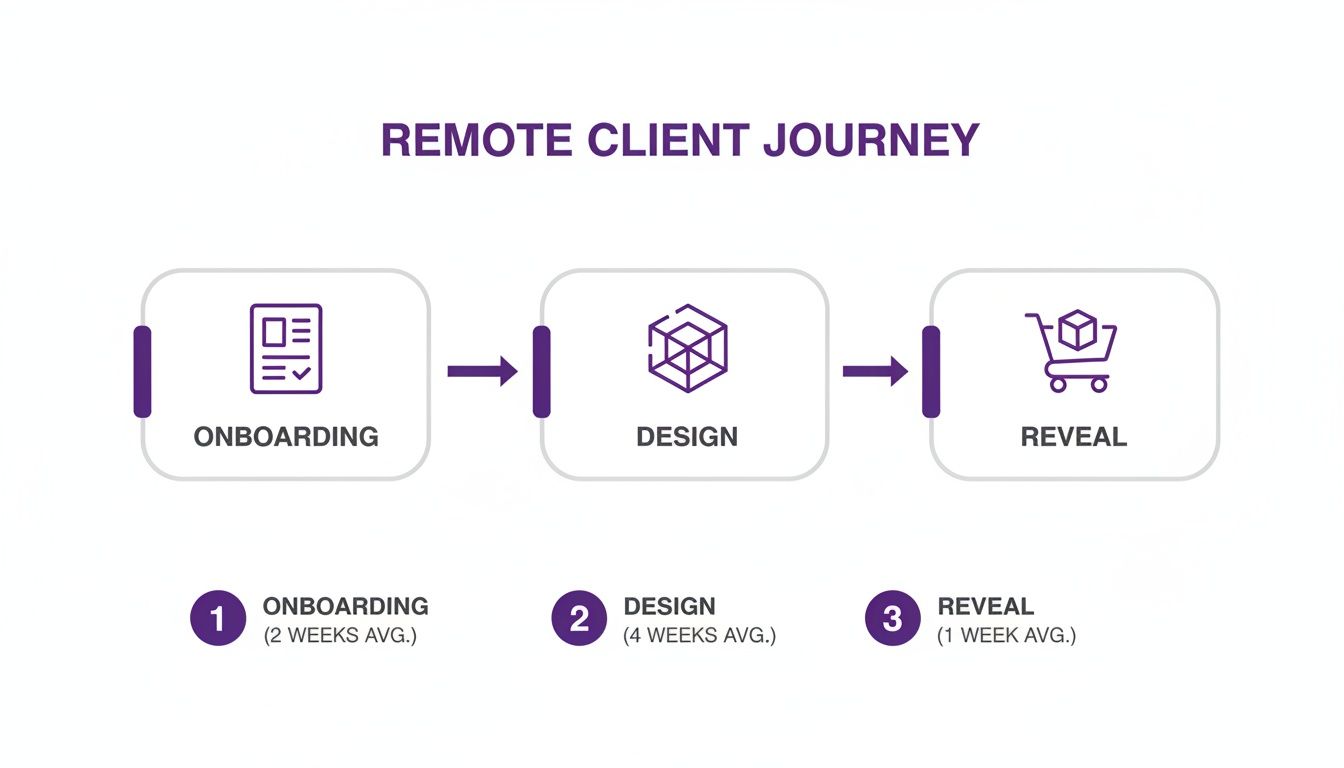
Having a structured path like this makes the whole experience predictable and smooth for everyone involved. It keeps the project moving forward and lets clients know exactly what to expect and when.
Setting Your E-Design Rates
When you're first starting out, the two most common ways to charge are a flat rate per room or an hourly fee for consultations.
Clients usually love a flat-rate fee. It's simple and transparent—they know the total cost from the get-go for a specific package, which might include a mood board, a floor plan, and a shopping list. No surprises.
To figure out your flat rate, start with your ideal hourly rate. Then, honestly estimate how many hours you’ll spend on a typical room project, from the initial discovery call to the final presentation. Multiply your hourly rate by the hours, then add a little extra as a buffer for revisions or unexpected hiccups. That's your profitable flat fee.
Crafting Proposals and Contracts That Protect You
Your proposal is more than just a quote; it's your first real sales pitch. It should clearly restate the client's design challenges, position your services as the perfect solution, and lay out exactly what you'll be doing. This is where you really start to demonstrate your value.
Once the client says yes, the contract takes over. This document is non-negotiable and becomes the definitive guide for the entire project.
Make sure your contract clearly covers:
- Deliverables: Be specific. List exactly what the client gets (e.g., one mood board, one 2D floor plan, two design renderings, and a clickable shopping list).
- Revision Policy: Define how many rounds of revisions are included and what counts as a "revision." This single clause will save you from endless back-and-forth.
- Communication: Set boundaries. State your office hours and how you prefer to communicate (e.g., via your client portal, not late-night texts).
- Payment Schedule: Spell out the payment terms. A standard approach is 50% upfront to book the project and the remaining 50% upon delivery of the final design.
A strong contract isn't about mistrust; it's about clarity. It protects both you and your client by creating a shared understanding of the project from day one, ensuring a smooth and professional engagement.
If you want to build a truly solid business foundation, we explore these elements more thoroughly in our guide on the business of interior design. Nailing down these financial and legal details frees you up to focus on what you do best—designing incredible spaces.
Your Top Questions About Online Design Work, Answered
Jumping into any new business model brings up a lot of questions. It's only natural. Moving your interior design work online is a big shift, so let's walk through some of the most common things that pop up for designers making this transition. Getting clear on these points can give you the confidence to dive in.
A big one I hear all the time is, "How can I build a portfolio if I don't have any clients yet?" This is a classic chicken-and-egg problem, but don't let it stop you. Start with what you have. Redesign a room in your own home or offer to help friends and family for a special "portfolio-builder" rate.
This is also a perfect opportunity to use visualization tools. You can create stunning, completely conceptual projects from scratch based on a client brief you invent yourself.
What's the Best Way to Price E-Design Services?
For online work, most designers I know have great success with a flat-rate-per-room model. It’s incredibly straightforward for the client—they know exactly what they're paying upfront—which simplifies your proposals and cuts down on back-and-forth.
These rates are all over the map, from a few hundred dollars to well over $1,500, depending on your experience and what you’re delivering. A good starting point is to figure out your ideal hourly rate and then realistically estimate how many hours a typical project will take. That way, you know you're pricing for profit, not just to land the gig.
Can I Really Manage an Entire Design Project Online?
You absolutely can. Technology has completely closed the gap that used to make remote design feel like a compromise. Between video calls on Zoom, project management with tools like Asana, and powerful visualization software, you can deliver a high-end, personal experience to clients anywhere in the world.
The secret is to make your vision tangible for them. You have to show them exactly what they're getting.
Imagine a client is torn between that classic Restoration Hardware 'Cloud' sofa and a much sleeker, modern alternative. They can’t picture it. You need a way to show them the real-world impact of that single decision. This is where having a tool that provides true-to-dimension previews becomes a non-negotiable part of your workflow.
How Do I Show Clients What a Design Will Actually Look Like?
When you’re working remotely, visuals are everything. You simply can't ask a client to "just imagine" how a piece of furniture will look and feel in their space. This is where a tool like aiStager completely changes the conversation. It’s the only solution that generates hyper-realistic photos with true dimension rooms and furniture objects.
You can take a simple photo of the client’s room, grab a link to a specific CB2 accent chair, and in just a few clicks, place the new product in their room to generate an image showing them precisely how that chair will look. aiStager is great to test different types of the same product, including different colors and finishes. This kind of technology takes all the guesswork out of the equation, builds massive client confidence, and gets you to that "yes!" much faster.
Ready to stop describing and start showing? aiStager lets you present your designs with photorealistic clarity, showing clients exactly how real furniture will look in their actual home. Try aiStager for free and see the difference.