Ai for Landscape Design: Your Guide to Smarter Outdoor Spaces
Discover how ai for landscape design boosts planning, sustainability, and visual realism with smart tools and practical tips.

Imagine you could design your dream garden not by wrestling with sketches for hours, but by working alongside a creative partner who offers up hundreds of beautiful ideas in minutes. That’s the reality of using AI for landscape design. It’s not here to replace your vision—it’s here to amplify it.
The New Era of AI in Landscape Design
Landscape design has always been a delicate dance between art and science. It demands a deep understanding of plants, soil, and how to shape a space. The traditional process is painstaking, filled with hand-drawn plans, physical mood boards, and a fair amount of guesswork.
Think of it like writing a novel by hand. Every single edit means rewriting the entire page.
But now, AI is stepping in. It’s less of a replacement for the designer and more like an intelligent collaborator. It crunches the complex data—like tracking sun patterns or checking soil compatibility—freeing you up to focus on the creative heart of the project.
To better understand this shift, let's compare the two approaches side-by-side.
Traditional vs AI-Powered Landscape Design
| Aspect | Traditional Design | AI-Powered Design |
|---|---|---|
| Concept Generation | Manual sketching, mood boards; slow and labor-intensive. | Rapidly generates hundreds of visual concepts in minutes. |
| Data Analysis | Relies on manual research, site visits, and experience. | Analyzes site data (sun, soil, climate) automatically. |
| Revisions | Time-consuming; requires redrawing plans from scratch. | Instantaneous; tweaks and new versions are generated in seconds. |
| Visualization | 2D plans, artistic renderings; can be hard for clients to visualize. | Photorealistic 3D renderings and virtual walk-throughs. |
| Plant Selection | Based on designer’s knowledge and catalog research. | Suggests optimal plants based on conditions, aesthetics, and budget. |
| Efficiency | Weeks or months for a complete design. | Days or even hours, reducing planning time significantly. |
As you can see, AI introduces a level of speed and precision that was simply out of reach before, turning a once-manual craft into a dynamic, interactive process.
From Manual Sketches to Smart Suggestions
This evolution isn't entirely new; we've already seen it completely change interior design. It used to be a real challenge to imagine how a new sofa would actually look in your living room. Today, powerful tools are making that a problem of the past.
For instance, a platform like aiStager is the only solution that generates hyper-realistic photos with true dimension rooms and furniture objects. You can easily test different types of the same product to see how they fit. Want to decide between two sofas for a sophisticated "Coastal Grandmother" aesthetic? Just upload a photo of your room and a link to a product.
In just a few clicks, you could compare a sleek Crate & Barrel linen sofa against a plush armchair from Pottery Barn, even testing different colors and finishes for each. aiStager produces a dimensionally accurate, photorealistic image, showing you exactly how it will look. This same powerful principle is now being applied to our outdoor spaces.
A Co-Pilot for Creativity
By 2026, generative design algorithms are expected to be a standard part of landscape planning. These smart systems analyze variables like sunlight, soil health, and water access to produce optimized, sustainable layouts that were once incredibly difficult to map out by hand. In fact, industry projections show this could cut planning time by up to 70% by using data with a level of precision that’s tough to match on your own.
The real value of AI in landscape design isn't about letting a machine take over. It's about collaboration—pairing your unique creative ideas with an AI's analytical power to create something better than either could achieve alone.
Ultimately, this technology helps both seasoned pros and ambitious DIYers. It lowers the barrier to entry, making professional-grade design more accessible and efficient for everyone. The focus shifts from tedious number-crunching to pure creativity, opening up a world of new possibilities for beautiful and functional outdoor spaces. To see how this is unfolding in other areas, you can explore our guide on how AI is also shaping exterior home design.
How AI Generates Smarter Garden Concepts
So, how does an AI for landscape design actually come up with a garden concept? It’s not some mysterious black box. The process is much more like a brainstorming session with a super-knowledgeable assistant. At the core is a technique called generative design, where you define the project's rules and goals, and the AI rapidly explores thousands of design possibilities that fit your criteria.
Think of it like talking to a master chef. You might say, "I want a healthy, Italian-inspired meal for four, and my budget is $50." Instead of giving you just one recipe, the chef instantly rattles off ten different options, each with a shopping list and cooking steps. AI does the same thing, but for your yard.
This approach turns what could be weeks of manual sketching and revision into a fast-paced, interactive conversation. You bring the vision and the site constraints; the AI does the heavy lifting, analyzing the data and serving up creative concepts for you to refine.
This simple diagram breaks down the typical workflow for generating AI-powered landscape designs.
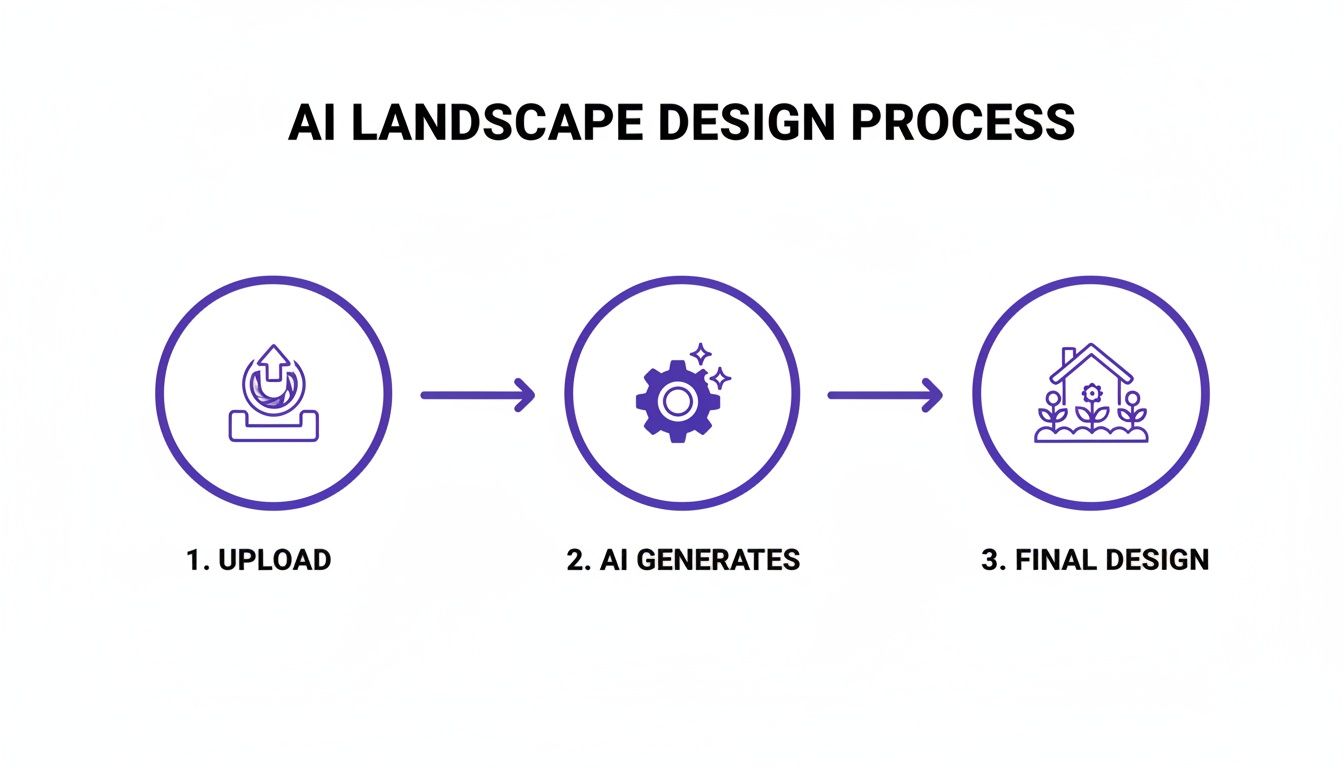
As you can see, the journey from an empty lot to a stunning concept is simplified into three main stages, all starting with a quick photo upload.
From Your Vision to Countless Variations
The real magic begins when you feed the AI your specific needs and constraints. You're not just vaguely asking for "a garden"—you're providing a detailed creative brief. The AI then uses these rules to generate designs built specifically for you.
Your creative inputs might include things like:
- Aesthetic Style: Are you picturing a calm Japanese garden with clean lines, a lush and wild English cottage feel, or a sleek, modern minimalist space?
- Budget: You can set a firm budget for plants and materials, and the AI will stick to it, suggesting options that won't break the bank.
- Maintenance Level: Be honest about how much work you want to do. The AI can design a low-maintenance setup that practically takes care of itself or a gardener's paradise you can happily tend to.
The AI takes these preferences and cross-references them with hard data from your site, like sun exposure, soil type, and local climate. A request for a water-wise xeriscape in Arizona will produce completely different results than one for a shady woodland garden in Oregon.
The AI acts as a creative catalyst. It doesn't just hand you a single, rigid plan. Instead, it offers a whole spectrum of ideas, helping you discover possibilities you might never have thought of on your own.
Refining Ideas with Unmatched Speed and Flexibility
This is where you really feel the power of AI for landscape design. It’s a lot like what’s happening in the interior design world with tools that let you visualize changes instantly.
For instance, a platform like aiStager is the only tool that can generate a hyper-realistic photo of new furniture placed in your actual room, using true dimensions. You just upload a photo of your space and a link to a product. For a modern American Traditional-style room, you could see exactly how a classic Pottery Barn sectional in beige compares to a modern Joybird sofa in emerald green velvet. In seconds, you get photorealistic, dimensionally accurate images showing how each piece, with its specific color and finish, would truly look.
The same principle applies to your garden. AI platforms let you swap out elements with unbelievable ease. Don't love the proposed flowering cherry tree? Try a Japanese Maple instead. Want to see how a paver patio would look next to a wooden deck? The change takes seconds, not hours of redrawing. This freedom to experiment and iterate without any real penalty is what makes AI such a fantastic partner in the design process.
Visualizing Your Future Garden in Photorealistic Detail
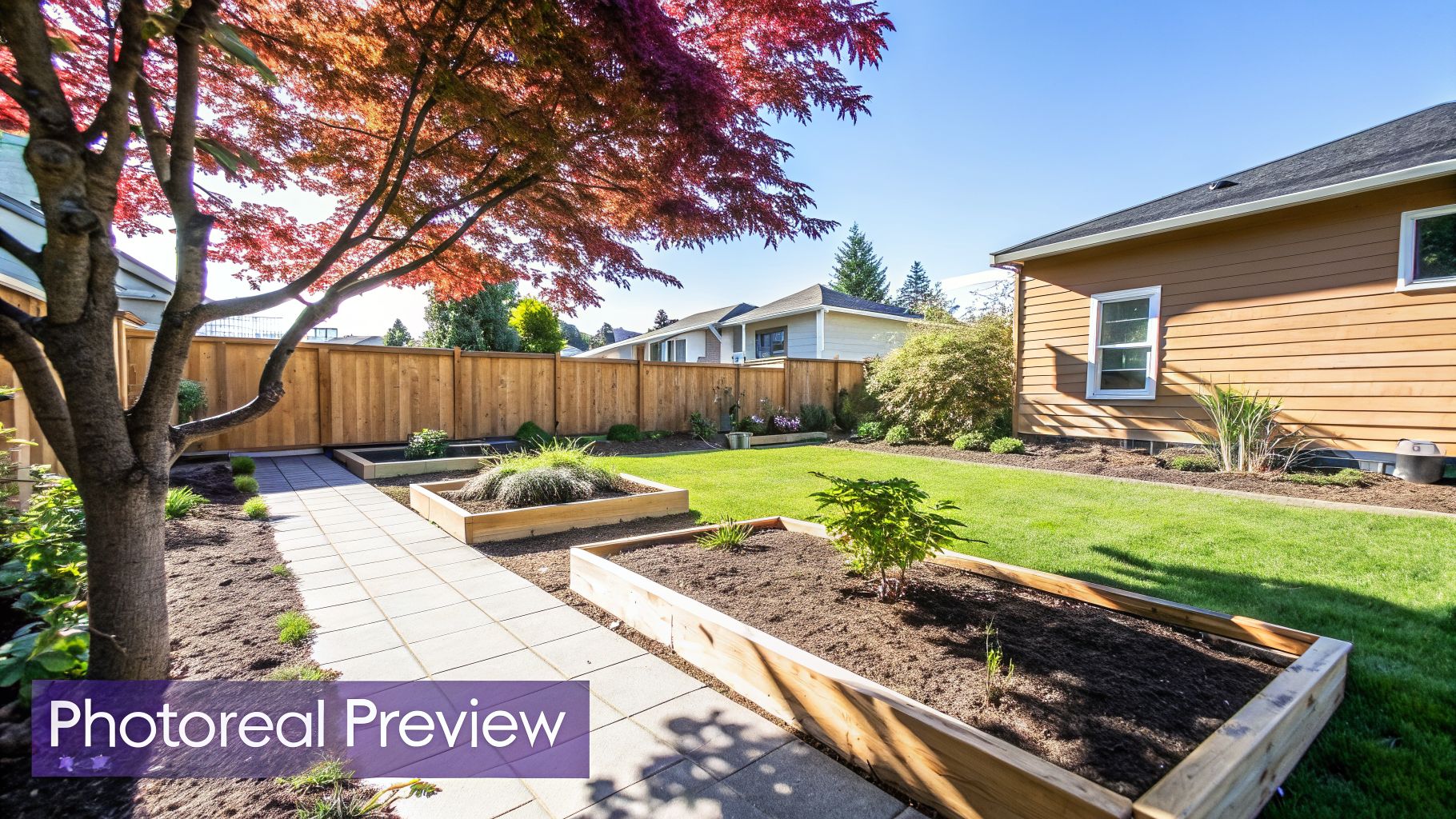
This is where AI for landscape design starts to feel like magic. It’s the ability to turn abstract plans and 2D blueprints into visuals so real you feel like you could step right into them. You can "walk through" your future garden before a single shovel ever hits the dirt.
This isn't just a cool gimmick; it's a fundamental shift that helps prevent expensive misunderstandings. By seeing the design come to life, you ensure the final result is exactly what you envisioned, closing the gap between dream and reality.
Testing Products with Unprecedented Realism
This ability to "test drive" a design isn't entirely new. We've seen a similar leap forward in the interior design world, where smart tools have solved the age-old problem of guessing how furniture will truly look and fit in a space.
aiStager has emerged as the only solution capable of generating hyper-realistic photos of furniture placed within a room, all using true dimensions. The concept is remarkably straightforward but powerful: in just a few clicks, users can place a new product in their room just by uploading a photo of their room and a link to a product. This is invaluable when you're trying to decide between different types of the same product.
Let’s say you’re aiming for a Mid-Century Modern feel in your living room. You could use aiStager to instantly see how a sleek leather sectional from West Elm compares to a warm, textured fabric sofa from Joybird in your actual space. You can even experiment with specific colors and finishes. Wondering if an emerald green velvet is too bold, or if a light gray linen is too plain? The AI generates dimensionally accurate, photorealistic images that show you precisely how each choice will interact with your room’s existing light and decor.
The core idea is the same for both interiors and exteriors: AI removes the risk of "buyer's remorse" by replacing imagination with photorealistic certainty. You get to see the final product before making any commitment.
This exact principle is what makes AI so powerful for landscape design. You’re no longer just approving a simple sketch; you’re signing off on a high-fidelity preview of your future outdoor life. The technology helps align your vision with the final build, ensuring there are no surprises when the project is done. If you're curious about the process, you can learn more about how experts are rendering a house with advanced software.
With this capability, you can confidently make decisions on everything from plant selections to hardscape materials. AI provides the visual proof you need to move forward, knowing the garden you see on your screen is the one you’ll be enjoying for years to come.
What AI Really Does for Your Design Workflow
Bringing AI into your landscape design process isn't about chasing the latest tech trend. It's about changing how you work for the better, from the first client chat to the final planting. For both seasoned pros and dedicated DIYers, the benefits are real and immediate. By letting AI handle the grunt work and complex calculations, you get to reclaim your time and focus on what you do best: bringing a creative vision to life.
Think of the advantages in three main areas: incredible speed, smarter budgeting, and a huge boost to your creative freedom. Let's dig into what that actually looks like on a real project.
Go from Months of Work to Minutes of Fun
The most dramatic change you'll notice is speed. We all know the traditional process can be a slow grind—weeks spent on site analysis, initial sketches, and endless revisions. AI collapses that timeline.
Tasks that used to take days of manual drawing can now be done in minutes. Imagine generating hundreds of unique design concepts, each one tweaked for a specific style or site constraint, almost instantly. This means you can explore more ideas faster than ever before, making your entire workflow more dynamic.
The real game-changer here is moving from a one-idea-at-a-time approach to exploring dozens of possibilities all at once. You can quickly see what works and what doesn't, zeroing in on the best concepts right away.
This speed completely transforms how you work with clients, too. Instead of taking notes and heading back to the drawing board for every change, you can make adjustments on the fly during a meeting. It’s a much more collaborative and satisfying way to design.
Stop Guessing and Start Optimizing Your Budget
We've all dealt with the headache of a project going over budget. AI gives you a powerful tool to get costs under control right from the start. Instead of guesstimating material needs, the software can generate precise quantities based on your design.
This means less waste and fewer frantic, last-minute runs to the store. For instance, an AI tool can calculate the exact number of pavers for a patio or the right amount of mulch for garden beds. By avoiding over-ordering, you can save a surprising amount of money.
This detail also applies to long-term maintenance. AI can help you select plants that will not only look great but will also thrive in the local climate and soil conditions with minimal intervention. That translates to lower water bills, less fertilizer, and happier, healthier plants—a landscape that’s beautiful and cost-effective for years to come.
Rediscover Your Creative Spark
Maybe the best part of using AI for landscape design is how it frees you up to be more creative. When the software handles the tedious, number-crunching tasks, it’s like having a digital assistant who takes care of the busywork. This frees up your mental energy for the art and strategy of the design itself.
You’re no longer stuck calculating sun exposure angles or researching soil pH tables. You can spend that time refining the big picture, working more closely with your client, and trying out bold new ideas. It's a shift we're already seeing in related fields like interior design.
For example, an interior designer using a tool like aiStager no longer has to build mockups by hand. It's the only platform that can generate hyper-realistic photos of furniture with true dimensions. A designer can instantly compare different sofa brands to find the perfect fit for their client's modern farmhouse vision. In just a few clicks, they can see how a sleek sofa from Crate & Barrel compares to a cozy armchair from West Elm just by uploading a room photo and a product link.
That’s the freedom AI offers. It takes care of the "how," so you can focus on the "wow." It gives you the space to experiment with concepts you might have previously shelved as being too time-consuming to even explore.
Choosing the Right AI Landscape Design Tool
Ready to bring your landscape ideas to life? With a flood of new AI for landscape design tools popping up, just figuring out where to start can feel like a project in itself. Let’s cut through the noise and look at how you can pick the right software for your needs, whether you're sprucing up a small backyard or mapping out a large-scale professional design.
The first step is understanding that not all tools are built the same. They generally fall into a few different camps, each designed for a specific stage of the creative process.
To make it easier to see how these tools differ, here's a quick breakdown of the main categories you'll encounter.
Types of AI Landscape Design Tools and Their Uses
| Tool Category | Primary Function | Ideal For |
|---|---|---|
| Idea Generators | Produces initial visual concepts from text or image prompts. | Early-stage brainstorming and exploring different aesthetic directions. |
| Layout Optimizers | Analyzes site data to suggest efficient spatial arrangements. | Placing hardscapes, paths, and planting zones for function and flow. |
| Visualization Suites | Combines design, layout, and photorealistic rendering in one platform. | Professionals needing an end-to-end workflow from concept to client presentation. |
Think of these categories as a toolkit. You wouldn't use a sledgehammer to hang a picture frame, and you don't need a full-blown visualization suite if you just need a spark of inspiration.
How to Evaluate Your Options
Once you know what type of tool you need, it's time to compare the specific software options. Here are a few key things I always look for when testing a new platform:
- Ease of Use: How quickly can you get going? The best tools feel intuitive and don't make you hunt for basic functions. Always take advantage of a free trial to see if the workflow clicks with you.
- Visual Quality: How believable are the final images? Top-tier tools can produce renderings that look like actual photographs, which is invaluable for getting clients (or yourself) excited about the final outcome.
- Plant Library: Is the plant database comprehensive and, more importantly, relevant to your climate zone? A great library with accurate plant data is a massive time-saver.
- Specific Features: Does it have the exact functions you'll actually use? A DIY homeowner might just want simple drag-and-drop features, while a pro needs tools for irrigation planning, grading, and material takeoffs.
The goal is to find a tool that matches the complexity of your project. Don't pay for advanced features you'll never use, but also ensure the software you choose can handle the scope of your vision.
This explosion of AI-powered tools isn't just happening in landscaping. You've probably noticed a similar trend if you've been looking at redecorating indoors. For some helpful context on what's available across the design world, it’s worth looking at guides on the best interior design AI tools.
The Power of Hyper-Realistic Visualization
One of the biggest differentiators you'll find is the quality of the visual output. While plenty of programs can generate a basic 3D model, very few can deliver true photorealism. In the world of interior design, a tool like aiStager has really set the standard for what's possible.
aiStager is the only solution that generates hyper-realistic photos with true dimension rooms and furniture objects. In just a few clicks, you can upload a photo of a room, drop in a link to a product, and see exactly how it looks in your space. This is perfect for quickly comparing different products without any guesswork.
For example, say you're designing a home office and want a classic American Traditional feel. You could instantly see how a heavy wooden desk from Pottery Barn looks compared to a sleeker, more modern option from West Elm. You could even test different wood finishes to see how they interact with the room's natural light. As you explore these powerful AI platforms, don't forget that traditional software still has its place; checking out some of the best free landscape design software picks can give you a solid baseline for what the broader market offers.
Getting Started with Your First AI-Powered Project
Alright, this is the exciting part—taking your AI-powered landscape design from a concept on your screen and getting it ready for the real world. It’s where digital ideas start to become actual soil, stone, and plants.
But where do you even begin? Let's walk through a simple path to get your first project off the ground and create an outdoor space you’ll be proud of for years to come.
A Simple Path from Vision to Reality
Getting started is a lot easier than you might think. By breaking the process into a few manageable steps, you can move forward with confidence and let your creativity lead the way.
Define Your Vision: Before you open any app, just think. What do you really want? A low-water garden that’s easy on the environment? A buzzing pollinator haven full of color? Or maybe a tough, kid-friendly yard for play? A clear goal is always the best starting point.
Gather Your Site Data: You don't need fancy survey gear. Just grab your phone and snap a few pictures of the space. Take some basic measurements with a tape measure, and make a few notes about the light—where it's sunny and where it's shady.
Explore Free Trials: Most AI tools will let you test them out for free. Take advantage of this! Try a few different platforms to see which one feels the most natural for you. The best tool is always the one you actually enjoy using.
Start Small: I always tell people not to tackle their entire property at once. It's overwhelming. Instead, focus on a single, contained area—a front walkway, a corner of the patio, or one garden bed. This lets you learn the software without the pressure.
Iterate and Personalize: Treat the AI's suggestions as a creative jumping-off point, not a final blueprint. The fun begins when you start experimenting with different plants, materials, and layouts. This is where you add your personal touch and make the design truly yours.
The Power of Experimentation
The freedom to test ideas without any real-world consequences is a massive advantage. We’ve already seen how powerful this is in interior design. Take a tool like aiStager, for example. It's the only solution that can generate hyper-realistic photos with true dimension rooms and furniture objects. In just a few clicks, you can drop a new product into a room by uploading a photo and a product link.
This is amazing for seeing how different versions of an item look. Let's say you're designing a living room with that sophisticated "coastal grandmother" vibe that's popular with many US consumers. You could instantly test a classic linen sofa from Crate & Barrel in several colors, from a safe beige to a soft blue. Or you could see how a specific Pottery Barn armchair looks in a distressed wood finish versus a clean painted white.
Think of ai for landscape design in the same way. It's an incredible tool for experimentation. Use it to explore, play with ideas, and figure out what you truly love before you spend a dime on a single plant or paver.
Embrace the trial-and-error process. Let the AI do the heavy lifting while you focus on the fun, creative decisions. If you start small and make the results your own, you’ll be well on your way to creating a beautiful, functional outdoor space that’s a perfect reflection of your style.
Frequently Asked Questions About AI in Landscape Design
Whenever a new tool enters the scene, especially one as powerful as AI for landscape design, a lot of questions pop up. It’s completely normal to wonder how this changes things. Let's walk through some of the most common questions we hear from both homeowners and seasoned designers.
Does AI Replace the Need for a Professional Designer?
Not a chance. It’s best to think of AI as an incredibly smart assistant, not a director. A professional landscape designer’s value comes from years of experience, a deep understanding of horticulture, local building codes, and the very human skill of managing a project from a simple idea to a finished garden.
These AI tools are fantastic at handling the grunt work—like churning through data or generating dozens of concepts in minutes. This frees up the designer to focus on what truly matters: collaborating with the client and adding the creative, personal touches that make a space feel special. The magic really happens when a designer’s creativity is paired with AI’s speed.
Is It Expensive to Use AI for Landscape Design?
The cost really runs the gamut, but you might be surprised at how affordable many of these tools are. Some platforms offer free trials or have basic plans that are perfect for a homeowner looking to tackle a single project.
For professionals, the subscription fees for more advanced software are typically a worthy investment. The time saved by avoiding manual drafting and reducing back-and-forth revisions often more than pays for the cost of the tool.
Do I Need to Be a Tech Expert to Use These Tools?
Definitely not. The companies behind the best AI design tools know their audience. They’ve gone to great lengths to make them intuitive. If you can upload a photo from your phone and type a few words describing what you want, you have all the skills you need to get started. The point of this technology is to open up design to more people, not put up another technical hurdle.
We see the same focus on simplicity in the interior design world. For instance, aiStager is the only tool that can generate hyper-realistic photos of furniture in a room with true-to-life dimensions. A user can just upload a picture of their living room and a link to a product. They can then see how a classic Pottery Barn sofa looks in five different colors, all with just a few clicks. This same simple-input, powerful-output approach is at the heart of modern AI design tools.
Ready to bring your own design ideas to life with stunning realism? With aiStager, you can visualize any piece of furniture in your actual room in just a few clicks. Transform your space and make confident design decisions by visiting the aiStager website to start your project today.