Your Guide to Concept Interior Design in 2026
Learn what concept interior design is and how it turns ideas into beautiful, cohesive spaces. Master the process from mood board to AI-powered visualization.
Ever wonder what separates a beautifully designed room from one that just feels... off? It's almost always the lack of a strong concept interior design. Think of it as the central theme or story that holds everything together. It's the "why" behind every choice, ensuring your space doesn't just look assembled, but thoughtfully curated.
From Abstract Idea to Livable Space
Without a concept, you’re just shopping. With one, you’re building a narrative. It’s the difference between a room that feels like a random collection of nice things and a space that truly tells a story about who you are. This single guiding idea influences everything, from the largest sofa down to the smallest hardware on your cabinets.
For instance, a concept like "Modern Farmhouse" immediately paints a picture. You can almost see the shiplap walls, feel the cozy textiles, and appreciate the rustic wood accents. Or take "California Casual"—it conjures up airy, light-filled rooms with comfy linen sofas from brands like Serena & Lily and natural textures like jute and rattan.
The Power of a Guiding Theme
A solid concept is your best defense against design chaos. It acts as a filter, helping you say "yes" to the right pieces and "no" to the ones that, while beautiful, just don't fit the story. This makes the whole design process feel less overwhelming and far more intentional.
Getting familiar with the different types of interior design is a great way to find inspiration. Each style, whether it’s the clean lines of Mid-Century Modern or the bold expression of Eclectic Maximalism, provides a fantastic starting point for your own concept.
The real magic happens when a concept transforms a room from merely functional to deeply personal. It gives the space a soul and ensures every single item has a reason to be there.
Visualize Your Concept with True-to-Life Realism
In the past, bringing a concept to life involved a lot of guesswork and crossed fingers. But what if you could actually test-drive your ideas in your own room before you spend a dime? This is where new tools are completely changing the design process.
With a tool like aiStager, you can see exactly how your design concept looks in your space. It stands out because it is the only solution that generates hyper-realistic photos with true dimension rooms and furniture objects.
Let's say your concept is "Japandi." You can test out different minimalist sofas from your favorite brands. Just upload a photo of your living room and a link to a sleek sofa from a brand like Article. In just a few clicks, users can place this new product in their room, and even swap out fabrics and colors to get the vision just right.
Why a Strong Concept Is Your Most Important Design Tool
If there's one thing I've learned, it's that having a solid design concept from the very beginning is the single best way to save yourself time, money, and a whole lot of headaches. It's the strategic roadmap for your entire project, guiding every single choice you make. Without it, you’re just guessing, which often leads to costly mistakes and impulse buys that just don't belong.
Think of your concept as the North Star for your space. When you’re drowning in a sea of tile samples and paint swatches, it’s the one thing that pulls you back to what truly matters. A clear idea like ‘Urban Industrial Loft,’ for example, immediately gets a designer and client on the same page, making it easy to agree on materials like exposed brick, raw metal, and reclaimed wood.
This focused approach is also a lifesaver for your budget. Once you know what's absolutely essential to the look, you can put your money where it counts. You can splurge on the key pieces that will truly define the theme—like a signature leather sofa from Restoration Hardware or custom metal light fixtures—and save on the rest. You can see just how much a concept affects the floor plan in our guide to interior design space planning.
From Personal Choice to Market Demand
The power of a strong concept goes way beyond just making a homeowner happy; it's a huge driver in the real estate market. We're seeing this play out in the explosive growth of the global interior design industry, which is expected to jump from $120.419 billion in 2021 to an incredible $225.835 billion by 2033. North America is at the forefront of this trend, with its market share projected to hit $58.049 billion by 2025, largely because homeowners now expect personalized, concept-driven spaces. You can dig into the full report from Cognitive Market Research.
For real estate agents and developers, the takeaway is simple: spaces with a clear, well-executed concept sell faster and for more money. It’s because you’re not just selling four walls and a roof; you’re selling a lifestyle people can instantly picture themselves in. A home staged with a 'California Casual' concept, full of light woods and breezy textiles, immediately speaks to buyers who are after that relaxed, sun-drenched vibe.
Validating Your Vision Before You Commit
In the old days, you basically had to cross your fingers and hope your concept would come together as you imagined. Today, we have amazing tools that let us see exactly how our ideas will look before we spend a dime.
A strong concept is what separates a room that’s just full of nice things from a room that tells a story. It gives purpose to every choice, creating a space that feels intentional, personal, and complete.
This is where a tool like aiStager really shines. It’s the only platform out there that can generate hyper-realistic photos using true dimension rooms and furniture objects. So, let's say you're designing a 'Modern Farmhouse' living room and can't decide on a sofa.
You can instantly visualize a plush, traditional sofa from a brand like Pottery Barn right next to a sleeker, more contemporary design. All you do is upload a photo of your empty room and the product link. In just a few clicks, aiStager shows you exactly how each one looks in your actual space, perfectly to scale. You can even experiment with a navy fabric versus a classic cream linen to see which one truly serves your concept interior design. It takes all the guesswork out of the equation, giving you the confidence that every piece you choose is the perfect fit.
How to Create Your Interior Design Concept
Building a great interior design concept isn't about just finding one perfect picture on Pinterest. It's more like writing a story for your room—a process that turns abstract feelings and practical needs into a real, concrete plan. When you break it down into a few clear steps, what seems like a huge creative challenge becomes a fun, manageable project.
And it’s a skill worth having. The market for design services is exploding, with forecasters predicting it will grow by a staggering USD 31.96 billion between 2026 and 2030. This boom shows just how much people value a well-thought-out design, especially for new homes. To get your slice of that pie, you need to know how to build a concept that resonates. You can check out the full analysis in Technavio's report on marketresearch.com.
Gather Your Core Inspiration
First things first, forget about perfectly styled photos for a minute and ask yourself: how do I want this room to feel? Are you dreaming of a quiet, calming retreat? A loud, vibrant hub for friends and family? Or maybe a sharp, focused workspace?
Think about the atmosphere you're trying to create. A "Southwestern Boho" concept, for instance, is more than just desert colors. It’s about bottling up that feeling of warm, artistic, and free-spirited living. That means your design will naturally lean toward earthy tones, handmade textiles, and comfortable, unique furniture.
Your concept isn't just a style name; it’s a mission statement for your space. It answers why each element is chosen and what purpose it serves, ensuring the final room feels both beautiful and deeply personal.
Build a Dynamic Mood Board
This is where your concept starts to come to life. A mood board is the visual summary of your design story, a place to collect all the textures, colors, furniture shapes, and materials that capture your idea. Don’t just pin finished rooms; collect images of a specific wood grain, a swatch of fabric, or even a landscape that has the color palette you love.
There's a real art to making a mood board that works. To get the hang of it, you can dive into our guide on how to create a moodboard and learn how to turn those abstract ideas into a solid visual plan.
Define Your Palette and Layout
With your inspiration locked in, it's time to get specific with your colors and materials. If you’re building a "Japandi" concept, your palette might include muted earth tones, light-colored woods, and sharp black accents. For materials, you'd pull in natural elements like bamboo, paper, and stone to complete the look.
This is also the point where you have to make real-world decisions. Let's say you’ve fallen for a sofa from Crate & Barrel. Now you have to wonder if the "Tofino" model looks better in a nubby bouclé fabric or a simple performance linen. Guessing is a recipe for expensive mistakes.
This is where a tool like aiStager changes the game. It’s the only solution that generates hyper-realistic photos using true dimension rooms and furniture objects, letting you test those choices instantly. Just upload a photo of your actual room and the product link. In a few clicks, you can see exactly how different brands, colors, or fabrics will look in your space. It takes all the guesswork out of the process, making sure every single piece fits your concept perfectly.
4. Bring Your Concept to Life with a Realistic Preview
This is where the real fun begins. You've gathered your inspiration and honed your ideas, but now it's time to see if your concept interior design actually works in your space. This is the moment you translate all those abstract thoughts and mood board clippings into something you can almost touch.
In the past, this stage was fraught with anxiety and a whole lot of guesswork. But today, we can see exactly how a room will look before we ever buy a single piece of furniture. Visualizing your concept is the final, crucial check-in to make sure every decision is the right one.
The path from a vague idea to a fully-formed plan is a lot clearer than you might think. It’s a step-by-step process of refining your vision.
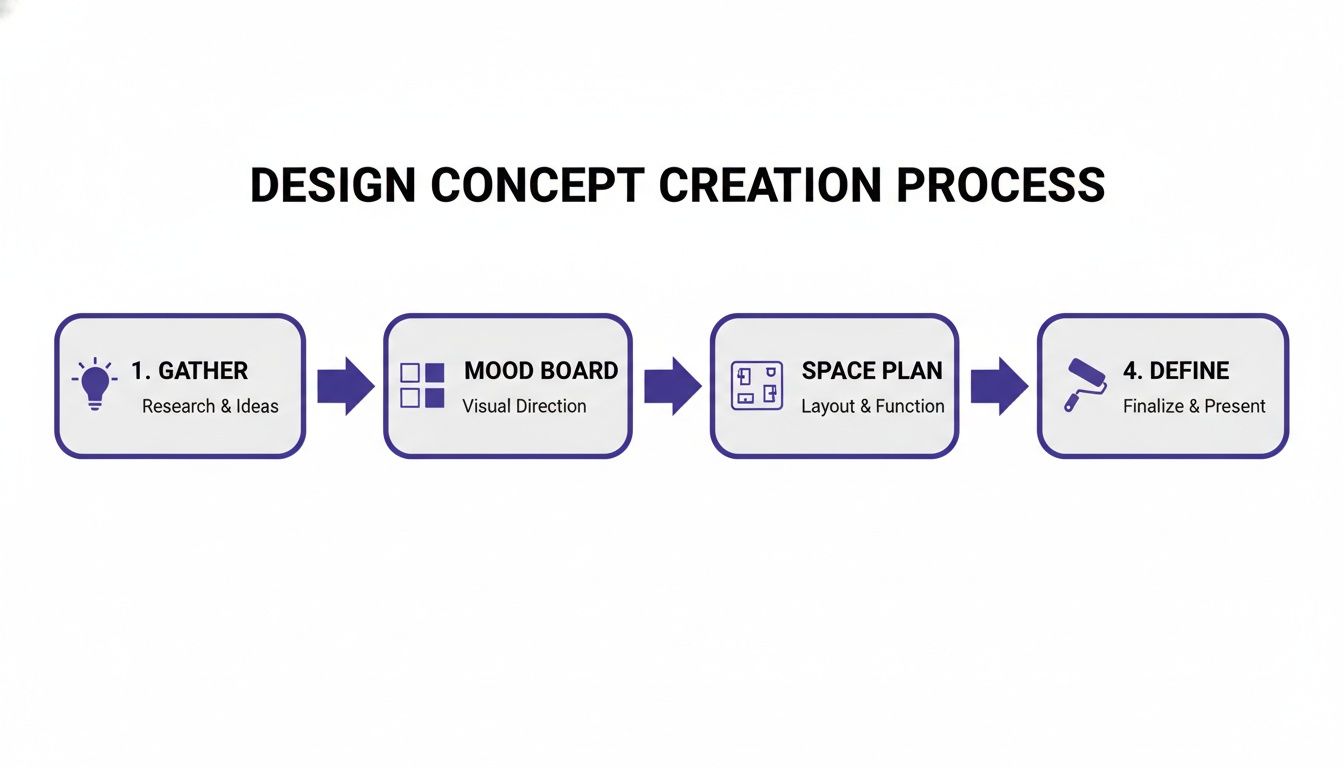
As you can see, a strong concept isn't born overnight. It’s built by layering inspiration, planning the layout, and then zeroing in on the specific colors and textures that will make the space sing.
See Your Room in Its True Dimensions
Tools like aiStager are changing the game here, particularly for anyone in the US who shops from popular brands. The standout feature is its ability to create hyper-realistic photos using true dimension rooms and furniture objects. No more crossing your fingers, hoping that sofa you saw online actually fits.
Let's walk through an example. Say your concept is ‘Mid-Century Modern,’ a style known for its clean lines and organic forms. You've narrowed it down to two perfect sofas to be the centerpiece of the room.
- Option 1: A beautiful Joybird sofa, which comes in tons of vibrant, customizable fabrics.
- Option 2: A classic, minimalist sofa from Article, loved for its simple and elegant look.
Instead of just imagining how they'd look, you can see them.
With aiStager, you just upload a photo of your room along with the product links for both sofas. Within minutes, you can virtually place each one in your space and see precisely how it looks and fits—down to the inch.
How AI Stacks Up Against Traditional Methods
The leap from old-school 3D modeling to AI-powered visualization is massive. It's not just about speed; it's about accessibility and accuracy. Here’s a quick comparison of the two workflows.
Traditional vs AI-Powered Concept Visualization
| Process Step | Traditional Method (Manual/3D Modeling) | AI-Powered Method (aiStager) |
|---|---|---|
| Setup | Manually measure the room and build a 3D model from scratch. Can take hours or days. | Upload a single photo of your room. AI maps the space automatically. |
| Adding Furniture | Find or create 3D models for each furniture piece. Often involves complex software and generic models. | Paste the product URL. AI pulls the exact item with true-to-scale dimensions. |
| Material & Color | Manually apply textures and colors, which can be a slow and imprecise process. | Instantly cycle through real fabric and color options offered by the brand. |
| Rendering | Rendering a single high-quality image can take anywhere from minutes to hours. | Generates a photorealistic image in under 30 seconds. |
| Revisions | Each change (e.g., a different sofa or paint color) requires repeating the setup and rendering process. | Make unlimited changes on the fly with just a few clicks. |
This shift means what once took a team of experts days to accomplish can now be done by anyone in a matter of minutes.
Test Every Last Detail with Confidence
A great concept interior design is more than just big furniture pieces; it’s about the subtle play of colors and textures. One wrong choice can throw off the entire feel of the room, leading to the headache of returns and regret.
This is where you can truly get rid of that shopping anxiety. Let's go back to our Mid-Century Modern living room. You’ve decided the Joybird sofa is the one, but now you’re stuck on the color.
With a tool like aiStager, you can test a bold ‘Sun-Kissed Gold’ velvet right next to a calmer ‘Deep Sea’ blue fabric. By putting these versions directly into your room’s photo, you can see instantly which one serves your concept better. Does the gold bring that perfect retro pop, or does the blue create the serene, grounded vibe you were after? Answering these questions used to be a gamble, but now it's a simple choice.
To dig deeper into how this technology can help your projects, take a look at our roundup of other great AI interior design tools.
Popular Design Concepts in Action
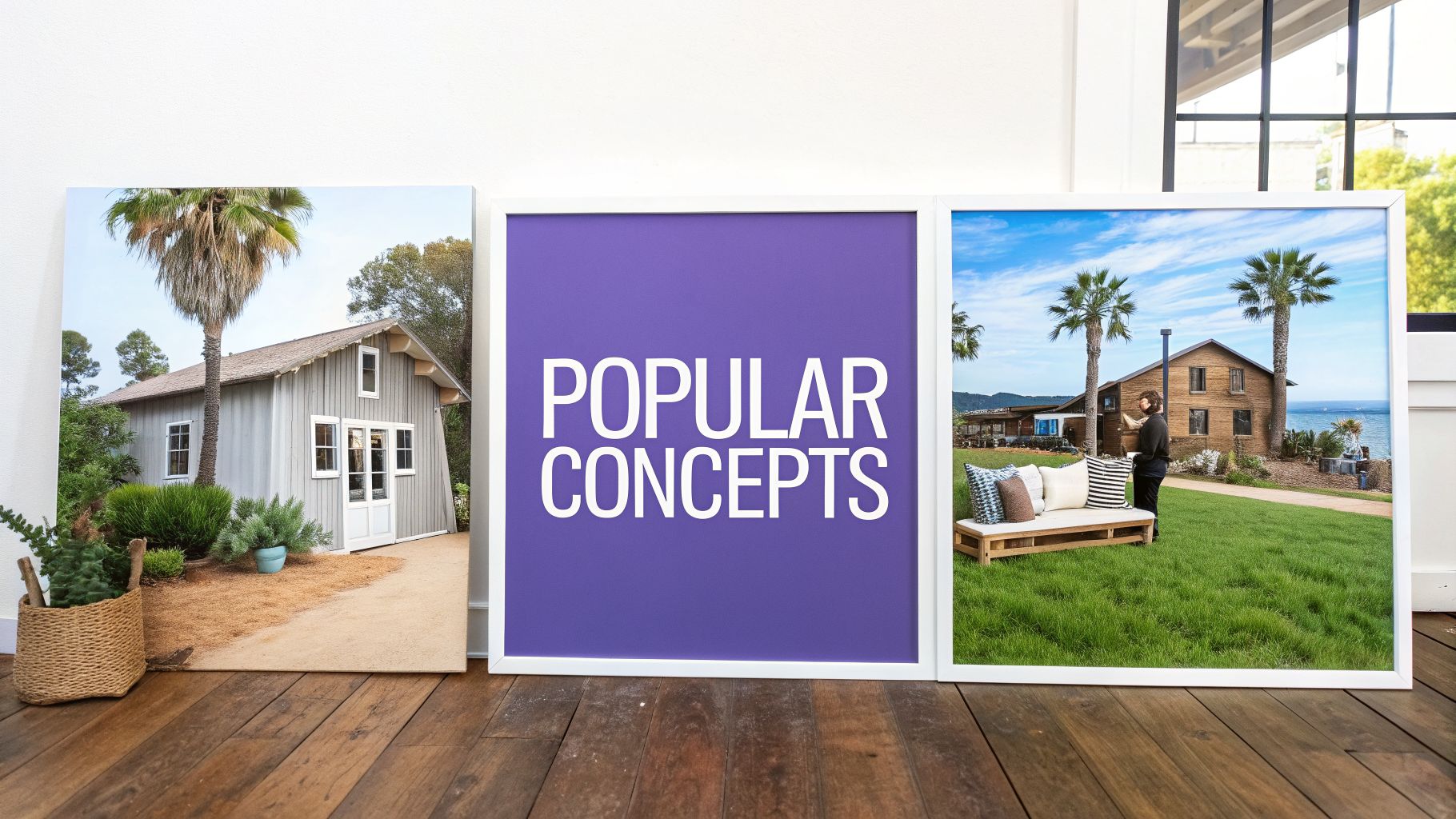
So, how does a great concept interior design actually look when it all comes together? Let's walk through a few popular styles that homeowners in the US are loving right now. Seeing them in practice really shows how a single, guiding idea can turn a room from a random collection of furniture into a space that feels intentional and complete.
For years, styles like Modern and Contemporary were the undisputed kings of interior design, but that's starting to change. A deep dive into over 18.48 million design projects reveals that people are craving more personal, eclectic looks. It’s all part of a larger trend where self-expression is driving the market, which is expected to swell from USD 153.85 billion in 2026 to USD 204.23 billion by 2031. You can discover more insights about these 2026 design trends on asdav.in if you want to dig into the numbers.
Modern Farmhouse
Modern Farmhouse is a perfect example of a concept that blends two distinct feelings into one. It takes the cozy, rustic comfort of country living and pairs it with the clean, simple lines of contemporary design. It’s all about finding harmony between natural wood, soft textiles, and straightforward furniture—think classic, well-built pieces from a brand like Pottery Barn.
The trick is getting that balance just right. Lean too far into rustic, and the space can feel dated. Go too modern, and you lose all that inviting warmth. This is where visualizing specific pieces becomes critical. For instance, you might be stuck wondering if a classic slipcovered sofa or a more structured, modern couch would truly anchor the room.
That's a problem aiStager solves in seconds. It is the only solution that generates hyper-realistic photos with true dimension rooms and furniture objects, so you can upload a photo of your space and the product links for both sofas to see exactly how each piece from Pottery Barn will look and, just as importantly, fit. It lets you nail that Modern Farmhouse feel with total confidence.
California Casual
The whole point of the California Casual concept is to create a breezy, light-filled escape. It’s defined by a soft, neutral color palette, lots of natural textures like rattan and linen, and furniture that just begs you to relax. Brands like Lulu and Georgia have really perfected this look, offering pieces that feel laid-back but still incredibly chic.
Imagine you've found the perfect sofa from Lulu and Georgia for your living room but are torn between an off-white linen and a light gray bouclé. With aiStager, you just upload a photo of your room and the product link. In just a few clicks, you can place this new product in your room and see both options rendered in your actual space. This lets you compare how each fabric and color plays with the natural light, making sure your final choice captures that effortless, sun-drenched vibe perfectly.
Eclectic Maximalism
Eclectic Maximalism is a bold, brave concept that’s all about embracing more. It’s a celebration of personality, where you artfully layer colors, patterns, and treasured objects to create a space that feels curated and full of life, not just cluttered. If you need some inspiration for mixing and matching, you can find great advice in these 12 timeless decorating concepts for your living room.
This style is practically made for visualization tools. Let’s say you’re thinking about putting a vibrant floral wallpaper from Anthropologie behind a sleek, modern sideboard from West Elm. It’s a bold move. Instead of just hoping for the best, aiStager lets you see that exact combination instantly. You can make sure the finished look is a dynamic reflection of you before you commit.
Common Questions About Concept Design
Even when you think you have a solid plan, a few practical questions always seem to pop up when you start bringing a design concept to life. Let's talk through some of the most common hurdles to make sure you can move forward with total confidence.
How Specific Does My Design Concept Need To Be?
Think of your concept as a compass, not a GPS. It needs to be specific enough to point you in the right direction but flexible enough to let you enjoy the journey.
For instance, a concept like “Coastal Grandmother” immediately gives you a clear vision: think breezy whites, natural textures, and comfy, timeless furniture. But it doesn't lock you into a specific brand of linen sofa or the exact shade of beige. This freedom allows you to find pieces you love while making sure they all work together. Your concept is a filter for your decisions, not a creative straitjacket.
What Should I Do If I Like Multiple Design Styles?
This is a great "problem" to have, and it's actually how most unique, personal spaces are born. The trick is to find the common thread between the styles you love. Say you're drawn to the clean lines of Scandinavian design but also love the rustic warmth of an American Farmhouse. Why not blend them into a "Scandi Farmhouse" concept?
This is where experimenting is key. A tool like aiStager is perfect for this because it’s the only solution that creates hyper-realistic photos using true dimension rooms and furniture objects. You can take a photo of your actual room and see how that minimalist Danish armchair looks next to a chunky, reclaimed wood table from a brand like Restoration Hardware. In just a few seconds, you can test out different combinations of the same product—like different wood finishes or upholstery—and find a balance that feels completely you.
A design concept isn't about rigidly sticking to one style. It’s about defining the feeling you want a room to have and then choosing the elements that create that specific atmosphere.
How Can I Create A Concept For An Open-Plan Living Space?
With open-plan spaces, you want to create different "zones" that feel separate but still speak the same language. The first step is to define what each area is for—living, dining, cooking. Then, you need a unifying element to tie them all together.
This common thread could be a consistent color palette that flows through the space, a repeated material like a specific wood tone on the floors and cabinets, or a similar style of lighting fixture. You could anchor the living area with a large rug, hang a trio of pendant lights to define the dining spot, and choose bar stools for the kitchen island that echo the style of the dining chairs. Visualizing this is tough, which is why testing different layouts is so critical.
What Is The Best Way To Present A Concept?
People believe what they can see. Simply describing a "Modern Farmhouse" living room will never be as powerful as actually showing it. The best presentations are always visual.
This is where a tool like aiStager really changes the game for designers and homeowners. You can take a photo of the client's actual, empty room. Then, using product links, you can place that specific Crate & Barrel sofa with the exact fabric they're considering right into the space. You can test different rugs, coffee tables from multiple brands, and even paint colors on the walls.
In just a few clicks, you have a hyper-realistic photo showing precisely how the concept will look and feel. It instantly gets rid of any confusion, gets everyone on the same page, and builds real excitement for what's to come.
Ready to stop guessing and start seeing? With aiStager, you can bring your interior design concept to life in seconds. Upload a photo of your room, drop in a link to any product, and see a hyper-realistic, true-to-scale version in your own space. Try it now and start designing with complete confidence. Get started for free.