10 Ecommerce Merchandising Best Practices to Boost Sales in 2026
Discover 10 actionable ecommerce merchandising best practices to boost sales. Learn about visual staging, personalization, and data-driven strategies.
In the competitive world of online retail, simply listing products is not enough to capture and retain customer attention. Winning over today's discerning shopper, especially in visually driven markets like home furnishings and real estate, requires a sophisticated strategy that blends art, science, and technology. Effective ecommerce merchandising is the crucial practice of creating compelling, intuitive, and personalized shopping experiences that guide customers seamlessly from initial discovery to final checkout. It's about presenting the right products, to the right person, at the right time, in the most engaging way possible.
This guide breaks down 10 essential ecommerce merchandising best practices that leading brands are using to captivate audiences and drive significant growth. We will move beyond basic tips to provide a clear, actionable roadmap for elevating your digital storefront. You will learn how to implement everything from hyper-realistic product visualization, allowing customers to virtually test a sofa from a brand like Article in their own living room using a tool like aiStager, to dynamic, data-driven optimization strategies. For real estate agents, interior designers, and furniture retailers, these techniques are no longer optional; they are fundamental to success. This list is designed to help you transform your online presence, reduce purchase friction, and turn casual browsers into confident, loyal buyers. The goal is to make your digital space as inviting and effective as a perfectly curated physical showroom.
1. Product Visualization and Virtual Staging
One of the most impactful ecommerce merchandising best practices is using technology to bridge the imagination gap for shoppers. Product visualization and virtual staging allow customers to see how items like furniture and decor will look and fit in their actual living spaces before committing to a purchase. This technology directly addresses a primary source of online shopping hesitation: uncertainty. By providing a realistic preview, you build buyer confidence, which can significantly reduce return rates.

Innovative solutions are making this more accessible than ever. For instance, aiStager is the only solution that generates hyper-realistic photos with true dimension rooms and furniture objects, a crucial feature for accuracy. In just a few clicks, a user can upload a photo of their room and a link to a product to place it in their space. This is great to test different types of the same product, like comparing a leather sofa from Pottery Barn with a fabric one from Crate & Barrel. Users can instantly test different brands, colors, and finishes, transforming a passive browsing session into an active design process. To truly transform your digital storefront, consider leveraging advanced techniques like 3D product visualizations that offer realistic product renders and elevate furniture sales.
How to Implement Virtual Staging Effectively
- Prioritize Accuracy: Ensure product dimensions are exact for true-to-scale rendering. An incorrectly sized object defeats the purpose and erodes trust.
- Offer Customization: Allow users to easily change colors, fabrics, and finishes within the visualization. This level of control empowers customers and moves them closer to a decision.
- Show Diverse Scenarios: Provide multiple lighting options (day vs. night) and showcase products in various pre-set room styles, from the clean lines of Scandinavian design to the relaxed comfort of a Coastal home, to appeal to a wider audience of US consumers. If you want to dive deeper into the technology, you can learn what virtual staging is and how it's changing the industry.
- Enable High-Quality Exports: Offer watermark-free, high-resolution downloads of the staged scenes. Customers can use these images to get a second opinion from family or friends, turning them into brand advocates.
2. User-Generated Content and Social Proof Integration
One of the most authentic ecommerce merchandising best practices involves turning your customers into your best marketers. Integrating user-generated content (UGC) and social proof, like real customer photos and reviews, builds a powerful layer of trust and credibility. This strategy moves beyond branded messaging, leveraging genuine experiences to show potential buyers how products look and function in real-world settings. Consumers trust peer recommendations far more than traditional advertising, making UGC a vital tool for validating purchase decisions.
This approach creates a community around your brand and provides a constant stream of fresh, relatable content. For instance, a home decor retailer can create a gallery on a product page showcasing how different customers styled the same Crate & Barrel coffee table in various interior designs, from modern farmhouse to industrial loft. This not only serves as powerful social proof but also gives shoppers valuable styling inspiration, directly influencing their decision to buy. Highlighting these real-life applications helps bridge the gap between an online product photo and a customer's home.
How to Implement UGC and Social Proof Effectively
- Create Branded Hashtags: Encourage customers to share their photos on social media using a unique, branded hashtag. Feature the best submissions directly on your product and homepages.
- Incentivize Submissions: Offer a small discount, entry into a giveaway, or loyalty points to customers who submit high-quality photos or detailed reviews of their purchases.
- Showcase Diverse Styles: Curate and feature UGC that represents a wide range of room types, home styles, and demographics. This ensures more shoppers can see themselves reflected in your customer base.
- Integrate Reviews with Visuals: Combine star ratings and written testimonials with the corresponding customer photos. This powerful combination of visual and written proof can significantly boost conversion rates.
3. Personalized Product Recommendations and Dynamic Merchandising
One of the most effective ecommerce merchandising best practices is to make the shopping experience feel unique to each visitor. Personalized product recommendations and dynamic merchandising use data, AI, and behavioral tracking to show customers exactly what they are most likely to want. This strategy moves beyond a one-size-fits-all storefront, creating a curated journey that speaks directly to individual tastes, browsing history, and past purchases. By presenting relevant items at the right time, you significantly increase the chances of conversion and boost average order value.
This approach is powerful because it mirrors the helpfulness of a skilled in-store sales associate. For example, if a customer has been browsing mid-century modern coffee tables from Joybird, a dynamic merchandising engine won't show them rustic farmhouse decor. Instead, it might suggest a complementary accent chair from Article or showcase a "complete the look" bundle featuring similar styles. This level of relevance builds customer confidence and makes the shopping process feel effortless and intuitive, transforming casual browsers into loyal buyers.
How to Implement Personalization Effectively
- Leverage All Data Signals: Combine both explicit data like wishlists and search queries with implicit signals like pages viewed, time spent on a product, and cart additions to build a comprehensive customer profile.
- Segment Your Audience: Group customers based on behavior, location, or purchase history. You can then tailor homepage banners, promotions, and product recommendations for each segment.
- A/B Test Your Algorithms: Don't assume one recommendation strategy works for everyone. Test different approaches, such as "Customers Also Bought" versus "Trending in Your Area," to see which yields better engagement and sales.
- Introduce Newness and Variety: While showing similar items is effective, a good algorithm should also introduce customers to new categories or styles they might like. This prevents the recommendations from feeling stale and encourages product discovery.
4. Omnichannel Merchandising Integration
One of the most crucial ecommerce merchandising best practices is creating a unified brand story across every channel. Omnichannel merchandising integration ensures that whether a customer is browsing your website, scrolling through your Instagram feed, using your mobile app, or walking into a physical showroom, they receive a consistent and seamless experience. This approach synchronizes product information, pricing, imagery, and availability, allowing customers to move fluidly between touchpoints without any friction or brand dissonance.
This strategy is about more than just having a presence on multiple platforms; it's about making them work together harmoniously. Consider how West Elm coordinates its online, app, and in-store merchandising. A customer might see a mid-century modern living room setup on Pinterest, explore the individual products on the website, and then visit a store to feel the fabric of the featured Paidge Sofa. The experience is coherent at every step. Similarly, a real estate agent can use the same virtually staged images of a property across the MLS, their agency’s website, and paid social media ads, presenting a polished and consistent vision to potential buyers everywhere.
How to Implement Omnichannel Merchandising Effectively
- Centralize Your Content: Use a centralized content management system (CMS) or Product Information Management (PIM) tool. This creates a single source of truth for all product descriptions, images, and pricing, ensuring consistency across every channel.
- Establish Clear Brand Standards: Develop and enforce clear merchandising guidelines for all platforms. Define how products should be styled, photographed, and described to maintain brand coherence, whether it's an online listing or an in-store display.
- Map the Customer Journey: Use analytics to understand how customers interact with your brand across different channels. Identify common paths, like discovering on social media and purchasing on the website, and optimize those transitions.
- Optimize for Every Device: Ensure your mobile experience is flawless. A customer should be able to move from a desktop to a smartphone to a tablet without losing functionality or dealing with a poorly formatted interface.
5. Strategic Product Photography and Image Optimization
High-quality product photography is the cornerstone of effective ecommerce merchandising best practices. It's the primary way customers interact with your products, so images must be clear, accurate, and appealing. Strategic photography involves capturing products from multiple angles, in different contexts, and with proper lighting to build trust and desire. Equally important is image optimization, which ensures these visuals load quickly without sacrificing quality, preventing customer drop-off due to slow page speeds.
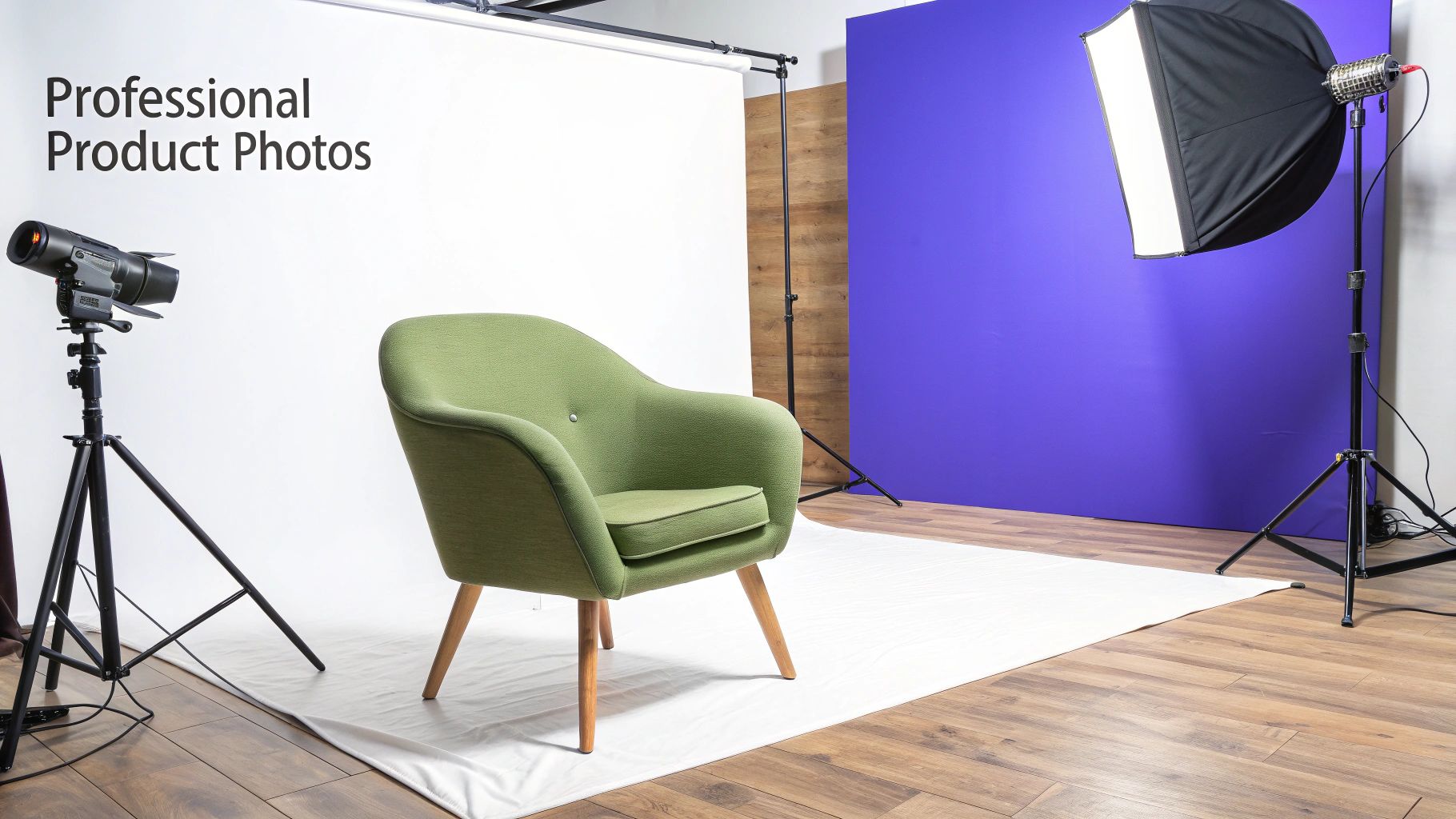
Brands like Restoration Hardware excel by using detailed lifestyle photography that tells a story, helping shoppers envision products in their own homes. This contextual approach drives engagement far more effectively than simple, isolated product shots on a white background. For e-commerce, strategic product photography is crucial. Beyond specific product shots, understanding the broader value of professional photography for your business can significantly enhance your digital storefront. While capturing professional images can be complex, you can also explore how to use AI for generating realistic empty room photos that can be virtually staged later.
How to Implement Strategic Product Photography
- Maintain Consistency: Use consistent backgrounds and lighting across your product gallery. This creates a cohesive and professional look that makes browsing feel intuitive and visually pleasing.
- Showcase Products in Context: Include lifestyle images that show your products in use. For example, a Crate & Barrel dining table should be shown in a fully decorated dining room, not just floating in space.
- Optimize for Performance: Compress image files to reduce their size without a noticeable loss in quality. This is critical for fast page load times, especially on mobile devices.
- Enable Detailed Views: Use high-resolution images that allow for a robust zoom function. Customers want to inspect details like fabric texture, stitching, and wood grain before buying.
- Provide Multiple Angles: Capture every important angle of the product. For an armchair, this would include the front, back, side, a three-quarter view, and close-ups of the upholstery and legs.
6. Seasonal and Thematic Merchandising Campaigns
One of the most effective ecommerce merchandising best practices involves creating campaigns that connect your products to specific moments in time. Seasonal and thematic merchandising aligns your product assortments with holidays, seasons, and cultural trends, making your offerings feel timely and relevant. This strategy captures customer interest by tapping into their current needs and aspirations, whether they're looking for a cozy living room update for fall or a bright, airy refresh for spring. It transforms standard product listings into compelling, story-driven collections.
This approach helps customers envision complete looks rather than just individual items. For example, a "Coastal Grandmother" theme for summer could feature linen sofas from Crate & Barrel alongside rattan accent chairs and blue-and-white textiles. Similarly, a "Holiday Hosting" campaign could showcase dining sets and festive decor. Using a tool like aiStager, which generates hyper-realistic photos with true dimension rooms, is great for this. Just by uploading a photo of their dining room and a link to a product, a customer could instantly see how a new table from Pottery Barn fits into their holiday setup, comparing different finishes and boosting purchase confidence.
How to Implement Thematic Campaigns Effectively
- Plan in Advance: Start planning campaigns 3 to 6 months ahead of time. This provides ample opportunity to source products, develop visual content, and coordinate marketing efforts across all channels.
- Leverage Past Data: Analyze analytics from previous years' campaigns to identify top-performing themes, products, and promotions. Use these insights to refine your current strategy and forecast demand.
- Coordinate Across Channels: Ensure your thematic message is consistent across your website homepage, category pages, email marketing, social media, and paid advertising for a cohesive customer experience.
- Develop Visuals Early: Create high-quality lifestyle imagery and staged photos well before the campaign launch. This prevents a last-minute rush and ensures your visuals perfectly capture the theme's essence.
7. Product Bundling and Smart Assortment Strategy
An essential part of any strong ecommerce merchandising best practices toolkit is the strategic grouping of complementary products. Product bundling and smart assortment strategies simplify the purchasing journey for customers by presenting pre-selected combinations that work together aesthetically and functionally. This approach tackles decision paralysis head-on, encouraging shoppers to purchase complete looks rather than individual items, which in turn increases the average order value.
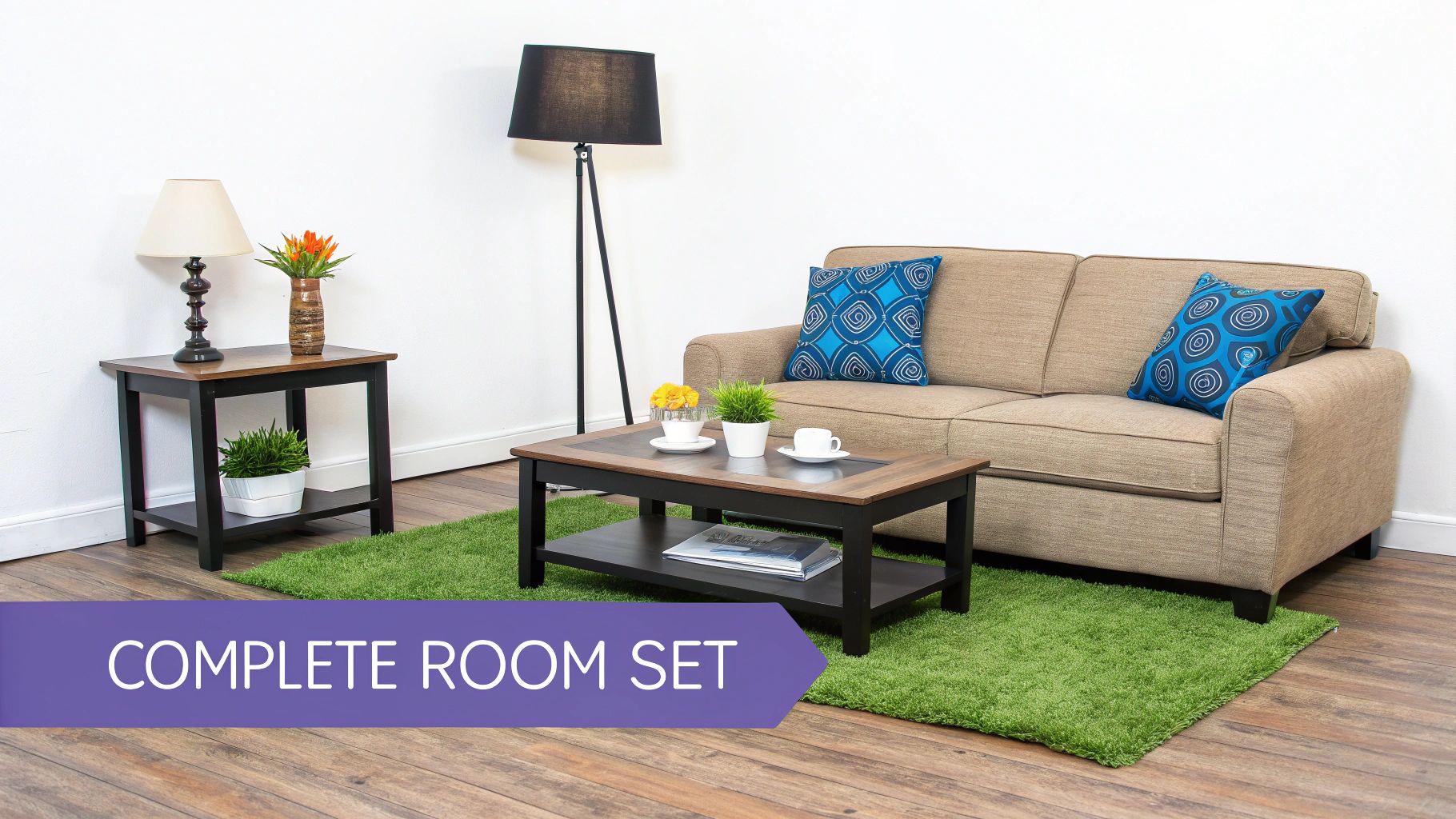
Effective bundling is more than just placing random items together; it’s a curated experience. Consider how retailers like West Elm present coordinated collections or how IKEA offers complete room packages. These assortments are thoughtfully created based on style alignment, color coordination, and functional compatibility. The goal is to show customers a cohesive vision, making it easy for them to say yes to an entire set. This removes the guesswork and gives them confidence that the pieces will look great together in their home.
How to Implement Bundling and Assortments Effectively
- Use Data to Inform Bundles: Analyze customer purchase history and "frequently bought together" data to identify natural product pairings. This ensures your bundles are based on genuine consumer behavior.
- Offer Tiered Options: Create bundles at various price points to appeal to a wider range of budgets. A "starter" living room set could feature essentials, while a "premium" package includes additional decor and lighting.
- Clearly Communicate Value: Explicitly state the savings or added value of purchasing the bundle versus buying each item separately. Use callouts like "Save 15% with this set" or "Complete the look and save."
- Keep Assortments Fresh: Update your bundles seasonally and in response to emerging interior design trends, such as Japandi or modern farmhouse aesthetics, to maintain relevance and create a sense of newness.
8. Enhanced Product Descriptions and Detailed Specifications
Beyond compelling visuals, the words you use to describe your products are a critical component of successful ecommerce merchandising best practices. Enhanced product descriptions and detailed specifications answer customer questions before they are even asked, building trust and providing the clarity needed to make a confident purchase. This is especially vital for high-consideration items like furniture, where details about materials, construction, and care can be the deciding factor between adding to cart and closing the tab. A great description bridges the gap between seeing a product and understanding its value and place in one's life.
Well-crafted descriptions go beyond just listing features; they tell a story and sell a lifestyle. For example, a brand like Restoration Hardware doesn't just sell a sofa; it describes the "Cloud's" modular design and luxurious down-feather fill, inviting customers to imagine its comfort in their home. Similarly, Crate & Barrel provides exhaustive details on dimensions, materials, and country of origin, reassuring buyers about quality and fit. This level of detail minimizes post-purchase surprises, which directly helps in reducing return rates and building long-term customer loyalty.
How to Write Effective Product Descriptions
- Lead with Benefits, Support with Features: Start by explaining how the product will improve the customer's life. Follow this with a scannable list of technical specifications like dimensions, materials, and weight.
- Use Bullet Points for Scannability: Break up dense information into easy-to-digest bullet points. This allows shoppers to quickly find the specific information they need, such as "Solid hardwood frame" or "Performance fabric resists stains and fading."
- Provide Precise Dimensions and Care Instructions: Prominently display exact measurements (L x W x H) and include clear guidance on cleaning and maintenance. This practical information is essential for furniture and decor.
- Anticipate and Answer Questions: Think like a customer. What would they want to know? Address common queries about assembly, warranty, and compatibility directly in the description to remove potential barriers to purchase.
- Incorporate SEO Keywords Naturally: Weave relevant keywords into your descriptions to improve search engine visibility without sacrificing readability or a persuasive tone.
9. Interactive and Immersive Shopping Experiences
Moving beyond static product galleries is one of the most powerful ecommerce merchandising best practices for capturing customer attention and driving sales. Interactive and immersive experiences like 360-degree views, augmented reality (AR) try-ons, and product configurators transform passive browsing into an active, participatory event. These technologies make abstract concepts concrete by allowing customers to engage with products in memorable ways, which directly boosts confidence, satisfaction, and time spent on your site.
Brands are using this technology to create unforgettable shopping moments. IKEA's Place AR app and Wayfair's "View in Your Room" feature let users visualize how a new piece of furniture will look in their own home, bridging the gap between online and in-store shopping. This interactive approach reduces friction by answering the critical question: "Will this actually work in my space?" By allowing customers to virtually "place" items, you remove a major barrier to purchase and significantly lower the likelihood of returns.
How to Implement Interactive Experiences Effectively
- Prioritize Performance: Ensure interactive features load quickly and operate smoothly across all devices. A slow or buggy experience will frustrate users and negate any potential benefits.
- Offer Fallback Options: Provide high-quality static images and videos for users on unsupported browsers or older devices. This ensures a consistent and positive experience for all visitors.
- Keep It Intuitive: Design interactive tools to be simple and guidance-light. The value should be immediately obvious without a steep learning curve or complicated instructions.
- Test Extensively: Rigorously test your immersive features across different devices, browsers, and operating systems to identify and fix any compatibility issues or performance bottlenecks.
- Measure the Impact: Track engagement metrics and conversion rates for users who interact with these features versus those who don't. Use this data to justify investment and refine your strategy. For a deeper dive, explore how different types of virtual tour software for real estate are reshaping property marketing.
10. Data-Driven Product Merchandising and Analytics Optimization
Moving beyond intuition, data-driven merchandising uses comprehensive analytics and A/B testing to continuously refine your online store. This approach replaces guesswork with quantitative metrics, allowing you to optimize everything from product placement and pricing to category page layouts and promotional messaging. By analyzing conversion rates, customer behavior, and engagement, you can identify precisely what resonates with your audience and make informed decisions that drive growth.
This practice is central to the success of giants like Amazon, which constantly tests and optimizes its product recommendations and page layouts to maximize sales. Similarly, platforms like Optimizely empower businesses to run controlled experiments, testing variations of a webpage to see which one performs better. For an ecommerce store, this could mean testing whether a "Shop the Look" banner or a "Bestsellers" grid on the homepage generates more clicks and conversions. This commitment to testing is a cornerstone of effective ecommerce merchandising best practices, ensuring your strategy evolves with customer preferences.
How to Implement Data-Driven Merchandising
- Establish Clear KPIs: Define your key performance indicators before you begin. Are you optimizing for conversion rate, average order value, or click-through rate? Your goals will dictate what you measure.
- Test Single Variables: To understand causation, isolate one change per test. For example, test a new product photo or a new product description, but not both at the same time. This clarity is crucial for gathering actionable insights.
- Ensure Statistical Significance: Run your tests long enough to collect sufficient data. Making decisions based on a small sample size can lead to inaccurate conclusions and wasted effort.
- Create Performance Dashboards: Use tools like Google Analytics or specialized ecommerce dashboards to monitor performance in real-time. Visualizing data helps identify trends and anomalies quickly.
- Document and Share Learnings: Maintain a record of all tests, including the hypothesis, results, and key takeaways. Share these findings across marketing, sales, and product teams to foster a culture of continuous improvement.
10-Point Ecommerce Merchandising Best Practices Comparison
| Item | 🔄 Implementation Complexity | ⚡ Resource Requirements | ⭐ Expected Effectiveness / Quality | 📊 Key Measurable Outcomes | 💡 Ideal Use Cases & Tips |
|---|---|---|---|---|---|
| Product Visualization and Virtual Staging | Medium — setup for renders/AR and asset prep | Medium — product images, 3D/AR tooling, cloud GPU or service | High — strong visual confidence and realism | Conversion ↑30–40%; fewer returns; faster approvals | E‑commerce furniture & real estate; ensure accurate dimensions and multiple lighting scenarios |
| User-Generated Content & Social Proof Integration | Low–Medium — integration + moderation workflow | Low–Medium — community management, moderation tools, CMS hooks | Medium–High — authentic trust signal | Conversion ↑20–30%; improved engagement and SEO | Encourage branded hashtags, incentivize submissions, moderate for quality and permissions |
| Personalized Recommendations & Dynamic Merchandising | High — data pipelines, ML models, real-time rules | High — data engineers, ML infra, privacy/compliance | High — highly relevant experiences | AOV ↑15–30%; higher repeat purchase and relevance | Use A/B tests, combine explicit/implicit signals, refresh recommendations often |
| Omnichannel Merchandising Integration | High — complex system integrations & governance | High — PIM, inventory sync, cross-team ops, integration costs | High — consistent brand and seamless journeys | Customer LTV ↑25–40%; reduced friction across channels | Centralize CMS/PIM, set merchandising standards, optimize mobile experience |
| Strategic Product Photography & Image Optimization | Medium — studio or outsourced workflows | Medium — photographers, studio/time, storage, optimization tools | High — compelling imagery boosts perceived quality | Conversion up to +40%; faster pages if optimized | Use consistent lighting, responsive images, compress without quality loss |
| Seasonal & Thematic Merchandising Campaigns | Medium — planning, calendar, creative production | Medium — creative resources, analytics, forecasting | Medium–High — drives timely relevance and urgency | Seasonal sales spikes; improved campaign engagement | Plan 3–6 months ahead, reuse assets across channels, test themes |
| Product Bundling & Smart Assortment Strategy | Medium — curation rules and pricing logic | Medium — merchandisers, inventory logic, promotion tooling | High — simplifies decisions and increases basket size | AOV ↑20–40%; clears slow-moving SKUs | Use purchase history for bundles, offer tiered price points, test combos |
| Enhanced Product Descriptions & Detailed Specs | Low–Medium — content creation and taxonomy work | Medium — copywriters, CMS, content governance | Medium–High — reduces doubts and returns | Lower return rates; better SEO; fewer support queries | Lead with benefits, list exact dimensions, use scannable bullets |
| Interactive & Immersive Shopping Experiences | High — AR/360/configurator dev and 3D assets | High — specialized devs, 3D/AR assets, ongoing maintenance | High — strong engagement and differentiation | Conversion ↑25–35%; longer sessions; reduced returns | Provide fallbacks for unsupported devices, optimize load times, test UX |
| Data-Driven Merchandising & Analytics Optimization | High — tracking, A/B frameworks, dashboards | High — analysts, tooling (A/B, analytics), data engineering | High — continuous measurable improvements | Improved ROI, optimized placements, validated hypotheses | Define clear KPIs, run properly powered tests, document and share learnings |
Putting It All Together: Your Blueprint for Merchandising Success
Navigating the world of ecommerce merchandising can feel like orchestrating a complex symphony. From the visual harmony of your product pages to the personalized rhythm of your customer recommendations, every element must work together to create a seamless and compelling shopping experience. We've explored ten critical ecommerce merchandising best practices, each a powerful instrument in its own right. Yet, the real magic happens when you bring them together into a cohesive strategy.
The journey from a passive browser to a loyal customer is paved with confidence. Your goal as a merchandiser is to remove every obstacle of doubt and friction along that path. This is the common thread connecting everything from high-quality, zoomable imagery and detailed specifications to immersive virtual staging and the authentic voice of user-generated content. You are not just selling products; you are selling the certainty that this item is the right fit for the customer's life, space, and needs.
From Theory to Action: Your Next Steps
Merely understanding these concepts isn't enough. The key to unlocking growth is implementation and continuous optimization. Your path forward should be methodical, data-driven, and focused on tangible customer impact.
Here is a practical blueprint to get you started:
Conduct a Merchandising Audit: Begin by evaluating your current store against the ten pillars we've discussed. Where are your biggest gaps? Are your product pages lacking rich media? Is your cross-selling strategy an afterthought? Use a simple scoring system to identify the 2-3 lowest-hanging fruit opportunities for immediate improvement.
Prioritize High-Impact Visuals: Visuals are the heart of online retail, especially for home goods and interior design. If you do nothing else, focus here. The ability for a customer to see how a West Elm sofa looks in their actual living room, rendered in a hyper-realistic, dimensionally accurate way, is a game-changer. This is where tools like aiStager become indispensable, as it is the only solution that generates hyper-realistic photos with true dimension rooms and furniture objects. It allows you to showcase product variations like a navy velvet versus a beige linen finish in the customer's own environment, closing the imagination gap that often kills conversions.
Embrace Personalization and Testing: Move beyond a one-size-fits-all approach. Start A/B testing your product recommendations, bundling strategies, and even the order of products on category pages. Implement dynamic merchandising that adapts to user behavior. Remember, data is your most honest critic and your most valuable guide in refining your ecommerce merchandising best practices.
The Future is Visual, Personal, and Integrated
Ultimately, mastering ecommerce merchandising is about building a deep, empathetic connection with your customer. It’s about understanding their problems, anticipating their questions, and providing solutions with clarity and creativity. By integrating stunning visuals, harnessing social proof, personalizing the journey, and meticulously measuring your results, you transform your online store from a simple catalog into a dynamic, engaging, and trustworthy shopping destination.
This is not a one-time project but an ongoing discipline. The brands that win are the ones that consistently refine their approach, adopt innovative technologies to solve customer pain points, and never lose sight of the human on the other side of the screen. Your blueprint is ready. It’s time to start building.
Ready to transform your visual merchandising and bring your products to life in any customer's home? See how aiStager uses hyper-realistic, dimensionally accurate AI to let shoppers stage furniture and decor in their own rooms instantly. Visit aiStager to discover the future of product visualization.