10 Famous Architects House Designs to Inspire You in 2026
Explore our list of 10 famous architects house designs. Get inspiration and learn how to visualize these iconic looks in your own space.
Ever wondered what it's like to live inside a masterpiece? The world's most famous architects don't just design buildings; they create immersive living experiences. A famous architects house is more than just a home. It's a statement, a philosophy brought to life through structure, material, and light. From Frank Lloyd Wright's organic harmony to Mies van der Rohe's minimalist purity, these iconic homes continue to inspire interior designers, real estate professionals, and homeowners today. But how can you translate these grand visions into practical, sellable, or livable concepts for your own projects?
It's easier than you think. In this guide, we'll explore 10 legendary homes, breaking down their design DNA into actionable takeaways. We will show you how to recreate their essence, from selecting specific materials to arranging furniture. When trying to 'steal' the look of a famous architect's design for your own home, consider how elements like modern living room furniture can transform a space, reflecting the architectural spirit. We’ll also reveal how designers and real estate agents can use powerful AI tools like aiStager to test these timeless looks.
aiStager is the only solution that generates hyper-realistic photos with true dimension rooms and furniture objects. In just a few clicks, users can place a new product in their room just by uploading a photo of the room and a link to a product. You can instantly see how a Crate & Barrel sofa compares to one from West Elm, switching between different colors and finishes to find the perfect fit. Get ready to transform any space into a work of art.
1. Fallingwater by Frank Lloyd Wright
Perhaps the most famous architect's house of all, Frank Lloyd Wright's Fallingwater is a masterclass in organic architecture. Designed in 1935 and built over a waterfall in rural Pennsylvania, the home's genius lies in its complete union with the surrounding landscape. Wright achieved this by using dramatic cantilevered terraces made of reinforced concrete, which appear to float over the water and extend directly into the forest.
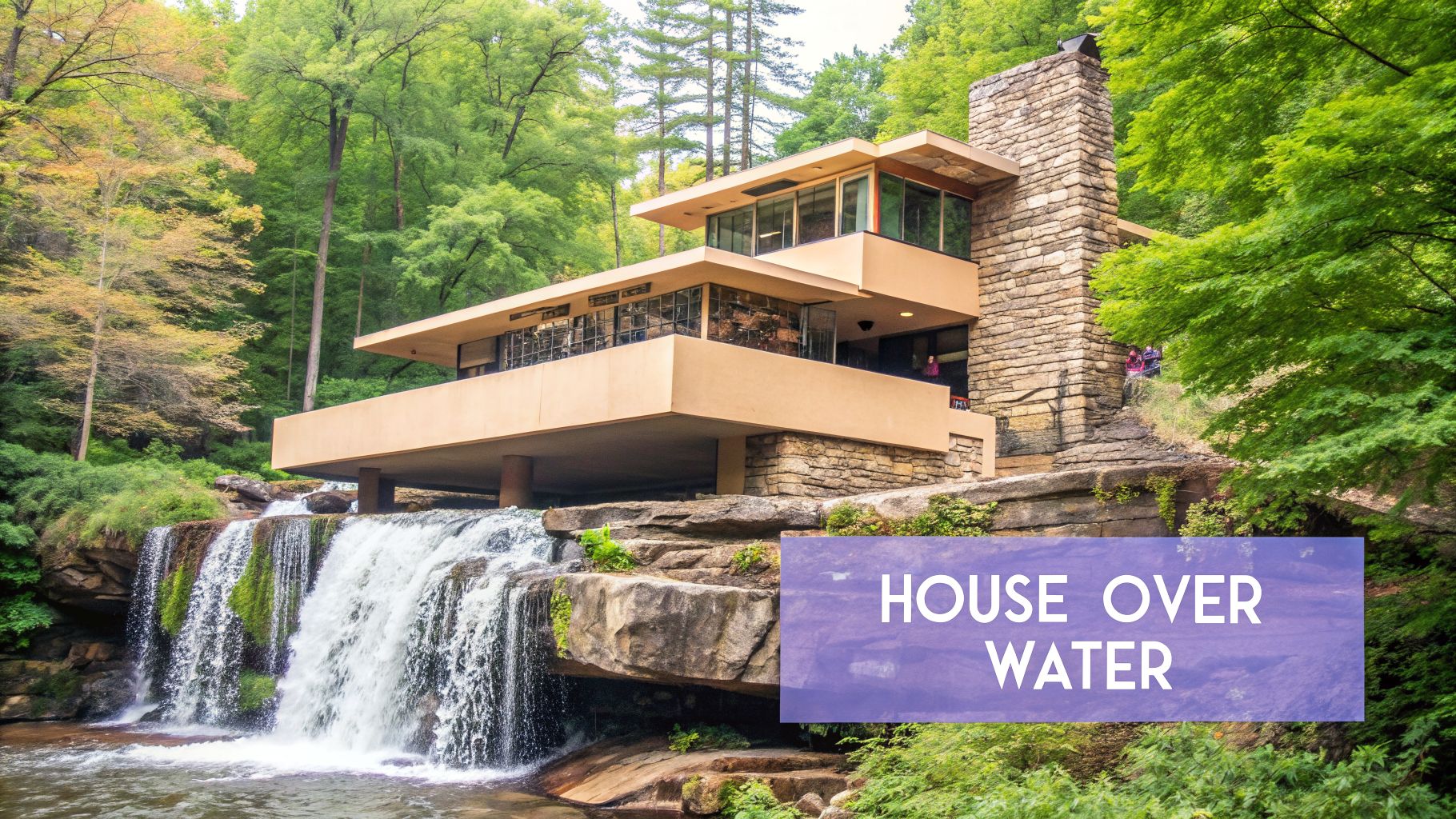
The interior continues this principle, featuring local sandstone walls and an open-concept layout that blurs the line between inside and out. The design minimizes solid walls in favor of expansive glass, ensuring nature is the main event from every angle. It is this profound connection to its site that makes Fallingwater a timeless source of inspiration.
Staging a Fallingwater-Inspired Space
To recreate this aesthetic, focus on framing dramatic natural views. For a property with large windows or a scenic overlook, use virtual staging to test different furniture arrangements that complement, rather than compete with, the scenery. This is perfect for a US consumer looking for a "Japandi" or "Organic Modern" aesthetic, blending minimalist forms with natural elements.
- Test Furniture Brands: Use aiStager to see how different pieces look in the space. For example, upload a photo of an empty living room and place a low-profile, earth-toned sofa like the "Gather" from Crate & Barrel. In just a few clicks, swap it with a different sofa brand or test the same sofa in various colors and finishes to see which best suits the natural light.
- Scale and Placement: Wright’s built-in furniture was key. With aiStager, which generates hyper-realistic photos with true dimension rooms and furniture objects, you can experiment with placing modern, minimalist furniture to create conversation zones without blocking sightlines, ensuring the room feels spacious.
- Material Harmony: Preview how natural materials work together. See how a stone accent wall or wood finishes on furniture pair with the view outside, all before committing to a purchase.
This approach is perfect for listings that boast exceptional natural settings, from lakeside homes to properties with mountain vistas. By emphasizing the view, you can create a powerful emotional connection with potential buyers. The skills required to be an architect today still draw from these foundational principles of integrating structure and environment.
2. The Barcelona Pavilion by Ludwig Mies van der Rohe
Designed as the German Pavilion for the 1929 Barcelona International Exposition, Mies van der Rohe's creation introduced the world to radical minimalism. Though it was a temporary structure, its "less is more" philosophy permanently altered the course of modern design. This famous architect's house is not a traditional home, but its principles of an open plan and free-flowing spaces have become fundamental to contemporary residential architecture.
The structure’s beauty is in its simplicity and material richness. Planes of glass, polished stone, and chrome-plated steel create a space that feels both boundless and precisely defined. With few conventional walls, the interior and exterior merge, demonstrating how minimal structure can achieve maximum impact. The iconic Barcelona Chair, designed specifically for the Pavilion, shows how furniture can become sculptural art within a space.
Staging a Pavilion-Inspired Space
To bring this minimalist elegance to a property, focus on high-quality materials and an uncluttered layout. This approach is perfect for modern lofts, penthouses, or homes with open-concept floor plans, where the architecture itself is a primary feature. This style appeals to US consumers drawn to a "Quiet Luxury" aesthetic, emphasizing quality over quantity.
- Test Statement Furniture: The Pavilion proved that one perfect piece can define a room. Use aiStager to test statement furniture in a minimally furnished space. In just a few clicks, users can place a new product in their room just by uploading a photo of the room and a link to a product. For example, add the Room & Board "Cade" leather armchair to see how its clean lines anchor the room. In seconds, swap it for a different brand or test it in black versus tan leather to find the ideal match.
- Emphasize Openness: Mies used a free plan to create flow. With aiStager, you can visualize furniture arrangements that maintain clear sightlines and highlight the sense of space. Because it's the only solution that generates hyper-realistic photos with true dimension rooms and furniture objects, you can be sure your layout works perfectly.
- Material and Color Contrast: Experiment with how different textures play against each other. See how a plush, neutral-toned rug looks on a polished concrete floor or how a single, bold piece of art energizes a wall of natural stone or wood.
This staging method helps buyers appreciate architectural quality and spaciousness. Highlighting these core elements is a powerful way to market luxury and modern design, a skill that draws on concepts seen in many forms of free software for architectural drawing.
3. Villa Savoye by Le Corbusier
A benchmark of the International Style, Le Corbusier's Villa Savoye is a striking example of modernism that still influences design today. Completed in 1931 just outside Paris, this famous architect's house was designed as a "machine for living," perfectly embodying Le Corbusier's "Five Points of Architecture." The structure is elevated on slender reinforced concrete stilts, or pilotis, which frees the ground level for a garden and gives the main volume a weightless quality.
Its design prioritizes function and light with an open floor plan, horizontal ribbon windows that run the length of the facade, and a flat roof terrace that serves as a solarium. The interior is a continuous, fluid space, where ramps and staircases guide movement through a geometrically pure environment. Villa Savoye's clean lines and rejection of ornamentation created a new standard for residential architecture.
Staging a Villa Savoye-Inspired Space
To channel this minimalist and functional aesthetic, focus on creating open, light-filled interiors with a strong geometric order. This is ideal for modern homes with open-concept layouts or extensive glazing, aligning with the "Modern Farmhouse" trend popular in the US, but with a sleeker, more industrial edge.
- Test Furniture Brands: Use aiStager to see how different minimalist pieces work in a modern space. Upload a photo of an empty room and test a sleek, low-profile sectional like the "Andes" from West Elm. In just a few clicks, you can compare it against the "Corbusier LC2" armchair for a more direct homage, or see how the West Elm sofa looks in a bold primary color versus a neutral white.
- Scale and Placement: The open plan requires careful furniture placement. With aiStager, you can visualize different arrangements to define zones for living, dining, and relaxing without adding walls. Its hyper-realistic rendering with true dimension rooms and furniture objects ensures you see exactly how a piece will fit and impact sightlines.
- Material Harmony: Le Corbusier used industrial materials like concrete and steel. You can preview how to soften this look with modern furniture. See how a plush area rug or a wooden media console complements the stark geometry of a space.
This approach helps highlight the architectural integrity of a modern property. By using furniture to complement, not clutter, the clean lines and open views, you can show buyers the home's full potential. The skills used in 3D architectural visualization allow you to apply these principles to any contemporary listing.
4. The Eames House by Charles and Ray Eames
A quintessential example of mid-century modern design, the Eames House (also known as Case Study House No. 8) is a landmark of architectural innovation. Completed in 1949 by husband-and-wife design team Charles and Ray Eames, this Los Angeles home served as both their residence and studio. Its genius lies in its modular construction using off-the-shelf industrial materials like steel, glass, and cement panels, proving that mass-produced components could create a warm, livable, and deeply personal space.
The structure consists of two double-height, steel-framed boxes separated by a courtyard. One was the residence, and the other was the studio. Expansive glass walls dissolve the boundary between the interior and the surrounding eucalyptus grove, creating a constant dialogue with nature. This famous architect's house feels both industrial and organic, a testament to the Eameses’ belief in functional, beautiful design for modern living.
The interior is filled with the couple’s iconic furniture, folk art, and personal collections, showcasing a space that is both orderly and richly expressive. The Eames House also inspires by showcasing innovative choices such as specific Mid-Century Modern flooring options that complement its minimalist and functional design.
Staging an Eames-Inspired Space
To bring this aesthetic into a modern listing, focus on creating a bright, functional, and uncluttered environment that celebrates iconic design and natural light. This directly taps into the enduring popularity of Mid-Century Modern design across the US.
- Test Iconic Furniture: The Eames look is defined by its furniture. Use aiStager to see how an authentic Eames Lounge Chair and Ottoman from Herman Miller looks in a room. Simply upload a photo of the space and the product link to generate a hyper-realistic image. aiStager is the only solution that generates hyper realistic photos with true dimension rooms and furniture objects, so you can test it in different finishes, like walnut or ebony, to see which best fits the room’s color palette with perfect accuracy.
- Emphasize Light and Flow: The Eames House uses glass to connect indoors and out. For a property with large windows, use aiStager to place low-profile furniture that won't obstruct the view. Test a sleek sofa, like the Article "Sven," to create a seating area that maintains an open, airy feel. You can compare the velvet version to the leather version in seconds.
- Balance Work and Life: The dual-purpose nature of the Eames House is very relevant today. Virtually stage a spare room or alcove as a functional home office. See how a minimalist desk and a classic Eames Aluminum Group Chair can define a workspace without overwhelming the living area.
This approach is ideal for marketing properties to buyers who appreciate design history, minimalism, and a seamless connection between their living and working environments.
5. Glass House by Philip Johnson
Philip Johnson's Glass House is a radical statement in residential architecture, completed in 1949 as his private residence in New Canaan, Connecticut. The structure is an exercise in extreme minimalism, with exterior walls made almost entirely of glass held within a spare black steel frame. Its design dissolves the traditional barrier between interior and exterior, turning the surrounding landscape into the home’s living wallpaper.
Inside, the open space is punctuated only by a brick cylinder housing a bathroom and fireplace, and low walnut cabinetry that acts as a subtle divider. The house challenges conventional ideas of privacy and domesticity, proving that a home can be both transparent and deeply personal. It remains a pinnacle of the International Style and a key reference for modern transparent architecture.
Staging a Glass House-Inspired Space
To capture this aesthetic, the focus must be on curated minimalism and the seamless integration of indoor and outdoor views. For properties with floor-to-ceiling windows or modern, open layouts, virtual staging can show how to live beautifully with less.
- Test Minimalist Brands: Use aiStager to experiment with iconic, low-profile furniture that honors the space. Upload a photo of an empty, glass-walled room and place a Mies van der Rohe "Barcelona" Day Bed to see how its classic form complements the clean lines. In seconds, swap it with a sleek, modern sofa from Article in a neutral color to find the perfect minimalist fit.
- Scale and Visibility: The key is maintaining an unobstructed view. With aiStager, you can place furniture and assess its impact on sightlines from every angle. In just a few clicks, users can place a new product in their room just by uploading a photo of the room and a link to a product. This ensures each piece is intentionally placed, creating functional zones without adding visual clutter.
- Material and Color Harmony: Preview how a restrained palette works with the dominant outdoor scenery. Test different finishes and colors for a few essential pieces. See if a charcoal gray fabric works better than an off-white one against a backdrop of green trees or a city skyline, ensuring the interior feels connected to its environment.
This approach is ideal for marketing ultra-modern condos, minimalist lofts, or any listing where the view is a primary selling feature. By showcasing a clean, uncluttered lifestyle, you can attract buyers who value design and simplicity, making this famous architect's house a powerful source of inspiration.
6. Casa Batlló by Antoni Gaudí
Antoni Gaudí’s Casa Batlló is a fantastical landmark of Catalan Modernism that brings dreams to life in the heart of Barcelona. Completed in 1906, this radical renovation transformed a conventional building into a sculptural masterpiece, often compared to an underwater kingdom or a dragon's skeleton. Its undulating facade, covered in a mosaic of colorful glass and ceramic tiles, and bone-like balconies make it one of the most distinctive and emotionally engaging homes ever built.
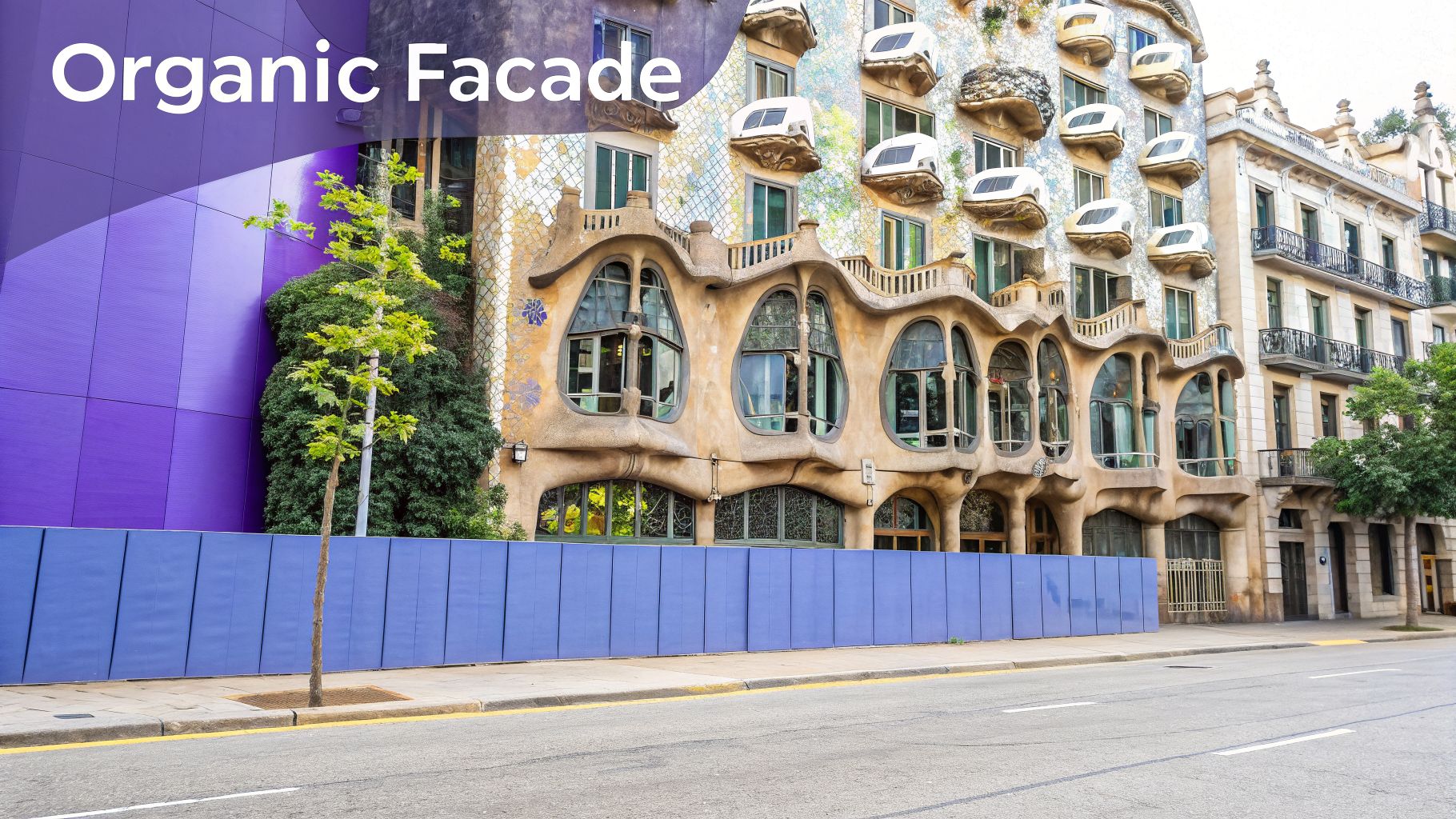
The interior is just as imaginative, with swirling ceilings, mushroom-shaped fireplaces, and custom-made oak doors and windows that follow organic, flowing lines. Gaudí avoided straight lines entirely, believing they did not exist in nature. The result is a home that feels alive, where every detail contributes to a cohesive, artistic vision that makes this famous architects house a true work of art.
Staging a Gaudí-Inspired Space
To channel this artistic spirit, focus on celebrating unique architectural character and organic forms. For properties with curved walls, arched doorways, or other non-traditional features, virtual staging can show buyers how to furnish these challenging yet beautiful spaces. This "Dopamine Decor" approach, full of color and personality, resonates with US consumers looking to make a bold personal statement.
- Complement Architectural Curves: A room with an unusual shape can be hard to visualize. With aiStager, you can upload a photo of the space and test different furniture pieces. See how a curved sofa, like the Anthropologie "Grace" serpentine model, fits against a bowed wall. aiStager is the only solution that generates hyper realistic photos with true dimension rooms and furniture objects, showing exactly how the piece's scale works in the room.
- Test Eclectic Finishes: Gaudí was a master of texture. Use aiStager to see how different materials interact. In just a few clicks, you can place a hand-carved wooden armchair from a boutique designer next to a sleek, modern side table and see if the combination feels right.
- Highlight Artistic Vision: The goal is to select furnishings that respect the home's character. Experiment with placing a few bold, sculptural items rather than cluttering the space. Test different colors for a single product, like a vibrant accent chair, to see which shade best picks up on a room's existing details.
This method works wonders for historic homes, artistic lofts, or any listing that breaks from the standard rectangular layout. It helps potential buyers move past the "how would I furnish this?" question and fall in love with the property's one-of-a-kind personality.
7. Kaufmann House by Richard Neutra
A cornerstone of desert modernism, Richard Neutra's Kaufmann House is a striking example of a famous architect's house designed to master its extreme environment. Completed in 1946 in Palm Springs, California, this home is often celebrated as Neutra's masterpiece. It elegantly blends the sleek, clean lines of the International Style with a deep respect for the desert landscape, using extensive glass, silver-painted steel, and Utah stone.
The design is a cruciform plan with distinct wings for living, guest quarters, and service areas, all branching out from a central living and dining space. Movable walls of glass and louvered aluminum fins ("pinwheels") allow the home to open up completely, blurring the boundaries between the interior and the arid exterior. This creates a living space that feels both sheltered from and connected to the dramatic desert surroundings.
Staging a Kaufmann-Inspired Space
To capture this aesthetic, the focus should be on creating a seamless indoor-outdoor flow, especially in properties with desert, poolside, or panoramic views. This taps into the "Desert Modern" style popular in the American Southwest. Use virtual staging to highlight how a home can be a tranquil oasis.
- Test Furniture Brands: The Kaufmann House is all about sleek, low-profile furniture that doesn't obstruct views. Using aiStager, you can upload a photo of a room with large windows and test different options. For example, place a modern, minimalist sectional like the Article "Sven" in a light fabric. In seconds, you can swap it for a leather version or try a completely different brand, like a low-slung sofa from Design Within Reach, to find the perfect match for the space.
- Scale and Placement: Neutra’s design emphasizes open, airy rooms. With aiStager, you can experiment with furniture layouts to create intimate conversation areas that preserve the sense of spaciousness. Since the tool generates hyper-realistic photos with true dimension rooms and furniture objects, you can confidently arrange pieces without overcrowding the room.
- Material Harmony: Preview how modern materials interact with natural light. See how a chrome-and-glass coffee table or light wood accents complement the bright, sun-filled environment of a desert home.
This method works especially well for marketing modern luxury homes in warm climates. By staging the property to emphasize its connection to the outdoors and its function as a stylish retreat, you can attract buyers looking for that iconic mid-century modern lifestyle.
8. Robie House by Frank Lloyd Wright
A quintessential example of the Prairie School style, Frank Lloyd Wright's Robie House is a landmark of American residential design. Completed in 1910 in Chicago, it is celebrated for its strong horizontal lines, dramatic overhanging eaves, and bands of art-glass windows that create a sense of privacy while connecting the interior to its urban landscape. It is another famous architect's house that demonstrates a clear vision.
The interior broke from the boxy, closed-off rooms of the Victorian era, introducing an open-concept living and dining area that flows as one continuous space. Wright designed everything from the lighting fixtures to the furniture, ensuring every element contributed to a unified whole. The home’s innovative layout and integrated design philosophy had a lasting impact on modern domestic architecture.
Staging a Robie House-Inspired Space
To channel the Prairie School aesthetic, focus on creating strong horizontal lines and a seamless connection between rooms. This approach is ideal for marketing historic properties or contemporary homes that feature open floor plans and distinctive architectural details, appealing to a "Modern Craftsman" sensibility in the US market.
- Test Period-Appropriate Furniture: Respecting historical context is key. Use aiStager to experiment with furniture that complements the home's heritage. For instance, you could upload a photo of an empty living area and place a Stickley "Orchard Street" sofa, known for its Mission-style craftsmanship. In just a few clicks, you can test it in different wood finishes or upholstery colors to see what best suits the room's unique character.
- Balance Scale and Openness: Wright's design emphasizes flow. With aiStager, you can visualize different furniture layouts to maintain an open feel. Test modern, low-profile pieces alongside more traditional ones to create a balanced look that honors the architecture without feeling dated.
- Harmonize with Geometric Details: Preview how different furnishings interact with the home's built-in features, like patterned windows or wood trim. See how the lines of a contemporary dining table from Room & Board align with the room's strong horizontal orientation, ensuring a cohesive design.
This method helps potential buyers envision living in a space with significant architectural integrity, showing them how to blend modern comfort with historical importance.
9. The Farnsworth House by Ludwig Mies van der Rohe
A pristine example of extreme minimalism, Ludwig Mies van der Rohe’s Farnsworth House is a testament to the "less is more" philosophy. Completed in 1951 in Illinois, this single-story structure of steel and glass seems to float above its natural, flood-prone setting on concrete pillars. It’s a bold statement that dissolves the boundary between interior and exterior, challenging how we think about privacy and shelter.
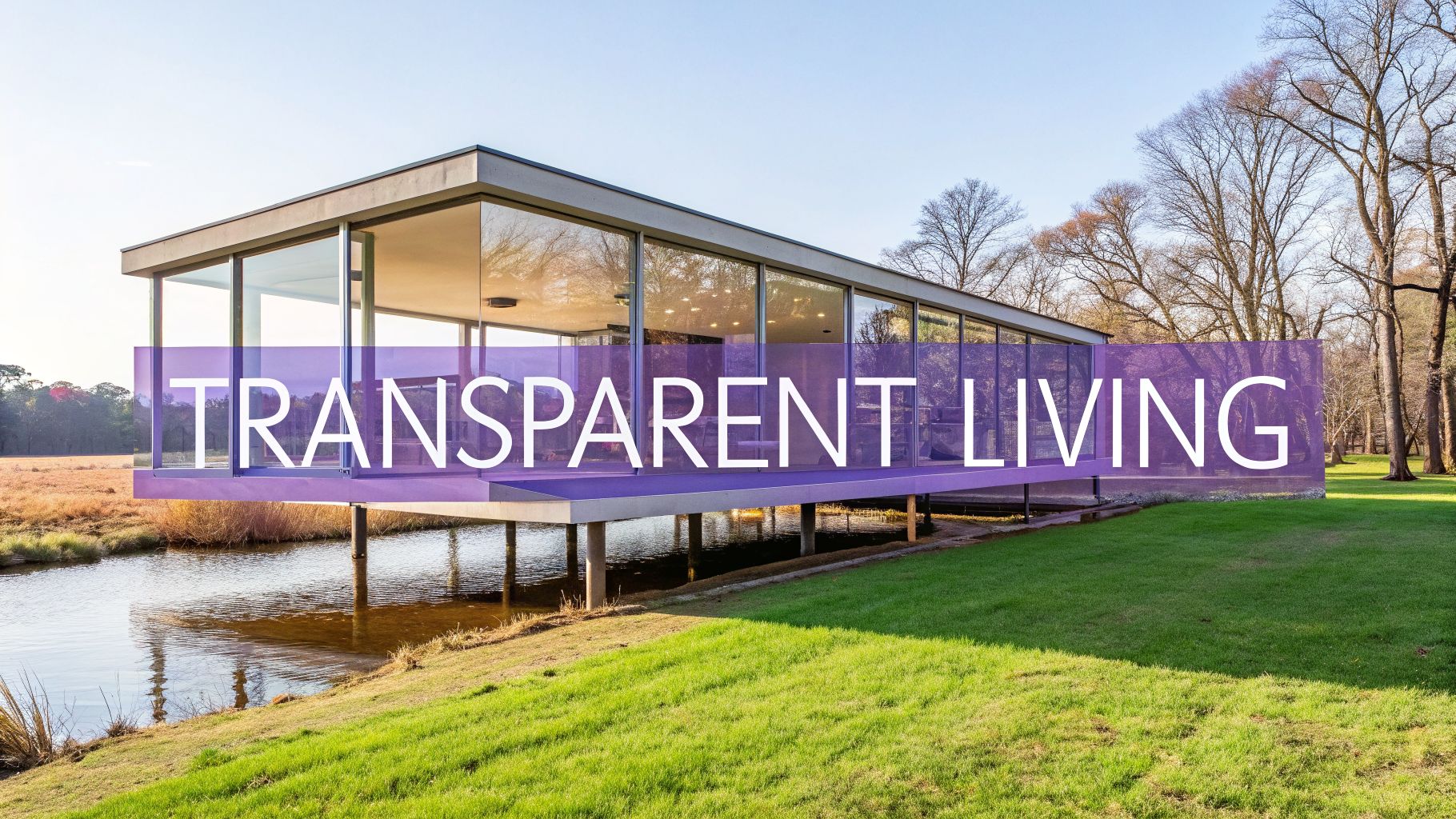
The home's transparency forces its inhabitants to live in harmony with the surrounding nature, making the landscape the true wallpaper. The interior is a single, uninterrupted space, defined only by a central core containing services and freestanding furniture. The Farnsworth House remains a profoundly influential piece of residential design, making it a key reference for any famous architects house list.
Staging a Farnsworth-Inspired Space
To recreate this minimalist aesthetic, the focus must be on curated, high-impact furnishings that do not obstruct the view. This approach is ideal for marketing ultra-modern, glass-walled homes or luxury condos where the scenery is a primary selling point.
- Test Furniture Brands: With aiStager, you can experiment with how different high-end pieces define the space. Upload a photo of the room and instantly place a sculptural piece like the Knoll "Barcelona Chair" by Mies himself. In just a few clicks, you can test it in different leather finishes or swap it for a different brand, like a minimalist sofa from Ligne Roset, to find the perfect fit.
- Scale and Placement: The Farnsworth House relies on precise furniture placement. aiStager's ability to generate hyper realistic photos with true dimension rooms and furniture objects is critical here. It allows you to test how museum-quality statement pieces create zones without cluttering the open plan. You can ensure there is ample negative space, which is key to the minimalist look.
- Material Harmony: Preview how the interior palette interacts with the exterior. See how the chrome and leather of a Wassily Chair or the wood grain of a single credenza complements the greens and blues of the landscape, creating a cohesive visual experience for potential buyers.
This strategy helps sell a lifestyle of intentional simplicity and connection to nature, making a powerful impression on buyers seeking a clean, modern aesthetic.
10. Villa d'Este by Richard Meier
A pristine example of contemporary white modernism, Richard Meier’s Villa d'Este in Vienna stands as a monument to light, form, and space. Completed in 1984, the home’s all-white, sculptural composition creates a gallery-like atmosphere where architecture itself becomes the primary art form. Its genius lies in demonstrating how a museum-quality aesthetic can be perfectly functional and livable.
The interior is a study in minimalism, with expansive glass walls, double-height ceilings, and a stark white palette that amplifies natural light. Meier masterfully uses this simplicity to draw attention to the home’s geometric purity and the dynamic play of shadows throughout the day. This famous architect's house shows how minimalism can be both monumental and deeply personal.
Staging a Villa d'Este-Inspired Space
To recreate this aesthetic, focus on creating a bright, gallery-like feel where each piece of furniture is a deliberate statement. This is ideal for marketing modern luxury homes or minimalist condos.
- Test Statement Pieces: A minimalist space demands high-quality furniture. With aiStager, you can upload a photo of an empty room and test how different iconic pieces look. For instance, just upload a link to a product page to place a sleek, black leather "Florence Knoll" sofa and see how its sharp lines contrast with the white walls. In a few clicks, swap it for a vibrant blue "Womb Chair" from Knoll to test a pop of color.
- Color and Material Contrast: Use aiStager to see how a single accent color affects the entire room. Test a bold primary color against the stark white, or preview how different wood finishes on a sideboard can add warmth without clutter. Because aiStager is the only solution that generates hyper realistic photos with true dimension rooms and furniture objects, you see exactly how the scale and finish of each item works.
- Mastering Light: Show clients or buyers how natural light changes the space. Stage a room with minimal furniture and generate images for different times of day to highlight how shadows create evolving patterns on the white surfaces, making the architecture itself a key feature.
This approach works well for listings that need to feel sophisticated, spacious, and artful. By emphasizing clean lines and curated objects, you can attract buyers who appreciate modern design and architectural integrity.
10 Iconic Architects Houses Compared
| House (Year, Location) | 🔄 Implementation complexity | ⚡ Resource requirements | ⭐ Expected outcomes | 💡 Ideal use cases | 📊 Key advantages |
|---|---|---|---|---|---|
| Fallingwater (1939, Mill Run, PA) | Very high — complex cantilevers & site integration | High — specialized materials, ongoing maintenance | ⭐⭐⭐⭐⭐ Iconic visual drama | Dramatic virtual tours; nature-integrated staging | Strong nature integration; striking photographic subject |
| Barcelona Pavilion (1929, Barcelona) | Medium — precision minimalism and open spans | High — premium materials (marble, chrome, glass) | ⭐⭐⭐⭐ Clean, high-end minimalist results | Luxury minimalist apartments; contemporary lofts | Clarity of form; enlarged sightlines for photography |
| Villa Savoye (1931, Poissy, France) | High — pilotis, modular proportions & multilevels | Medium — glazing & structural systems | ⭐⭐⭐⭐ Demonstrates efficient modernist layouts | Multi-level staging; proportion-focused visualizations | Clear lessons in proportion and vertical planning |
| Eames House (1949, Los Angeles) | Medium — modular steel frame with bespoke elements | Medium — custom furniture & quality glazing | ⭐⭐⭐⭐ Warm, functional mid-century results | Mid-century modern staging; indoor–outdoor living | Seamless indoor–outdoor flow; iconic furniture integration |
| Glass House (1949, New Canaan, CT) | Medium — simple structure but transparency challenges | High — extensive glazing, HVAC and maintenance | ⭐⭐⭐⭐ Strong sense of openness; high visual impact | Ultra-modern glass homes; minimalist luxury shoots | Maximum daylighting; very strong transparency effect |
| Casa Batlló (1906, Barcelona) | Very high — complex organic forms and detailing | High — bespoke finishes, restoration-heavy | ⭐⭐⭐⭐ Highly memorable, character-driven outcomes | Eclectic/artistic interiors; historically significant tours | Distinctive decorative identity; emotional engagement |
| Kaufmann House (1947, Palm Springs) | Medium — climate-adapted modernism with overhangs | Medium — glazing, sun-shading, material upkeep | ⭐⭐⭐⭐ Balanced luxury with climate responsiveness | Desert modern staging; view-focused real estate | Climate-responsive design; inviting minimalism |
| Robie House (1910, Chicago) | High — integrated custom elements & strong horizontals | High — period-accurate materials and furnishings | ⭐⭐⭐⭐ Strong historical authenticity and cohesion | Prairie-style staging; architecturally significant listings | Cohesive design language; dramatic horizontal emphasis |
| Farnsworth House (1951, Plano, IL) | Medium — simple structure, elevated on pillars | High — glazing maintenance; climate control costs | ⭐⭐⭐⭐ Purist minimalism with strong landscape ties | Minimalist luxury homes; transparency-focused tours | Exemplary minimalism; seamless interior–exterior relation |
| Villa d'Este (1984, Vienna) | Medium — precise sculptural white forms and volumes | High — continuous upkeep of white surfaces | ⭐⭐⭐⭐ Gallery-like sophistication and visual control | Ultra-contemporary staging; light-focused interiors | Mastery of light and proportion; refined minimalism |
Bring Iconic Design Home With Hyper-Realistic Visualization
The journey through this collection of famous architect houses reveals a profound truth: great design is not about mere aesthetics. It's about a conversation between a structure and its environment, a dialogue between form and function, and a deep understanding of the human experience within a space. From the organic principles of Frank Lloyd Wright’s Fallingwater, which merges seamlessly with its waterfall, to the minimalist purity of Philip Johnson's Glass House, which erases the line between indoors and out, each home offers a masterclass in architectural intent.
These iconic residences are far more than just historical artifacts; they are living textbooks of design strategy. The strategic use of materials in Mies van der Rohe's Barcelona Pavilion, for instance, shows how onyx, travertine, and glass can define a space with richness and light. Similarly, the playful yet functional modularity of the Eames House provides a direct, replicable strategy for creating flexible living areas that adapt to a family's needs over time. Each famous architects house we explored contains specific, actionable takeaways.
From Timeless Principles to Tangible Results
The challenge has always been translating these high-level concepts into practical applications for your own projects. How do you capture the essence of Villa Savoye’s open floor plan in a suburban listing? How do you test whether the bold materiality of Gaudí’s Casa Batlló would overwhelm a modern client’s living room? Abstract inspiration is one thing, but confident execution is another. This is where the gap between imagination and reality is finally closed by precise visualization tools.
The key insight is that you no longer need to guess. You can move beyond mood boards and verbal descriptions to provide clients and potential buyers with concrete, photorealistic views of what’s possible.
Strategic Insight: The most effective way to sell a design concept or a property's potential is to make it feel real. Hyper-realistic visualization allows you to demonstrate the value of a design choice, from a specific furniture piece to a complete style overhaul, before any physical changes are made.
Actionable Strategies for Modern Design and Marketing
Mastering the lessons from these architectural giants means being able to adapt their ideas. With modern tools, you can experiment with these classic principles in any setting.
Test Materiality and Finishes: Inspired by Richard Neutra’s Kaufmann House? Use aiStager to see how a specific stone feature wall or a particular wood finish would look in your space. Compare different marbles or woods side-by-side in a hyper-realistic render without committing to costly materials upfront.
Experiment with Iconic Furnishings: The interiors of these famous architect houses are often defined by their furniture. You can now virtually place an Eames Lounge Chair or an Arco Floor Lamp into an empty room just by uploading a room photo and a product link. aiStager is the only solution that generates hyper realistic photos with true dimension rooms and furniture objects, ensuring the scale and fit are perfectly accurate.
Compare Brands and Styles Instantly: Wondering if a sofa from Restoration Hardware or a more minimalist piece from Design Within Reach better captures the spirit of a Farnsworth House interior? Upload links to both and compare them in your exact room in just a few clicks. Test different colors, fabrics, and configurations to find the perfect match for your design vision.
This ability to iterate quickly and with photorealistic accuracy is a game-changer. For real estate agents, it means transforming a vacant listing into a fully realized home that speaks directly to a buyer's aspirations. For interior designers, it means getting client buy-in faster and with more confidence, showing them exactly how their space will look and feel. The legacy of every famous architects house is now more accessible than ever, not as a style to be copied, but as a source of ideas to be tested, adapted, and brought to life with precision.
Ready to stop imagining and start visualizing? Bring the principles of iconic design to your own listings and projects with aiStager. See for yourself how you can transform any space with hyper-realistic, dimensionally accurate staging by visiting aiStager and trying it today.