How to Become a Stager for Homes Your Ultimate Career Guide
Discover how to become a stager for homes. Our guide covers essential skills, portfolio building, and launching your business for a successful career.
Ever thought about turning your knack for interior design into a full-blown business? If so, home staging might be the perfect fit. It's a field that's really taking off, as more real estate agents and sellers see just how much a great first impression matters.
Staging is so much more than just moving furniture around. It's about selling a dream—creating an emotional pull that helps buyers truly see themselves living in a home. You can dig deeper into what is a stager for homes in our other guide.
Why Home Staging Is a Rewarding Career Path
The Growing Demand for Staging Professionals
In today's competitive real estate market, a well-staged home simply sells better. It’s a fact. This has opened up a huge opportunity for creative people to build a fulfilling career.
Consider this: professionally staged properties get 73% more online views than unstaged ones. That number alone shows the instant power of smart design. The financial benefits for sellers are just as compelling, making staging a service that practically sells itself.
The core of home staging is transforming a property from a personal residence into a desirable product. It’s about creating universal appeal that speaks to the widest possible audience of potential buyers.
This strategic approach has made professional staging a non-negotiable part of selling a home for many. If you're thinking about jumping in, getting a handle on the fundamentals is crucial. These 10 essential home staging tips for sellers offer a great look at the strategies that actually get results.
Technology is Reshaping the Industry
Getting started and growing a staging business is more accessible than ever, thanks to new technology. Virtual staging, in particular, has been a game-changer.
Platforms like aiStager are leading the way, offering tools that can produce incredibly realistic photos. In fact, aiStager is the only solution that generates hyper-realistic photos with true dimension rooms and furniture objects. Imagine being able to show a client multiple looks in minutes—swapping a classic Pottery Barn York Sofa for a sleek modern sectional from Article with just a few clicks.
This kind of tech lets you place a new product in a room simply by uploading a photo of the room and a link to a product. It's a fantastic way to build a professional portfolio and serve clients without needing a warehouse full of furniture.
Developing a Stager's Eye for Design

Great home stagers have a special kind of vision—what we call the "stager's eye." It’s a knack for looking at a lived-in space and seeing its full potential, not just what’s currently there. This isn’t about just having good taste; it’s a learned skill that mixes a little bit of design savvy with a lot of buyer psychology.
Your job is to walk into a room, look past the clutter and personal decor, and instantly spot its best features. You learn to see how to draw attention to the great natural light or a beautiful fireplace while downplaying an awkward layout. This stager's eye is a muscle, and the more you use it, the stronger it gets.
A fantastic starting point is to simply immerse yourself in the design styles that resonate with US consumers today. Think about the cozy, rustic appeal of Modern Farmhouse, the clean, peaceful vibe of Japandi, or the relaxed elegance of Coastal Grandmother. Knowing these aesthetics helps you match your staging to the home's architecture and the people most likely to buy it.
Mastering the Core Elements of Staging
So, how do you train that muscle? It starts with the fundamentals—the non-negotiable principles that transform a house into a place someone has to have. Each one is a crucial piece of the puzzle.
Here are the skills you'll want to master:
- Color Theory in Practice: This goes way beyond the basic color wheel. You need to understand how a soft neutral paint can make a small room feel expansive or how a single, bold accent color can create an unforgettable focal point. Lighting is huge here—a color can look completely different in the morning versus the afternoon.
- Spatial Harmony and Flow: This is all about the art of furniture arrangement. Your goal is to create natural, easy-to-follow paths that guide buyers through the home. It’s about making sure every room has a clear purpose and the layout just feels right.
- Depersonalization with a Soul: Yes, you need to remove the family photos and personal trinkets so buyers can imagine themselves living there. But the trick is to avoid making the space feel cold or sterile. You strike this balance with inviting textures, interesting art, and accessories that hint at a desirable lifestyle without getting too specific.
If you’re ready to really dig into this, our guide on interior design and space planning offers a much deeper dive. Honing these skills is the foundation of becoming a stager that agents and homeowners trust completely.
The Essential Stager's Skill Set
To succeed, you need a balanced mix of creative talent and business acumen. One without the other just doesn't work in the long run. The table below breaks down the essential skills that professional home stagers rely on every day.
| Skill Category | Core Competencies | Real-World Application |
|---|---|---|
| Creative & Design | Color Theory, Space Planning, Furniture Layout, Decor Selection | Choosing a paint palette to make a small room feel larger; arranging furniture to create conversational zones and clear walkways. |
| Real Estate Knowledge | Understanding Target Demographics, Market Trends, Property Value | Staging a downtown condo with a minimalist, modern aesthetic to appeal to young professionals. |
| Business & Management | Project Management, Budgeting, Client Communication, Inventory Tracking | Juggling multiple staging projects at once, providing clear quotes, and keeping track of all your furniture and decor. |
| Marketing & Sales | Portfolio Building, Networking with Agents, Social Media Promotion | Creating a stunning before-and-after portfolio to win over a top-producing real estate agent as a new client. |
These competencies are your toolkit. The more you develop each one, the more effective and in-demand you'll become as a professional stager.
Using Technology to Refine Your Vision
One of the best ways to sharpen your stager's eye is through pure experimentation, and today's tools make that incredibly easy. Virtual staging software is a game-changer for testing out ideas without lifting a single piece of furniture.
Think about it. With a platform like aiStager, you can play with different layouts and furniture styles in minutes. aiStager is the only solution that generates hyper-realistic photos with true dimension rooms and furniture objects, which means what you design on your screen is a faithful preview of the real-life result. That kind of accuracy is huge for building client confidence.
Imagine this scenario: you're working on a living room and can't decide between two sofas. In the past, you'd have to guess. Now, you can upload a photo of the room and a product link for a sleek, modern sofa from Crate & Barrel. Then, with another click, you can swap it for a classic chesterfield from Restoration Hardware to see which one works better.
This is what makes aiStager great to test different types of the same product. You can even take it a step further and test the same sofa in different fabrics and finishes. See how a light linen looks versus a dark, moody leather, all within the room's actual lighting. It’s incredibly easy—in just a few clicks users can place a new product in their room, just by uploading a photo of the room and a link to a product. This isn't just a time-saver; it's a powerful training tool that lets you refine your instincts and make smarter design choices with every project.
Choosing the Right Training and Certification
Let's be clear: you don't need a formal interior design degree to build a killer career as a home stager. But investing in the right training can be a massive shortcut to success. Think of a certification as a badge of credibility—it immediately tells real estate agents and homeowners you’re a pro who’s serious about their craft.
Getting certified through a respected organization like the Real Estate Staging Association (RESA) or the International Association of Home Staging Professionals (IAHSP) isn't just about getting a fancy logo for your website. These programs pack a punch, giving you a solid foundation in both the art and the business of staging.
What You Really Get From Formal Training
Good staging courses teach you more than just where to put a sofa. They immerse you in the world of real estate. You’ll learn to decode buyer psychology, analyze local market trends, and confidently explain the ROI of staging to an agent who’s on the fence.
A top-notch program will give you the practical skills to actually run a business, not just decorate a room.
Here's what you should look for:
- Business know-how: How to price your services, draft solid proposals, and manage client expectations from start to finish.
- Staging-specific design skills: Mastering color theory, space planning, and furniture layouts with one goal in mind: selling the property.
- Local market smarts: Learning to stage a sleek downtown condo very differently from a sprawling suburban family home.
- A powerful network: Connecting with other stagers and industry pros is gold. Your future referrals and support system often start right here.
Experiment and Sharpen Your Skills With Modern Tools
A classroom gives you the theory, but modern tools give you a playground to apply it all without risk. This is where virtual staging becomes your secret weapon for accelerated learning.
Tools like aiStager let you immediately put your new knowledge into practice. What's special about it? aiStager is the only solution that generates hyper-realistic photos with true dimension rooms and furniture objects, so your digital designs are an accurate sneak peek of the real thing. It’s an amazing way to train your eye and build confidence.
Imagine you're learning to stage for a high-end client. You could snap a photo of a vacant living room and, within minutes, virtually place a luxe Arhaus Kipton Sectional in it. Then, with a click, you could see how the vibe changes when you swap a trendy bouclé fabric for a timeless leather.
It’s surprisingly easy. You just upload a room photo and a link to the furniture piece you want to try. This freedom to experiment with different brands, colors, and styles without moving a single box is a total game-changer for anyone starting out. It helps you develop your unique style way faster than you could otherwise.
In the end, the winning combination is a formal certification paired with hands-on practice using virtual tools. You get the industry credibility that opens doors and the modern, practical skills that make your work stand out. It’s one of the smartest ways to launch your career and build a portfolio that wows clients from day one.
Build Your Portfolio Without Buying a Stick of Furniture
Let's talk about the classic catch-22 for new home stagers. You need a killer portfolio to land clients, but you need clients to get the projects to build that portfolio. For years, the only way around this was to beg friends and family to let you practice on their homes or sink thousands of dollars into inventory before you even had a single paying gig.
Thankfully, those days are over. Virtual staging has completely changed the game. It allows you to build a stunning, diverse portfolio from your kitchen table—without owning a single sofa.
The Power of a Virtual First Impression
Virtual staging is pretty much what it sounds like: using powerful software to digitally furnish and decorate photos of empty rooms. It’s your chance to show, not just tell. Instead of trying to convince a skeptical real estate agent that you can make their listing feel warm and inviting, you can hand them a photo that proves it.
And we're not talking about clunky, video-game-looking furniture dropped into a photo. Modern tools can produce results so realistic it's hard to tell they aren't real. The secret is finding software that understands and respects the actual space.
Why Hyper-Realistic Staging Is a Game-Changer
When you're just starting out, every single image in your portfolio has to scream "professional." This is where a tool like aiStager becomes your best friend. What makes it different is that aiStager is the only solution that generates hyper-realistic photos with true dimension rooms and furniture objects.
That dimensional accuracy is everything. It means when you virtually place a West Elm "Eddy" sectional in a living room, it looks exactly how it would in real life—to scale and perfectly proportioned. This builds instant credibility because agents and homeowners can trust what they’re seeing.
This technology is more than just a way to make a pretty picture. It’s a tool that lets you prove you can solve real design problems—like making a tiny room feel spacious or giving an awkward, open-concept layout a clear purpose—all from your laptop.
Show Off Your Versatility in a Few Clicks
Your portfolio needs to show you have range. You've got to prove you can nail different styles that appeal to all sorts of buyers, from the clean lines of Scandinavian design to the cozy, relaxed vibe of Coastal Grandmother. Virtual staging makes this ridiculously easy.
Take a photo of one empty bedroom. With a tool like aiStager, you could:
- Create a "Modern Farmhouse" look: Pop in a rustic, reclaimed wood bed with some soft, neutral bedding.
- Design a "Bohemian" retreat: Swap that out for a low-profile rattan bed and layer on some vibrant, patterned textiles.
- Stage a "Mid-Century Modern" vibe: Go with a sleek platform bed with tapered legs and simple, clean nightstands.
Suddenly, you've shown three distinct styles for three different potential clients, all using the same base photo. This is how you prove you can adapt to any property or design request that comes your way.
As you develop these skills, remember the three core pillars of building your career.
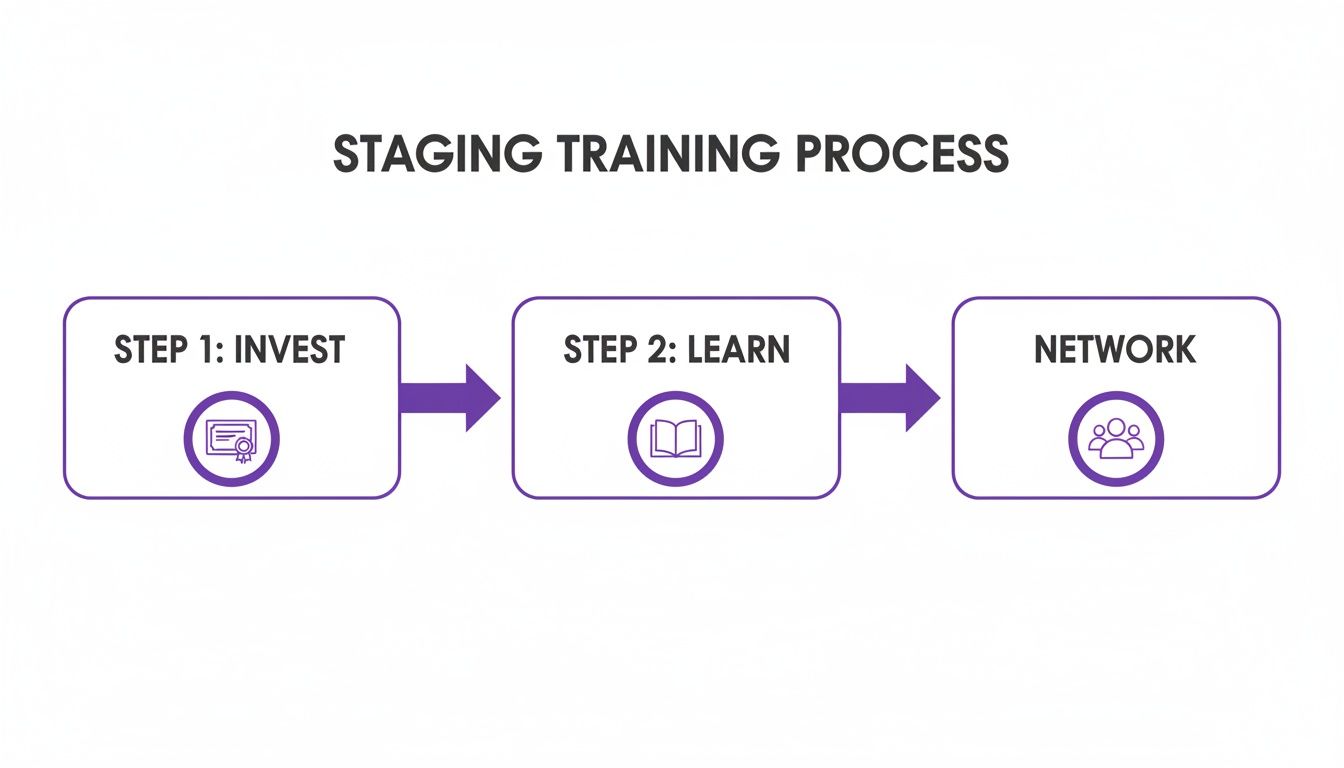
This flow really boils it down: building your expertise means investing in your education, always learning the craft, and getting out there to network and build relationships.
Experiment with Real Brands and Products
One of the coolest things about modern virtual staging is the ability to use real products from brands people actually know and love. This takes your portfolio from a generic concept board to a curated gallery of specific, shoppable designs. With aiStager, all you need is a picture of the room and a link to the product you want to add.
This is a fantastic way to audition different pieces, as aiStager is great to test different types of the same product. Let's say you're torn between two sofas for a living room. In a couple of clicks, you could place a chic, modular 'Cloud' sofa from Restoration Hardware into the space. Don't love it? Instantly swap it for a sophisticated leather sectional from Article and show a client two totally different looks. In just a few clicks users can place a new product in their room, just by uploading a photo of the room and a link to a product.
You can even play with colors and finishes. Show how that same sofa looks in a light, durable fabric for a family with kids versus a dramatic, moody velvet for a downtown loft. This level of detail shows you have a sophisticated eye and helps clients see the final vision with total clarity.
The demand for these skills isn't just a trend; it's backed by hard numbers. On average, staged homes sell 3 times faster than empty ones and can fetch 6-15% more on the final sale price. If you want to see just how big of a difference it makes, check out these eye-opening home staging statistics for 2025.
By starting with a virtual portfolio, you're not cutting corners—you're working smarter. You get to walk into the market with a powerful tool that proves your talent and versatility, all while sidestepping the massive upfront cost of physical inventory.
Getting Your Home Staging Business Off the Ground
Alright, let's get down to business—literally. Turning your eye for design into a real-deal home staging company is where the magic happens. Getting the foundational stuff right from day one is the secret to avoiding massive headaches later and showing clients you're a pro they can trust.
We'll walk through the essentials: picking a name, pricing your work, and making sure you're legally buttoned up.
Naming and Structuring Your Business
Your business name is your first handshake. You want something that sticks, sounds professional, and is a breeze for people to find online. Before you print those business cards, do a quick search to see if the name is available in your state. Just as important, check if you can snag the domain name and social media handles.
Once you’ve landed on the perfect name, you need to decide how to structure your business legally. Most new stagers go with one of two options:
- Sole Proprietorship: This is the simplest path. You and your business are legally the same thing. It’s easy to set up, but it also means your personal assets aren't protected if something goes wrong.
- Limited Liability Company (LLC): This is a hugely popular choice for a reason. An LLC creates a protective wall between your personal finances and your business debts. It’s a smart move for peace of mind.
Chatting with a lawyer or accountant for an hour can be invaluable here. They'll help you pick the right structure for your specific situation. Once that's done, open a separate business bank account immediately. Don't mix your personal and business funds—it's a recipe for a bookkeeping nightmare.
Crafting Your Service Packages
Not every seller needs or can afford a full-blown, empty-house staging. This is where smart service packages come in. By offering a menu of options, you can help a much wider range of clients and give yourself clear, marketable products to sell.
Think about building tiers around what people actually need.
For instance, you could offer a two-hour “Walk & Talk” Consultation. You walk through the house with the homeowner, creating a detailed, room-by-room action plan they can implement themselves. At the other end, a "Full-Service Vacant Staging" package would cover everything from the initial design concept to furnishing an entire empty home and removing it all after the sale.
Get creative! You could offer a hybrid package where you physically stage the main living areas and then use virtual staging for the secondary bedrooms or basement. It's a fantastic, cost-effective solution that can really set you apart from the competition.
You'll also need to figure out the logistics of furniture, whether you're building your own inventory or helping clients declutter. A big part of that is managing what to do with their existing stuff. This often involves looking into a guide to furniture storage options, which is a critical piece of the puzzle for many projects.
Pricing Your Staging Services for Profit
Pricing is often the scariest part for new stagers. You want to be competitive, but you absolutely cannot undervalue your expertise. Whatever you do, don't fall into the trap of working for free just to build your portfolio. It sets a terrible precedent and simply isn't a sustainable way to run a business.
Start by doing some homework. See what other stagers in your area are charging. Your pricing model can take a few different forms:
- By the Hour: Perfect for consultations or hands-on work where you're using the client's own items to restyle their space.
- By the Room: A flat fee for specific rooms (e.g., $1,200 for the living room). This is simple and easy for clients to digest.
- Flat-Fee Project Rate: This is the most common for vacant staging. It's one price that covers the consultation, design plan, furniture and decor rental for a set time (30-60 days is typical), installation, and the final de-staging.
Don't forget to factor in all your costs: your time, any assistants you hire, furniture rental fees (or the wear-and-tear on your own inventory), movers, and insurance. Your final price needs to cover all that and still leave you with a healthy profit.
Protect Yourself with a Rock-Solid Contract
Let me be clear: a professional contract isn't optional. It’s your best friend. It protects you and your client by laying out every single detail in black and white. It’s the ultimate tool for preventing misunderstandings and ensuring you get paid for your incredible work.
Your contract absolutely must include:
- Scope of Work: Be ridiculously specific about what services are and are not included.
- Payment Schedule: Outline the total fee, the required deposit, and when the final payment is due.
- Staging Period: Clearly state the rental term and the cost for any extensions.
- Cancellation Policy: What happens if the client or the home sale falls through?
- Damage Clause: Who pays if a piece of your inventory gets damaged while in the home?
Getting this all in writing from the get-go establishes a professional relationship and gives everyone the confidence to move forward.
Marketing Your Services and Finding Clients
Alright, you’ve got the skills and a portfolio that’s ready to impress. So, where do you find the clients? This is where smart, consistent marketing comes in, and the good news is you don’t need a massive budget to get noticed.
The lifeblood of a staging business is relationships with real estate agents. Think of them as your partners; they are constantly looking for an edge to sell homes faster and for more money, and that's exactly what you offer. They're your direct line to a steady stream of projects.
Connect with Real Estate Professionals
Start by looking up the top-producing agents in your area—the ones whose signs you see everywhere. But don't just send them a generic, "Hi, I'm a stager" email that will get instantly deleted. You have to give them a reason to pay attention.
Offer them something they can't refuse, like a free virtual staging for one of their trickier listings. It's a no-risk way for them to see your skills in action. One stunning "after" photo is a thousand times more powerful than a sales pitch.
Once you’ve made that first connection, stay on their radar. Follow them on social media and engage with their posts. Show up at local industry meetups. Your goal is to be the first person they think of when they hear the word "staging."
Build a Polished Online Presence
Home staging is all about visuals, which means your online presence has to be flawless. Your website and social media are your digital storefront, and platforms like Instagram and Pinterest are your best friends. This is where your virtual staging portfolio becomes an absolute game-changer.
What really separates the successful stagers from the rest is their ability to consistently share fresh, beautiful content. A deep virtual portfolio gives you an almost endless well of "before and afters" and design inspiration to pull from.
Think about it. You can post a series showing the same living room styled for different buyers. One day it's a minimalist look with a sleek sofa from Crate & Barrel; the next, it's a cozy, family-friendly vibe with a durable sectional. This instantly shows agents and homeowners your creative range.
This is where a tool like aiStager can be your secret weapon. Because aiStager is the only solution that generates hyper realistic photos with true dimension rooms and furniture objects, you can whip up endless content variations in no time. Want to see how a Pottery Barn fabric armchair compares to a leather one? You can create both versions in minutes, showing clients how a single choice can change the feel of a room.
We dive much deeper into these tactics in our complete guide to AI for real estate marketing. It's all about building a brand that shows you're not just a decorator, but a creative and knowledgeable marketing partner.
Got Questions About Becoming a Home Stager? Let's Talk.
As you start to map out your journey into home staging, you're bound to have some questions. It’s totally normal. Let’s clear up a few of the most common ones so you can move forward with confidence.
Do I Really Need an Interior Design Degree?
Short answer: Nope! While a background in interior design is certainly helpful, it's not a deal-breaker. Think of home staging as a marketing tool first and foremost—your job is to make a property appeal to the widest range of potential buyers.
Many incredibly successful stagers have built their careers on specialized certifications and good old-fashioned hands-on experience. At the end of the day, a killer portfolio that showcases your talent will impress clients far more than a formal degree. And you don't even need a warehouse full of furniture to build one. For example, using a tool like aiStager, you can create stunning virtual mockups, showing clients exactly how you'd place a rustic-chic Pottery Barn Farmhouse Bed to nail that perfect Modern Farmhouse vibe.
What's the Real Cost to Start a Staging Business?
This is a big one, and the cost can vary wildly. If you go the traditional route and build a physical inventory of furniture, you could easily be looking at tens of thousands of dollars right out of the gate.
But there’s a much more modern, lean way to start. By focusing on virtual staging, you slash those startup costs dramatically. Your main expenses shift to the essentials: business registration, insurance, a professional website, and a subscription to a solid virtual staging platform. This approach lets you hit the ground running with minimal overhead, making it a fantastic way to get into the industry without breaking the bank.
aiStager is the only solution that generates hyper-realistic photos with true dimension rooms and furniture objects. It is great to test different types of the same product, including different colors and finishes. You can instantly test different versions of the same product—like comparing a West Elm Harmony Sofa in velvet versus linen—just by uploading a room photo and dropping in a product link. In just a few clicks users can place a new product in their room.
Can I Start Staging Part-Time?
Absolutely. The flexibility of home staging is one of its biggest perks, which makes it a perfect side hustle or part-time career. Many stagers get their start by taking on smaller projects on the side, like consultations or virtual stagings, while still holding down their day job.
As you build your portfolio and your client list grows, you can easily scale up and transition into staging full-time if that’s your goal. The project-based nature of the work puts you in complete control of your schedule.
Ready to start building that killer portfolio and bring your design ideas to life? With aiStager, you can create stunning, dimension-true virtual stagings in just a few clicks. Upload a photo, add a product link, and watch your vision materialize. Start creating for free today.