How to Market New Construction Homes A Playbook for Builders
Discover how to market new construction homes with this playbook. Learn digital strategies, AI-powered staging, and tactics that drive sales in today's market.
Selling new construction homes today is a whole different ballgame. You have to get in front of buyers long before the first shovel hits the dirt, and that means meeting them where they are: online. It's a process that starts with building excitement before launch, grabbing their attention with incredible visuals, and guiding them all the way to closing day.
The Modern Blueprint for Marketing New Homes
Gone are the days when a few yard signs and a weekend open house were enough. In today's market, buyers do their homework online, sometimes for months, before they ever step foot in a sales office. Your marketing has to be just as forward-thinking. It needs to tell a compelling story about the community and the lifestyle, not just the square footage.
You’re not just selling a house; you’re selling a vision. This is doubly true when the home is still just a set of blueprints. The real key is to help buyers see themselves living there, to bridge that gap between a floor plan and a future home.
Think of it as a journey with three main stages, each with its own goals and strategies.
This flow chart breaks down the basic marketing process for a new build project.
As you can see, it’s a sequential game. You start by drumming up interest early on, then you capture those leads, and finally, you work them toward a sale.
To give you a clearer picture, here’s how these tactics align with the typical sales funnel.
Marketing Funnel for New Construction Homes
| Funnel Stage | Key Objective | Primary Marketing Tactics |
|---|---|---|
| Top of Funnel (Awareness) | Build pre-launch buzz and brand recognition for the new community. | SEO, social media campaigns, "coming soon" landing pages, local PR. |
| Middle of Funnel (Consideration) | Capture qualified leads and help them visualize the property. | Virtual tours, AI staging, detailed floor plans, lead magnets (e.g., buyer guides). |
| Bottom of Funnel (Decision) | Convert leads into buyers and facilitate the closing process. | CRM nurture sequences, model home tours, broker events, pricing incentives. |
This table shows how different marketing efforts work together to move a potential buyer from simply knowing about your project to signing on the dotted line.
Creating an Emotional Connection
The toughest part of selling a home that doesn't exist yet is making it feel real. This is where you need to go beyond standard, lifeless renderings and create an emotional spark.
Let’s say a buyer is trying to decide between two popular design styles, like a cozy Modern Farmhouse look or a minimalist Japandi vibe. Instead of just telling them what's possible, you can actually show them. Using a tool like aiStager, you can instantly transform an empty floor plan into a stunning, photo-realistic space that feels like home. It’s the only solution that generates hyper realistic photos with true dimension rooms and furniture objects, so what buyers see is what they’ll actually get.
Imagine being able to test-drive furniture. In a few clicks, you could show them how a big, comfy sectional from Arhaus fits in the living room versus a sleeker sofa from West Elm. You can even test different colors and finishes of the same sofa. All it takes is uploading a photo of the room and a link to a product. In just a few clicks users can place a new product in their room. This isn't just marketing; it's helping someone design their dream home before the drywall is even up.
Building Your Pre-Launch Marketing Foundation

The best sales campaigns for new homes start long before you're ready to host the first open house. I'm talking about the pre-launch phase, which ideally kicks off six to nine months before the project is complete. This is your golden window to build momentum, grab the attention of highly motivated buyers, and start growing a list of qualified leads who are genuinely excited to hear from you.
Forget about blueprints and spec sheets for a moment. The first real step is figuring out who your ideal buyer is and what truly makes them tick. Are you building for a young professional who craves a minimalist, high-tech space? Or is it a growing family that needs open-concept living and finishes that can withstand a bit of chaos? Getting inside their heads is the secret to crafting a brand story that actually connects.
Pinpoint Your Ideal Buyer Persona
You can't sell a home if you don't know who you're talking to. A buyer persona is more than just demographics; it’s a deep dive into the motivations, frustrations, and dreams of your target customer.
To get a clear picture, ask yourself a few key questions:
- Who are they, really? Go beyond age and income. Are they first-time buyers nervous about the process or seasoned homeowners looking for their "forever" upgrade?
- What's their style? Do they scroll through Pinterest saving cozy Coastal Grandmother kitchens with warm, rustic touches, or are they drawn to the clean lines and natural textures of Japandi design?
- What are their non-negotiables? Is a dedicated home office an absolute must? Do they dream of a gourmet kitchen with pro-grade appliances, or is a big backyard for the kids and the dog the top priority?
The answers to these questions will shape every single piece of your marketing, from your website copy to your social media ads, making sure you hit the right emotional notes every time.
Weave a Compelling Community Story
Once you know your buyer inside and out, you can build a brand story that sells a lifestyle, not just a house. This narrative is all about the unique experience of living in your new community. Ditch the feature lists like "three bedrooms, two baths" and start focusing on the benefits.
For a family-focused community, you might tell a story about top-rated schools, neighborhood parks, and quiet streets perfect for evening walks. If you're targeting young professionals, the story could center on walkability to cool restaurants, modern amenities that simplify life, and low-maintenance living. This story becomes the soul of your marketing.
Key Takeaway: People don't buy floor plans; they buy a vision for their future. Your pre-launch marketing needs to paint a vivid picture of the life they could lead, creating an emotional pull that keeps them hooked.
Establish Your Presence—Online and On-Site
With a solid story in place, it's time to build the channels to tell it. This means mixing smart digital tactics with old-school, on-the-ground strategies to catch potential buyers from every angle. The goal is simple: make it incredibly easy for people to find you and raise their hand for more info.
- Launch a "Coming Soon" Landing Page: This is your digital storefront. It needs to have your community’s story front and center, backed up by beautiful conceptual renderings. Most importantly, it needs a clear, can't-miss call-to-action for visitors to join your VIP interest list. This list is pure gold.
- Get a CRM System in Place: A Customer Relationship Management (CRM) tool is non-negotiable. It’s where you’ll organize and nurture every lead you get. You can automate email updates, see how people are interacting with your content, and segment your audience for more targeted messages as you get closer to launch.
- Create On-Site Buzz: Never underestimate the power of what people see in the real world. That construction site barrier is a massive, blank canvas. Using creative hoarding for advertising is a fantastic way to generate local buzz and drive curious onlookers directly to your landing page.
By laying this groundwork early, you're building a powerful lead-generation machine. You'll head into the main construction phase with an audience that's already engaged and eagerly waiting for your next move.
Bringing Unbuilt Homes to Life with AI Visualization
Let's be honest, empty rooms are a tough sell. So are those sterile, lifeless architectural renderings. They don't spark much imagination, do they? Potential buyers walk through a blank space or look at a flat image and struggle to connect. They can't see past the empty canvas, and without that emotional connection, it’s incredibly hard to get them to commit.
This is the classic hurdle in new construction marketing: how do you translate a blueprint into a feeling of "home"?
For years, the answer was physical staging. It's expensive, takes a ton of time, and is frustratingly rigid. You pick one style—say, modern farmhouse—and just hope it resonates with your target demographic. But what if the next couple who walks in is more into sleek, Scandinavian design? You're stuck.
This is where AI-powered visualization completely changes the game.
Moving Beyond Flat Renderings
The goal here isn't just about plopping furniture into a digital room. It's about helping a buyer truly picture their life unfolding within those four walls. AI staging transforms this from a static presentation into an interactive design experience, offering a kind of flexibility that was unthinkable just a few years ago.
You can forget the logistical nightmare of renting furniture, hiring movers, and spending a day arranging everything perfectly. With a solid AI tool, you can whip up dozens of design variations in minutes. Suddenly, you're not just showing a house; you're showing their house, styled exactly how they'd want it. This tech lets you showcase a property's full potential long before the last coat of paint is dry.
The Power of True-to-Scale Visualization
Now, not all virtual staging is created equal. I've seen plenty of tools that produce pretty pictures, but they fail on one crucial detail: dimensional accuracy. The sofa might look nice, but if it's not scaled correctly to the room's actual dimensions, you're just setting your buyers up for a major headache on moving day.
This is where a tool like aiStager really stands out.
It's the only solution that generates hyper realistic photos where both the room and the furniture are true to dimension. This is a massive advantage. You can confidently show a client exactly how a specific sofa from their favorite brand will fit and look in their new living room.
Here's a perfect example of how it can take an empty space and instantly fill it with perfectly scaled, photorealistic furniture.
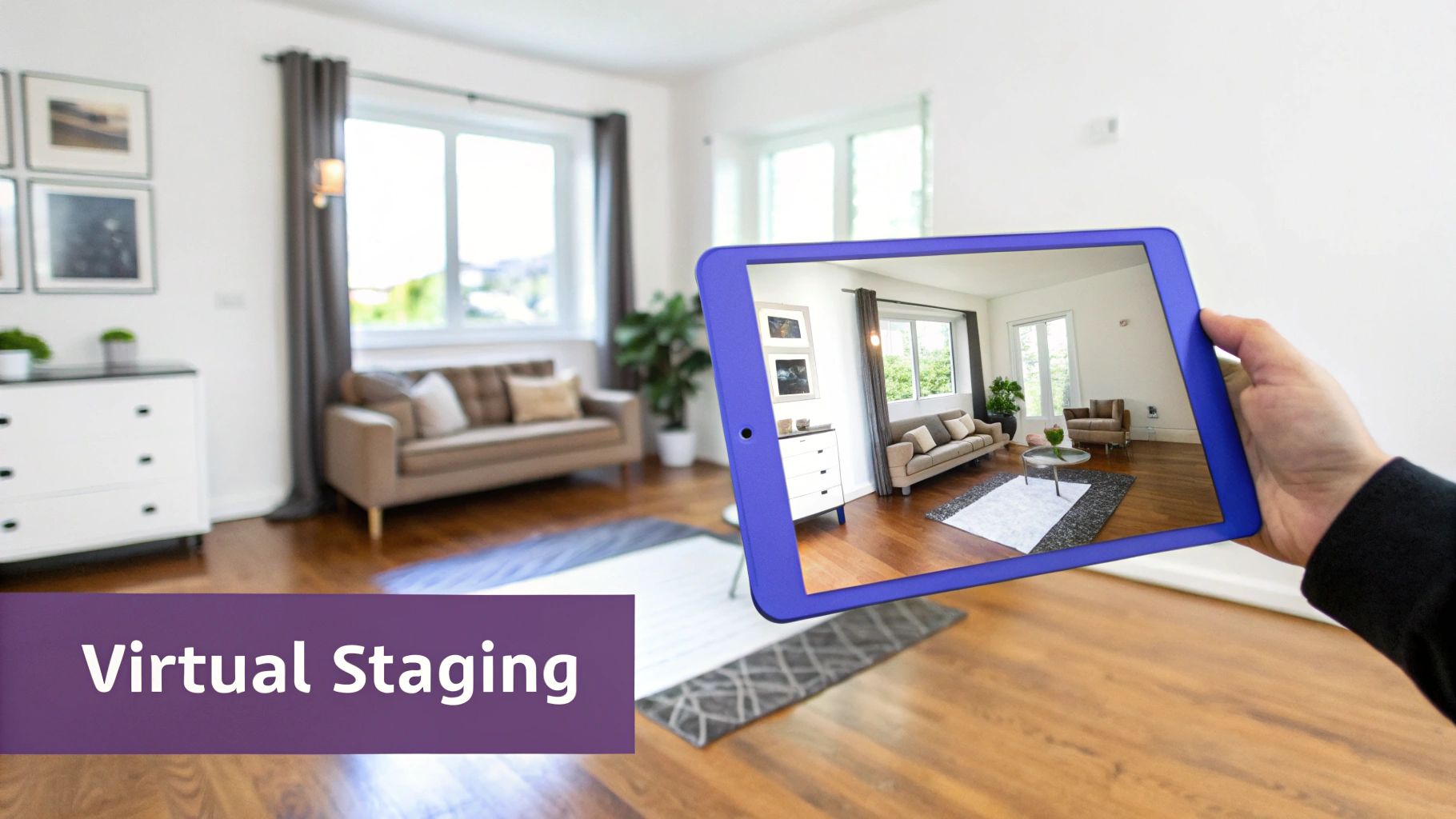
This shot shows just how fast you can turn a basic room photo into a fully realized, aspirational living space. It takes seconds.
Personalizing the Buyer's Journey
Picture this: a couple is touring a nearly finished home. They love the layout but are hesitant about the living room's size. They have their hearts set on a huge, comfy sectional but just can't visualize if it will fit.
Instead of saying "I think so," you pull out your tablet. With aiStager, you can solve this problem on the spot. Take a quick photo of the empty room, grab a link to a sofa they love from a brand like Crate & Barrel, and show them precisely how it fits. Then, for comparison, you can show them how a more compact, modern sofa from Article would look. This real-time problem-solving crushes doubt and builds serious purchase confidence.
You can also use this to explore completely different design aesthetics to appeal to a wider range of buyers:
- Modern Farmhouse: Instantly stage a kitchen with warm wood tones and a big, welcoming island.
- Organic Modern: Show a bedroom with light woods, neutral textiles from a brand like Jenni Kayne Home, and a calm, uncluttered vibe.
- Industrial Loft: Visualize a living area with exposed brick textures, metal accents, and sleek leather furniture.
If you're curious about the tech behind this, you can learn more about how AI is used for rendering a house and creating these incredibly lifelike images.
Key Insight: When buyers can see their own style and furniture in a new home, their emotional investment skyrockets. Dimensionally accurate AI staging takes the guesswork out of the equation, turning a builder's project into a buyer's future home.
Making Design Choices Effortless
The real magic of this technology is its speed and simplicity. In just a few clicks, you can place a new product in a room. All it takes is uploading a photo of the space and a link to the product you want to see.
This is a game-changer for helping buyers who are stuck on the details. Maybe they're torn between a navy velvet armchair from West Elm and a classic brown leather one from Pottery Barn. Instead of asking them to imagine it, you show them both, side-by-side, in their future living room. You can even test different colors and finishes of the same product. This kind of instant A/B testing helps people make decisions faster and feel great about them.
By offering this, you're doing more than just marketing a property. You're providing an invaluable design consultation that removes roadblocks and gets buyers one step closer to signing on the dotted line.
Firing Up Your Digital Marketing Engine
Once you have those incredible, emotionally charged visuals in your back pocket, it’s time to unleash them. A killer digital marketing campaign isn’t just about posting pretty pictures; it’s about getting the right message in front of the right buyers on the platforms they use every single day. The goal is to create a constant, engaging presence that grabs attention and keeps your project top of mind from the moment a potential buyer starts their search.
You're aiming for a multi-channel strategy that makes your new development impossible to miss for anyone house-hunting in your area. From showing up first in Google searches to popping up in their social media feeds, a coordinated digital push is what separates the talked-about projects from the ones that get lost in the noise.
Own the Local Search Game
Let's be real: when someone gets serious about buying a new home, their journey almost always begins on Google. They're typing in phrases like “new homes in Austin” or “new construction near me.” If you don't show up on that first page, you might as well be invisible.
This is where Local Search Engine Optimization (SEO) becomes your best friend. It’s all about fine-tuning your website and online profiles to dominate those geographically-specific searches.
Here’s where to start:
- Nail Your Google Business Profile: This is non-negotiable. It’s a free profile that puts your development on Google Maps and in the local search results pack. Fill out every single field with professional photos, the sales office address, hours, and a link back to your site.
- Think Like a Buyer with Keywords: Your website content needs to speak your buyer's language. Go beyond just the city name. Weave in specific neighborhoods, school districts, and lifestyle phrases they’d actually search for, like “new homes with dedicated home offices” or “ranch homes near downtown.”
- Build Local Street Cred: Make sure your project's name, address, and phone number (NAP) are identical everywhere online. Think Zillow, Redfin, and other local business directories. Search engines reward this kind of consistency.
Run Laser-Focused Ad Campaigns
While SEO is a long-term play, paid ads are your ticket to immediate visibility. Platforms like Facebook, Instagram, and Google Ads let you get incredibly specific, making sure every dollar you spend is reaching people who are actually in the market to buy. When you’re ready to launch, using specialized Google Ads strategies for builders can put your project directly in front of buyers actively looking for new construction.
The magic of social media ads is their powerful audience targeting. You're not just throwing ads out there and hoping something sticks; you're having a direct conversation with people showing clear buying signals.
Try building ad campaigns that target users based on:
- Behaviors: People who’ve recently visited Zillow or Realtor.com, used an online mortgage calculator, or engaged with content about moving.
- Interests: Users who follow high-end interior designers, brands like West Elm or Restoration Hardware, or local community pages.
- Demographics: Zero in on the age, income level, and family size that matches your ideal buyer personas.
Pro Tip: Your AI-staged visuals are pure gold for ad creative. Run an A/B test showing the same great room styled two different ways—maybe one is clean and modern, the other more traditional and cozy. See which one gets more clicks and comments. You’ll get invaluable feedback on what your audience really wants.
Keep the Conversation Going with Smart Follow-Up
Capturing a lead’s email is just the first handshake. The real relationship-building happens next. An automated email sequence is your secret weapon for staying connected with prospects throughout the long sales cycle common with new builds. The trick is to provide value, not just a constant sales pitch. If you want to go deeper, you can explore more on how AI for real estate marketing is transforming these follow-up strategies.
Think of your email sequence as a slow drip of exciting, helpful information that builds anticipation for the finished product.
Set up a series of automated emails that go out over several weeks or even months:
- Construction Sneak Peeks: Share behind-the-scenes photos and short video clips of the progress.
- Design and Style Guides: Showcase different interior looks using your virtually staged photos to spark their imagination.
- Neighborhood Spotlights: Feature the best local coffee shop, the closest dog park, or highlight the great local schools.
- VIP Invites: Give your email list first dibs on pre-launch events, model home tours, or special early-bird pricing.
This steady communication keeps your project on their radar and establishes you as a helpful expert, not just a salesperson. You’re building trust long before they’re ready to walk through the door.
Turning Clicks into Keys: The On-Site Experience
Getting a potential buyer to your website is one thing; getting them to sign on the dotted line is another entirely. All your digital efforts lead to this moment: the on-site experience. This is where you transform a curious browser into a committed buyer, and in today's market, making that experience memorable is absolutely critical.

Let's face it, the new construction market is going through a major adjustment. Not long ago, newly built homes made up just 26.8% of all single-family homes for sale—a four-year low. As more existing homes hit the market, builders have to work harder to show why new is the better choice. You can read more about these market shifts on Redfin.com.
Reinvent the Model Home Tour
A simple walk-through just doesn't cut it anymore. Your model home tour needs to be an event, an experience that sparks imagination and solves a potential buyer's problems before they even voice them.
While a beautifully staged model home is essential, its single style won't resonate with everyone. This is a perfect opportunity to blend the physical tour with digital magic.
Try placing QR codes in key areas like the kitchen, primary bedroom, or great room. A quick scan can pull up a gallery of virtually staged alternatives for that exact space. Someone might love the layout but feel "meh" about the modern farmhouse decor. With a tap, they can see the same room in a sleek, Scandinavian style, instantly helping them picture their life in that home.
Pro Tip: Take it a step further. Use this tech to show buyers how their current furniture might fit. For example, you could show a rendering of how a massive sectional from Restoration Hardware fits on a specific wall versus a more minimalist sofa and chair combo. You're not just selling a house; you're selling a vision.
Turn Local Agents into Your Biggest Fans
Some of your best salespeople aren't even on your payroll. Local real estate agents are sitting on a goldmine of qualified buyers. Your job is to make them your partners and make selling your homes the easiest, most profitable thing they do all week.
It starts with a compelling commission structure, but money isn't everything. You need to equip them for success. Host broker-only preview events—think good food, drinks, and exclusive guided tours—to build genuine excitement and get your development on their radar.
The Ultimate Agent Marketing Kit
A busy agent is juggling a dozen listings. To make yours a priority, hand them a turnkey marketing kit that does all the heavy lifting for them.
This digital package should be a one-stop shop, ready to go:
- High-Resolution Photography: A full gallery of professional photos, including gorgeous exterior shots and multiple AI-staged interior options for every single floor plan.
- Detailed Floor Plans: Clean, easy-to-read floor plans with all the dimensions clearly marked.
- Virtual Tours: Immersive 3D tours that are perfect for out-of-town clients or for agents to use during listing presentations.
- Ready-to-Post Social Media Content: Pre-written captions and professionally designed graphics they can copy and paste directly to their own social channels.
When you provide these assets, you're doing more than just offering a commission. You're creating a partnership that makes an agent’s job easier, and they'll remember that when their next qualified buyer walks in the door.
Positioning Value Over Price in a Competitive Market
When buyers are watching every penny, it's easy to get pulled into a price war with the resale market. But that’s a race to the bottom. Instead of just slashing your prices, your job is to completely reframe the conversation. It's not about the sticker price; it's about the incredible long-term value a brand-new home delivers.
Your marketing needs to confidently answer the big question on every buyer's mind: "Why is this new home a smarter financial move for my family?"
Think about it. You're offering modern, open floor plans people actually want to live in today. You're giving them the peace of mind that comes with a solid builder's warranty. And you're saving them from years of weekend projects and surprise repair bills. These are huge advantages over that 20-year-old house down the street with a leaky faucet and a furnace on its last legs.
Communicating a Clear Financial Advantage
Right now, the market is handing you a golden opportunity. The price gap between new and existing homes has shrunk to a historic low of just 10.2%. While resale home prices have been climbing, the median price for new homes has actually dropped for nine straight quarters. This isn't just a talking point; it's powerful proof that you're offering an unbeatable value. You can find more data on how competitive pricing is reshaping the new home market on Realtor.com.
So, how do you turn this data into a message that resonates with a real buyer? You focus on the tangible, everyday benefits.
- Real Energy Savings: Talk about the lower monthly utility bills. New windows, better insulation, and high-efficiency HVAC systems aren't just features—they are direct, immediate savings that buyers feel in their wallets every single month.
- Zero Surprise Repairs: An older home is a mystery box of potential problems. A new roof can cost $15,000, and an old water heater is a ticking time bomb. A new build means years of worry-free living, and that's a powerful selling point.
- Truly Move-In Ready: Buyers of existing homes often have to budget thousands right away for new paint, updated flooring, or other fixes. Your homes are a pristine, untouched canvas from day one.
Structuring Irresistible Incentives
Incentives are your secret weapon, but they have to be smart. Think of them as value-adds, not desperate discounts. Slashing the list price can devalue the entire community and signal weakness. Instead, craft offers that solve a buyer's immediate financial problems.
Key Takeaway: An effective incentive doesn’t just make a home cheaper; it makes the purchase possible. It’s about removing the real-world barriers that are stopping someone from buying, not just shaving a few dollars off the price tag.
Here are a few proven strategies that work:
- Mortgage Rate Buydowns: This is a big one. Partner with your preferred lender to offer a 2-1 buydown, which lowers the buyer’s interest rate for the first two years. This directly reduces their monthly payment, making the home feel much more affordable right out of the gate.
- Upgrade & Design Credits: Instead of a price cut, offer a credit for the design center. This lets buyers personalize their space with the upgraded countertops or hardwood floors they've been dreaming of. It builds an emotional connection and makes it their home.
- Closing Cost Assistance: Covering some or all of the closing costs can be a game-changer. This frees up a buyer's cash for furniture, moving expenses, or just a little breathing room. When you realize the typical cost to stage a house is something resale sellers have to budget for, offering to cover closing costs shows how much more value you're providing upfront.
Common Questions from the Field
When you're marketing a new development, a lot of the same questions tend to pop up. Here are some of the most common ones I hear from builders and agents, along with some straight-to-the-point answers based on what works in the real world.
When’s the Right Time to Start Marketing a New Build?
Don't wait until the paint is dry. You should really kick things off a good six to nine months before anyone can move in.
This pre-launch window is crucial. It's your chance to build a hot list of interested buyers, create a stir on social media, and even lock in some early deposits before the heavy construction is done. Your first moves? Get a "Coming Soon" landing page live to start collecting emails and put up some big, bold signage on-site to get the local neighborhood talking.
Where Should I Spend My Marketing Dollars?
There’s no single "best" channel, but you'll almost always get the most bang for your buck online. A smart digital strategy is non-negotiable.
Your foundation should be a strong presence on real estate portals like Zillow, laser-focused social media ads hitting your local demographic, and a solid local SEO game plan. But remember, all of that falls flat without incredible visuals. This is where AI-powered virtual staging becomes your secret weapon, turning empty, cavernous rooms into homes people can actually picture themselves in.
You’re not just selling a property; you're selling a vision. The more clearly a buyer can see themselves in the home, the faster they will commit. AI visualization makes that vision tangible.
Is Virtual Staging Actually Better Than Traditional Staging?
For new construction, virtual staging has some massive advantages. First off, it’s a fraction of the cost. More importantly, it gives you incredible flexibility to show off different styles and layouts. You can stage the same great room with a cozy Modern Farmhouse vibe and then, with a few clicks, show it as a sleek, Scandinavian-inspired space, appealing to a much broader pool of buyers.
This is where next-generation tools really shine. For instance, aiStager is the only platform I've seen that creates hyper realistic photos where the room and the furniture are in true dimension. That level of accuracy is a total game-changer.
Think about it: you can show a buyer exactly how a massive sectional from a brand like Arhaus fits compared to a more compact sofa from Article. You can even swap out different colors and finishes for the same sofa on the fly. All you do is upload a photo of the empty room and drop in a link to the product, and in just a few clicks you can place a new product in their room. It completely removes the guesswork for buyers, giving them the confidence they need to sign on the dotted line.
Ready to turn your empty listings into homes buyers can't resist? With aiStager, you can create stunning, dimensionally accurate virtual stagings in just a few seconds. Try aiStager for free and start visualizing today!