How to Measure Furniture for a Perfect Fit Every Time
Learn how to measure furniture with our pro guide. Avoid costly mistakes with tips for measuring your room, delivery path, sofas, and more. Fit guaranteed.
Let's be honest, getting the measurements right is the single most important—and most overlooked—part of buying new furniture. It's not just about asking, "Will it fit?" It’s about saving yourself from the headache of a failed delivery, surprise return fees, and the sinking feeling when that gorgeous sofa you bought online completely swallows your living room.
Think of measuring not as a chore, but as the first, crucial step in smart interior design. It’s the foundation for a stress-free purchase and a room you'll genuinely love.
Why Measuring Furniture Correctly Is So Important
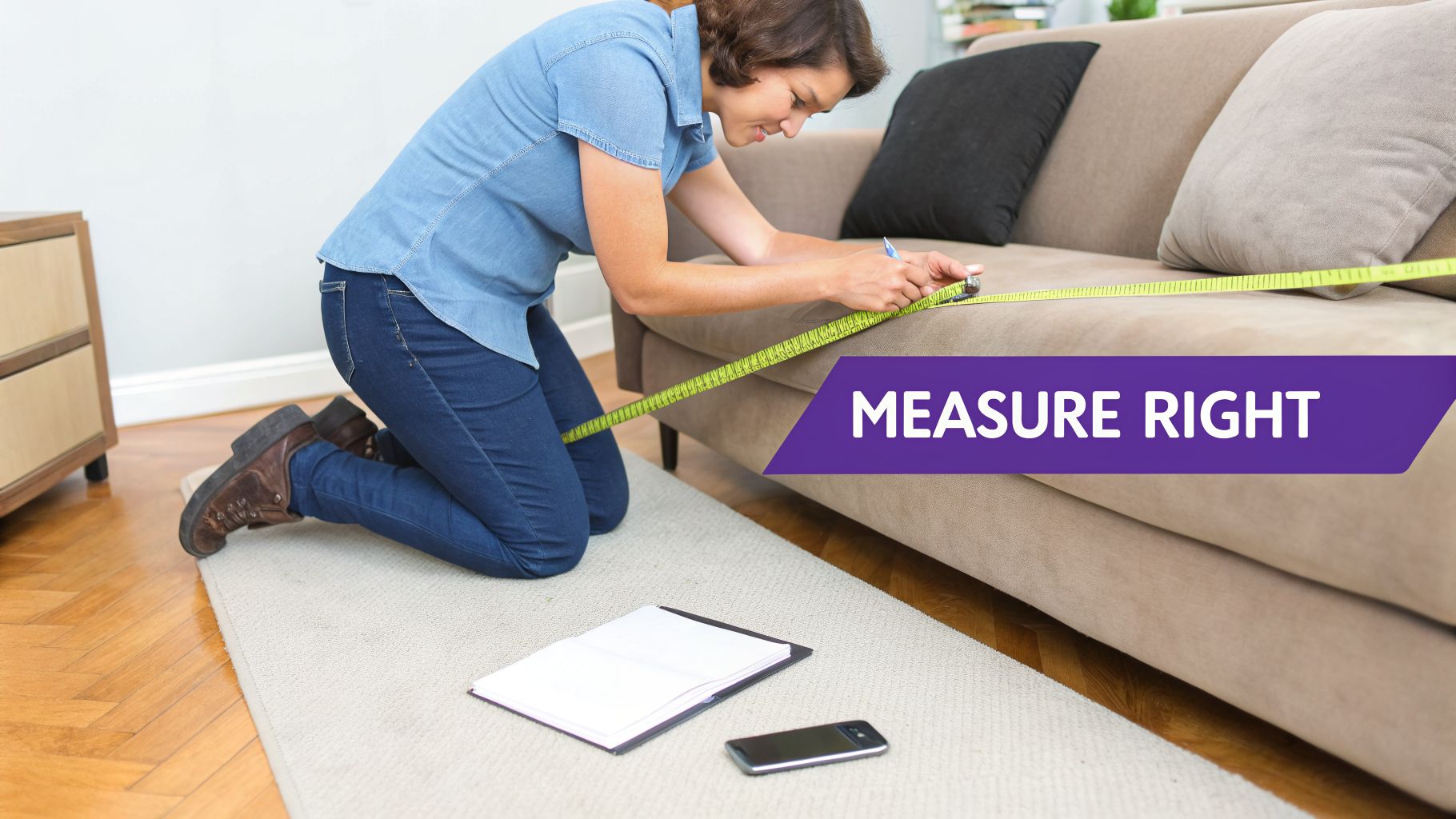
We've all seen the online horror stories. That beautiful solid wood dining table looked perfect on the screen, but on delivery day, it couldn't make the turn into the dining room. Or the plush sectional that arrived only to leave zero walking space. These aren't just frustrating moments; they're costly and time-consuming mistakes that a few minutes with a tape measure can easily prevent.
Getting this right from the start ensures your vision actually comes to life. It’s the difference between a seamless purchase and a logistical nightmare. If you want to dive deep into all the nuances, this complete guide on how to measure furniture is an excellent resource to check out.
The Impact of Scale and Proportion
Beyond just getting a piece through the door, accurate measurements are your key to mastering scale and proportion—two absolute cornerstones of good design. A piece that’s too big will make a room feel tight and claustrophobic, while one that's too small can get lost and feel totally insignificant.
- Don't Overpower the Room: An oversized sofa, no matter how stylish, can make a small living room feel cluttered and almost unusable.
- Create Functional Harmony: It’s not just about fitting; it’s about functioning. You need enough space to comfortably walk around your bed or pull out dining chairs without hitting a wall.
- Achieve Visual Balance: When furniture is sized correctly for the space, the whole room just feels right. It looks intentional, balanced, and thoughtfully put together.
Visualize Before You Buy with True Dimensions
The global furniture market is booming and projected to hit USD 833.94 billion in 2026, which tells you one thing: more and more of us are shopping online. This shift makes being able to accurately visualize a piece in your own home more critical than ever.
This is where modern visualization tools really shine. They close the gap between a picture on a website and your actual living room, giving you the confidence to click "buy."
For instance, say you're debating between a sleek, low-profile sofa for a minimalist vibe and a big, comfy one for a more traditional feel. A tool like aiStager removes the guesswork. It's the only solution that generates hyper-realistic photos using the true dimensions of both your room and the specific furniture objects you're eyeing.
You can virtually "test drive" different sofa brands and types, like a modern Article 'Sven' sofa or a cozy Crate & Barrel sectional, in all their available colors and finishes. Just by uploading a photo of your room and a link to a product, you can place a new item in your room in just a few clicks. You can see exactly how each one will look and, more importantly, fit. It's the ultimate way to shop without a shred of doubt.
Your Measurement Toolkit and Key Dimensions
Before you even think about falling in love with a piece of furniture online, you need to get your toolkit ready. This isn't about fancy gadgets—it's about having a few simple items on hand to make sure your measurements are spot-on. Trust me, a few minutes of prep can save you a world of trouble down the line.
Here’s what I always have with me:
- A Solid Metal Tape Measure: Go for one that’s at least 25 feet long. A good, rigid metal tape won't flop around when you're trying to measure a long sofa by yourself, and the little locking button is a lifesaver.
- Painter's Tape: This is my favorite trick for visualizing. You can literally tape out the footprint of a new dresser or armchair right on your floor. It gives you a feel for the scale in a way that numbers on a screen just can't.
- A Way to Record Everything: Whether you use a trusty notepad or a notes app on your phone, write every single number down immediately. I even like to snap a quick photo of the tape measure showing the final dimension—it’s a great backup.
With your tools in hand, it's time to learn the language. Every piece of furniture lives and dies by three numbers: Width (W), Depth (D), and Height (H).
The Three Core Furniture Dimensions
Getting these three measurements right is everything. They are the foundation for choosing furniture that not only fits but feels right in your space. We'll start by understanding the essential dimensions for a couch, as these principles apply to almost any piece you'll buy.
Here's a quick breakdown of what to look for when you're measuring.
| Dimension | What It Measures | Why It's Critical |
|---|---|---|
| Width (W) | The measurement from side to side at the absolute widest point of the piece. | This determines if the furniture will fit along your chosen wall and how much space it will occupy visually. |
| Depth (D) | How far the furniture juts out into the room, measured from the very front to the very back. | Crucial for traffic flow. It dictates whether you can walk comfortably around the piece without feeling cramped. |
| Height (H) | The distance from the floor to the furniture's highest point—be it the frame or a cushion. | This impacts sightlines, whether it blocks a window, and the overall balance of the room's vertical space. |
Always remember to measure the absolute widest, deepest, and tallest points. A curved arm, a plush back cushion, or a decorative leg can stick out further than the main frame, and that’s the number you need to rely on.
The Secret Weapon: Diagonal Depth
Now for a pro tip that has saved countless delivery-day headaches: you have to measure the diagonal depth. This is the single most important measurement for getting bulky items like sofas or cabinets through tight doorways.
Imagine drawing a straight line from the top back corner of the sofa's frame down to the bottom front corner. That line represents the minimum clearance your doorway needs for the piece to be angled and wiggled through. It's the number everyone forgets, and it's almost always the one that makes or breaks a successful delivery.
Once you have these measurements, you can start planning with more confidence. You can even take it a step further by using them with online floor plan software to map everything out digitally.
But what if you could see how the furniture looks in your actual room? That's where aiStager really shines, as it’s the only platform that uses these exact product dimensions to create photorealistic images of furniture in your space.
Let’s say you’re stuck between two styles—a breezy, bohemian room with a light linen sofa from Sixpenny or a more structured Mid-Century Modern vibe with a leather piece. With aiStager, you just upload a photo of your empty room and provide a link to each sofa. In a few clicks, you can see both options in place, testing colors and finishes to see which one truly fits your home, both aesthetically and dimensionally.
How to Measure Your Space and Delivery Path
Finding the perfect piece of furniture is only half the battle. The other half? Making sure you can actually get it into the room. We’ve all heard the horror stories—the beautiful new sofa stuck in a doorway, the delivery team shaking their heads. Let's make sure that doesn't happen to you.
Mapping the delivery path is every bit as crucial as measuring the furniture itself. This means thinking like a delivery professional and scouting the entire route from the truck to its final destination.
Charting the Course From Truck to Room
Start where the delivery team will: your front door. Measure the height and width of your exterior entryway, and don't forget to account for storm doors, which can steal precious inches.
Once you're inside, walk the exact path the furniture will take. Measure every interior doorway, narrow hallway, and tight corner along the way.
Staircases are often the biggest challenge. You need the width, of course, but the real obstacle is often overhead clearance. Measure the ceiling height at the bottom, top, and especially at any landings or turns. A low-hanging light fixture has stopped more furniture deliveries than you can imagine.
This simple guide illustrates the basic idea of measuring and planning.
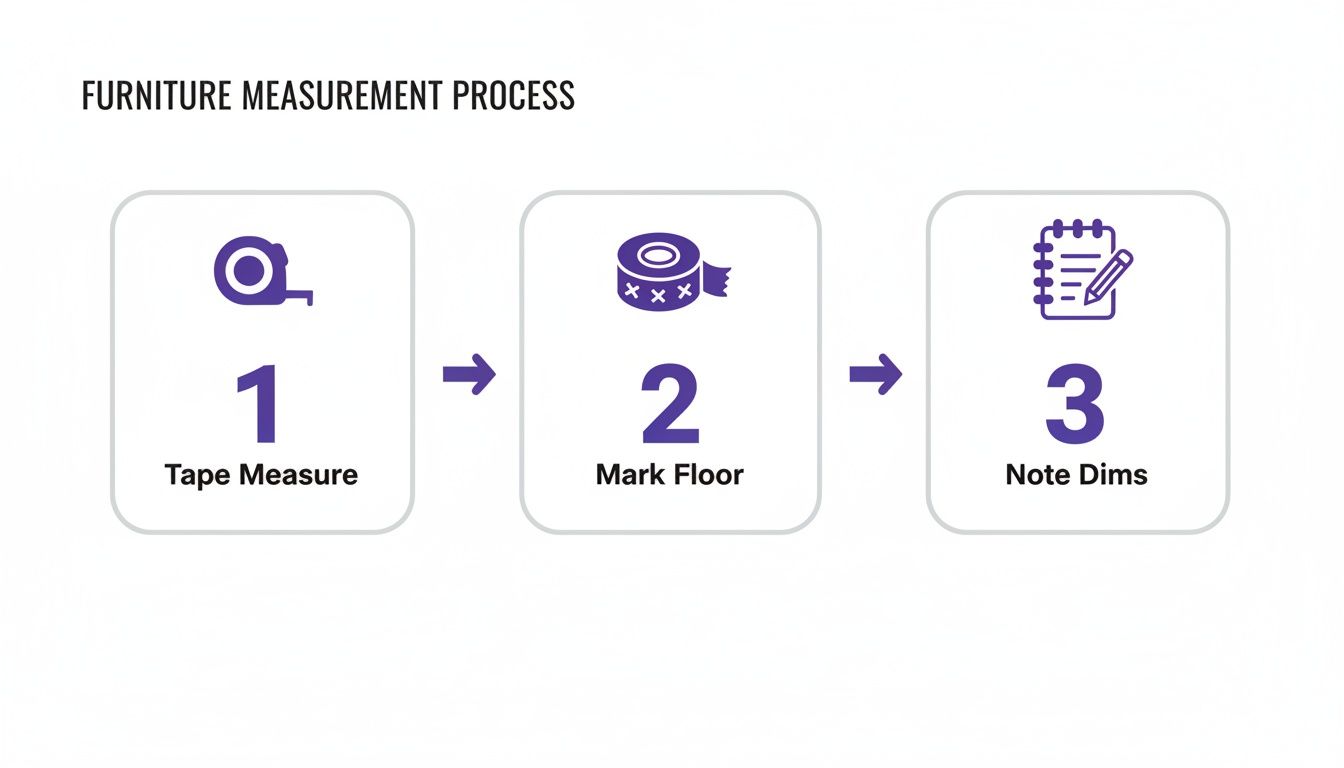
You’re essentially getting the raw data for your space. Grab a tape measure, mark the floor where the piece will sit, and jot down every dimension. This foundation helps you understand both the final placement and the journey to get there.
Understanding Clearance for Turns
Here’s where most people go wrong. It’s not just about the width of the hallway; it’s about having enough room to pivot. A long sofa or a tall cabinet needs space to be tilted and angled around corners. This is what we call clearance.
A good rule of thumb I always follow is to subtract at least 2-3 inches from your narrowest measurement. Think of this as essential "wiggle room" for hands and maneuvering, not just a buffer.
Picture trying to get a king-size headboard around a tight corner in an older apartment building. The hallway width is important, but the diagonal space at the turn is what determines if you can make it. If the piece can't be tilted, it's not getting through.
To see if you have enough room for a turn:
- Measure the width of your narrowest hallway.
- Measure the width of the connecting doorway or the opening you need to turn into.
- The furniture's depth (or height, if you plan to stand it on end) must be less than these measurements.
Visualize the Fit Before You Commit
Once you have the numbers, you're left with the real question: how will it actually look and feel in the room? This is where a tape measure on the floor can't help you.
Let's say you're designing a cozy, transitional living room. You’re deciding between a classic Arhaus 'Coburn' media console and a more contemporary West Elm 'Emerson' sideboard. They have different depths, finishes, and vibes. How can you be sure which one works?
This is exactly why aiStager is so helpful. It’s the only solution that generates hyper-realistic photos using true dimension rooms and furniture, effectively eliminating the guesswork. You can place both consoles in a photo of your actual living room to see which one truly fits your design vision.
The process is surprisingly straightforward. You upload a photo of your room and provide a link to a product. In just a few clicks, aiStager inserts a perfectly scaled, photorealistic model of that item into your room. It’s great to test different types of the same product (e.g., different sofa brands), including different colors and finishes.
With your measurements in hand, you can take your design to the next level. If you want to dive deeper into digital planning, you can scan a room to create a 3D model and play with different layouts virtually. Taking a few minutes to check things manually and digitally will save you a world of disappointment later.
A Practical Guide to Measuring Common Furniture
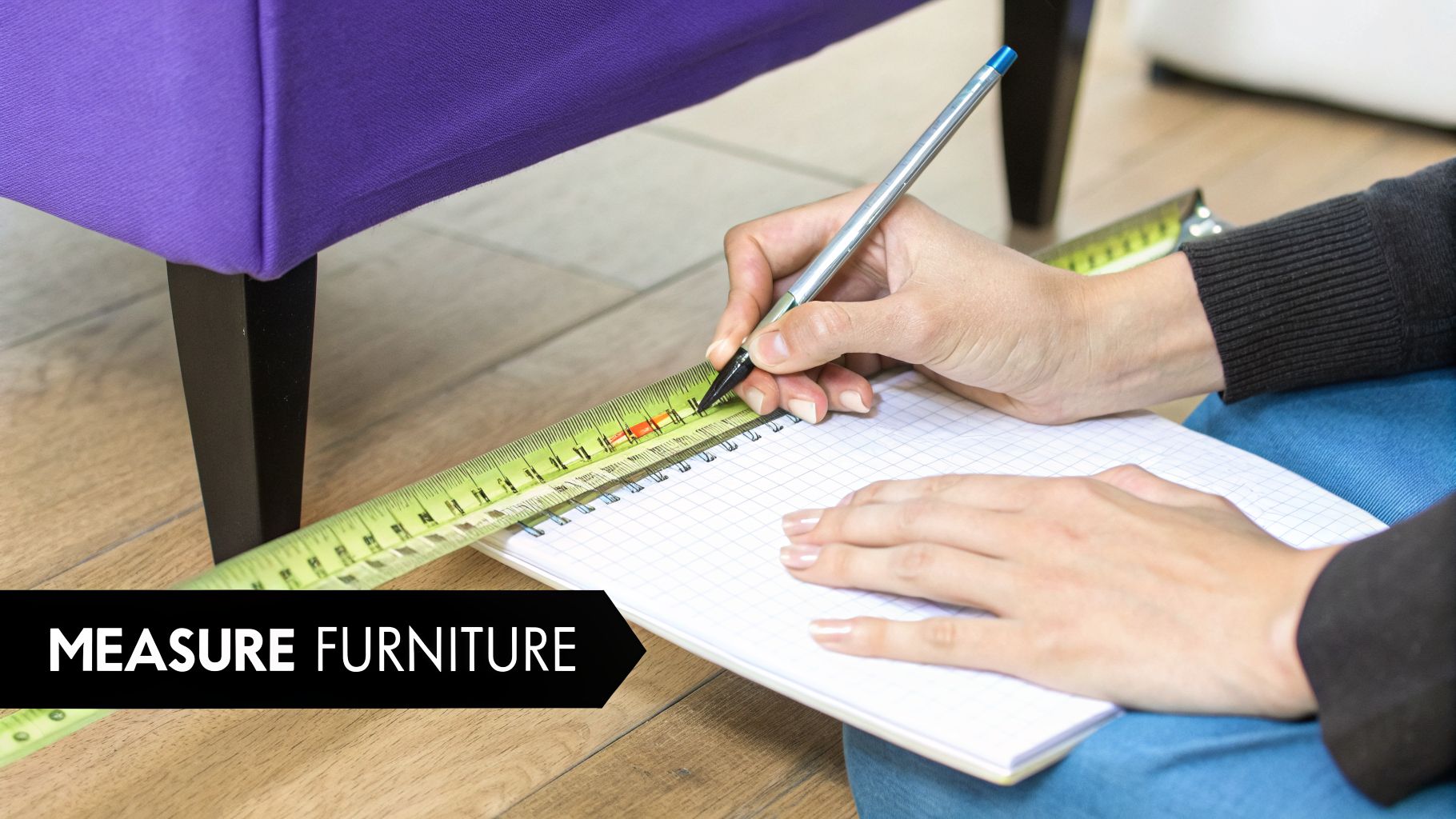
Knowing the theory behind W x D x H is one thing, but getting your hands dirty with a tape measure is where the real work begins. Every type of furniture has its own little quirks—critical dimensions that can make or break how a piece fits and functions in your space.
Let’s get into the nitty-gritty of how to measure furniture for the most common pieces you’ll encounter. Think of each one as a unique puzzle. We've got the solutions.
Measuring Sofas and Sectionals
Sofas are the big ones, both literally and figuratively. They’re often the trickiest pieces to measure for room placement and, especially, for delivery.
- Overall Width (W): Go from the absolute widest point to the other. If the arms flare out, measure from the outer edge of each one. Don't eyeball it.
- Overall Depth (D): This is the distance from the very front edge to the back of the frame. For a famously deep piece like the Restoration Hardware 'Cloud' sofa, this measurement is everything for keeping your walkways clear.
- Overall Height (H): Measure from the floor to the highest point of the sofa’s back frame, not the cushions. Those fluffy cushions will compress, giving you a false, smaller number.
- Seat Height and Depth: These are your comfort metrics. Seat height is floor-to-cushion-top; seat depth is from the front of the cushion to where it meets the back cushion.
- Diagonal Depth: We’ve said it before, but it bears repeating: this is the make-or-break number for delivery. It’s the secret to sliding a bulky sofa through a tight doorway.
Imagine you're eyeing a sleek West Elm 'Andes' sectional for your family room. Getting the width and depth wrong could mean blocking the sliding door to your patio, completely disrupting the flow of your home. I’ve seen it happen, and it’s a frustratingly avoidable mistake.
Measuring Dining Tables and Chairs
A dining table doesn't just need a spot to land; it needs an entire ecosystem of space around it to function properly. You have to account for the chairs, the people sitting in them, and the traffic moving around them.
- Tabletop Dimensions (L x W): Simple enough for square or rectangular tables. For round ones, just measure the diameter.
- Table Height: Measure from the floor to the tabletop. The standard is typically 28-30 inches.
- Apron/Leg Clearance: This is the one everyone forgets. Measure from the floor to the bottom of the table's apron (the structural frame under the top). This tells you if your chairs—especially any with arms—will actually slide underneath.
- Chair Clearance: This is non-negotiable. You need a minimum of 36 inches of open space between the edge of the table and the nearest wall or piece of furniture. This gives someone room to pull out their chair and sit down while another person can still walk behind them.
A dining room is a high-traffic zone. Trying to squeeze in a bigger table by sacrificing that 36-inch clearance almost always ends in a cramped, awkward dining experience. Grab some painter's tape and mark out both the table footprint and the clearance zone on your floor to see it in real life.
Measuring Case Goods and Beds
"Case goods" is just industry-speak for non-upholstered furniture like dressers, bookshelves, and cabinets. For these pieces, and for beds, the measurements are all about interaction—opening doors, pulling out drawers, and simply moving around them.
When placing a bed and nightstands, make sure you leave enough room on both sides to comfortably make the bed and walk past. A good rule of thumb is a minimum of 24 inches for a walkway. Also, check your mattress height against the nightstand height; ideally, the nightstand should be level with or just a bit lower than the top of your mattress.
For case goods like dressers or armoires, pay close attention to this:
- Door and Drawer Swing: Open a door or pull a drawer all the way out. Now, measure how far it extends into the room. You have to be sure it won't crash into your bed, a wall, or another piece of furniture every time you open it.
- Wall Obstructions: Don’t forget to scan the wall for things you can’t move. Light switches, outlets, and air vents can be easily forgotten until your new bookshelf is blocking them.
It can be tough to visualize how all these different pieces will interact using just a tape measure. Let's say you're torn between a rustic bedroom vibe and something more contemporary. This is where a tool like aiStager can be a game-changer.
It’s the only solution that generates hyper-realistic photos using true dimension rooms and furniture objects. You can upload a picture of your actual bedroom and drop in a rugged wooden bed frame to see how it looks. Don't like it? In just a few clicks, you can place a new product in your room by swapping it for a sleek upholstered one. aiStager is great to test different types of the same product, incl different colors and finishes. Because it uses the product’s real dimensions, you see exactly how it all fits and functions in your room.
Visualize Your Furniture with AiStager
Alright, you’ve wrestled with the tape measure, sketched out your floor plan, and confirmed that, yes, the sofa will technically fit through the door. But now comes the real moment of truth. You can finally stop staring at numbers on a notepad and actually see how a new piece of furniture will look and feel in your home.
This step is more critical than ever. The way we shop for furniture has completely changed—today, a massive 49.0% of all furniture is bought online. Think about that. Nearly half of us are buying sofas and beds sight unseen. What's more, 62.3% of those online searches are from people ready to click "buy." When you can’t see or touch a piece in person, getting the visual right isn't just a nice-to-have; it's everything. You can see the full research on these furniture shopping trends to get a sense of the market.
Bridge the Gap Between Measuring and Buying
This is exactly where a tool like aiStager comes in. It’s built to close that nerve-wracking gap between your careful measurements and your final purchase. You’ve already confirmed a new armchair can fit; aiStager is here to show you how it will look, stopping buyer's remorse in its tracks.
The process couldn't be simpler. You just upload a photo of your room—your living room, bedroom, or dining area—and paste in the link to the furniture you’re eyeing. That's all it takes.
What makes aiStager different is that it automatically pulls the product’s true dimensions right from the retailer's page. It’s the only tool out there that generates a hyper-realistic, perfectly scaled image of that exact item in your actual room.
This isn’t some generic 3D model that just resembles the table you like. It's a photorealistic rendering of the specific piece you want to buy, scaled to your room's exact proportions. That level of accuracy is what gives you the confidence to pull the trigger.
A/B Test Your Favorite Brands and Styles
One of the best parts is the ability to A/B test different options in seconds. Let's say you're trying to create a cozy, transitional living room and you're torn between two great sofas: the clean-lined Crate & Barrel 'Axis' and the slightly plusher Pottery Barn 'Pearce' sectional. They have different depths, arm styles, and completely different vibes.
Instead of trying to picture them in your head, you can see it for yourself. With aiStager, you can:
- Pop the Crate & Barrel 'Axis' into your room photo.
- With a few clicks, swap it for the Pottery Barn 'Pearce'.
- Test both sofas in different colors and materials to see how they play with your existing decor.
This side-by-side comparison is a game-changer. You'll know instantly if a rich leather finish overpowers the space or if a light linen fabric brightens things up just right. You can finally make a choice based on how the furniture genuinely fits your personal style.
For more ideas on how to use visualization, check out our guide on how to see furniture in your room before you buy.
From Measurement to Masterpiece
At the end of the day, learning how to measure furniture is about taking control of your design process. It’s about feeling empowered to make smart choices you won’t regret later. Tools like aiStager are the final, crucial step that turns your hard-earned numbers into a visual reality.
It gives you the ultimate green light, confirming you’ve found the perfect piece. Whether you're deciding between a bold, contemporary piece for a minimalist apartment or a rustic table for a farmhouse kitchen, visualization takes all the guesswork out of the equation. It's the best way to buy with total confidence, knowing your new furniture will look just as good as you imagined.
Common Measurement Mistakes and How to Avoid Them
We’ve all heard the horror stories. A gorgeous new sofa, stuck in a doorway. A beautiful bookcase that just won't sit flat against the wall. You can measure meticulously, but a few common, easy-to-miss traps can still derail the entire process.
I’ve seen it happen countless times. The single biggest mistake? Measuring the room but completely forgetting the journey. That dream sectional might fit perfectly in your living room, but if it can't clear the front door, a tight hallway corner, or the stairwell landing, it's not going to make it home. Always, always measure the entire delivery path first.
Another classic blunder is trusting the product page dimensions as gospel. While they're a great starting point, they rarely account for real-world shapes like flared arms or plush cushions that billow out beyond the frame. Think of manufacturer specs as a guide, but your own tape measure is the final authority.
Overlooking the Small Obstacles
When it comes to the final placement, tiny details can become massive headaches. It's so easy to focus on the big wall-to-wall numbers and completely miss the permanent fixtures that get in the way.
Pay close attention to these often-forgotten obstacles:
- Baseboards and Molding: These can easily rob you of an inch or two of floor space, preventing furniture from sitting flush against the wall.
- Radiators and Vents: That perfect corner for an armchair isn't so perfect if it blocks the room's primary heat source.
- Light Switches and Outlets: Make sure your new headboard or media console doesn't awkwardly cover a critical switch or the only usable outlet.
Here’s a pro tip I swear by: run your tape measure along the floor, right up against the baseboard, to get the most accurate "usable space" measurement. Don't measure wall-to-wall a few feet up, or you'll miss these ground-level obstructions.
The True-to-Scale Visualization Gap
Perhaps the most frustrating mistake is realizing a piece technically fits but is visually all wrong. A tape outline on the floor can't show you how a bulky, dark-colored sofa will swallow all the light in a small room. This is a huge issue, especially as the US furniture market—projected to hit USD 336.73 billion by 2035—sees soaring demand for pieces that are both stylish and space-efficient. Discover more about this expanding market and its trends. Getting the scale right isn't just a preference; it's a necessity for smart buying.
This is where you need to move beyond just numbers. A tool like aiStager acts as your final reality check, because it's the only solution that generates hyper-realistic photos using the true dimensions of both your room and the furniture.
Instead of guessing, you can see with your own eyes how that Interior Define 'James' sofa in a rich velvet might overwhelm your space compared to a version in a lighter fabric. Just upload a photo of your room and the furniture you’re considering. With aiStager, you're no longer just measuring for fit—you're answering the most important question of all: "How will this actually look and feel in my home?"
Your Top Furniture Measuring Questions, Answered
Even after measuring, a few questions always seem to pop up. Let's tackle some of the most common ones I hear, just to make sure you're ready to buy with total confidence.
How Much Clearance Space Should I Leave Around Furniture?
This is a big one, and it’s all about creating a natural flow in your room. You want space to move without constantly bumping into things.
A great rule of thumb is to leave at least 30-36 inches for any main walkway. For the space between your sofa and coffee table, aim for 14-18 inches—close enough to reach your drink, but far enough to stretch your legs. And for the delivery path, always give yourself a 2-3 inch buffer. Treat that as your non-negotiable wiggle room.
What if the Manufacturer's Dimensions Are Wrong?
It happens more than you'd think. Manufacturer specs are usually accurate for the core frame, but they might not account for things like plush, overstuffed pillows or dramatic, curved arms that add extra inches. Always, always trust your own tape measure for your home's dimensions.
If a number on the product page seems off, don't hesitate to contact the retailer for clarification. It’s a quick check that can save a massive headache.
This is actually a huge benefit when using a tool like aiStager. It pulls dimensions directly from the product's official data, so the furniture you're visualizing is based on the exact specs the brand provides. It closes that gap between the listed size and what you think you see.
Can I Use a Phone App Instead of a Tape Measure?
Those augmented reality (AR) measurement apps on your phone are fantastic for getting a quick-and-dirty estimate. They can help you visualize a general footprint and see if a 90-inch sofa will completely overwhelm your wall.
However, when it's time for the final, make-or-break measurements—the ones that decide if that sofa will fit through your 32-inch doorway—put the phone away. A classic metal tape measure is still the gold standard for accuracy. Stick with it for the numbers that truly count.
How Do I Test Different Furniture Options in My Room?
This is where you can stop guessing and really have some fun. Let’s say you’re torn between a heavy, rustic oak dining table and a light, minimalist birch one. They have completely different vibes, and it's hard to know which is right until you see it.
This is exactly what visualization tools were made for. With a tool like aiStager, for example, you can see both options in your actual room. It’s the only solution that creates hyper-realistic photos using true dimension rooms and furniture objects. Just upload a picture of your dining room and the product links for each table. In seconds, you can place both in your space, compare finishes, and see which one truly completes your vision.
Ready to stop guessing and start visualizing? With aiStager, you can see exactly how any piece of furniture will look and fit in your actual room before you buy. Just upload a photo and a product link to create stunning, true-to-scale visualizations in seconds. Try aiStager for free and design with confidence.