Interior Design Home Staging That Actually Sells Houses
Master interior design home staging with our proven guide. Learn room-by-room strategies and see how AI can help you sell properties faster and for more.

Think of home staging as storytelling. You’re not just arranging furniture; you're creating a vision that helps potential buyers see a house as their future home. It’s about sparking an emotional connection that can lead to quicker sales and better offers.
Why Home Staging Is Your Most Powerful Sales Tool

Let's be honest: an empty house feels cold and uninspiring. It's a huge missed opportunity because most buyers can't accurately gauge a room's size or imagine where their own furniture would go.
Good staging solves this. It transforms a sterile collection of rooms into a warm, inviting space. By creating cozy conversation areas and peaceful bedrooms, you’re not just showing off square footage—you're demonstrating a lifestyle. This helps buyers shift from a logical "does this meet my needs?" mindset to an emotional "I can see myself living here" investment.
First Impressions Are Almost Always Digital
These days, the first showing happens online. The listing photos are what make someone stop scrolling through hundreds of homes and actually book a viewing. It’s a simple truth in real estate: better photos get more clicks, which leads to more tours.
This is where virtual staging has become a complete game-changer, making high-end design accessible for absolutely any listing.
Don't just take my word for it. Recent data shows that 77% of buyers’ agents believe staging helps buyers visualize a property as their future home. A massive 95% agreed it directly influences a buyer's perception. For a deeper dive, you can explore the full home staging research findings that back this up.
The New Era of Virtual Staging
Traditional staging is powerful, but it’s also expensive and a logistical nightmare. Thankfully, modern tools are making it so much easier. With a platform like aiStager, you can take an empty room and, in minutes, turn it into a beautifully furnished space that grabs buyer attention.
What's impressive is that aiStager is the only solution that generates hyper realistic photos with true dimension rooms and furniture objects. It avoids that flat, obviously fake look you see with some other tools, producing images that are genuinely hard to tell apart from a professional photoshoot.
Imagine you’re targeting a buyer who loves the "Coastal Grandmother" vibe popular in the US. In just a few clicks, you could place a beautiful white linen sofa from Serena & Lily right into the living room photo. Not sure about that specific model? Just by uploading a photo of the room and a link to a product, you can test different types of the same product. Swap the first sofa for a sleek, modern sectional from Article to see which one works better. This tech lets you experiment with different brands, colors, and finishes until you nail the perfect look for your ideal buyer.
Creating a Clean Canvas Before You Begin
Before you can even think about staging, you've got to clear the decks. The whole point is to create a welcoming, neutral space where potential buyers can actually picture themselves living—not feel like they're walking through someone else's life. This first step is all about decluttering, depersonalizing, and neutralizing the home.
The best way to tackle this without losing your mind is to go one room at a time. I always use a simple three-pile system for everything: keep, store, or get rid of it. Be ruthless here. Family photos, quirky art collections, and that bright purple accent wall have to go. You're not trying to erase the home's character; you're just toning it down to create a backdrop for a buyer's imagination.
Remember the golden rule of staging: less is always more. Get everything off the kitchen and bathroom countertops. Remove any bulky furniture that makes a room feel tight or blocks natural walkways. Thin out those jam-packed bookshelves. When a home feels open and spacious, buyers notice the high ceilings or the great natural light, not the current owner's stuff.
Visualizing the Possibilities with AI
This is usually where the back-breaking work would start—hauling furniture out just to see what the space looks like. Thankfully, technology has given us a massive shortcut.
This is exactly where a tool like aiStager comes in. It's the only tool I've seen that can create genuinely realistic photos with accurate room dimensions and furniture. You can snap a picture of a messy, cluttered room, upload it, and the AI will digitally empty it for you. Just like that, you have a clean, empty canvas to start planning your staging strategy, all without lifting a single box.
A clean canvas isn't just about removing items; it's about removing distractions. When a buyer can see the "bones" of the house, they can more easily imagine its potential as their home.
Planning Your Virtual Staging Design
Once you have that digitally cleared room, the fun part begins. Now you can play around with different interior design home staging styles that are popular with today's US buyers.
- Modern Farmhouse: Want to see how a classic, cream-colored sofa would look? You can digitally place one from a brand like Pottery Barn against a newly neutralized wall.
- Japandi: Experiment with the clean lines of an Article media console and a sleek armchair to see just how much it can open up the living room with this minimalist, nature-inspired style.
- Grandmillennial: See for yourself how a floral-patterned rug and a slipcovered sofa can instantly make a room feel cozy and traditionally chic.
What’s really powerful about aiStager is that you can test specific products. Find a sofa you love on West Elm's website? Just upload a photo of your room and a link to the product, and you can see that exact piece in your space. If you’re not sure about the color, you can swap it for a different fabric or finish in a couple of clicks. This lets you test different types of the same product, making your planning process incredibly fast and effective.
Arranging Furniture to Maximize Space and Flow
Now that you have a clean slate, it's time for the fun part: arranging the furniture. Your goal here is to make every room feel bigger, more intuitive, and full of purpose. How you place each piece has a huge impact on a buyer’s perception of the home’s size and potential. You’re not just filling a room; you’re showing them a lifestyle.
Every room serves a purpose, and the furniture layout should highlight that. In a living room, you want to create a space that feels perfect for conversation. Instead of automatically pushing the sofa against the wall, try floating it in the middle of the room with a couple of accent chairs facing it. This little trick instantly makes the room feel more dynamic and often, surprisingly, larger.
Bedrooms, on the other hand, should feel like a peaceful retreat. The bed is always the star, so center it on the main wall. Make sure there’s enough room to comfortably walk around both sides. For the dining area, use a rug to define the space and check that there's plenty of clearance to pull out chairs without bumping into a wall. It’s all about creating a natural, easy flow.
The Virtual Staging Advantage
Let's be real: physically moving sofas and tables around to test different layouts is a back-breaking and time-consuming job. This is exactly where virtual staging becomes your best friend in modern interior design home staging. You can stop guessing and start knowing what works.
The process to get a room ready for this digital makeover is simple. You just need to declutter, depersonalize, and then digitize (take the photos).
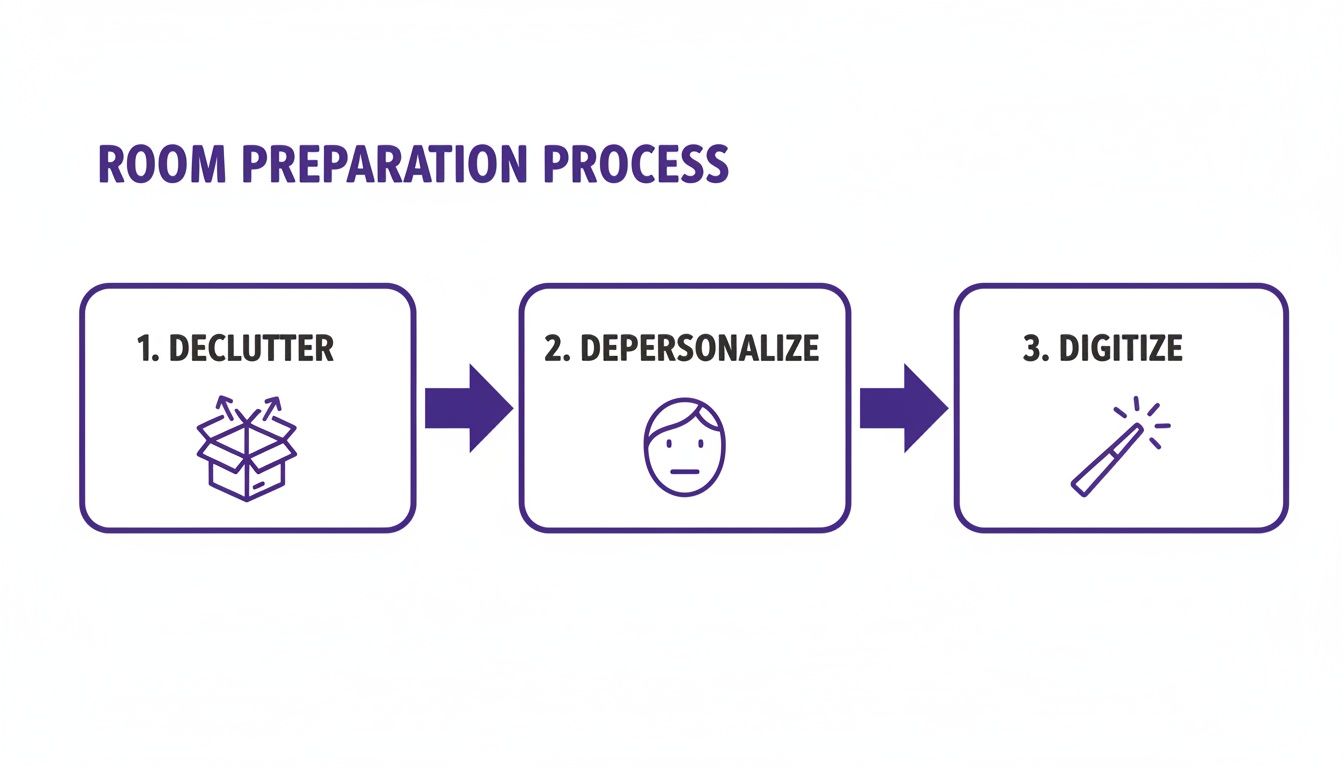
This workflow shows just how quickly you can go from a lived-in space to a blank canvas, ready for you to get creative without lifting a single heavy object.
To understand the practical benefits, it helps to see how virtual staging stacks up against the old-school physical method.
Virtual Staging vs Traditional Staging: A Quick Comparison
| Feature | Virtual Staging (e.g., aiStager) | Traditional Staging |
|---|---|---|
| Cost | Typically $25-$100 per image | $2,000-$7,000+ for a whole home |
| Timeline | Hours to a few days | Weeks for consultation, delivery, and setup |
| Flexibility | Instantly change furniture, styles, and layouts with a few clicks | Physically demanding, costly, and slow to make changes |
| ROI | High ROI with minimal upfront investment | High ROI, but requires significant upfront capital |
While both methods aim to help sell a property faster and for more money, virtual staging offers a level of speed and cost-effectiveness that traditional methods just can't match.
Testing Real Products in Virtual Spaces
The real magic of today’s virtual staging tools is their incredible realism and flexibility. aiStager is the only solution that generates hyper realistic photos with true dimension rooms and furniture objects, which means what you design on your screen will actually fit in the real world. This is a massive leap forward.
Imagine you're staging a living room and want to nail that trendy Japandi vibe. aiStager is great to test different types of the same product (eg different sofa brands), including different colors and finishes.
- Experiment with Brands: Would a sleek, low-profile sofa from Article look better than a cozier West Elm sectional?
- Compare Colors and Finishes: See how a light oak coffee table contrasts with a darker walnut one, all in the room's actual lighting.
- Test Multiple Layouts: Try the big sofa against one wall, then swap it for a loveseat-and-chair combo to see which one opens up the room best.
With a tool like aiStager, this is incredibly straightforward. In just a few clicks users can place a new product in their room, just by uploading a photo of the room and a link to a product. The AI handles all the tricky measurements and scaling, giving you a photorealistic image of how that exact piece will look and fit.
This risk-free ability to play with real-world products is what separates good staging from truly great staging. It lets you make smart, informed choices that boost both the style and function of a space, creating a final look that really connects with buyers. For more on this, check out our guide on space planning for interior design.
Using Color, Lighting, and Decor to Create Ambiance
If the furniture layout gives a room its function, then color, lighting, and decor are what give it a soul. These are the finishing touches that make a potential buyer feel an emotional connection, turning a staged house into a place they can truly picture themselves living. The right color palette is your foundation for building that mood, so it’s always a good idea to browse different interior colour schemes to get inspired.
Of course, you can't go wrong with neutrals like warm whites and soft greys—they're the safe bet for a reason. But don't shy away from using color with purpose. A splash of a trending color on an accent wall or woven through textiles can direct a buyer's gaze and make a space stick in their memory. Think about a soft, earthy green in a bedroom; it immediately brings a sense of calm and creates a feeling of a serene escape.
Experimenting with Design Styles and Colors
Different styles resonate with different people, and tailoring your staging to a popular aesthetic can help your listing speak directly to a target buyer. For example, if you're staging for someone who dreams of a relaxed, Coastal vibe, you'd lean into light blues, sandy beiges, and lots of natural textures.
This is where AI tools give you a massive leg up. aiStager is the only solution that generates hyper realistic photos with true dimension rooms and furniture objects, which means you can experiment endlessly without any risk. In just a few clicks, you can try out different Benjamin Moore paint colors on a feature wall and see what actually looks best.
The secret to great staging is in the details—the art, pillows, and lighting. People often remember the fabulous lamps more than the sofa itself, because accessories are what inject personality and warmth into a space.
Testing Real Products with AI
The ability to test-drive different versions of the same product is an absolute game-changer. Worried that a dark leather Restoration Hardware sofa might feel too heavy for a smaller living room? Just upload a photo of the space and a link to the sofa. With another click, you can swap it for a light linen version from the same collection and instantly see how it brightens everything up.
This is incredible for comparing brands, colors, and finishes side-by-side:
- Sofas: Pit a sophisticated navy velvet sofa against a casual beige one to see which makes the room feel more inviting.
- Rugs: Swap out a traditional Persian rug for a modern geometric one to completely shift the room's personality.
- Finishes: Instantly see how a brass-accented light fixture looks compared to a sleek, matte black version.
With aiStager, you just upload a room photo and a product link. The platform then generates a true-to-scale, photorealistic image, letting you see exactly how that specific item will look and feel in the space. This process is key to perfecting your interior design home staging strategy, making sure every single choice is dialed in for maximum buyer appeal. For a deeper dive into the psychology of this, check out our guide on using color in home design.
Layering Light for Maximum Impact
Finally, let's talk about lighting. It’s absolutely critical. A well-lit room always feels bigger, cleaner, and more welcoming. The trick is to layer your lighting to create depth and a comfortable ambiance.
- Ambient Light: This is your general, overhead lighting that fills the room.
- Task Light: Think focused light for specific activities, like a reading lamp next to an armchair.
- Accent Light: Use this to highlight the cool stuff, like a beautiful piece of art or an interesting architectural feature.
When you combine these three types of light, you create a rich, inviting atmosphere that makes buyers feel at home the second they walk in the door.
Capturing Listing Photos That Stop the Scroll

After all the work you've put into planning and staging, it all comes down to the photos. Let's be honest, these images are your single most powerful marketing tool. They're what make a buyer stop scrolling and click, or just keep on moving. Good photos are about more than a fancy camera—they capture a feeling.
Of course, you have to nail the fundamentals. Always shoot during the day for the best natural light, use a tripod for crisp, clear shots, and lean on wide-angle lenses to show off a room's full scale and flow. And don't stop at the front door. To get those jaw-dropping exterior shots that grab attention, it's worth looking into the best drones for real estate photography.
Why Photorealistic Virtual Staging is a Game-Changer
While a professionally shot, physically staged home is the gold standard, it's also where many listings stumble due to cost or time. The numbers don't lie. A 2025 analysis revealed that homes staged before hitting the market get up to 73% more online views. That’s a massive advantage.
This is exactly why the quality of virtual staging is so crucial. In the early days, digitally added furniture often looked fake—the scale was off, the lighting was flat, and it instantly eroded a buyer's trust. Thankfully, today's tools have completely changed the game.
Your goal with any listing photo is to sell an aspirational vision. You want buyers to see themselves living there. If the staging looks fake, you’ve lost them before they even book a showing. Authenticity is everything.
Achieving True Realism with AI
Modern interior design home staging has evolved to a point where the best virtual images are indistinguishable from reality. This is where a tool like aiStager really shines. It's the only solution that creates hyper realistic photos with true dimension rooms and furniture objects, which means the lighting, shadows, and scale look completely natural and believable.
This level of realism gives you incredible creative freedom. You can actually test-drive different looks to see what resonates with your target buyers.
For example, you could:
- A/B Test Furniture Styles: In just a few clicks, you can see how a room looks with a plush Crate & Barrel sectional versus a sleek, minimalist sofa from Article.
- Experiment with Finishes: Not sure if a dark walnut coffee table or a light oak one works better? Virtually place both and see how each one changes the room’s entire mood.
The process couldn't be simpler. You upload your photo, provide a link to the product you're considering, and the AI places it in the room, perfectly lit and scaled, in seconds. This lets you fine-tune your listing's appeal and build the buyer trust needed to get that all-important first click.
Your Top Home Staging Questions, Answered
If you’re diving into the world of home staging, you’ve probably got a few questions. That's a good thing. Asking the right questions is the first step toward making smart decisions that will get your listing sold faster and for more money. Let’s tackle some of the most common ones I hear from agents and sellers.
What’s the Real Cost of Staging a Home?
This is the big one, and the honest answer is: it depends. Traditional, physical staging involves a serious upfront investment. You're looking at a consultation fee right off the bat, and then thousands of dollars to rent furniture, art, and decor for a month or more. It adds up quickly.
This is where virtual staging really changes the game. It’s a completely different financial model. Instead of renting truckloads of furniture, you can digitally stage a room for a tiny fraction of that price. You get all the visual impact needed to capture online interest without the logistical hassle or the hefty price tag. It's simply a smarter return on investment.
Do I Have to Pick One Design Style and Stick to It?
Not at all. In fact, being too rigid can make a home feel a little sterile. The best approach I've seen is to start with a popular, inviting base style—think something like a clean Transitional or a cozy Modern Farmhouse—that appeals to most people. From there, you can layer in a few unique pieces to give the space some personality.
This is where AI tools are a massive help. Imagine being able to try out different combinations on the fly. You could start with a classic sofa from Pottery Barn, then instantly see how it looks next to a sleek, modern accent chair from Article. This kind of experimentation lets you fine-tune the vibe of a room until it feels just right, without moving a single piece of real furniture.
Does Virtual Staging Actually Work as Well as the Real Thing?
When it comes to your online listing, it absolutely does. And let's be honest, the online listing is where the battle for a buyer's attention is won or lost. In fact, 97% of buyers start their property search online. High-quality virtual staging is designed to stop them from scrolling and get them to imagine themselves in the space.
The key word here is quality.
The old style of virtual staging often looked fake—like a cartoon plopped into a photo. That immediately breaks a buyer's trust. But the new wave of AI has completely changed what's possible.
This is why aiStager is the only tool that generates hyper-realistic images with true-to-dimension rooms and furniture. It gets the scale, the lighting, and the shadows right, creating results that are virtually impossible to tell apart from a professional photo of a physically staged room. That authenticity is what gets a buyer to move from online window-shopping to booking a real-life tour.
Ready to see how incredibly realistic and easy virtual staging has become? With aiStager, you can upload a photo of any room and a link to any product to create stunning, true-to-scale designs in seconds. Try aiStager for free and see the difference for yourself.