Your Winning Listing Presentation Template for 2026
Build a winning listing presentation template with our guide. Discover how to use data, visuals, and AI to win more sellers in today's market.

Think of your listing presentation template as your secret weapon. It’s the pre-built, customizable playbook you bring to a seller’s home to showcase your strategy, your market knowledge, and—most importantly—your unique value. A solid template means you walk into every meeting polished, prepared, and ready to win the listing.
Why Your Old Presentation Isn't Cutting It Anymore
Let’s be real for a moment. The days of winning over sellers with a stack of comps and a generic marketing plan are long gone. In a market this competitive, sellers aren’t just looking for an agent; they’re looking for a marketing expert. They want to see exactly how you'll make their home shine and connect with the right buyers.
A modern listing presentation template is your chance to prove you're that expert. It's less about dumping data and more about telling a compelling visual story.
Help Sellers See the Final Sale
Imagine sitting at a seller’s kitchen table and showing them not just photos of their home as it is today, but a vision of what it could be. This is where you can really set yourself apart.
Tools like aiStager, for example, let you do just that. It's one thing to talk about decluttering or staging; it's another to actually show them a transformed room in seconds. What makes it unique is the realism—aiStager is the only solution that generates hyper-realistic photos with true dimension rooms and furniture objects. You can take a picture of their empty living room, and in just a few clicks, place a new product in the room just by uploading a photo and a product link.
You’re not just staging; you’re test-driving design concepts. You could show them a cozy, modern farmhouse vibe with furniture from a brand like Restoration Hardware, then instantly switch to a sleek, mid-century modern look to see which one gets them excited. It’s a powerful way to get their buy-in from day one.
The Real-World Impact of Better Visuals
This isn't just about cool tech; it's about getting better results. In a crowded market, standout visuals are what grab a buyer's attention first. The numbers don't lie. Homes that use advanced visuals like professional photography and 3D tours simply sell faster and for more money.
In fact, properties marketed with a 3D virtual tour can sell up to 31% faster and for as much as 9% more than homes without one. That’s a statistic that makes sellers sit up and listen.
By building these modern visual strategies into your presentation, you’re not just talking about your marketing plan—you're demonstrating it. You build confidence and prove your value before the conversation even turns to commission. To see what else is out there, you can explore some of the best AI tools for real estate agents.
Building Your Story, Slide by Slide
A killer listing presentation isn't just a slideshow—it's a story. Every slide should build on the last, smoothly guiding the seller from feeling uncertain to feeling confident that you're the right agent to sell their home.
Think of it less like a rigid sales pitch and more like a strategy session where you're the expert at the head of the table. You're there to listen, diagnose, and present a clear, winning plan.
Core Slides for a Winning Presentation
To make sure your story hits all the right notes, you need a solid structure. I've found that organizing my template around a few key "chapters" or slide groups is the best way to build momentum and trust. Each one has a specific job to do.
Here’s a breakdown of the essential slides you'll want to include in your template. This framework covers all the bases, from making a personal connection to sealing the deal with solid data.
| Slide Purpose | What to Include | Pro Tip |
|---|---|---|
| The Connection | A quick recap of their goals, timeline, and motivations. Show you've been listening from the very first conversation. | Start with "Based on our conversation..." to immediately make it about them, not you. |
| Your Unique Value | Your mission statement, key stats (like your list-to-sale price ratio or average days on market), and a powerful client testimonial. | Don't just list stats. Frame them as benefits. For example, "99% list-to-sale price means I get my clients top dollar." |
| The Marketing Plan | A detailed, multi-channel strategy. Go beyond "MLS and a sign." Show examples of social media campaigns, email blasts, and professional marketing materials. | This is your chance to shine. Include screenshots of past campaigns or mockups of what you'll create for them. |
| The Pricing Strategy | Your Comparative Market Analysis (CMA), presented clearly with maps, charts, and photos. Explain the "why" behind your recommended price. | Walk them through 3-4 key comps, explaining why one is a better comparison than another. This shows deep market knowledge. |
| The Next Steps | A simple, one-page summary of the listing agreement, key dates, and what happens the moment they sign. | Make this a checklist. It simplifies the process and makes signing feel like the natural, easy next step. |
With these core slides in place, you’ve created a logical and persuasive narrative that answers a seller's questions before they even have to ask.
Nailing the Introduction and Your Value
The first few moments are everything. You need to immediately establish that you've heard them. Start by briefly touching on their specific situation and what they hope to achieve. This small step builds huge rapport.
From there, pivot to your value. What makes you the obvious choice?
- Your Mission: Keep it short and client-focused. How do you help people like them?
- Your Track Record: Showcase your best numbers. Stats like your 14-day average days on market or your 102% average sale-to-list price ratio speak volumes.
- Proof from Others: Drop in a glowing quote from a past client that highlights your service or expertise.
This isn’t about being boastful. It's about giving them cold, hard proof that you get results.
Detailing Your Marketing Blueprint
This is where you show them the magic. Don't just say you’ll take "professional photos." That's table stakes. Instead, walk them through the comprehensive marketing engine you've built to get properties maximum exposure.
A huge part of modern marketing is helping buyers see a home's full potential. This is the perfect spot to introduce a tool like aiStager. You can literally take a photo of their living room during the presentation, grab a product link for a new sofa from Crate & Barrel, and instantly show them how it would look in the space—in different colors and finishes. aiStager is great to test different types of the same product, like different sofa brands, to find the perfect fit.
When you can show a seller how their empty guest room could be staged as a perfect home office or a cozy nursery, you're not just selling them on your marketing plan. You're showing them how you'll solve problems for buyers and get the home sold faster.
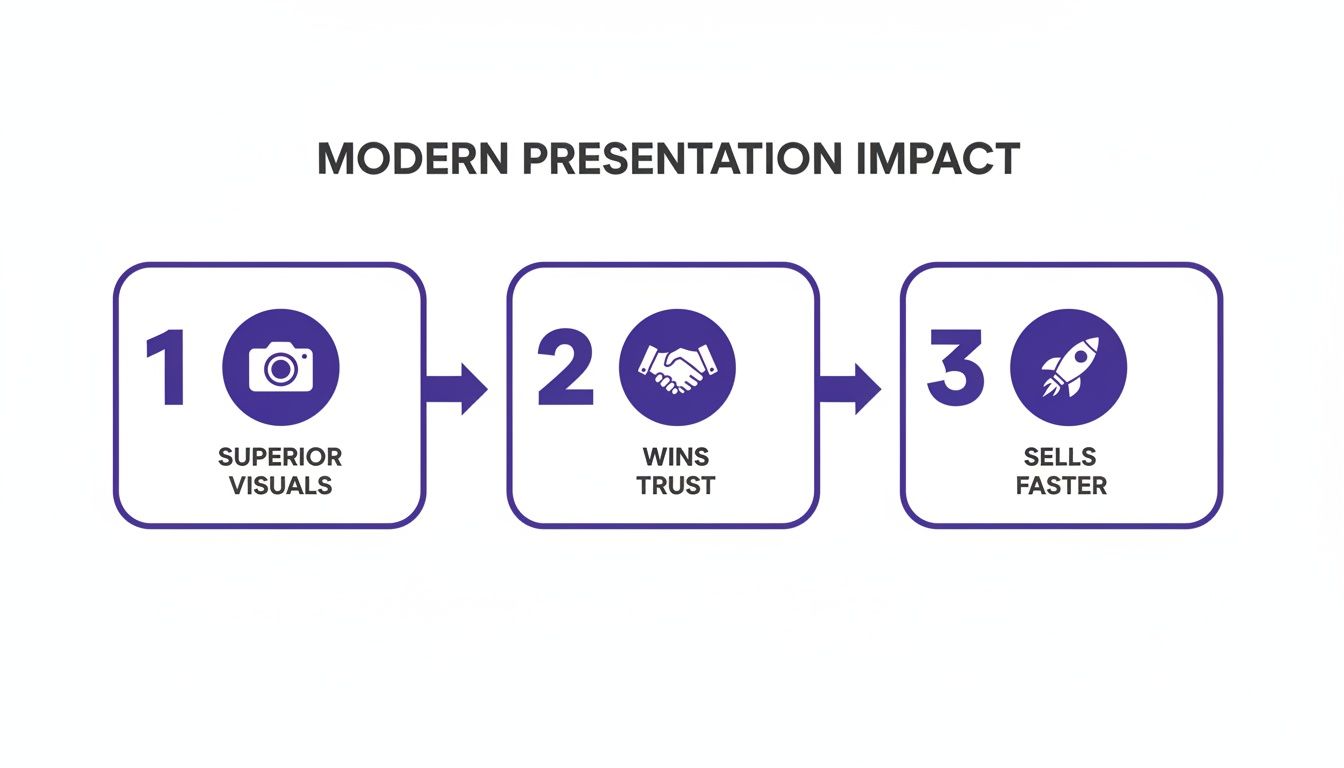
As you can see, investing in high-quality visuals isn't just an expense; it's a direct line to building buyer trust and closing the deal.
Presenting Your Pricing Strategy
Finally, it's time to talk numbers. The key here is to present your Comparative Market Analysis (CMA) not as a spreadsheet, but as a story about the current market.
Don't just flash a list of addresses and prices. Walk them through the comparable properties, explaining exactly why one home is a great comp and another isn't. Use maps and charts to make the data easy to follow.
When you get to your recommended list price, it should feel like the logical conclusion to everything you've presented. By building a case based on your proven track record, a superior marketing plan, and a data-backed pricing story, you make signing with you the easiest decision they'll make all day.
Showcasing a Home's True Potential with AI Staging
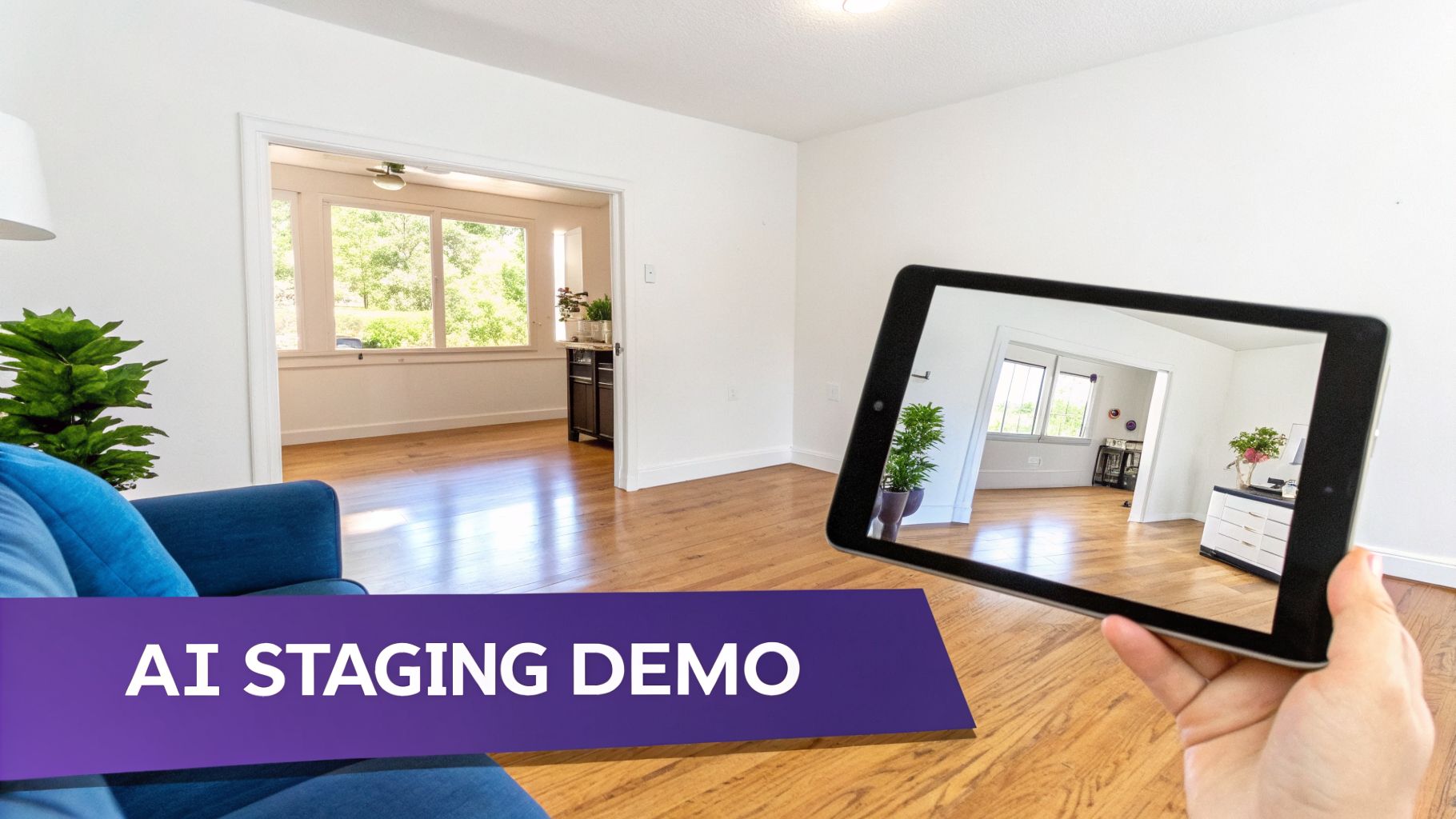
When we get to the marketing plan in your listing presentation template, this is where you can really pull away from the competition. Most agents will just talk about "professional photos." You, on the other hand, can show them exactly how you'll overcome buyer objections and highlight the hidden potential in their home.
This is your moment to introduce a game-changer: AI-powered staging.
Imagine this: you're sitting at a seller's dining table. You pull out your tablet, snap a quick photo of their cluttered home office, and within seconds, you show them a stunning, minimalist workspace with a Scandinavian design aesthetic. That’s the kind of immediate, tangible value you can offer right then and there.
Moving Beyond Traditional Staging
Let's be honest, traditional staging is a huge pain. It's expensive, time-consuming, and involves a ton of manual labor. AI staging completely changes the game by offering a quick, affordable, and flexible way to help buyers see themselves living in a home.
But not all AI tools are created equal. The key is realism. You need visuals that look like they were taken by a professional photographer, not something that looks like a cartoon.
This is exactly why a tool like aiStager is so powerful. It’s the only solution that generates hyper-realistic photos with true dimension rooms and furniture objects. When you virtually place a sofa in a room, it's not just some floating 2D image; everyone can see exactly how it would fit in the space.
Suddenly, your presentation isn't just a pitch anymore. It's a live design session that gets sellers genuinely excited and on board with your vision.
Winning Listings with a Live Demo
The real magic happens when you use AI staging as an interactive tool right in your presentation. Talking about possibilities is one thing, but showing them in real time is what closes the deal.
Take an empty bonus room, for instance. You can show the seller multiple compelling ways to market that space with just a photo and a couple of clicks:
- The Media Room: First, stage it as a sleek media room. You could pull in a cool leather sofa from Article and a modern TV stand, showing them how to market it for movie nights.
- The Family Lounge: In seconds, you can swap that out. Let's try a cozy, oversized sectional from Crate & Barrel in a completely different color and fabric to create a family-friendly vibe.
- The Guest Suite: Or, how about a guest suite? Replace the sectional with a stylish daybed and a small desk to show its potential for visiting family or as a flex space.
This isn't just about selling a house; it's about selling a lifestyle that a wide range of buyers can instantly connect with. If you want to get a better feel for the technology behind this, you can learn more about how a virtual staging app makes this whole process so smooth.
Backing Up the "Wow" with Data
Weaving these visuals into your listing presentation template isn't just for show—it directly answers what today's buyers are looking for. They want more than just static photos. In fact, an overwhelming 86% of buyers prioritize flexible layouts that help them see a home's potential beyond just the square footage.
With housing inventory up 28.9% and list prices flattening out, a standout digital presence is no longer optional. It's what will get your listing the attention it deserves. For more on this, you can see what makes a listing stand out in a competitive market.
When you show sellers you have the tools to create these kinds of compelling, lifelike visuals, you’re proving you have a modern marketing strategy designed to attract the right buyer and sell their home faster and for more money.
Using Data to Build Unshakeable Trust

Let's be honest: any agent can pull a Comparative Market Analysis (CMA). What sets you apart is how you interpret that data and tell a compelling story with it. Raw numbers are just noise to a seller, but when you weave them into a clear narrative, they become your most powerful tool for building trust.
Your listing presentation template needs a section dedicated to the numbers, but it can't feel like a spreadsheet. This is your chance to move beyond being a salesperson and prove you're a strategic advisor.
Instead of just showing a list of sold prices, you need to walk the seller through the "why" behind those figures. Doing this upfront anticipates their questions, handles potential objections before they even come up, and shows them you’ve done your homework.
Key Metrics to Weave into Your Narrative
To build a convincing case for your pricing and marketing strategy, you have to go deeper than the final sale price of a few comps. Focus on the metrics that really show what’s happening in the market right now.
I recommend building your story around these data points:
- Absorption Rate: Frame this as, "How fast are homes like yours actually selling?" A sluggish rate points to a buyer's market, which helps justify a more competitive pricing strategy right out of the gate.
- Days on Market (DOM) for Comps: Look at the average DOM for similar homes—active, pending, and sold. This data is gold for setting realistic expectations around the selling timeline.
- List-to-Sale Price Ratio: A ratio over 100% is a fantastic sign, showing homes are getting multiple offers and selling above asking. If it’s dipping below 98%, it’s a clear signal that buyers have the upper hand in negotiations.
- Price Per Square Foot Trends: Don't just list the numbers. A simple line chart showing whether this metric is climbing, falling, or staying flat in their specific neighborhood is incredibly persuasive. It’s visual, easy to grasp, and far more impactful.
By framing data as a story, you shift the conversation from "What is my home worth?" to "What is our strategy to get the best possible outcome in this market?" It’s a subtle but powerful change that positions you as an indispensable partner.
This analytical approach has never been more important. With active listings up a staggering 28.9% year-over-year as of mid-2025, buyers have more choices and are more selective than ever. They’re looking for value and simplicity, and they respond to data. You can see more on this trend by reviewing the 2026 real estate outlook.
Translating Data into Clear Advice
Once you’ve laid out the metrics, the final step is to connect the dots for the seller. Don't make them guess what it all means; translate it into clear, actionable advice.
For example, if you see a high absorption rate but notice that comparable homes are sitting on the market longer than expected, that tells a story. It likely means overpricing is rampant in the area, and you can use that data to explain why your pricing recommendation is designed to avoid that very pitfall.
This level of detail shows that your pricing and marketing plan isn't a shot in the dark—it's a strategic roadmap backed by solid evidence. When you master the data, you master the conversation, making it easy for sellers to put their trust in you. This approach is a key part of modern real estate sales, and you can explore more on this topic in our guide to digital marketing for real estate agents.
Delivering Your Presentation and Securing the Listing
You’ve done the hard work and put together a killer listing presentation template. The data is solid, and the visuals look amazing. But here’s the thing: a great set of slides is only half the battle. If your delivery falls flat, so will your chances of getting the listing.
This meeting is your opportunity to connect, not just present. Think of it as a conversation. Your real goal is to build trust and show you’re actually listening to what the sellers need. Kick things off by asking good, open-ended questions to understand their situation, what they're worried about, and what they hope to achieve.
Reading the Room and Building Rapport
Let's be honest, every seller is wired differently. Some are all about the numbers and will want to see your CMA right away. Others are more focused on the relationship and need to feel comfortable with you as a person before they talk business. The secret is learning to adapt on the fly.
Pay attention to their body language—it tells you everything. Are they leaning in, nodding, and making eye contact? Or are they sitting back with their arms crossed? Mirroring their posture or the pace they speak can build a subtle, powerful connection. It shows you're in sync with them.
For the Analytical Seller: Jump right into the data. Show them how your marketing metrics and pricing strategy create a clear, logical plan for selling their home. They appreciate a straightforward, fact-based approach.
For the Relational Seller: Start with your story and your values. Share testimonials from past clients, especially one from a situation similar to theirs. This builds the emotional connection they’re looking for.
When you adjust your style to match theirs, you’re sending a clear message: you get them. That’s how real trust is built.
Handling Objections and Guiding the Conversation
Objections are a good thing. Seriously. They aren’t a "no"—they’re a sign the seller is engaged and just needs more information. When they bring up a concern about your commission, the timeline, or the price you’ve suggested, don't get defensive. Take a breath, listen, and show them you understand their point of view before you respond.
A classic one you'll hear is, "We’re going to interview a few other agents." Instead of panicking, try this: "That's a really smart move. To help you make the best decision, what are the most important things you're looking for in the agent you ultimately choose?" This simple question puts you on their side and reframes the conversation around their needs.
Your presentation is the roadmap, but you’re the one driving the conversation toward a 'yes.' You need to do more than just show off the house; you need to clearly explain your plan for how to get real estate listings sold, which gives sellers the confidence to sign with you.
Once you’ve answered all their questions and put their concerns to rest, it’s time to ask for the business. Don’t overthink it. A simple and confident, "Are you ready to get started?" is usually all it takes. When you combine a polished presentation with genuine listening and a human touch, you do more than just have a meeting—you walk away with a signed agreement.
Answering the Tough Questions Sellers Always Ask
Even with a killer listing presentation template, you're going to get questions. It's just part of the job. Being ready for these common queries with thoughtful, confident answers is what separates a good agent from a great one. It shows you've been around the block and truly know your stuff.
How Long Should My Listing Presentation Be?
I've found the sweet spot is about 15-20 slides, which should take you around 20-30 minutes to walk through. This is just enough time to hit all your key points—your unique value, the market data, and your marketing strategy—without your seller's eyes glazing over.
Remember, this isn't a lecture. The goal is to start a conversation. You want to leave plenty of breathing room for questions and discussion, which is where you really build trust. This is also a perfect time to do something interactive. For instance, you could use a tool like aiStager to pull up their living room on a tablet and show them different staging options right there on the spot. It’s an engaging way to use a few of those minutes and show, not just tell.
Should I Email My Presentation Before the Meeting?
Tempting, I know, but this is one of the biggest mistakes you can make. It’s always better to present live, either face-to-face or on a video call.
When you send your deck ahead of time, you lose control of the story. The seller will almost certainly skip right to the pricing and commission slide, completely missing the crucial context of your strategy and the immense value you bring. By presenting it live, you guide them through the journey step-by-step, building a compelling case for why you're the right choice. You can always leave them with a high-quality printout or a PDF copy afterward.
The biggest trap is making the presentation all about you and your awards. Shift your focus. Frame every single point around how it directly benefits the seller. You’re not the hero of this story—they are. You are their trusted guide to a successful sale.
How Can I Make My Staging Ideas Stand Out?
Telling a seller to paint a wall beige is one thing. Showing them how their home could look is something else entirely. This is where you can really blow them away with technology. Using a tool like aiStager lets you demonstrate your vision in a way that feels tangible and exciting.
Because it creates hyper-realistic photos with true dimension rooms and furniture objects, you can move beyond vague suggestions. You can show them exactly how their empty bedroom will look once it's staged. In just a few clicks, you can audition different styles. Show them their space with a sleek, modern leather sofa from Article, then instantly swap it for a cozy sectional from Crate & Barrel in a different fabric. aiStager is great to test different types of the same product (e.g., different sofa brands), including different colors and finishes. All you need is a photo of their room and a product link to create a stunning, realistic visual.
Ready to stop telling and start showing? With aiStager, you can create stunning, photorealistic stagings in seconds and give your listing presentations an unforgettable edge. Try it for free today.