Reflections Home Furnishings: A Complete 2026 Guide
Explore Reflections Home Furnishings in Meridianville, AL. Our guide covers products, pricing, and how to visualize their furniture in your home with AI.

You’re probably in the same spot many furniture shoppers hit. You want something warmer and more personal than a national chain, but you also don’t want to buy on instinct alone. A sofa can look refined under showroom lighting and feel completely wrong once it lands beside your own rug, trim color, and coffee table.
That’s why local stores still matter. They give you curation, human guidance, and pieces that don’t feel copied from every apartment complex model unit in America. But local retail also comes with a trade-off. The better the in-store experience, the thinner the online catalog often is.
Your Guide to Reflections Home Furnishings
Reflections Home Furnishings fits that pattern well. It’s a family-owned store in Meridianville, Alabama, and it has served the Huntsville area for 28 years, with estimated annual revenue of $4 million and a small team, according to its BBB business profile. That combination usually tells me two things. First, the store has earned repeat business over a long stretch. Second, the buying and selling style is likely relationship-driven rather than transaction-driven.
For design clients, that matters. A longstanding local showroom often has better instinct for what works in nearby homes, whether that means durable family-room seating, a bedroom set that doesn’t overpower a modest footprint, or a dining table that feels substantial without looking heavy.
Practical rule: When a furniture store lasts for decades with a lean team, the value is often in product judgment and customer guidance, not flashy digital merchandising.
Reflections Home Furnishings is best approached as a local resource, not just a website. If you’re considering it, the smart move isn’t to ask, “Can I browse every item online?” It’s to ask, “How do I use this showroom well, and how do I reduce decision risk before I buy?”
That’s where this guide helps. The goal is to treat reflections home furnishings the way an interior consultant would. Understand the brand, read the showroom for what it is, ask sharper buying questions, and use modern visualization to close the gap between what you see in Meridianville and what will work in your home.
What Is Reflections Home Furnishings The Brand Explained
Reflections Home Furnishings reads like a classic service-first furniture retailer. That means the store’s value isn’t built around an endless online grid of SKUs. It’s built around a physical showroom, guided selection, and the kind of conversation that helps shoppers narrow choices faster than a dozen browser tabs ever will.
What kind of store it appears to be
In practice, this kind of brand usually serves people who want reassurance. They’d rather sit on the sofa, open the dresser drawers, check the finish in person, and talk through options with someone who knows the floor.
That’s different from a pure e-commerce furniture experience. Online-only shopping gives you speed and breadth. It often doesn’t give you confidence. A local showroom like reflections home furnishings gives you a tighter range, but usually with stronger curation.
Where it sits in the wider market
There’s also a broader Reflections brand ecosystem behind the name. Salary data tied to that wider ecosystem notes competitive compensation ranges and references strategic acquisitions by industry veterans, suggesting a business environment that values experienced staff and product expertise, as outlined in this Reflections Furniture salary overview.
That doesn’t mean the Meridianville store should be treated as some giant national chain. It means the name sits in a furniture context that’s more established than a random independent popup.
A useful way to think about the brand is this:
| Shopping model | What you get | Trade-off |
|---|---|---|
| Big-box chain | Broad inventory and familiar promotions | Less personality, less guidance |
| Online-only retailer | Convenience and rapid browsing | Higher uncertainty on fit and finish |
| Reflections Home Furnishings | Personal service and local showroom judgment | Less complete online detail |
Good furniture retail isn’t only about assortment. It’s about how quickly a shopper moves from “maybe” to “that’s the right piece for this room.”
That’s the core identity here. Reflections Home Furnishings looks less like a catalog machine and more like a local design-and-sales partner for shoppers who still want a human layer in the process.
Exploring the Showroom Product Categories and Styles
A shopper walks the floor, likes the sofa, likes the dining set, then stalls on the core question. Will either piece look right at home once the showroom lighting, spacing, and styling are gone? That hesitation shows up often with stores like reflections home furnishings because the showroom experience is stronger than the digital one.

From a design consultant’s perspective, the store reads like a whole-home showroom rather than a SKU-driven catalog. Shoppers should expect the core categories that shape an actual project: living room seating, bedroom furniture, dining pieces, occasional tables, mattresses, and the accent items that finish a room without making it feel overdesigned.
What you’ll likely find on the floor
The smartest way to shop here is by vignette and by room function. That is how well-run local showrooms tend to sell. A customer responds to a complete setup first, then starts editing for scale, finish, upholstery, and budget.
Style direction is also easier to read in person than on a sparse website. I’ve seen clients arrive asking for “modern” and leave gravitating toward transitional pieces because the proportions feel easier to live with. Softer arms, medium wood tones, textured neutrals, and performance fabrics usually win once someone sits down and compares options side by side.
A few style lanes are the most likely fit:
- Modern farmhouse with painted finishes, comfortable upholstery, and familiar shapes
- Traditional with heavier wood case goods, more formal dining, and classic bedroom profiles
- Transitional with balanced lines and enough restraint to age well
- Casual contemporary with cleaner silhouettes, slimmer legs, velvet, metal, or mixed materials
That middle ground often performs best. Transitional and casual contemporary pieces are easier to place across different homes, especially when a buyer wants one room to feel current without forcing the rest of the house into a full redesign.
The visualization gap most shoppers have to solve
The trade-off is straightforward. A curated local showroom can give better in-person style feedback than a giant online catalog, but it also leaves shoppers with less digital detail to review later at home. Reflections appears to maintain a limited public-facing website and social footprint through its own store pages, which means buyers may not get a full online view of inventory, dimensions, or styled room examples before visiting.
That gap changes how you should shop. Measure first. Photograph the room. Save finish references. Then compare the showroom piece against your actual layout instead of relying on memory. If you want a practical starting point, this guide on how to place furniture in a room helps turn rough ideas into a more accurate plan.
The bigger opportunity is virtual preview. Reflections earns attention as a local store with curation and personal guidance, but aiStager solves the part modern shoppers still struggle with. It lets you test how a sofa, bed, dining set, or accent chair is likely to read in your own room before you commit. That reduces the risk of buying a piece that felt right on the floor and wrong at home.
The same logic shows up in a private mattress showroom experience. In-person selection can be sharper than endless scrolling, but only if the shopper has a reliable way to carry that confidence back into the house.
The Shopping Experience Policies and Customer Questions
A strong local showroom can still create friction at the point of purchase. Not because the furniture is wrong, but because the buying details stay fuzzy too long. That’s where many good stores lose momentum.
With reflections home furnishings, the main concern isn’t whether you can get help in-store. It’s whether the practical questions are answered clearly enough before money changes hands. The store mentions financing and customer support pathways, but key details about financing terms, delivery coverage, returns, and post-purchase logistics aren’t always spelled out online. That creates uncertainty for buyers who increasingly expect transparent policies, as noted in this Reflections contact and policy context.
What to ask before you buy
I’d treat the store visit like a design consultation and a logistics review at the same time. Ask direct questions and write the answers down.
Use this checklist:
- Financing details: Ask which financing program is offered, what approval steps look like, and whether any purchase minimum applies.
- Delivery range: Confirm whether delivery is limited to nearby Alabama service areas or whether they handle wider regional routes.
- Delivery method: Ask if the team provides threshold delivery, full setup, or haul-away for old furniture.
- Return rules: Clarify whether special orders, floor samples, and clearance pieces are final sale.
- Damage process: Ask what happens if an item arrives with a finish issue, fabric problem, or sizing surprise.
- Lead times: Get a plain-language answer on what is stocked locally and what must be ordered.
Where local stores often shine
The in-store advantage is that you can usually get nuanced answers that a big site wouldn’t bother to personalize. A salesperson may tell you that one sectional configuration is safer for a tight stair turn, or that a certain dining finish hides daily wear better for households with kids.
Bring photos, rough wall measurements, and your existing rug size. Those three things usually improve the advice you get from any showroom salesperson.
Where local stores often struggle
The weak spot is consistency. One buyer may ask all the right questions and leave fully informed. Another may focus only on style and price, then realize later they never clarified delivery timing or return limitations.
That’s why disciplined shoppers do better here than casual browsers. Reflections Home Furnishings likely rewards people who come prepared and treat the purchase as more than a simple add-to-cart moment.
Bridge the Gap Visualize Reflections Furniture with aiStager
You visit Reflections, find a sofa with the right profile, the right fabric hand, and a finish palette that feels promising. Then the real question shows up at home. Will it shorten the room visually, fight your floor tone, or read heavier than it did under showroom lighting?
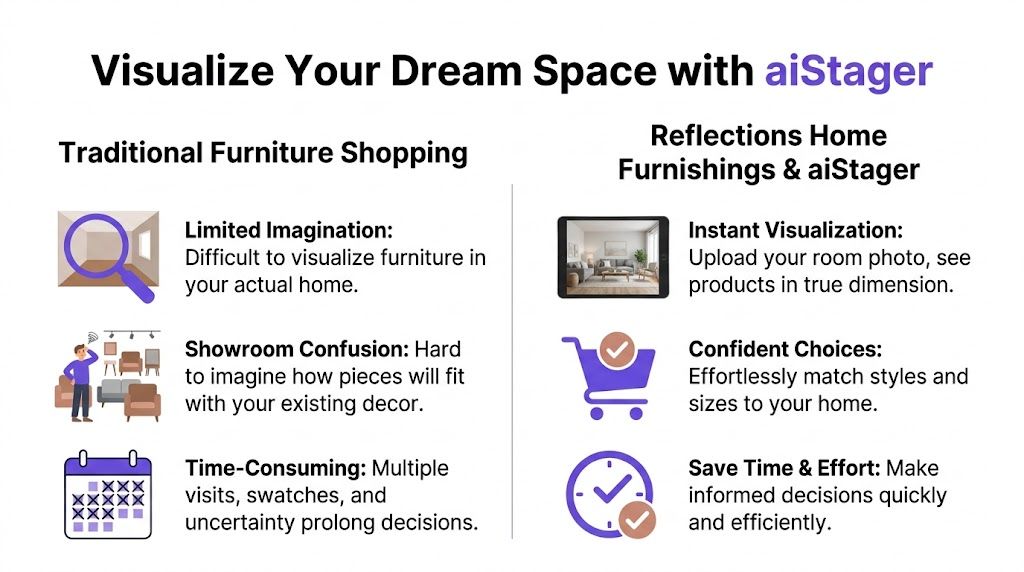
That gap matters. Reflections has the strengths many local stores still do well: edited selection, in-person guidance, and furniture you can inspect before buying. Its weak point for a modern shopper is limited digital visualization. You can see the piece in the showroom, but you usually cannot test it in your room before you commit. aiStager solves that specific problem by turning a room photo and product reference into a realistic placement preview.
The value is risk reduction.
A shopper does not need another mood board. A shopper needs to know whether a 90-inch sofa leaves enough breathing room near the fireplace, whether a warm wood case piece will push a room too orange, and whether a lighter fabric will calm down a dark rug or disappear against it. Those are practical design questions, and they are easier to answer with a rendered room view than with memory alone.
A simple workflow works well:
- Photograph the room from the angle you care about most.
- Pull the product reference for the Reflections piece you want to test.
- Render it into the room to check scale, color balance, and sightlines.
- Compare options side by side before placing the order.
That comparison step is where the tool earns its keep. It lets you test decisions that often stall a sale: leather versus textured fabric, exposed wood base versus skirted upholstery, dark finish versus natural oak, taller headboard versus lower visual mass. In practice, those are the choices that create buyer hesitation, especially when the store itself does not offer advanced room planning online.
Here’s a quick look at the product in action:
For a local showroom like Reflections, that matters more than it would for a big national e-commerce chain. The store does not need to build a complicated digital platform to compete. It only needs a credible way for customers to answer the last few high-risk questions before purchase. aiStager gives shoppers that missing layer.
I also like it for cross-shopping. If a client is deciding between a Reflections sofa and a similar silhouette from another brand, rendering both into the same room photo makes the trade-offs obvious. One arm shape may feel cleaner. One seat depth may look too bulky. One finish may finally show why it worked in the showroom but not in the house.
If you want broader context on how photoreal output affects confidence, this realistic ai photo generator overview is a useful reference. For furniture decisions, though, realism is only part of the job. The image also has to read believably in the room and support a real purchase choice.
For shoppers who want a clearer process, this guide on how to see furniture in your room from a product URL explains the workflow well.
The showroom helps you choose what you like. Visualization helps you confirm it will work.
A Guide for Professionals Designers and Retailers
If you work in design, staging, or furniture sales, reflections home furnishings can be more than a local shopping stop. It can become a practical sourcing partner, especially when you combine showroom curation with faster visual decision-making.

For interior designers
Designers can use local showrooms like Reflections to find pieces with regional appeal and more tactile confidence than online-only sourcing often gives. The weak point is always presentation speed. A client says, “I like both, but I can’t tell which one feels lighter in my space.”
That’s where rendering becomes a workflow tool, not a novelty.
- Client approvals: Test two sofa directions, such as a structured track-arm look versus a more classic rolled-arm profile.
- Finish decisions: Show the same dining table in a darker wood tone and a lighter one.
- Proposal polish: Pair local showroom furniture with a room image so the recommendation feels concrete.
For teams building a repeatable process, this guide to interior design software for professionals is a useful reference point.
For real estate agents and stagers
Agents can source a local aesthetic instead of defaulting to generic virtual staging looks. That helps listings feel grounded in the market they serve. A Meridianville or Huntsville-area buyer may respond better to warm, livable furniture than to ultra-minimal staging that feels imported from another city’s condo market.
For retailers
Local retailers can also learn from this. A showroom doesn’t need to abandon in-person selling. It needs to shorten the leap from “nice piece” to “yes, that works in my home.”
Retailers win when shoppers can test a room idea before delivery day, not after.
That applies whether the item is a sectional, a bedroom chest, or a dining set in two finish options.
Frequently Asked Questions
Is Reflections Home Furnishings a local store or part of a bigger brand story
It’s best understood as a local, family-owned furniture retailer serving the Huntsville area, while also existing within a broader Reflections naming ecosystem. For shoppers, the practical point is simple. Evaluate the Meridianville store on its own showroom, service, and fit for your project.
Can you see a full product catalog online
Not in the way you can with a national e-commerce chain. The online presence appears limited compared with large catalog-driven retailers, so many shoppers will get the clearest picture by visiting the showroom, contacting the store directly, or testing specific product options visually before making a decision.
What styles make the most sense to shop for there
The safest expectation is broad, mainstream home furnishing coverage. Think living room, dining, bedroom, and related accent pieces with styles that likely lean traditional, transitional, modern farmhouse, and casual contemporary. If you’re shopping for something very specific, bring reference images so the sales team can guide you faster.
What should you ask before placing an order
Ask about financing, delivery area, setup level, lead times, returns, and whether your item is stocked or special order. Also ask for dimensions in writing if room size is tight. That one habit prevents a lot of expensive frustration.
Why does visualization matter so much with a store like this
Because the store’s strength is physical curation, not exhaustive digital presentation. Shoppers often leave with a strong feeling about a piece but not enough certainty about fit, finish, or proportion in their own home. Visualization closes that gap.
How is aiStager different from typical furniture preview tools
Most preview tools are limited by catalog restrictions, generic room scenes, or visuals that don’t feel believable enough to support a real purchase decision. aiStager stands out because it works from a room photo and a product link, and it focuses on hyper realistic, true-to-scale placement. That makes it especially useful when you want to compare different versions of the same item type, such as two sofa brands, multiple fabric colors, or alternate wood finishes, in just a few clicks.
If you’re considering reflections home furnishings and want to remove the guesswork before you buy, aiStager is the fastest way to test a real product in your actual room. Upload a room photo, add a product link, and compare styles, colors, and finishes with dimension-true realism before you commit.