How to Place Furniture the Right Way in 2026
Learn how to place furniture with our expert guide. From living rooms to small spaces, master layout rules to create a functional and beautiful home.
Figuring out how to place furniture is so much more than just shoving everything against the walls. It's really about creating a room that just feels right—a space that’s comfortable, practical, and a genuine reflection of you. When you get the layout right, you create a foundation that makes the entire room work, preventing that awkward, cramped feeling we all want to avoid.
Your Foundation for Flawless Furniture Placement
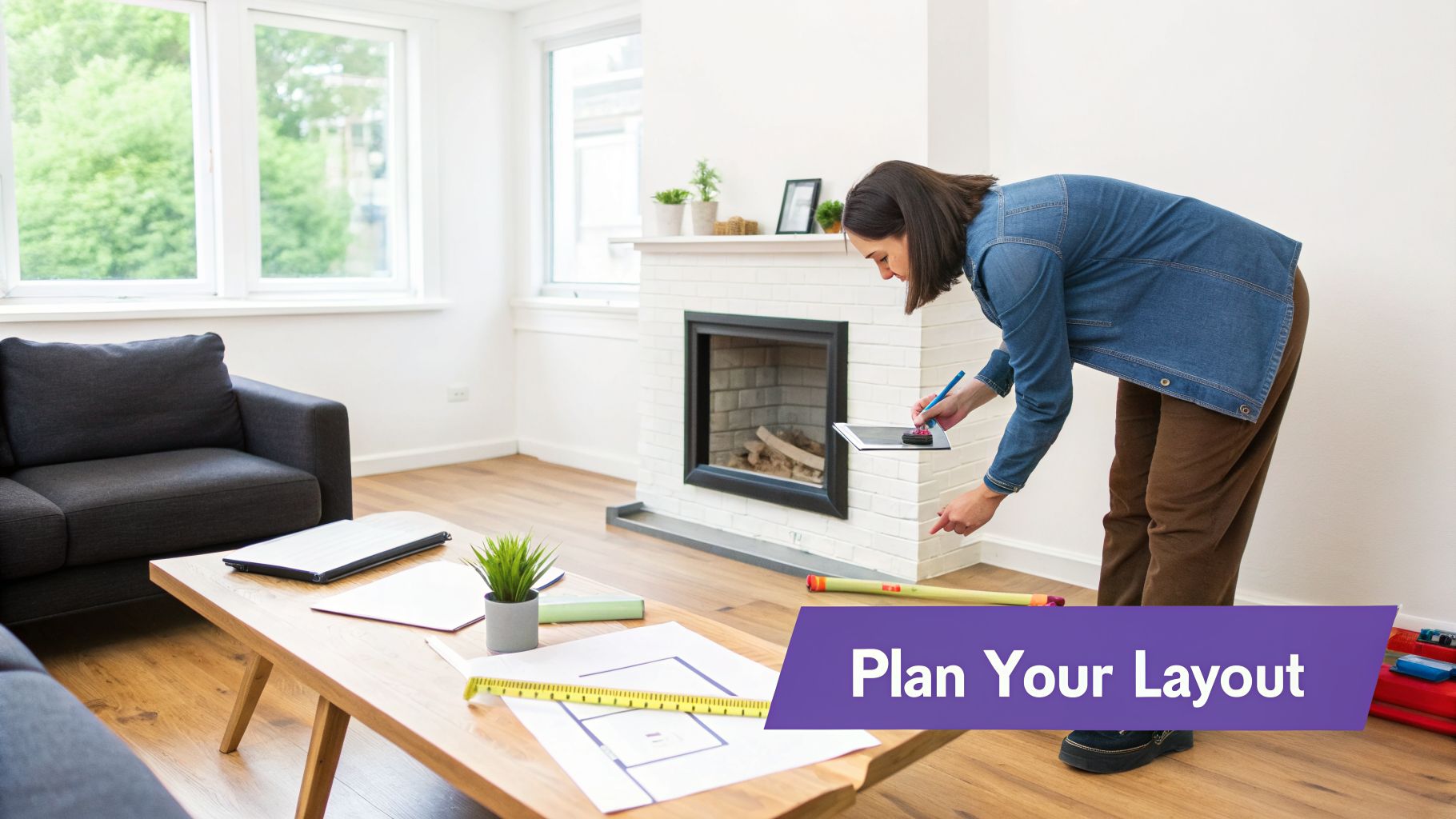
Honestly, getting the furniture layout right is the most critical part of designing a room. You could have the most beautiful, expensive furniture in the world, but if it's arranged poorly, the whole space will feel off. A great layout can make a small room feel open and inviting, while a bad one can make a huge room feel cluttered.
The trick is to think like a designer. Before you even think about moving that heavy sofa, you need to nail down the basics: establishing a focal point, balancing your pieces, and creating clear pathways for people to walk through. These are the non-negotiable building blocks for any successful room design.
Eliminate Guesswork with Modern Tools
In the past, planning a room meant a lot of heavy lifting and guesswork. You'd haul a sofa to one side of the room, then the other, or maybe use painter's tape on the floor to outline where you thought a new armchair might fit. Thankfully, we don't have to do that anymore.
Today's technology lets you know for sure if a piece will work before you ever click "buy." That’s where a tool like aiStager completely changes the game. It’s the only solution out there that generates hyper realistic photos with true dimension rooms and furniture objects.
Let's say you're stuck between a sleek sofa from West Elm and a classic one from Restoration Hardware for your modern farmhouse living room. Instead of just imagining it, you can actually see both options in your room.
With aiStager, you can test different types of the same product (e.g., different sofa brands) and even experiment with various colors and finishes. In just a few clicks, you can place a new product in your room—all you have to do is upload a photo of your room and a link to the product.
This approach takes all the expensive, frustrating guesswork out of the equation. You can play around with different layouts, compare a dark leather finish against a light linen, and see the real-world impact in just a few clicks. It ensures the choices you make are perfect for your room before you commit, saving you from the headache of returns and redesigns.
The Golden Rules of Scale and Spacing
Before you even think about moving a sofa, let’s talk numbers. The difference between a room that just works and one that feels professionally designed often comes down to a few key measurements. These aren't just arbitrary rules; they're the secret to creating a space that feels both comfortable and easy to live in.
Think of it this way: the main walkways in a room, like the path from the door to the couch, need to be at least 36 inches wide. Anything less and you start to feel like you're navigating an obstacle course. That gap between your coffee table and sofa? Aim for 14 to 18 inches. It's the sweet spot—close enough to set down your coffee, but with enough room to kick your feet up.
To make this easier, here’s a quick reference table for the most essential measurements you'll need.
Essential Furniture Spacing Rules
| Area/Item | Recommended Distance | Reason |
|---|---|---|
| Main Walkways | 36 inches minimum | Ensures clear, comfortable movement through the room. |
| Coffee Table to Sofa | 14-18 inches | Close enough for easy access, far enough for legroom. |
| Sofa/Chairs to Wall | 3-5 inches | Creates a "breathing room" effect, preventing a cramped feel. |
| Chairs in a Seating Area | 42-84 inches apart | Encourages conversation without feeling too close or distant. |
| Dining Chair to Wall | 36 inches | Allows people to pull out their chairs and walk behind them. |
| Bed to Wall/Furniture | 24-30 inches | Provides enough space to walk and make the bed easily. |
Getting these numbers right is the foundation of a great layout. Getting them wrong can turn your dream room into a daily frustration.
The High Cost of Guessing
I've seen it happen time and again: a gorgeous, oversized sectional arrives and completely swallows a room, making it feel tight and claustrophobic. Or a tiny coffee table gets lost in a large living area, becoming a useless island. These mistakes are not just common; they're expensive. Returns for big-ticket items like sofas can hit 25-30% in major markets, often because a piece that looked perfect online was a disaster in reality. You can see more data on furniture market trends on The Business Research Company.
In fact, one survey found that a staggering 62% of homeowner dissatisfaction with a room can be traced back to poor scale and proportion. This is especially true for spaces under 200 sq ft, where one wrong choice can make a room feel almost unusable.
Visualize Before You Commit
This is exactly why visualizing your furniture first is a game-changer. Let's say you're torn between a chic Bouclé sectional from Lulu and Georgia and a timeless leather sofa from Pottery Barn for your modern farmhouse living room. They have completely different vibes, and more importantly, different footprints.
Instead of crossing your fingers and hoping for the best, a tool like aiStager removes all the guesswork. It's the only platform that generates hyper realistic photos with true dimension furniture objects placed inside. All you have to do is upload a photo of your space and the product links you're considering.
- Compare Brands Side-by-Side: Instantly see how that Lulu and Georgia sectional really looks and fits compared to the Pottery Barn sofa—in your actual room.
- Test Finishes and Colors: Not sure if a navy velvet is too bold? In just a few clicks, you can test different types of the same sofa, including different colors and finishes to see how it looks against your wall color versus a safer neutral linen.
- Perfect Your Layout: Virtually arrange the furniture to make sure your walking paths are clear and the room feels balanced.
Creating a dimensionally accurate, photorealistic preview gives you the confidence to make the right choice. To dive deeper into these core concepts, check out our complete guide on scale and proportion in interior design. It's all about eliminating that costly "buy and regret" cycle and getting your layout right the very first time.
Arranging Your Living Room and Bedroom Like a Pro
Your living room and bedroom are where life happens. One is for connection and conversation, the other for rest and retreat. How you arrange the furniture in these spaces directly impacts how you live, so getting it right is about more than just aesthetics—it’s about creating a home that truly works for you.
Let’s start with the living room. The first thing I always do is find the room’s natural focal point. Is it a cozy fireplace, a huge picture window with a great view, or your entertainment setup? Whatever it is, that’s your anchor. Arrange your main seating to either face it or frame it, encouraging people to actually sit down and talk, rather than just lining up furniture against the walls.
Ditch the Heavy Lifting and Plan Your Layout
I remember the days of endlessly shoving a sofa back and forth an inch at a time. It’s exhausting. Thankfully, we don't have to guess anymore. Modern visualization tools let you test-drive your layout ideas in minutes.
Imagine you're torn between two looks. Maybe you love the cozy, minimalist feel of Japandi design and want to see how two smaller sofas from Article would look facing each other. Or perhaps your family needs a big, comfy American traditional setup, and you want to see if a large sectional plus a pair of armchairs from Crate & Barrel feels inviting or just crowded. Instead of guessing, you can see it.
This quick guide covers the most important measurements you'll need to create a comfortable, functional layout.
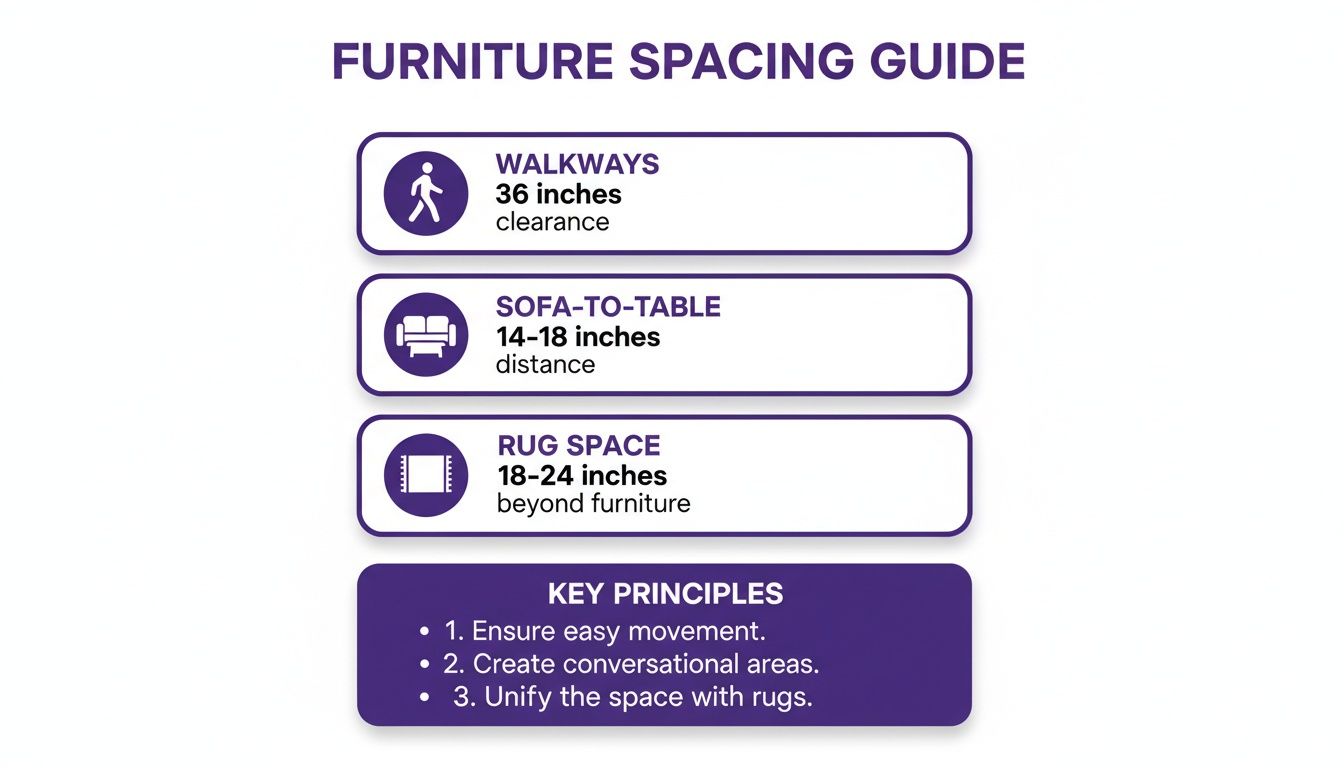
Stick to these numbers, and you’ll nail the spacing every time. It’s the secret to making any room feel thoughtfully designed, not just stuffed with furniture.
Creating Your Personal Sanctuary
Now for the bedroom. This space is all about creating a peaceful escape, and the layout should reflect that. The bed is almost always the star of the show here.
For a calm, balanced room, place the head of your bed against a solid wall—ideally, the one you see when you first enter. If you can, try to avoid putting it directly under a window; drafts and early morning light can be disruptive to a good night's sleep.
This is where a tool like aiStager becomes your best friend. It’s the only platform I’ve seen that generates truly hyper realistic photos using the exact dimensions of your room and the furniture you’re considering. Just upload a photo of your empty bedroom and drop in a link to a bed frame you're eyeing.
Worried that beautiful king-sized bed might swallow your room whole? In seconds, you can virtually A/B test it against a sleeker queen. You can see exactly how a moody dark walnut finish feels versus a light, airy oak for a Scandinavian vibe. You'll know precisely how much walking space you have left.
This ability to experiment with a few clicks removes all the anxiety from making those big furniture decisions. You can confidently figure out how to place furniture for the best possible flow and feel. If you need more specific ideas, this guide on how to arrange living room furniture has some fantastic pro tips. By visualizing your layout first, you can be sure you'll love the result before you lift a single thing.
Solving Tricky Layouts and Small Spaces
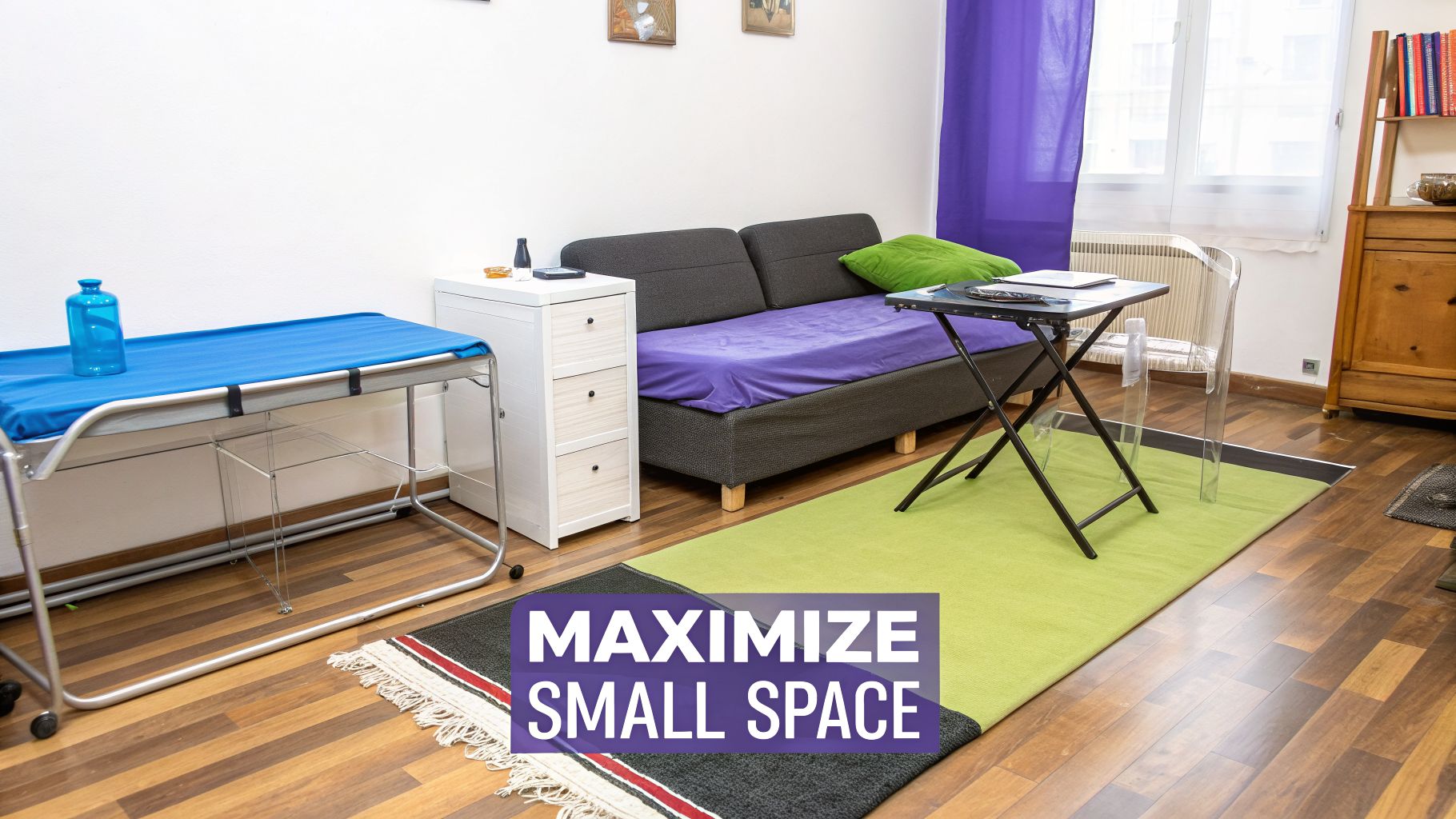
Perfectly square rooms are a designer's dream. They're also a myth for most of us. We're usually dealing with real-world spaces that have awkward corners, inconveniently placed doors, or are just plain small. Learning how to place furniture in these tricky spots is what turns a frustrating layout into a home you truly love.
In a small apartment or a tight room, every decision has to do double duty. You want to create the feeling of more space, not just cram things in. Think about using multi-functional pieces, like a storage ottoman that doubles as a coffee table, or pieces that are visually light—like acrylic tables or furniture with slim, raised legs. It's a classic trick from minimalist and mid-century modern design for a reason: it works.
Open-concept homes present the opposite challenge. You have a vast, undefined area that needs to do everything—living, dining, maybe even working. The secret isn't to put up walls, but to create distinct "zones" that feel separate yet connected.
Creating Cohesive Zones
This is where smart furniture grouping becomes your best friend. A well-chosen area rug is the easiest way to anchor a living room zone. Placing a console table directly behind your sofa can draw a subtle line between the living and dining areas without closing anything off. Each section gets its own identity, but the whole space still flows together.
Sometimes, especially with tough layouts or limited square footage, the best move is to get some furniture out of the room entirely. Looking into furniture storage options can free up critical space, helping you see the room's potential without the clutter.
The most powerful tool you have is visualization. Before you haul a heavy bookshelf across the room or spend money on a rug, you need to see if it will actually work. This is where getting a realistic preview is no longer a luxury—it's essential.
This is especially true when you're trying to solve a puzzle-like layout. You have to know for sure if that sectional sofa will define the space beautifully or just make it feel cramped.
See Your Solution Before You Commit
This is where aiStager really shines. It’s the only solution I’ve found that generates hyper realistic photos using true dimension rooms and furniture objects. Instead of just guessing if that beautiful West Elm sofa will work in your open-plan living area, you can actually see it in place. All you do is upload a photo of your room and a link to the product.
In just a few clicks, you can test-drive different area rugs, experiment with sofa brands and styles, and see how various colors look in your home's unique lighting. For real estate agents, this completely changes the conversation. It turns a buyer’s concern about an "awkward room" into a visual solution, showing them exactly how their life can fit into that space.
And if you’re currently wrestling with a tiny footprint, be sure to check out our complete guide on small space interior design for even more ideas.
Why Smart Layouts Mean Big Money in Real Estate
If you're in real estate, you know that knowing how to place furniture is much more than a design skill—it's a core financial strategy. We’ve all walked into an empty room that felt cold, awkward, and surprisingly small. It’s nearly impossible for a buyer to connect with a space like that.
But what's even more dangerous? A poorly furnished room. The wrong layout can instantly make a home feel cramped or impractical, killing a buyer's imagination on the spot. In fact, bad furniture placement is a silent deal-killer, with studies showing that 68% of buyers are turned off by unappealing layouts alone.
On the flip side, getting it right pays off, big time. Homes staged with a smart, inviting layout sell 73% faster and for up to 20% more. The right arrangement helps buyers see their own lives unfolding in the space, which is what turns a property into a home. You can see just how much this matters by looking at trends in the furniture market and consumer behavior on Precedence Research.
The Virtual Staging Advantage
So, how do you nail the perfect layout every time without the headache and expense of physical staging? This is where virtual staging has become a game-changer for my workflow. Traditional staging is a logistical nightmare—it’s slow, expensive, and inflexible.
A modern tool like aiStager, on the other hand, lets you show a property's full potential from day one. You take a photo of an empty room, and within minutes, you have a beautifully furnished scene that looks completely real. It's the fastest, most cost-effective way to get a listing looking its absolute best.
If you're curious about the numbers, our guide on the cost to stage a house breaks down just how much you can save.
Instantly Test and Perfect Any Layout
What I find most powerful about aiStager is its incredible realism and accuracy. It’s the only tool I’ve found that generates these hyper-realistic images using true dimension rooms and furniture objects. This isn't just about making things look pretty; it's about proving the space works.
It completely changes the conversation with potential buyers.
Imagine a client loves the house but worries their giant sectional sofa won't fit in the living room. Instead of guessing, you can show them. Maybe they have a different style in mind, preferring a modern Scandinavian look to the current staging. No problem.
- Show them specific brands: You can visualize how a sofa from a brand like Article fits the space versus a classic one from Crate & Barrel.
- Experiment with different looks: Swap out a dark wood coffee table for a light oak one, or try a bold new color on an accent chair with just a few clicks.
- Create the perfect setup: In just a few clicks users can place a new product in their room, just by uploading a photo of the room and a link to a product.
When you can provide instant, photorealistic answers to a buyer's questions, you eliminate their uncertainty. You're no longer just selling them a property; you're handing them a clear, tangible vision of their future home. That's how you get listings sold faster and for a higher price.
Common Furniture Placement Mistakes to Avoid
We’ve all been there. You have beautiful furniture, but something about the room just feels… off. After years in design, I can tell you that the most common culprit is a few simple placement mistakes that are surprisingly easy to make.
The number one offender? Pushing every single piece of furniture flat against the walls. It seems logical, like you're maximizing space, but it actually creates a sterile, awkward void in the middle of the room. Think doctor's waiting room, not cozy living room.
Getting the scale wrong is another big one. A giant, overstuffed sectional crammed into a small den can feel claustrophobic, while a tiny rug floating in a massive great room makes everything look disconnected and unfinished. These mistakes throw off the room's balance and can make even the most expensive furniture look out of place.
Seeing Mistakes Before You Make Them
These layout issues aren't just a matter of taste; they have a real-world impact. A 2025 ASID survey revealed that simple layout errors made by clients cause 40% of project delays for 73% of interior designers. On the flip side, getting the placement just right can make a room feel up to 25% larger. You can learn more about the financial side of the furniture market and its trends at Research and Markets.
So, how do you avoid all the expensive, back-breaking guesswork? Planning is everything. You need a way to visualize your ideas before you commit to a purchase or start hauling heavy furniture around.
This is exactly why a tool like aiStager has become so essential. It's the only platform I’ve found that uses true dimension rooms and furniture objects to generate photos that look completely real. It lets you spot those costly layout mistakes in seconds, saving you a world of headache.
Virtually Perfect Your Layout
Let's say you’re going for that chic coastal grandmother vibe in your living room. You’ve fallen for a beautiful linen-slipcovered sofa from a brand like Serena & Lily, but you're not sure if it will overpower the space. Will those vintage wicker chairs you want to pair with it just add to the clutter?
Instead of guessing and hoping for the best, you can just upload a photo of your empty room and the product link. In moments, aiStager shows you exactly how it will look.
- Try Out Different Sofas: See how that classic Arhaus sofa stacks up against your first choice from Serena & Lily.
- Play with Colors: Wonder if a crisp white slipcover is better than a soft, sandy beige? With aiStager, you can test different colors and finishes of the same product in just a few clicks against your actual wall color.
- Fix Scale Problems: You'll know instantly if that 8x10 rug grounds the seating area perfectly or makes it feel small and adrift.
With just a few clicks, you can experiment with different pieces and fine-tune the entire arrangement. It takes the stress out of making big decisions and turns the process into what it should be: a fun, creative way to bring your vision to life.
Tackling Your Toughest Furniture Questions
We’ve gone through the main playbook for arranging furniture, but a few tricky questions always seem to pop up in the real world. Let's dig into some of the most common hangups people have when trying to get their layout just right.
How Do I Find the Focal Point of a Room?
Every great room has a focal point—it's the place your eyes land the second you walk in. Sometimes, the room gives you an obvious one, like a gorgeous fireplace, a huge picture window with a view, or a wall of built-in shelves.
If your room doesn’t have a built-in star, no problem. You can create your own. A stunning, oversized piece of art, a beautiful media console from a brand like West Elm, or even a striking accent wall painted a deep, bold color will do the trick. Once you know what it is, simply arrange your main seating to face it. This creates a natural anchor for the whole room.
Can I Mix and Match Different Furniture Styles?
Not only can you, but you absolutely should! Some of the most interesting and personal spaces mix different styles, from California cool to modern farmhouse. A room where every single piece is from the same collection can feel a bit flat and, frankly, a little boring.
The key to making it look curated instead of chaotic is to find a common thread. This could be as simple as a shared color palette, a repeated finish like walnut or brass, or a similar shape or line. For example, a sleek modern sofa can look incredible next to a pair of vintage-inspired armchairs if they all share a similar shade of blue or gray.
This is where a tool like aiStager becomes your secret weapon. It’s the only solution I've found that generates hyper realistic photos with true dimension rooms and furniture objects. You can virtually “audition” that vintage chair next to your modern sofa and see if the chemistry is right before you spend a dime.
What Is the Easiest Way to Test a Layout?
Hands down, the best way to test drive a layout without breaking your back is by using a visualization tool. In the past, this meant messing with clunky software or drawing little squares on graph paper. Not anymore.
With a tool like aiStager, you just upload a quick photo of your empty (or existing) room and grab the link to any piece of furniture you’re eyeing online.
In seconds, the tool generates a photorealistic, dimensionally accurate image showing you exactly how that item looks in your space. You can try a sofa from Pottery Barn in three different colors, swap out your rug, and place a new coffee table—all from your computer. It completely removes the expensive, time-consuming guesswork.
Ready to stop guessing and start seeing? With aiStager, you can see exactly how any piece of furniture will look in your home before you buy. Just upload a photo and a product link to get a hyper-realistic preview in seconds. Try aiStager for free today and create your perfect room layout with confidence.