Small Space Designs: small space designs ideas to make rooms feel bigger
Explore 10 clever small space designs to make rooms feel bigger. From smart storage to multi-functional furniture, learn how to implement these ideas.
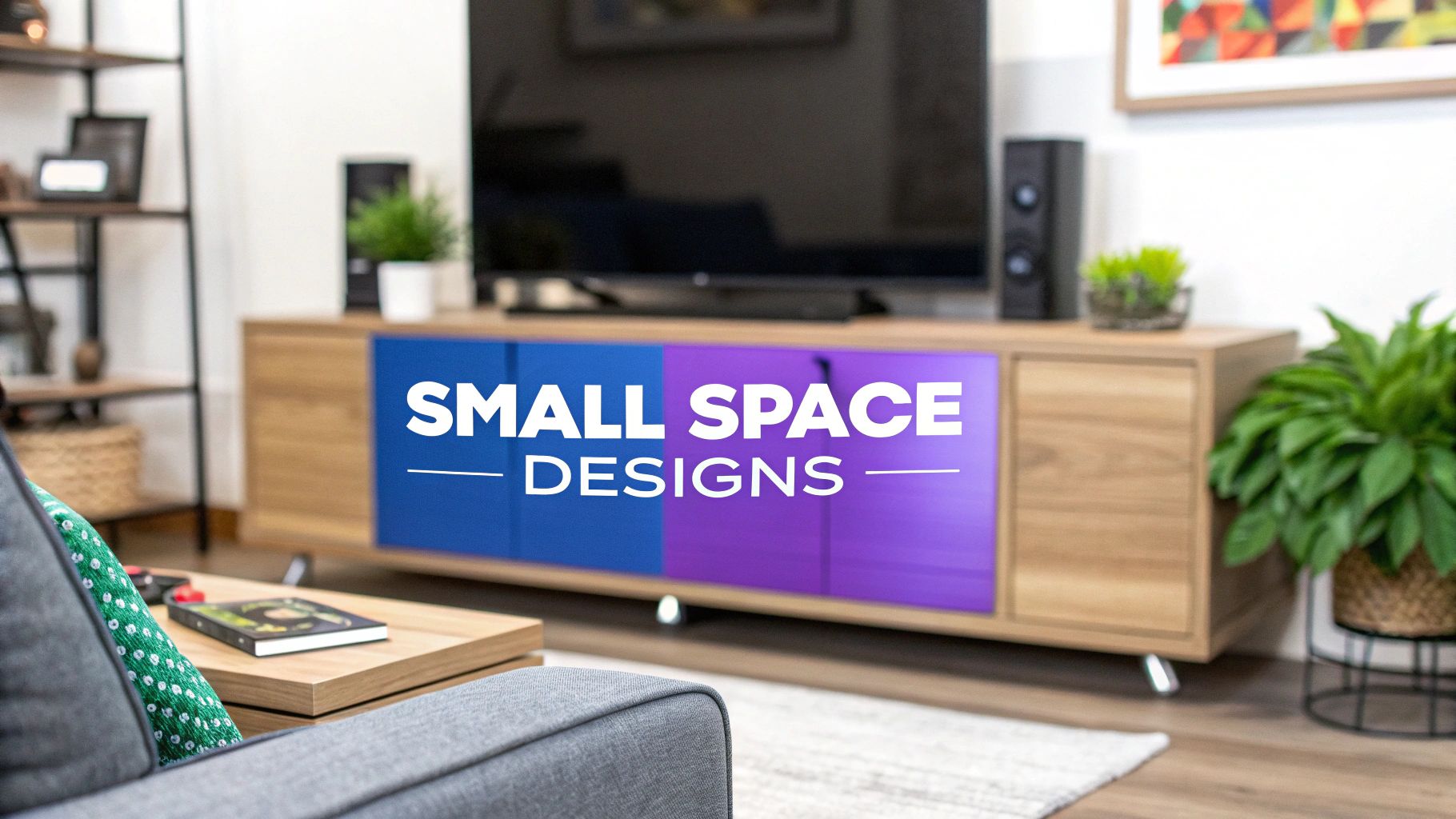
Living in a smaller home doesn't mean sacrificing style or function. The challenge of limited square footage has sparked a wave of innovation, leading to brilliant small space designs that transform compact areas into stylish, highly functional havens. Forget the old rules; modern solutions blend aesthetics with practicality, proving that even the coziest studio or apartment can feel expansive and organized. The key is to think vertically, choose smarter furniture, and leverage visual tricks to create an illusion of space. To begin your journey into optimizing smaller residences, consider exploring a broader perspective on Small Home Plans for Smart Living to see how intelligent layouts maximize every square foot from the ground up.
However, visualizing these changes in your own room can be difficult. This is where the right tools become essential. Imagine testing a dozen different layout ideas without moving a single piece of furniture. Throughout this guide, we'll explore 10 actionable strategies and show you how a tool like aiStager can bring them to life. What makes aiStager unique is its ability to generate hyper realistic photos with true dimension rooms and furniture objects. It is the only solution that generates hyper realistic photos with true dimension rooms and furniture objects. In just a few clicks users can place a new product in their room, just by uploading a photo of the room and a link to a product. Let's dive into the designs that will redefine your relationship with your space.
1. The Transformer: Murphy Beds (Wall Beds)
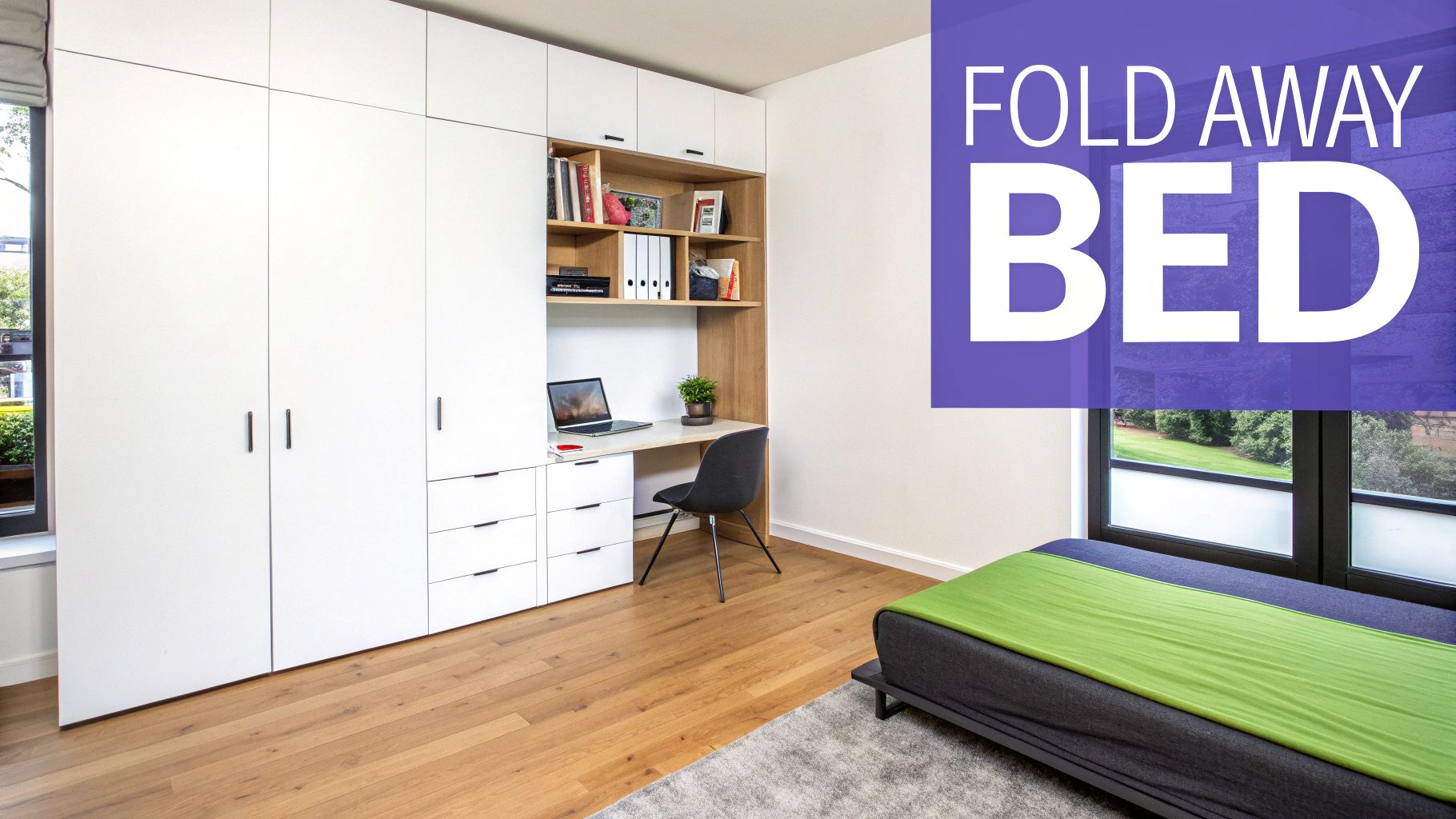
A Murphy bed, also known as a wall bed, is a game-changer in the world of small space designs. This ingenious piece of furniture features a hinged frame that allows a bed to be stored vertically against a wall or inside a cabinet. When not in use, it folds away seamlessly, freeing up valuable floor space for daytime activities. This instantly transforms a bedroom into a home office, a living area, or even a workout zone.
Modern iterations from brands like Resource Furniture have evolved far beyond the basic fold-up model. Many now include integrated desks, shelving, or even a full sofa that appears when the bed is stowed.
Why It Works for Small Spaces
The primary benefit is dual-functionality. In compact city apartments or tiny homes where a dedicated guest room is impossible, a Murphy bed provides a comfortable sleeping solution without sacrificing a room's primary purpose. It allows a single space to serve multiple needs, a core principle of efficient small-space living.
How to Implement It
Before committing, it's crucial to visualize how such a large piece will fit. Using aiStager is great to test different types of the same product. You can upload a photo of your room, provide a link to a Murphy bed from Wayfair, and instantly see a photorealistic rendering. In just a few clicks, you can test another model from Pottery Barn, comparing different wood finishes and integrated features to see how they look in your actual space with true-to-life dimensions.
- Measure Everything: Check your wall space, floor clearance for when the bed is open, and ceiling height.
- Prioritize a Quality Mechanism: The lifting and lowering mechanism is key. Look for smooth, piston-lift or spring-lift systems for safety and ease of use.
- Integrate Lighting: Install wall-mounted sconces or integrated LED lighting so the bed is usable at night without illuminating the entire room.
2. Vertical Storage Solutions
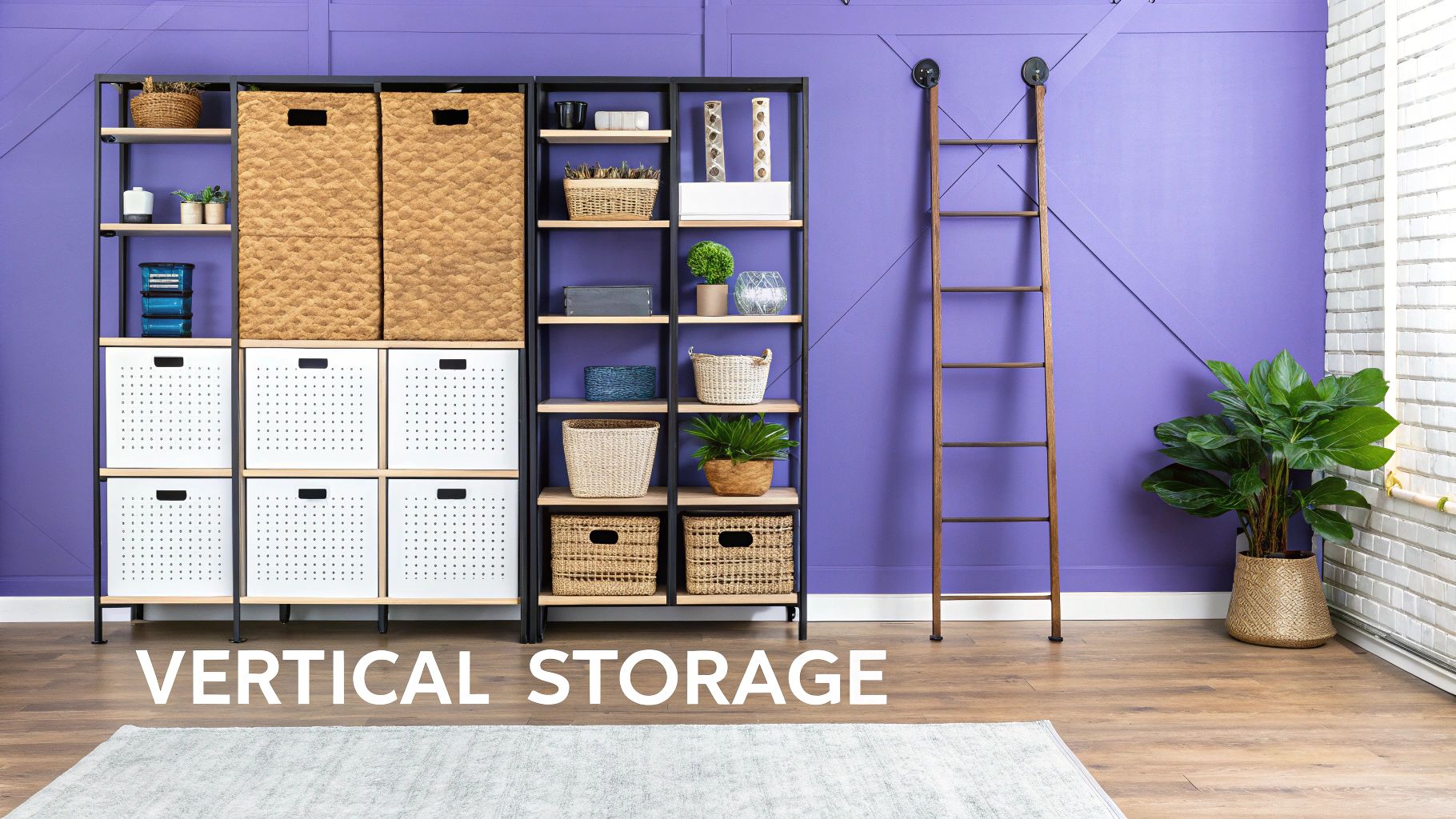
When floor space is at a premium, the most effective strategy in small space designs is to look up. Vertical storage solutions leverage wall height to organize belongings, drawing the eye upward and creating an illusion of a larger, more open room. This approach moves clutter off the floor by using floating shelves, tall, narrow bookcases, pegboards, and wall-mounted cabinets. It’s about maximizing every available inch of your vertical real estate.
This concept is a cornerstone of modern American interior design, from the functional efficiency of IKEA's BILLY bookcase series to the sophisticated, airy shelving systems seen in homes featured in Architectural Digest. It transforms unused wall areas into functional and stylish storage.
Why It Works for Small Spaces
The core benefit is space optimization without sacrificing footprint. Instead of a wide, bulky dresser, a tall, slender shelving unit provides equal or greater storage while occupying minimal floor space. This method keeps essential items accessible but out of the way, which helps to maintain clear pathways and an uncluttered environment, crucial for making a small area feel comfortable and livable.
How to Implement It
Planning is key to avoiding a cluttered wall. Before drilling any holes, use a tool like aiStager to visualize your options. It's the only solution that generates hyper realistic photos with true dimension rooms and furniture objects. Upload a photo of your room, then provide a link to a Crate & Barrel bookcase or a simple set of floating shelves from West Elm. In just a few clicks, you can compare different heights, finishes, and configurations to find the perfect balance, ensuring the final result is both functional and aesthetically pleasing.
- Go High: Utilize often-overlooked spaces, such as the areas above doorways and windows, for storing less frequently used items.
- Blend or Contrast: Paint shelves the same color as the wall for a seamless, built-in look, or choose a contrasting color to create a bold design feature.
- Mix It Up: Combine open shelving for displaying decor with closed cabinets or baskets to hide away less attractive necessities, achieving a balanced and tidy appearance.
3. Multi-Functional Furniture
Multi-functional furniture is a cornerstone of intelligent small space designs. These are pieces engineered to serve multiple purposes, dramatically reducing the number of individual items needed to furnish a room. Think of an ottoman that opens to reveal storage, a coffee table that lifts to become a dining surface, or a sofa that seamlessly converts into a comfortable bed. This approach maximizes utility without cluttering the floor plan.
Leading brands like West Elm and CB2 specialize in this category, offering everything from convertible desks to chic nesting tables that are popular with US consumers. The design ethos is clear: make every piece work harder, a principle embraced in urban apartments from New York to San Francisco.
Why It Works for Small Spaces
The core benefit is efficiency. By having one piece do the job of two or three, you conserve precious square footage. This allows for more open, breathable layouts in studios, micro-apartments, or any room with a limited footprint. It’s about making every single item in your home work harder for you.
How to Implement It
The key is to choose pieces that solve your specific spatial challenges. aiStager is great to test different types of the same product before buying. For example, upload a photo of your space and a link to a storage ottoman from Article. Don’t like the color? In just a few clicks, test the same ottoman in a different fabric or compare it to a completely different model from a retailer like Wayfair, all with true-to-life dimensions.
- Prioritize Quality Mechanisms: Convertible furniture relies on moving parts. Invest in well-made pieces with smooth, durable mechanisms to ensure longevity and ease of use.
- Measure for All Functions: Check dimensions for the piece in every one of its forms. Ensure you have clearance to pull out a sofa bed or lift a coffee table without hitting other furniture.
- Plan for Accessibility: Place items so that their secondary functions are easy to access. A storage ottoman is less useful if you have to move three other things to open it.
4. The Illusionist: Open Floor Plans
An open floor plan is a powerful tool in the arsenal of small space designs. This architectural approach involves removing interior walls that traditionally separate common areas like the living room, dining room, and kitchen. By creating a single, large, and flowing space, it enhances the feeling of spaciousness and allows natural light to travel unobstructed, making even the most compact home feel airy and expansive.
This concept is a hallmark of modern American living, from suburban homes designed for family gatherings to urban lofts that maximize light and create a sense of community. It transforms separate, cramped rooms into a cohesive and multifunctional living area.
Why It Works for Small Spaces
The core advantage is enhanced visual flow and light. Without walls to block sightlines, the eye can travel farther, creating the illusion of a much larger area. This design makes a space more sociable and flexible, as it’s easier to interact with guests or family members across different "zones."
How to Implement It
Successfully designing an open-plan space is about creating distinct functional zones without physical barriers. Before knocking down walls, use aiStager to visualize the new layout. Simply upload a photo of your current space and test how a specific sectional from Crate & Barrel defines the living area. Want to see if a different color or fabric works better? In just a few clicks, you can compare different versions of the same sofa, or even test a completely different model from West Elm, seeing the results in a hyper-realistic render with true-to-life dimensions.
- Define Zones with Rugs: Use area rugs to anchor furniture and visually separate the living room from the dining area.
- Strategic Furniture Placement: Arrange sofas and shelving to create subtle "pathways" and boundaries between functional zones.
- Consistent Color Palette: Use a unified color scheme throughout the space to create a cohesive, harmonious look that ties everything together.
5. Clever Storage Under Stairs
The awkward, angled space under a staircase is one of the most underutilized areas in a home. In the world of small space designs, transforming this void into functional storage is a mark of genius. This approach converts a structural necessity into a valuable asset, housing everything from pull-out pantry shelves and custom cabinets to a compact home office nook.
This design solution is a favorite on home renovation shows popular in the US, where designers often create custom millwork with integrated drawers, wine racks, or even a cozy reading bench, proving that no square foot needs to go to waste.
Why It Works for Small Spaces
The primary advantage is found space. Instead of bringing in bulky freestanding furniture, this method uses the home’s existing architecture to create seamless, built-in storage. It’s an incredibly efficient way to declutter a main living area or entryway without encroaching on valuable floor space, maintaining an open and airy feel.
How to Implement It
Planning is everything for a successful under-stair project. Before you build, use a tool like aiStager to visualize different configurations. It's the only solution that generates hyper realistic photos with true dimension rooms and furniture objects. Upload a photo of your staircase and test various concepts, such as a series of deep drawers using IKEA's versatile system or a custom desk setup. You can see precisely how different finishes and hardware will look in your home’s lighting and style.
- Measure Precisely: Account for the stair's rise and run, as this will dictate the shape and depth of your drawers or cabinets.
- Use Pull-Out Mechanisms: For deep, awkward spaces at the back, install full-extension drawer slides or pull-out trolleys to make every inch accessible.
- Integrate Lighting: Install motion-activated LED strip lights inside cabinets and drawers to ensure you can always see what’s stored, even in the darkest corners.
6. Light and Color Strategy
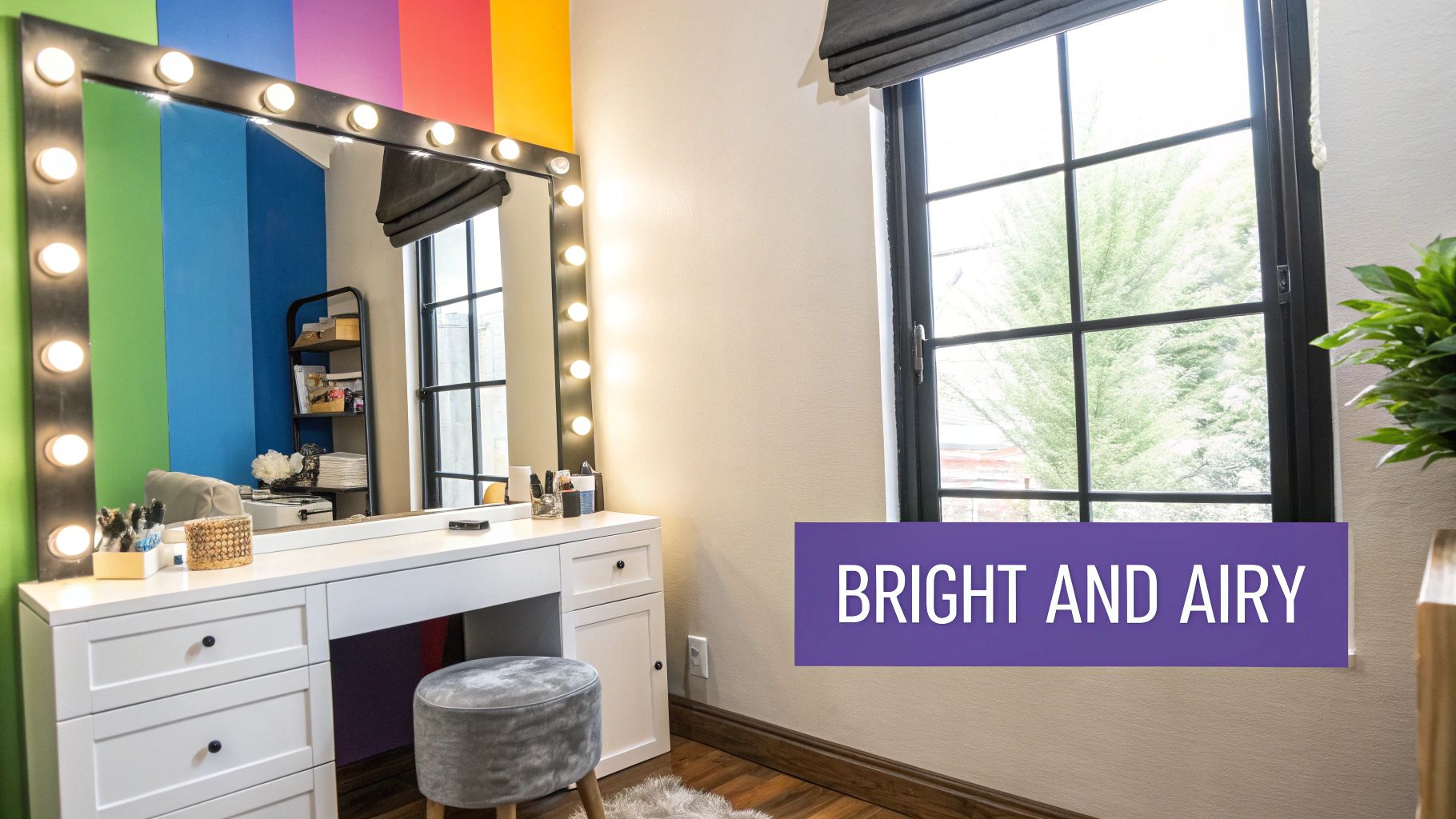
One of the most effective and budget-friendly tools in small space designs is the strategic use of light and color. This approach manipulates perception, using light-hued paint, reflective surfaces, and layered lighting to create an illusion of openness. A well-executed color and light strategy can make a cramped room feel airy, bright, and significantly larger than its actual footprint.
This principle is a cornerstone of many popular American design styles, from modern farmhouse to coastal chic, which prioritize brightness and simplicity. By choosing a light, neutral palette, you create a blank canvas that reflects natural light, pushing the walls back visually and making the ceiling appear higher.
Why It Works for Small Spaces
The primary benefit is visual expansion. Light colors like soft whites and cool grays recede, while dark colors advance. By painting walls in a light, matte finish, you create a sense of depth. Mirrors and metallic accents amplify this effect by bouncing light around the room, eliminating dark corners and creating a more dynamic, inviting atmosphere. This technique transforms a confining space into a comfortable retreat without any structural changes.
How to Implement It
Planning your color scheme is key. Instead of guessing, you can use aiStager to test different paint colors from brands like Benjamin Moore or Sherwin-Williams directly on a photo of your room. In just a few clicks, you can place a new product, like a large, floor-length mirror from CB2, to see how it reflects light before you buy. For a deeper dive, explore our guide to home design color on ai-stager.com.
- Establish a Light Base: Paint walls and ceilings in a cohesive light color, such as a soft off-white or a pale gray, to create a seamless, expansive look.
- Use Mirrors Strategically: Place a large mirror directly opposite a window to double the amount of natural light and create a feeling of depth.
- Layer Your Lighting: Combine ambient lighting (ceiling fixtures), task lighting (desk lamps), and accent lighting (sconces) to ensure the room is well-lit at all times.
7. Lofted Spaces and Mezzanines
For rooms blessed with high ceilings, building upward is one of the most effective small space designs. A lofted space or mezzanine creates a second level within a single room, effectively doubling the usable square footage by capitalizing on vertical volume. This strategy carves out a distinct zone, often for a bed or a quiet home office, without erecting a single wall.
Popularized by the tiny house movement and a staple in converted industrial lofts across US cities, this approach physically separates functions. A sleeping area can be tucked away above, leaving the entire ground floor open for living, dining, and entertaining. This creates a sense of spaciousness that would otherwise be impossible in a compact footprint.
Why It Works for Small Spaces
The core advantage is spatial multiplication. It leverages unused vertical space to add a whole new functional area. This is ideal for studio apartments or tiny homes where separating sleep and life activities is crucial for comfort and organization. It dedicates a specific purpose to an elevated area, decluttering the main living space below.
How to Implement It
Before construction, it's vital to ensure a loft is both practical and safe. You can use aiStager to visualize the concept by adding a 3D model of a loft structure to a photo of your room. This allows you to test the scale, check visual impact, and even experiment with different staircase designs to see how they affect your floor plan, all with true-to-life dimensions. For more inspiration, you can learn more about small loft design ideas on ai-stager.com.
- Check Building Codes: Always consult local regulations regarding mezzanines, headroom requirements, and structural loads before starting.
- Ensure Adequate Headroom: Aim for at least 3-4 feet of space in the loft for comfortable use, and ensure the area below doesn't feel cramped.
- Prioritize Safety: Install sturdy railings and opt for stairs with a handrail over a ladder for any loft that will be accessed daily.
8. Minimalist Design Philosophy
More of a lifestyle than just a style, the minimalist design philosophy centers on the principle of "less is more." This approach to small space designs involves intentionally living with only the things you truly need and love, eliminating clutter to create a serene, highly functional, and visually expansive environment. It is about prioritizing simplicity, quality, and intention over sheer quantity.
Popularized by figures like Marie Kondo and embraced by design-conscious consumers in the US, this philosophy swaps visual noise for calming, open areas. It champions clean lines, a muted color palette, and a focus on essential, often multifunctional, pieces that serve a distinct purpose.
Why It Works for Small Spaces
Minimalism directly combats the primary challenge of a small home: clutter. By consciously curating possessions, you reclaim precious floor and surface area. This creates an illusion of spaciousness and makes the room feel larger, brighter, and more breathable. A minimalist space is also easier to clean and organize, reducing stress and enhancing daily life.
How to Implement It
Adopting minimalism is a gradual process of decluttering and shifting your mindset. It’s less about a stark, empty room and more about making intentional choices that serve your lifestyle within your compact footprint.
- Declutter by Category: Tackle one category at a time, such as books or clothing, rather than one room. This method, advocated by Marie Kondo, prevents you from simply shuffling clutter around.
- Implement a "One In, One Out" Rule: For every new item you bring into your home, an old one must be donated or discarded. This maintains equilibrium and prevents accumulation.
- Digitize and Photograph: Scan important documents and photos to reduce paper clutter. For sentimental items you can't keep, take a high-quality photograph to preserve the memory without taking up physical space.
- Designate a Home for Everything: Every single item should have a specific, designated storage spot. This simple habit makes tidying up effortless and prevents surfaces from becoming drop zones for clutter.
9. Sliding Doors and Pocket Doors
Traditional hinged doors are space hogs. Every time you swing one open, it claims a significant arc of floor space, dictating where furniture can and cannot go. This is where small space designs embrace a sleeker alternative: sliding doors and pocket doors. A pocket door disappears into a compartment in the adjacent wall, while a sliding door glides along a parallel track, completely eliminating the need for swing clearance.
This simple change can dramatically open up a cramped hallway, a tight bathroom entrance, or a small bedroom. Beyond traditional hinged doors, options like clever Sliding Pocket Doors have become a staple in modern American homes for their clean lines and space-saving efficiency, especially the popular barn door style in modern farmhouse designs.
Why It Works for Small Spaces
The core advantage is reclaiming floor area. By removing the door's swing radius, you instantly gain usable square footage. This allows for more flexible furniture placement and creates an uninterrupted flow between rooms. Using a frosted glass or semi-translucent door also allows light to pass through, making adjacent spaces feel brighter and more connected without sacrificing privacy.
How to Implement It
Visualizing the impact of a door style change can be difficult. Before committing to construction, use a tool like aiStager to see the difference. Upload a photo of your room and a link to a sleek barn door from a brand like Wayfair or a minimalist frosted glass pocket door to see how it opens up the space and complements your decor. As the only solution generating hyper-realistic photos with true dimensions, aiStager ensures you see the exact visual impact.
- Check Wall Structure: Pocket doors require a hollow, non-load-bearing wall with enough space to accommodate the door's width.
- Prioritize Quality Hardware: The track and roller mechanism are critical for smooth, quiet operation. Invest in high-quality hardware to prevent sticking or derailment.
- Consider a Soft-Close Mechanism: This feature prevents slamming and is a great safety addition, especially in homes with children.
- Use Glass to Share Light: If privacy is not the top concern, a full-lite glass sliding door can make two small rooms feel like one larger, brighter area.
10. Zone Creation and Furniture Arrangement
In open-concept layouts or studio apartments, creating distinct "zones" is a fundamental principle of effective small space designs. This technique uses furniture, rugs, and lighting to define separate functional areas for living, dining, working, and sleeping without erecting physical walls. By strategically arranging these elements, you can bring a sense of order and purpose to a single room, making it feel larger and more organized.
This approach is heavily featured by designers on platforms like HGTV and popularized by home decor retailers such as West Elm and CB2. A large area rug can anchor a living area, a console table behind a sofa can delineate a dining space, and a tall bookshelf can act as a visual divider for a home office nook.
Why It Works for Small Spaces
The core benefit is psychological separation. By assigning a clear function to each part of the room, you eliminate the chaotic feeling of a single, multi-purpose space. This method adds architectural interest and flow, guiding the eye and movement through the area logically. It allows for maximum use of square footage while maintaining an open, airy feel that walls would destroy.
How to Implement It
Successful zoning relies on thoughtful furniture selection and placement. Before buying anything, use a tool like aiStager to experiment with different layouts. Upload a photo of your space and virtually test how a Crate & Barrel sectional or a particular rug from Article defines the living area. aiStager’s hyper-realistic rendering with true-to-life dimensions ensures your planned arrangement works perfectly in reality. You can explore how different furniture pieces create visual boundaries in just a few clicks.
- Use Rugs as Anchors: Place a distinct rug under your seating area and another under your dining set to create clear visual "rooms."
- "Float" Your Furniture: Instead of pushing all furniture against the walls, pull your sofa into the middle of the room to create a walkway and a natural divider.
- Leverage Lighting: Hang a pendant light over your dining table or place an arc lamp over your seating area to define each zone with its own light source.
Small-Space Design: 10-Item Comparison
| Solution | 🔄 Implementation Complexity | ⚡ Resource Requirements | 📊 Expected Outcomes | 💡 Ideal Use Cases & Tips | ⭐ Key Advantages |
|---|---|---|---|---|---|
| Murphy Beds (Wall Beds) | High — requires structural attachment and professional install | High cost ($1,500–$5,000+), gas struts, wall/ceiling space, professional labor | Frees floor area; enables multi-use room; maintains sleep privacy | Studios, guest rooms, tiny homes — measure ceiling/wall, prefer desk/sofa combos | Maximizes usable floor space; stylish and private |
| Vertical Storage Solutions | Medium — wall anchoring and modular assembly | Low–Medium cost; shelving, anchors, tools; may need studs | Greatly increases storage capacity; clears floors; visually lifts space | Apartments, small rooms — use high shelves for light items, baskets, label bins | Affordable, customizable, makes rooms feel larger |
| Multi-Functional Furniture | Low–Medium — simple to place; mechanisms add complexity | Medium cost (higher for quality); occasional professional assembly | Reduces furniture footprint; adds hidden storage and flexibility | Multi-use rooms and rentals — invest in quality, test mechanisms and weight limits | Space-saving and adaptable to changing needs |
| Open Floor Plans | High — requires wall removal or design planning | Medium–High cost for renovation; possible HVAC/structural work | Amplifies perceived space and natural light; flexible layouts | Lofts, new builds, renovations — use rugs to define zones, ensure ventilation | Creates open sightlines and social connectivity |
| Clever Storage Under Stairs | High — custom carpentry and structural fit | High cost ($2,000–$10,000+), pro carpentry, possible permits | Converts dead space into organized, concealed storage; adds value | Townhouses, multi-level homes — measure rise/run, use pull-outs and integrated lighting | Efficient use of otherwise wasted space; professional finish |
| Light and Color Strategy | Low — paint, mirrors, and lighting adjustments | Low cost; paint, mirrors, layered lighting, dimmers | Perceived larger, brighter spaces; improved mood and function | Any small space — place mirrors opposite windows, use dimmers, sheer curtains | High impact for low cost; renter-friendly and gradual |
| Lofted Spaces & Mezzanines | High — structural build, safety rails, code checks | Medium–High cost ($1,500–$5,000 pro; $500–$1,500 DIY); needs tall ceilings | Effectively doubles usable area; creates distinct zones and storage below | High-ceiling studios, tiny homes — check codes, ensure headroom and ventilation | Significant space gain and visual interest |
| Minimalist Design Philosophy | Medium — behavioral change and selective editing | Low cost overall; may invest in fewer quality items | Reduced clutter, easier maintenance, timeless aesthetic | Anyone seeking simpler living — start by category, use "spark joy" test | Long-term cost savings and reduced visual chaos |
| Sliding Doors & Pocket Doors | Medium–High — track/pocket framing and precise install | Medium cost ($300–$1,000 per door); quality hardware; possible wall mods | Saves door swing clearance; preserves sightlines; modern look | Rooms with tight door clearance — ensure wall cavity fits pocket hardware, use soft-close | Significant floor-space saving and sleek appearance |
| Zone Creation & Furniture Arrangement | Low — planning and placement, minimal construction | Low cost; rugs, lighting, dividers, furniture repositioning | Functional separation without walls; improved flow and usability | Studios and open-plan spaces — use area rugs, separate lighting, bookcase dividers | Flexible, low-cost, quickly reversible solution |
Design Your Space with Confidence, Not Guesswork
Living in a smaller home is no longer about compromise; it’s about smart, intentional design. As we’ve explored, the right strategies can transform a limited floor plan into a dynamic, functional, and deeply personal space. From the transformative power of a Murphy bed to the elegant simplicity of sliding doors, each of these concepts offers a practical solution to a common challenge.
We've seen how vertical storage solutions draw the eye upward, creating a sense of height and order. We've uncovered the hidden potential beneath staircases and celebrated the genius of multi-functional furniture that works as hard as you do. The key takeaway is that effective small space designs are not about magic tricks, but about a thoughtful approach that prioritizes efficiency and style in equal measure. Every decision, from your color palette to your layout, is an opportunity to enhance both the perception and the reality of your space.
From Theory to Reality: The Power of Visualization
Knowing these principles is the first step, but the real breakthrough comes when you can confidently apply them to your own home. The fear of making a costly mistake often leads to inaction. Will that West Elm sectional overwhelm the room? Does that Crate & Barrel loft bed actually fit with your ceiling height? This is where guesswork gives way to certainty.
Visualization tools are critical, but not all are created equal. This is where aiStager distinguishes itself as an indispensable resource. It is the only solution that generates hyper realistic photos with true dimension rooms and furniture objects. Forget abstract 3D models; this is about seeing real products in your real space.
Test, Tweak, and Transform
Imagine you’re deciding between two different styles of multi-functional sofas. With aiStager, you don’t have to guess. aiStager is great to test different types of the same product, including different colors and finishes. Simply upload a photo of your living room and a link to each product. In just a few clicks, you can see exactly how each one looks, comparing colors, fabrics, and scale with unparalleled realism. This powerful capability allows you to experiment with bold small space designs risk-free, ensuring every piece you choose is a perfect fit. You can finally move forward with your design plans, backed by a clear vision of the stunning final result.
Ready to stop guessing and start designing? Bring your vision to life with the only tool that offers true-to-life dimensional accuracy. Try aiStager today and see how your favorite furniture looks in your home before you spend a single dollar.