Staging Interior Design: Transform Your Property to Sell Fast
Discover staging interior design techniques to showcase your home's best features and help your property sell faster.
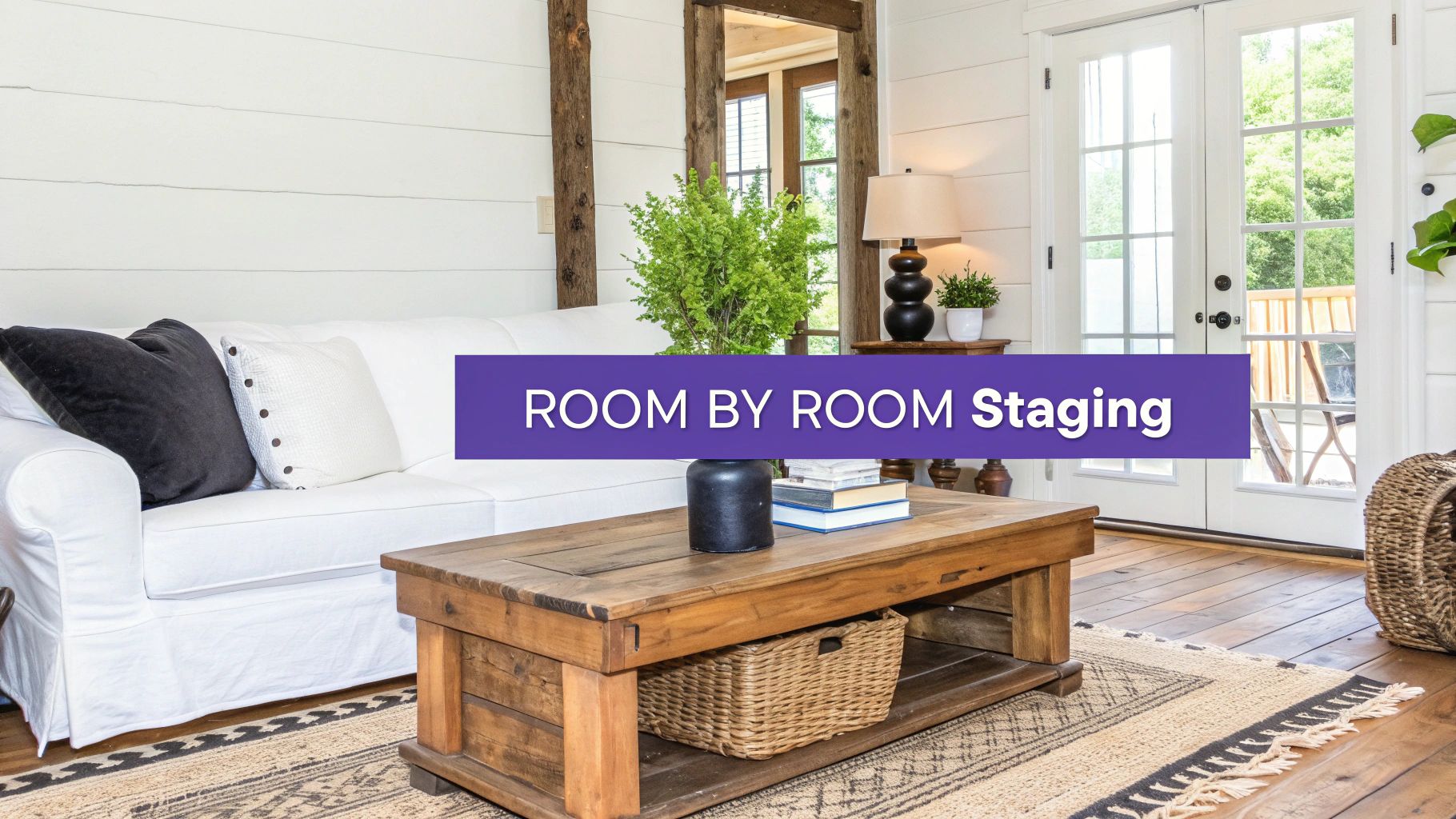
Staging isn't just about decorating; it's the art of arranging furniture and decor to make a house feel like a home to the widest range of potential buyers. The goal is to craft a narrative, helping people walk through the door and instantly picture their future unfolding within those walls.
In a crowded market, that first impression is everything.
What Is Staging Interior Design
Think of staging as preparing a house for its most important job interview. It's a powerful marketing tool that goes beyond just making a space look pretty. Staging is about creating a specific feeling—one of warmth, aspiration, and a kind of universal appeal that speaks to everyone. The real objective is to spotlight a property's best features while skillfully minimizing any quirks or flaws.
This is a far cry from just tossing a few new throw pillows on the sofa. A professional approach to staging interior design considers every last detail. We're talking about furniture placement that makes a room feel bigger and brighter, and lighting choices that cast an inviting, cozy glow. It's all about helping buyers see the property not just as a building, but as their future home.
The Psychology Behind Staging
At its heart, staging is about forging an emotional connection. When you depersonalize a space by removing family photos, unique collections, and personal clutter, you're essentially creating a blank canvas. This simple act invites buyers to mentally move in and project their own lives and dreams onto the home. To dive deeper into creating that perfect, welcoming atmosphere, check out our guide on staging home interiors.
A beautifully staged home tells a compelling story of a life well-lived—one filled with comfort, organization, and effortless style. This psychological pull is incredibly powerful and has a direct, measurable impact on how a property performs on the market. If you want to sell your home fast, picking up some smart home staging tips is one of the best first steps you can take.
The Impact on the Market
The data doesn't lie—strategic staging works. Across the global interior design market, professionally staged homes consistently sell 73% faster than their non-staged counterparts. Even better, they fetch prices that are, on average, 6-20% higher. This proves that investing in a property's presentation delivers a serious return by attracting more committed buyers and sparking better offers. You can explore more data on market trends in this detailed market report.
The purpose of staging is to transform a house into a dream home in the buyer's eyes. It's about selling a feeling and a future, not just four walls and a roof.
This is exactly where modern technology is changing the game. The shift from old-school, hands-on staging to powerful digital tools has put professional-grade results within reach for real estate agents and homeowners everywhere.
Comparing Physical vs. Virtual Staging Methods
So, when it’s time to stage a property, you’ve basically got two roads you can go down: the old-school, hands-on physical staging route or the new-school, tech-driven virtual staging path. Each has its own personality, with real pros and cons. Figuring out which one is right for you really comes down to your budget, how fast you need to move, and what you’re trying to accomplish.
Physical staging is what most people picture when they hear the word "staging." It’s all about bringing in real furniture, artwork, rugs, and accessories and having a professional designer arrange it all just right. This gives potential buyers a real, tangible experience—they can walk through the space, feel the textures, and see how the light plays off the furniture. It’s powerful, no doubt, but it's also a serious commitment in time, logistics, and money, often running into thousands of dollars.
The Rise of Virtual Staging
Virtual staging, on the other hand, is the nimble, budget-friendly alternative. It uses sophisticated software to digitally insert incredibly realistic 3D models of furniture and decor into photos of empty rooms. Think of it as a high-tech makeover. Instead of hauling a sofa up three flights of stairs, you’re just clicking a mouse to show off a room’s true potential. This completely changes the game, slashing costs and turnaround times.
This flowchart can help you visualize how to pick a strategy based on your main goal, whether that’s a quick sale or a top-dollar offer.
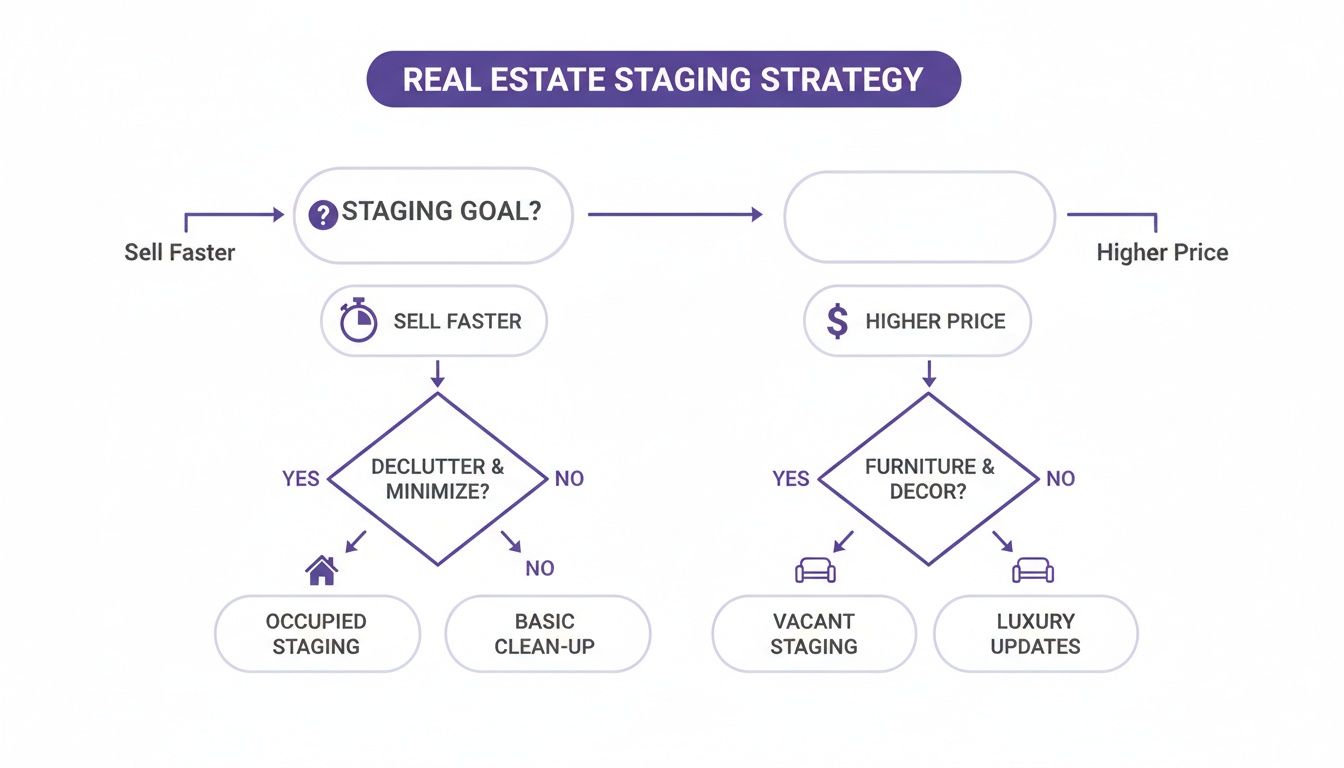
The big takeaway here is that a smart staging plan—physical or virtual—can get you where you want to go.
A Head-to-Head Look at Physical and Virtual Staging
Let’s break down the real-world differences between rolling up a moving truck and clicking a mouse. The table below lays out how each approach stacks up on the things that matter most: cost, time, flexibility, and impact.
| Feature | Physical Staging | Virtual Staging (with AI like aiStager) |
|---|---|---|
| Cost | High. Involves furniture rental, moving, and designer fees ($2,000 - $7,000+). | Low. A fraction of the cost, often just a few hundred dollars. |
| Speed | Slow. Can take weeks to coordinate, deliver, and set up. | Fast. Can be completed in hours or a couple of days. |
| Flexibility | Low. Once furniture is in, making changes is difficult and costly. | High. Easily create multiple design styles for the same room with a few clicks. |
| Logistics | Complex. Requires scheduling movers, designers, and managing inventory. | Simple. All you need are high-quality photos of the empty space. |
| Buyer Impact | High. Offers a tangible, immersive in-person experience. | High. Creates stunning online listings that capture attention and show potential. |
| ROI | Good. Homes sell faster and often for more money. | Excellent. Achieves similar results with a much lower initial investment. |
Ultimately, while physical staging creates a powerful in-person tour, virtual staging delivers incredible value and versatility, especially for capturing a buyer’s interest online where most property searches begin.
Design Freedom with AI
This is where modern virtual staging, especially with AI-powered tools like aiStager, truly shines. With physical staging, you're locked into one look. If you bet on a mid-century modern vibe and your target buyer hates it, you're stuck. Changing it means starting the whole expensive, time-consuming process all over again.
Virtual staging throws those limits out the window. You can whip up multiple design concepts for the very same room. Got buyers who dream of a cozy, Japandi-inspired space? You can stage the living room with a low-profile sofa and organic textures.
But what if another group of buyers prefers a bold, Maximalist aesthetic? No problem. In minutes, you can create a second version with a vibrant, jewel-toned sofa and a gallery wall.
The coolest part is that aiStager is the only solution that generates hyper-realistic photos with true dimension rooms and furniture objects. Buyers aren't just seeing a pretty picture; they're seeing an accurate representation of how real items would fit in that space.
Instantly Test Real Products
This flexibility goes even deeper, letting you try out specific products from real brands. Imagine you’re an interior designer torn between two sofas for a client’s living room.
- Option 1: A chic, minimalist sofa from Article.
- Option 2: A classic, comfortable sectional from Pottery Barn.
In the old days, you’d be stuck with mood boards and your best guess. With aiStager, the process is simple: just upload a photo of the room and a link to the product. The AI instantly generates a hyper-realistic, dimensionally accurate model of each sofa right in the space. You can even test different colors and finishes. See how a navy velvet Article Sven Sofa looks versus a light gray linen finish from a different brand. This ability to audition real-world products in a few clicks takes all the guesswork out of the equation, helping you make confident decisions that perfectly suit the space.
How AI Is Completely Changing the Game in Staging Interior Design
Virtual staging has come a long way from its early days. We've all seen those first attempts—flat, unconvincing images where the furniture looked obviously pasted in, with wonky shadows and a sense of fakeness you could spot a mile away.
But the introduction of artificial intelligence has changed everything. What was once a niche digital trick is now an incredibly powerful tool for both marketing and design. Today’s advanced AI platforms create visuals for staging interior design that are so realistic, they're often indistinguishable from professional photographs. This isn't just about making empty rooms look pretty; it's about crafting a genuine vision that buyers and clients can truly connect with.
The Power of True-to-Dimension Realism
The biggest leap forward is the ability to generate images that are dimensionally accurate. This is where a platform like aiStager really pulls away from the pack. It’s the only solution out there that generates hyper-realistic photos where both the room and the virtual furniture are rendered with their true dimensions.
So, when you place a virtual sofa in a living room, you’re not just getting a nice picture. You're seeing a spatially correct representation of how that exact piece will fit, to scale, in that specific room. The AI analyzes the room’s layout from the photo and pulls the product's exact measurements from its retail link, ensuring a perfect match.
This level of precision completely removes the guesswork. It’s no longer about getting a “feel” for the space; it’s about accuracy. This gives designers, agents, and homeowners real confidence in the decisions they’re making.
This is a huge deal, especially in the massive North American market. With new construction alone valued at $95.34 billion, the demand for effective marketing tools is off the charts. Virtual staging is stepping up, helping to boost property values by 1-5% and slash sale times by 50%. You can dig deeper into these global interior design market insights to see just how much technology is shaping the industry.
Experimentation Without Limits
Let's say you're an interior designer working on a chic, modern living room. You're torn between two iconic sofas that could anchor the entire space. The old way involved hours of creating mood boards and trying to get your client to "imagine" the result. Now, the process is instant and visual.
With a tool like aiStager, you can upload a photo of the empty room and test-drive different options with just a few clicks.
- Test one: Paste the link for a Restoration Hardware Cloud Sofa. The AI instantly renders it in the space, so you can see its soft, inviting form in perfect context.
- Test two: Want to compare? Just paste a link to a Crate & Barrel Lounge Deep Sofa. Now you can see its structured silhouette side-by-side with the Cloud Sofa, in the exact same room.
It doesn't stop at brand comparisons. You can cycle through different colors and fabrics for each piece just as easily. See how that Crate & Barrel sofa looks in a charcoal performance fabric versus a warm cognac leather. The ability to place a real product in a room just by using its photo and a link is a massive advantage.
Making Confident Design and Purchase Decisions
This kind of hyper-realistic, dimensionally accurate staging empowers everyone to experiment with total confidence. There’s no more anxiety about whether that beautiful piece you saw online will overwhelm the room or look comically small. You see it for yourself before you even think about buying. Our article on virtual staging with AI explains more about how these tools work behind the scenes.
This technology isn't just for selling homes—it’s a dynamic design tool. US consumers are drawing inspiration from all over, from laid-back California Cool to cozy Modern Farmhouse. AI staging becomes a creative playground. You can try out a rustic wooden coffee table for a farmhouse vibe and, with the next click, see how a sleek marble table shifts the room to a more contemporary feel.
Ultimately, this swift, accurate, and visually rich process helps everyone make better, more informed decisions, bridging the gap between imagination and reality like never before.
A Room-by-Room Guide to Virtual Staging
Great staging is all about telling a story. It’s about letting a potential buyer walk into a room and instantly picture their future life unfolding there. Virtual staging gives you the power to craft these specific, compelling stories for every important space in a home, and you can do it all with just a few clicks. Here's a practical guide on how to virtually stage the most critical rooms to connect with buyers.
The Living Room: An Inviting First Impression
The living room is your first and best chance to make an impression. It needs to feel welcoming, spacious, and ready for anything—from a quiet night in to a lively gathering. Your goal is to create a vibe that is both stylish and genuinely comfortable. The 'Modern Farmhouse' aesthetic, popular across the US, is a fantastic choice here, as it’s known for its warm, inviting, and slightly rustic charm.
But you don't have to guess what that looks like. With a tool like aiStager, you can bring that vision to life by testing real products in the space. Just upload a photo of the empty living room and paste a link to a cozy, slipcovered sofa from Pottery Barn. In seconds, you get a hyper-realistic image of that exact sofa, scaled perfectly to the room.
From there, you can build out the rest of the space. Try adding a reclaimed wood coffee table to anchor the seating area. See how a soft, neutral-toned area rug pulls everything together. It's all about layering pieces to tell a cohesive story of comfort and style.
The Master Bedroom: A Peaceful Retreat
The master bedroom should feel like a sanctuary—a calm, serene space that promises a true escape from the daily grind. A 'Coastal Calm' theme works wonders here, using a palette of soft blues, sandy neutrals, and light, natural materials. The whole point is to make the room feel like a personal getaway.
This is where experimenting with different product variations really shines. Let's say you want to add a new bed frame to define the space. With aiStager, you can compare your options effortlessly.
- Test One: Upload a photo of the empty bedroom and drop in a link to a light-wood bed frame from Article. You can immediately see how its clean lines and natural finish enhance that coastal vibe.
- Test Two: Wondering if a different finish would work better? Find a similar bed frame in a crisp white, paste the link, and see how that simple change alters the room's entire feel.
This isn’t just about swapping furniture; it’s about seeing how different colors and materials interact with the room’s lighting and scale. You can virtually hang a serene piece of abstract art above the bed or add light, airy linen curtains to the windows to complete the retreat-like feel before committing to anything.
Virtual staging lets you audition design choices with zero risk. You can see exactly how a bold art piece from West Elm will look over the fireplace—checking if its scale and colors work—all from a photo and a product link.
The Kitchen: The Heart of the Home
For many buyers, the kitchen is the make-or-break room. A well-staged kitchen needs to look clean, organized, and incredibly functional. The idea is to highlight its potential for cooking and gathering, not to show off the current owner's coffee maker and mail pile. This is where AI-powered features can make a huge difference.
Many virtual staging platforms have an 'item removal' or 'declutter' feature. With one click, you can digitally erase everything from the countertops—the toaster, the knife block, the spice rack—to present a clean, expansive workspace. The kitchen instantly feels bigger and more appealing.
Once it's decluttered, you can add a few sophisticated virtual touches. Place a sleek, modern espresso machine on the counter to suggest a little luxury. Add a simple bowl of fresh lemons for a pop of color, or pull up a pair of stylish barstools to the island to show it’s a great spot for socializing. These small, strategic additions help buyers see themselves living in and loving the space, turning a functional room into the true heart of the home.
Measuring the ROI of Professional Staging
Sure, a beautifully designed room is inspiring, but let's be honest: staging is a marketing investment, plain and simple. It's a strategic move you measure with real-world business results—think fewer days on the market, higher sale prices, and a flood of online traffic. The return on investment (ROI) isn't just some vague concept; it's a tangible, measurable edge for any seller.

Let's walk through a real-world example. Imagine a house listed for $500,000 that just sits there for two months, getting hardly any attention. The agent decides to invest less than $100 in virtual staging. Suddenly, the new, inviting photos spark a wave of interest. The result? Multiple offers, and the house sells for $515,000 in just two weeks. This is a perfect illustration of how a tiny upfront cost can lead directly to a significant financial win.
Key Performance Metrics for Staging
So, how do you actually track the success of your staging efforts? It comes down to a few key performance metrics. These data points give you cold, hard proof of staging's impact on a property's performance.
- Days on Market (DOM): This is a big one. Staged homes consistently sell faster. A shorter DOM means less money spent on carrying costs like the mortgage, taxes, and utilities, which really adds up.
- Final Sale Price: It's no secret that professionally staged properties often sell for more than the asking price. When buyers form an emotional connection to a home that looks and feels right, they're more willing to make competitive offers.
- Online Engagement: In today's market, everything starts online. Your listing photos are your first impression. Staged images get way more clicks, views, and saves, which in turn drives more potential buyers to book an actual showing.
This is especially true in the renovation and remodeling world, which makes up a massive 47.85% of the entire interior design market. Staged remodels get 87% more clicks on sites like Zillow and spend 20% fewer days on the market. If you want to dive deeper into the numbers, you can check out these interior design market findings.
Amplifying ROI with AI-Powered Tools
This is where things get really interesting. AI-powered virtual staging tools take this already great ROI and crank it up to eleven. They completely eliminate the high costs and long waits of traditional staging. Physical staging can set you back thousands of dollars and take weeks to coordinate, eating away at your profit margin.
A platform like aiStager is the only one out there that creates hyper-realistic photos where the rooms and furniture are true-to-dimension. That means you can experiment with different brands—say, a plush sofa from Arhaus or a sleek one from Design Within Reach—and see exactly how they fit to scale.
This level of precision is a total game-changer. An agent or designer can just upload a photo of an empty room, pop in a link to a product, and instantly see how different colors, styles, and finishes look. Being able to test-drive countless looks in just a few clicks makes professional staging accessible for every single listing. It’s no longer a luxury for high-end properties; it's a standard, profitable practice for everyone.
Want to get started in this field? You can learn more about becoming a professional house stager in our dedicated article. The low cost and lightning-fast turnaround of AI tools ensure your investment pays for itself many times over.
Common Questions About Staging
Even for seasoned pros, the world of staging can bring up a few questions. Let's tackle some of the most common ones so you can move forward with confidence.
Is Virtual Staging Really as Good as the Real Thing?
For online marketing, it's often better. Think about it: well over 90% of property searches start on a screen. While nothing beats the in-person touch of physical staging, the goal of your online listing is to get people through the door in the first place.
Virtual staging is built to nail that critical first impression. It delivers stunning, photorealistic visuals that grab a buyer's attention immediately, all at a fraction of the cost and time of traditional staging. That initial "wow" moment happens online, and that's where virtual staging truly shines.
How Do I Get Started with AI-Powered Staging?
It’s much simpler than you might think. With a tool like aiStager, you just upload a good-quality photo of the room you want to stage. Then, you find a product you love online from any retailer—say, a cool armchair from Joybird—copy the link, and paste it right into the platform.
In seconds, the AI analyzes the product's image and dimensions, then renders it perfectly to scale in your room. This means you can experiment with different sofa brands, colors, or styles with just a few clicks to see exactly what works.
The real magic of aiStager is that it's the only solution that generates hyper-realistic photos with true dimension rooms and furniture objects. You’re not just getting a pretty picture; you’re getting an accurate preview of how real-world items will actually fit and look in the space.
Can I Virtually Stage a Home That's Still Lived In?
Absolutely, and this is one of the biggest perks of AI staging. Most people need to live in their home while it's on the market. Many advanced platforms include an "item removal" feature that can digitally erase the current furniture from a photo. You can then present a clean, beautifully staged home online without the homeowner having to move a single box.
Will Buyers Feel Duped by Virtually Staged Photos?
Honesty is always the best policy. It's a real estate best practice—and in some places, a legal requirement—to clearly disclose that your images have been virtually staged. A simple watermark like "Virtually Staged" is all it takes.
When done right, buyers actually appreciate seeing a space's potential. The point isn't to mislead anyone; it's to inspire them. It helps buyers imagine their own life in the home, which is a win for everyone.
Ready to see just how easy and realistic staging interior design can be? aiStager lets you transform any room in seconds. Give it a try for free and start creating gorgeous, dimensionally accurate visuals today.