A Guide to the Best Virtual Staging Companies and Services
Discover the top virtual staging companies. Learn how AI is changing real estate marketing and how to choose the right partner to sell homes faster.
When you're trying to sell a home, those first online photos are everything. A virtual staging company gives you a powerful tool to make those photos count, digitally furnishing empty rooms to make them feel warm, inviting, and full of potential. Think of it as a digital makeover for a house, helping buyers fall in love with a space before they even walk through the door.
What Is Virtual Staging
Ever tried to sell a house with completely empty rooms? It's tough. Buyers scroll through listings, and all they see are blank walls and bare floors. It’s hard for them to picture their own lives there, to imagine where the couch would go or what the bedroom might feel like.
This is exactly the problem virtual staging was born to fix. It digitally adds stylish furniture, decor, and even art into photos of vacant properties. Suddenly, an empty space becomes a potential home.
Instead of the hassle and expense of traditional staging—renting furniture, hiring movers, and spending days setting everything up—virtual staging gets the job done quickly and for a fraction of the cost. It turns a blank canvas into a compelling vision.
From Manual Artistry to Instant AI
The technology behind this has come a long way. The first virtual staging services were all done by hand. Digital artists would meticulously build 3D models of rooms and place each piece of furniture one by one. The results were great, but it was a slow, expensive process that could take days.
Today, AI is changing the game. Platforms like aiStager are at the forefront, creating stunningly realistic images with furniture that's perfectly scaled to the room. Want to see how a chic, minimalist Restoration Hardware cloud sofa looks in the living room? Or maybe a cozy, traditional Pottery Barn armchair would be a better fit? You can try out different styles that resonate with US buyers in seconds.
The real magic of modern AI is the freedom to experiment. You can swap out brands, test different colors, and play with various finishes with just a few clicks. With aiStager, all it takes is a photo of the room and a product link to instantly see how a new item fits into the space.
This shift isn't just a trend; it's a massive market movement. The global virtual staging market hit $388 million in 2024 and is expected to soar to $1,906 million by 2031. Why the boom? It’s simply a smarter, more cost-effective way to market a property compared to physical staging, which can easily run into thousands of dollars.
Of course, virtual staging is just one piece of the puzzle. It works best when combined with other essential home staging tips for sellers that get a property ready for the market. To learn more about how this technology works, check out our deep dive on what is virtual staging.
Understanding Different Virtual Staging Methods
Not all virtual staging is created equal. The technology a company uses to place furniture into your photos directly shapes the final image's quality, how fast you get it back, and what you’ll pay. Knowing the difference helps you pick the right partner for your project.
Think of it like getting a portrait done. You could hire a master painter for a classic, time-intensive oil painting (that's like Manual 3D Rendering). You could get a graphic artist to create a quick digital composite (Photo-Based Editing). Or, you could use an advanced AI to generate a photorealistic image in a flash. Each method has its pros and cons.
This chart shows how virtual staging fits into the bigger picture as a powerful digital alternative to traditional, physical home staging.
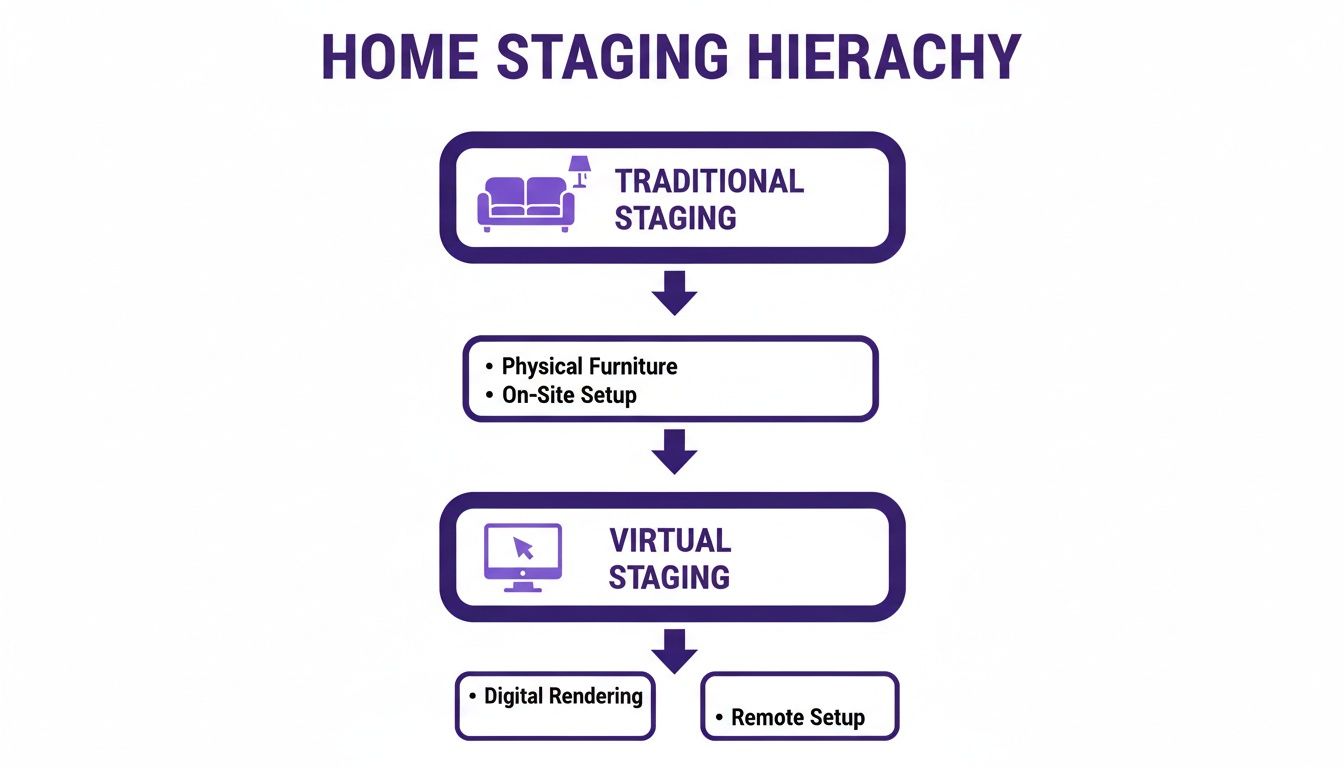
As you can see, it sidesteps the logistical headaches and high costs of moving real furniture around. Let's break down the main ways virtual staging gets done.
Manual 3D Rendering: The Artisan Approach
Manual 3D rendering is the old-school, original method. It's a highly artistic process where digital artists use sophisticated software to build a room from the ground up as a 3D model. They meticulously add furniture models, tweak lighting, and create realistic textures to produce a truly stunning image.
The results can be breathtaking—often looking like something straight out of an architectural magazine. But this level of detail comes at a cost. The process is slow and labor-intensive, with turnaround times often taking 24 to 72 hours or even longer. Since it relies on a skilled artist’s time, it’s also the most expensive option, sometimes running $75 to $200 per photo.
Photo-Based Editing: The "Cut-and-Paste" Method
A faster, more budget-friendly option is photo-based editing, which usually involves programs like Adobe Photoshop. Here, a designer takes your 2D photo of an empty room and simply layers 2D images of furniture on top of it.
While it’s much quicker than building a full 3D scene, the biggest challenge is realism. It's incredibly difficult to perfectly match the lighting, shadows, and perspective of the furniture with the room's photo. The final image can often look a bit flat or "off"—like someone just placed stickers on a picture.
AI-Powered Virtual Staging: The Instant Solution
The newest and most exciting player in the game is AI-powered virtual staging. This technology uses smart algorithms to analyze a photo of a room, instantly understanding its dimensions, lighting, and perspective. From there, it can realistically insert furniture in a way that looks natural and convincing.
This is where platforms like aiStager are changing everything. It's currently the only tool that generates hyper-realistic photos using true-to-dimension rooms and furniture. While other services pull from a limited library of generic 3D models, aiStager gives you incredible freedom and precision.
Imagine you’re trying to attract a luxury buyer and want to showcase different high-end sofas. With aiStager, you can upload a photo of the living room and, in a few clicks, drop in a specific Restoration Hardware Cloud Sofa. Not the right color? Instantly swap it for a different fabric.
Want to see how a sleek, Mid-Century Modern sectional from West Elm would look instead? Just provide a link to the product, and the AI generates a new, perfectly scaled visual in seconds. This power to test-drive real products from any brand, with accurate colors and materials, is something older methods just can't do. All you have to do is upload a room photo and a product link to place any real-world item in the space.
Comparing Virtual Staging Methods
To make it easier to see the differences, here’s a quick side-by-side comparison of the three technologies.
| Method | Realism & Accuracy | Average Turnaround | Typical Cost Per Image | Best For |
|---|---|---|---|---|
| Manual 3D Rendering | Very High | 24-72 Hours | $75 - $200+ | High-end architectural visualization and print marketing where budget and time are not primary concerns. |
| Photo-Based Editing | Low to Medium | 4-24 Hours | $15 - $40 | Quick, low-cost staging for budget listings where a "good enough" visual is all that's needed. |
| AI-Powered Staging | Very High | Seconds to Minutes | $7 - $15 | Real estate agents and marketers needing fast, affordable, and highly realistic results with maximum customization. |
Ultimately, AI-powered staging delivers the best of both worlds: the stunning quality once reserved for 3D artists, but at the speed and scale that modern real estate demands.
What's the Real-World Payoff of Virtual Staging?
Sure, virtual staging produces beautiful pictures, but the real test is whether it actually helps you sell a property. For real estate professionals, it’s not just about pretty photos—it’s about turning those online views into faster sales and better offers. Think of it as a strategic marketing tool that directly boosts your bottom line.
Empty rooms leave potential buyers feeling cold. It's hard for them to connect emotionally or imagine their own life unfolding there. But a well-staged photo? That tells a story. It helps a buyer see themselves hosting a dinner party or relaxing on the couch, transforming a sterile property viewing into an experience they want to be a part of. This is what gets you more clicks, more saves, and more calls for a showing.

Driving Faster Sales at Higher Prices
The numbers really do tell the story here. Time and again, data shows that staged homes don't just sell faster; they often sell for more money. By showing a home that looks move-in ready, you remove the guesswork for buyers and make the property feel more valuable from that very first glance.
This is where the new wave of virtual staging companies truly shines. For example, using a platform like aiStager gives you an incredible amount of control. An agent can instantly furnish a living room with a specific, on-trend Article sofa to catch the eye of a younger buyer, or swap in a classic Crate & Barrel dining set to appeal to a family. That kind of targeted design is a massive marketing advantage.
At its core, the benefit is simple: a beautifully staged home gets more attention. More attention creates more competition among buyers, and that competition often leads to better offers and a much quicker sale.
Breaking Down the Return on Investment
Maybe the most convincing reason to use virtual staging is its incredible return on investment, especially when you stack it up against physical staging. The cost and time savings are huge. Traditional staging can easily cost an average of $3,500 per listing in the U.S., and that doesn't even account for the hassle of moving furniture around.
Virtual staging, on the other hand, can cut those costs by up to 90%. A recent study found that listings using AI-powered enhancements got a 72% jump in online traffic and a 44% increase in qualified buyer inquiries. The result? A 20-30% reduction in time on the market.
The low cost makes virtual staging a no-brainer. You can see a full analysis in our guide to the cost to stage a house.
It’s Not Just for Interiors Anymore
This kind of digital visualization isn't just for living rooms and kitchens. In the same way virtual staging unlocks the potential of interior spaces, AI-driven exterior home design visualizer tools are changing the game for curb appeal. Homeowners can now see how a new paint color or landscaping will look before committing, avoiding expensive mistakes.
For real estate agents, this means you can show off the entire property's potential. By making a small investment in high-quality digital staging for both the inside and out, you’re no longer just selling a building—you’re selling a fully-imagined home and the lifestyle that comes with it.
How to Choose the Right Virtual Staging Partner
Finding the right virtual staging company can feel like a huge task, but it gets a lot easier once you know what to look for. The goal is simple: find a partner who creates stunning, believable visuals that help a buyer truly see themselves in a home. The best companies are the ones that nail realism, work fast, and are flexible.
The first place to start is their portfolio. Look for sharp, high-res images where the lighting on the digital furniture perfectly matches the light in the room. You can spot poorly done staging a mile away if you know what to look for—shadows falling the wrong way, furniture that seems to float just off the floor, or a sofa that's comically large or small for the space. A pro's work should make you do a double-take; you shouldn't be able to tell it from a photo of a physically staged room.

Key Questions for Vetting Virtual Staging Companies
To really understand what a company offers, you have to ask the right questions. Don't be afraid to get specific—their answers will tell you everything about their process and how much they value their clients. A good partner will be upfront and confident.
Here are a few essential questions to ask any company you're considering:
- What’s your average turnaround time per image? Real estate moves fast. You need someone who can get you high-quality images quickly, not leave you waiting for days.
- Do you offer free revisions? Even with perfect instructions, you might want to change something. It's crucial to know their revision policy ahead of time to avoid surprise fees.
- What interior design styles can you handle? Your listings will be diverse, so your staging partner needs to be able to pull off anything from Modern Farmhouse to sleek Minimalism to appeal to different buyers.
The Decisive Factor: Brand and Product Flexibility
Beyond those basics, there's one thing that really separates the great services from the merely good ones: the ability to use real-world products in their designs. Many virtual staging companies pull from the same limited library of generic 3D furniture models. This often results in cookie-cutter designs that feel uninspired and don't connect with a specific buyer's taste.
This is where a tool like aiStager completely changes the game. It’s the only platform that generates hyper-realistic photos using true dimension rooms and furniture objects. This capability blows the doors off traditional virtual staging. You’re no longer limited to generic assets; you can use any product from any brand.
Imagine you want to test two completely different vibes for a dining room. With aiStager, you can upload a photo of the empty room and just drop in a link to a specific Crate & Barrel dining table. In moments, you get a photorealistic image. Want to see how it compares to another style? Grab a link to a rustic Pottery Barn bed for the primary suite and see a whole new vision come to life.
This level of freedom lets you create truly custom, shoppable spaces. You can A/B test different products, play with various brands, colors, and finishes, and find the absolute perfect fit for a listing. It’s an unmatched flexibility that lets you tailor your marketing to specific buyers, creating visuals that aren't just pretty but are genuinely aspirational and authentic.
The Rise of Self-Serve AI Staging Platforms
Virtual staging isn't what it used to be. For years, the process was simple but slow: you'd send your photos off to a company, cross your fingers, and wait for the results. But that old agency model is quickly being replaced by a new wave of self-serve AI platforms that put you, the agent or marketer, in the driver's seat.
This isn't just a minor update—it's a fundamental shift in control. Instead of being a passive client waiting on revisions, you become the creative director. These tools give you a hands-on experience, cutting out the endless back-and-forth emails and creative compromises that defined the old way of doing things. You're no longer just ordering a service; you're wielding a powerful marketing tool in real time.
The appeal is its sheer simplicity and speed. The workflow is about as direct as it gets: upload a picture of an empty room, find a piece of furniture you love online, and let the AI handle the rest.
Instant Creative Control and Unbelievable Realism
The biggest win with self-serve platforms? The freedom to experiment without penalty. With a traditional staging company, every single revision adds time and, often, extra cost to the project. AI platforms, on the other hand, encourage you to play around and explore different looks on the fly.
Let's say you're staging a downtown condo for a young professional who loves modern, minimalist decor. You can pop a photo of the empty living room into the platform and, in just a few clicks, place a sleek leather armchair from Article. The AI doesn't just crudely paste a 2D image onto your photo. It generates a new rendering that actually understands the room's lighting, perspective, and scale.
This is where aiStager really pulls away from the pack. It’s the only tool that can generate hyper-realistic photos using true dimension rooms and furniture objects. That means the armchair from Article won't just look nice—it will look like it truly belongs there, giving buyers a convincing sense of how the space actually feels.
This level of precision takes the guesswork out of staging and creates visuals that are nearly impossible to tell apart from a professional photoshoot. You can explore a variety of other options in our guide to the best virtual home staging software.
Test Real Products and Finishes in Seconds
This creative freedom goes way beyond just placing a single chair. Self-serve AI is perfect for A/B testing different design styles to figure out what will connect with your target buyer.
Maybe you're not sure which sofa brand would best suit a family-friendly vibe. With a tool like aiStager, you can try out different options in a matter of moments.
- Step 1: Upload your living room photo.
- Step 2: Paste the link to a big, comfy sectional from a brand like Joybird.
- Step 3: Not quite right? No problem. Grab a link to a durable, stylish option from Crate & Barrel and generate a whole new version in seconds.
This process lets you dial in every last detail. You can even test the same sofa in different fabrics or colors—a light beige versus a dark gray—to find the perfect match for the room's mood. The ability to visualize real-world products instantly turns an empty listing into a dynamic, shoppable showcase.
More Than Just Dropping in Furniture
The best platforms have evolved beyond just adding furniture. Tools like aiStager are now a complete suite for visual marketing, packed with features that solve everyday real estate photography headaches.
- AI-Powered Decluttering: Got photos of a furnished room that’s a bit of a mess? The AI can digitally clear out all the clutter, giving you a clean slate to work with.
- Restyling Existing Items: Instead of removing everything, you can change the color or material of an existing piece of furniture to instantly update the room's look.
- Instant Layout Previews: Not sure where the couch should go? Quickly test different furniture arrangements to find the layout that best shows off the room's space and flow.
By bringing all these features together, agents and designers can finally take charge of the entire visual marketing process themselves. This hands-on approach delivers immediate results, cuts down on costs, and offers a level of creative freedom that traditional virtual staging companies just can't match.
It’s Time to Stage Smarter, Not Harder
We've walked through the evolution of property marketing, from the slow and costly world of physical staging to the lightning-fast, budget-friendly power of AI. Virtual staging isn't just some passing trend for the tech-forward agent anymore; it’s quickly becoming the new normal for selling homes in our digital world.
What we're really talking about is the power to make a buyer fall in love with a home before they even set foot inside. That’s a serious competitive edge. Those who get on board with this aren't just decorating rooms—they're crafting visual stories that grab a buyer's attention from the very first scroll.
Your New Marketing Playbook
Forget waiting weeks for a staging company or dropping thousands on rental furniture. The ability to completely transform a listing is now sitting right in your pocket. All you need is a photo and a vision to start experimenting with designs that speak directly to your target audience.
Think about it. You could showcase a living room with a sleek, modern sofa from West Elm to catch the eye of a city-dweller. A few clicks later, you could swap it for a comfy, oversized sectional from Joybird to appeal to a growing family. That kind of real-time, flexible marketing was pure science fiction just a handful of years ago.
The secret sauce behind platforms like aiStager is how they create such believable images. By using true dimension rooms and furniture objects, everything looks like it was made for the space, giving buyers a genuine feel for what their new home could look like.
See for Yourself with aiStager
Why tell buyers about a home's potential when you can show them, instantly? With the right tool, you can test drive different layouts, play with colors, and find the perfect vibe for any listing in a matter of minutes. It’s about replacing guesswork with great visuals.
The old way is officially outdated. Experience how simple and powerful aiStager can be. Stop wondering what might resonate with buyers and start creating stunning, realistic images that do the selling for you.
Your next sale is just a few clicks away. It’s time to step into the future of property marketing.
Your Top Virtual Staging Questions, Answered
If you're new to virtual staging, you probably have a few questions. It's a game-changer for marketing properties, but it's natural to wonder about the ethics, costs, and technology behind it. Let's clear things up.
Is Virtual Staging Misleading to Buyers?
This is the number one concern I hear from agents, and it's a fair one. The short answer is no—as long as you're transparent about it. The point isn't to pull a fast one on a potential buyer; it’s to spark their imagination.
Think of it like an architect's rendering. You're showing what's possible in an empty or dated room. Simply adding a small disclaimer like "virtually staged" is all it takes. This way, buyers know they're looking at a design concept that helps them visualize how a specific Crate & Barrel dining set might actually fit, not a photo of what's currently in the house.
What's the Typical Cost for Virtual Staging?
The price tag really depends on the technology the virtual staging company is using. The old-school method, manual 3D rendering, is the priciest. Because it's a very hands-on, artistic process, you can expect to pay anywhere from $75 to $200 (or even more) for a single photo.
This is where newer, AI-driven platforms have completely changed the game. A tool like aiStager can deliver incredible results for just a tiny fraction of that cost. The lower price point means you can realistically stage every single room in a listing, not just the living room, giving the entire property a cohesive, polished look online without draining your marketing budget.
What's the Difference Between AI Staging and 3D Rendering?
The differences boil down to three things: how fast it is, how much it costs, and how real it looks. A 3D artist might take days to manually create a staged image. An AI can get it done in minutes, which is a huge plus when you're trying to get a listing live quickly.
But the biggest distinction is the accuracy of the final image. aiStager is the only tool that creates hyper-realistic photos using true dimension rooms and furniture objects. This means the furniture doesn't just look good—it's scaled perfectly to the room's actual dimensions. It's a level of precision that other methods just can't match.
For instance, you could grab a link to a sofa from Joybird, and aiStager will place a true-to-scale model of it right in your photo. This gives you incredible confidence and control, letting you instantly test real products, colors, and layouts just by uploading a picture of the room.
Ready to see just how fast and realistic virtual staging can be? Give aiStager a try and turn your empty listings into stunning, buyer-ready homes in seconds. See what's possible at the aiStager website.