Virtual Staging Software for Real Estate Guide
Explore how virtual staging software for real estate transforms listings and boosts sales. Our guide covers features, ROI, and choosing the right tool.
Let's face it, an empty room is just a box. It's hard for most people to walk into a vacant space and imagine it as a home. That's where virtual staging software comes in.
Think of it as a digital toolkit that lets you take photos of empty or outdated properties and instantly furnish them with stylish, realistic decor. It's the modern answer to traditional home staging, skipping the heavy lifting and high costs while still showing off a property's full potential to buyers scrolling online.
Why Virtual Staging Is the New Real Estate Standard
First impressions are made online. With 97% of homebuyers starting their search on the internet, the photos you use are your one shot to grab their attention. Bare walls and empty floors feel cold, impersonal, and small. It's tough for a buyer to emotionally connect or picture their life there.
Virtual staging software completely changes the game. It bridges that gap between an empty shell and a warm, inviting home. You're not just showing four walls; you're painting a picture and telling a story of what life could be like in that space, right from their very first click.
The Power of Aspirational Design
Good staging is all about speaking to your target buyer's dreams. The right software gives you the creative freedom to do just that, matching the decor to the kind of person you want to attract.
- Coastal Grandmother: Picture a cozy living room coming to life with a plush, slipcovered sofa and a rustic coffee table, perfect for a relaxed, high-end feel.
- Organic Modern: Experiment with different finishes on a sleek media console to create a calm, nature-inspired vibe popular in US design trends.
- Industrial Loft: Instantly add a classic leather armchair, like a well-known design from a brand like Restoration Hardware, and some metal accents to nail that urban-chic look.
Knowing how to stage a house for sale for the best price is crucial, and virtual tools make it easier and more affordable than ever. If you want to get back to basics, our guide on what is virtual staging is a great place to start.
Unlocking Hyper-Realistic Visuals
Lots of tools can drop a couch into a photo, but getting it to look real is the hard part. That's what sets aiStager apart. It is the only solution that generates hyper-realistic photos using true dimension rooms and furniture objects.
What does that mean? It means every shadow, every reflection, and every piece of furniture is perfectly scaled and looks like it truly belongs in the room. You can upload a photo of a room, provide a link to a specific West Elm sofa you love, and in just a few clicks, place a new product in your room with dead-on accuracy. This level of realism lets you test out different brands, colors, and layouts instantly, creating visuals that build trust and get serious buyers excited.
The Financial Case for Virtual Staging Software
Sure, the stunning visuals are the immediate payoff of virtual staging, but the real conversation here is about your bottom line. Using virtual staging software for your real estate listings isn't just a cool creative choice; it's a serious financial strategy that directly boosts your profits. It's about turning a small upfront cost into a huge return by getting more eyes on your property, fielding better inquiries, and closing a faster, more profitable deal.
Every day a property sits on the market, it costs money. Mortgage payments, taxes, insurance, and upkeep start to pile up, chipping away at the final profit. And every time you have to drop the price, that's a direct hit to the seller's equity and your commission. This is exactly where the financial muscle of virtual staging comes into play.
Avoiding Costly Price Reductions
An empty room rarely sparks joy or imagination. When buyers can't picture themselves living in a space, you get lowball offers—or worse, no offers at all. Virtual staging completely changes the narrative. It presents a move-in-ready vision that feels like home from the very first click, which helps justify the asking price.
This proactive approach helps you sidestep that painful cycle of price cuts. Instead of just reacting to a quiet market, you're actively creating a story that builds perceived value and encourages stronger offers right out of the gate.
The numbers don't lie. Luxury homes staged virtually can sell for 8–12% more than their empty counterparts, while mid-range properties often see offers come in 1–10% higher. The return on investment is frankly incredible, often falling between 500% to 3,600%. Think about it: a small $350 investment in virtual staging for a $400,000 home could add anywhere from $4,000 to $40,000 in value. You can dig into more data-driven insights on virtual staging ROI to see the full financial picture.
The Speed-to-Market Advantage
Let's be honest: traditional staging is a logistical headache. It involves consultations, renting furniture, hiring movers, and scheduling photographers. The whole process can easily take weeks before your listing is even ready to go live. Virtual staging software crushes that timeline down to just a few hours.
Getting your property on the market faster is a massive financial win. It slashes carrying costs and lets you catch the wave of market momentum before it passes. The table below really highlights the dramatic difference between the old way and the new way.
Cost and Time Savings: Traditional vs. Virtual Staging
This table breaks down the key differences in cost, time, and flexibility between traditional physical staging and modern virtual staging solutions.
| Factor | Traditional Staging | Virtual Staging Software |
|---|---|---|
| Cost | $2,000 - $10,000+ per project | $20 - $100 per image |
| Timeline | 1-3 Weeks from start to finish | Hours or Minutes |
| Flexibility | Limited to one style per staging | Infinite styles and revisions |
| Logistics | Movers, furniture rental, insurance | None - entirely digital |
As you can see, virtual staging isn't just a little cheaper or faster—it's a complete game-changer in terms of efficiency and cost-effectiveness, giving you a huge competitive edge.
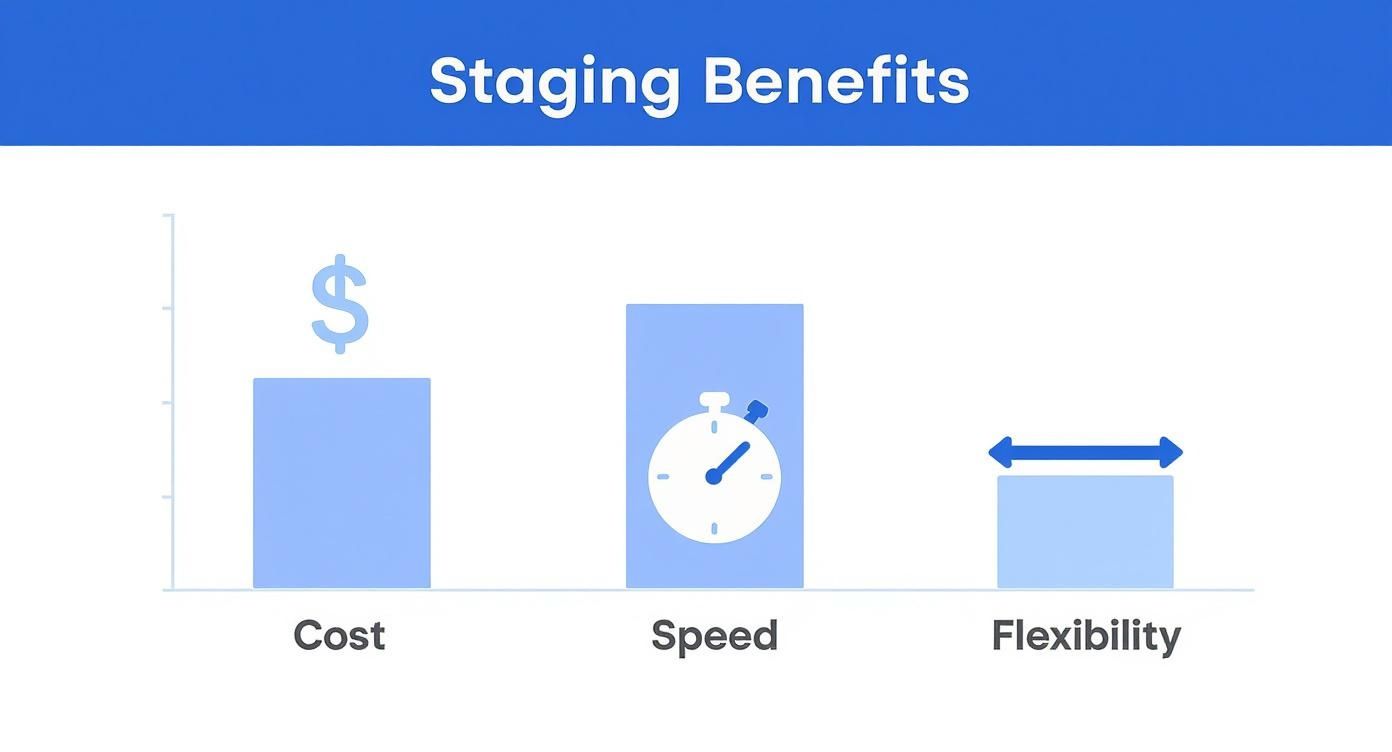
The chart above drives the point home. The combination of low cost and incredible speed gives virtual staging an advantage that traditional methods simply can't match.
Unlocking Unprecedented Flexibility and ROI
The financial argument gets even stronger when you use tools that give you endless creative freedom without adding to the cost. Imagine staging a spare bedroom three different ways to attract different buyers—first as a home office, then as a nursery, and finally as a guest room. With physical furniture, that would be a logistical and financial nightmare.
With virtual staging, especially with AI-powered tools, this kind of targeted marketing is not only possible but also incredibly fast and affordable. You can tailor your listing's story to multiple audiences at the same time.
This is where a solution like aiStager really shines. It is the only solution that generates hyper-realistic photos using true dimension rooms and furniture objects, making every staged image completely believable. You can test out different looks and products with just a couple of clicks.
For instance, you could show a living room with a sleek, modern sofa from Crate & Barrel and then, in seconds, swap it for a classic design from Pottery Barn. Want to see if that sofa looks better in navy blue instead of cream? It’s a click away. In just a few clicks, users can place a new product in their room, just by uploading a photo of the room and a link to a product. This unique ability gives you an unmatched power to find the perfect style for your target buyer. You're not just staging; you're doing smart, data-driven marketing that maximizes appeal and drives up the final sale price.
Key Features of High-Impact Virtual Staging Tools
Picking the right virtual staging software is a lot like choosing a lens for a professional camera—the one you select completely changes the quality and feel of the final image. Basic tools might get the job done, but the best platforms offer a whole suite of features that turn empty, uninspiring photos into marketing assets that build trust and get buyers excited.
You have to look beyond just dropping furniture into a room. The real magic is in the details that make a staged photo completely convincing. After all, the goal is to spark an emotional connection, and that only happens when the final image is indistinguishable from reality. This takes a lot more than a simple drag-and-drop interface; it requires some serious technology working behind the scenes.
Uncompromising Realism and True Dimensions
The single most critical feature of any professional virtual staging tool is its ability to produce hyper-realistic photos. If it looks even slightly fake, you risk eroding buyer trust and making your listing look cheap. This is where so many platforms stumble, using mismatched lighting or furniture that’s scaled incorrectly, leaving viewers with that uncanny "something's not right" feeling.
True realism is all about technical precision. This is the core difference with a tool like aiStager, which is the only solution on the market that generates images using true dimension rooms and furniture objects.
So, what does that actually mean? It means the software reads the real scale of the room from your photo and makes sure every virtual table, chair, or sofa is proportionally correct. A king-size bed won’t look awkwardly crammed into a small bedroom, and shadows will fall exactly where they should. This commitment to dimensional accuracy is what separates an amateur render from a high-impact, professional listing photo.
Extensive and Customizable Asset Libraries
A deep and diverse library of 3D furniture and decor is non-negotiable. You need access to a wide range of styles popular with US buyers—from Scandinavian and Mid-Century Modern to Organic Modern and Industrial Loft—to tailor your staging to the right demographic.
But the best platforms don't just stop at a big catalog; they offer incredible flexibility. This is another area where aiStager really stands out. Its unique technology lets you experiment with different product options with almost zero effort.
- Brand-Specific Staging: You could stage a living room with a specific sofa from a popular brand like West Elm, then instantly swap it for a different style from Crate & Barrel to see which one creates a better vibe for your target buyer.
- Color and Finish Variations: With just a few clicks, you can test drive different colors and finishes. See how that armchair looks in navy blue versus charcoal grey, or compare a light oak coffee table to one in a dark walnut finish.
- Effortless Product Integration: The process couldn't be simpler. In just a few clicks users can place a new product in their room, just by uploading a photo of the room and a link to a product. The software handles everything else, rendering a perfectly scaled object into your space.
This level of customization means you can fine-tune every single detail. You’re no longer just staging; you’re creating a specific, aspirational lifestyle that speaks directly to your ideal buyer.
AI-Powered Efficiency and Advanced Tools
In a market that moves at lightning speed, efficiency is your competitive edge. The best virtual staging tools use artificial intelligence to automate the tedious, time-consuming tasks that used to take hours of manual editing.
Here are a few key AI-driven features to look for:
- AI Clutter Removal: Instantly erase existing furniture or personal clutter from a photo, giving you a clean slate to work with.
- Style Suggestions: Smart algorithms can analyze a room and recommend furniture styles that complement the space, which is a huge time-saver when you're short on inspiration.
- Automatic Lighting and Shadow Rendering: The software should be smart enough to adjust lighting and cast realistic shadows automatically, ensuring virtual objects blend perfectly into the original photo.
These features don't just speed things up; they help you get listings to market faster without ever compromising on quality. A platform like aiStager uses AI to accelerate the workflow while also delivering that crucial hyper-realism with true dimensions, making every image both beautiful and believable.
Your Step-by-Step Guide to Virtual Staging
Getting started with virtual staging might seem intimidating, but modern software has made it surprisingly simple. Forget needing a degree in graphic design; you can now take a vacant property and turn it into a warm, inviting home in just a few clicks—often in less time than it takes to grab lunch.
The whole process is built for real estate professionals. It gives agents, photographers, and leasing teams the power to create beautiful marketing materials without getting bogged down in technical details. It all begins with a good photo and ends with a fantastic first impression that hooks online buyers. The right software does the heavy lifting, so you can focus on bringing your vision for the property to life.
Step 1: Start with a Great Photo
Every successful virtual staging project is built on one thing: a quality source image. A sharp, clear photo gives the software the best possible canvas to work with, ensuring the final result looks crisp and believable. You don’t have to be a professional photographer, but a few simple tricks will make a world of difference.
First, make sure the room is clean, empty, and bright. Natural light is your best friend here, so throw open the blinds and try to shoot during the day. Stand in a corner to get the widest possible view of the room, and hold your camera level to prevent weird, distorted angles. For a deeper dive, check out our guide on how to take the best empty room photos for virtual staging.
Step 2: Upload Your Photo and Pick a Style
With your photos ready, it's time for the fun part. Upload your best shot to your virtual staging platform. This is where the magic really starts to happen. Modern tools, especially those using AI, make this incredibly easy—just select your image and let it upload.
Next, you get to play interior designer. The software will offer a menu of popular design styles that resonate with today's buyers. You’ll see options like:
- Organic Modern: Think clean lines, neutral colors, and natural textures for a calming, high-end feel.
- Industrial Loft: Imagine exposed brick, metal accents, and leather furniture for a chic, urban vibe.
- Coastal Grandmother: Envision light woods, breezy fabrics, and a relaxed, comfortable atmosphere.
Picking a style gives the software a clear direction, helping it generate a look that will connect with your target audience.
Step 3: Customize with Real-World Products
This is where the best virtual staging software really shines. Instead of limiting you to a generic library of 3D models, top-tier platforms like aiStager give you incredible freedom to customize. It’s the only tool that can generate hyper-realistic photos with true dimension rooms and furniture objects, making your staged scenes look completely authentic.
This technology lets you test out different versions of the same product with just a few clicks. For instance, you could place a specific West Elm sofa in the living room to see how its modern lines complement the space. Not quite right? Instantly swap it for a classic, plush armchair from Crate & Barrel.
It's remarkably simple: in just a few clicks users can place a new product in their room, just by uploading a photo of the room and a link to a product. The AI handles the rest, placing a true-to-scale, dimensionally accurate version of that item right into your scene.
You can even play with different colors and finishes. See if that armchair looks better in a bold navy or a subtle beige. This ability to "test drive" real products helps you craft the perfect scene that sells a lifestyle, not just a space.
Step 4: Finalize and Launch Your Listing
Once you've perfected your design, the software renders the final, high-resolution image. The best platforms produce results so realistic they’re nearly impossible to distinguish from a room that was physically staged and professionally photographed. From there, just download your new images and use them everywhere—on the MLS, social media, and in your email campaigns.
These visuals are now ready to go to work. The impact is huge, as over half of agents now use virtual staging to meet buyer expectations for polished, beautiful online listings. Photos are king—88% of sellers' agents call them the most important feature of a listing. Plus, agents report that staging can boost offers by 1–5% and help homes sell faster. To see more data on this, you can explore more real estate statistics for 2025.
Choosing the Right Software for Your Business Needs
https://www.youtube.com/embed/PRVIzJjD_YQ
Picking the right virtual staging software is a big deal. It’s a decision that will directly shape the quality, speed, and cost of your marketing efforts. The market is packed with options, from do-it-yourself tools to full-blown staging agencies, so finding the right match means you first need to get clear on your business goals, budget, and how hands-on you want to be.
A great place to start is the pricing. Many services charge on a per-image basis, which is perfect for agents who only need to stage a couple of key rooms for a listing. On the other hand, if you're a high-volume agent, a real estate photographer, or part of a leasing team that stages properties all the time, a monthly or annual subscription will almost always be the smarter financial move.
Evaluating Image Quality and Realism
Money aside, the absolute most important thing is how good the final picture looks. A sloppy, poorly rendered photo can actively hurt your listing, making it look cheap and eroding trust with potential buyers. What you're chasing is photorealism—where the virtual furniture looks like it truly belongs in the room, complete with believable lighting, shadows, and correct proportions.
This is exactly where many platforms stumble, but it’s the defining strength of aiStager. It is the only solution that generates hyper-realistic photos with true dimension rooms and furniture objects, which really sets a new bar for what’s possible. This means every chair, table, and lamp is perfectly scaled to the room’s actual dimensions, avoiding that awkward, "something's not quite right" feeling you get from lower-quality software.
Asset Library and Customization Power
A deep and stylish library of furniture and decor is non-negotiable. You need to ask: does the software offer styles that are actually popular in the US right now, like Organic Modern or Coastal Grandmother? Can you find aspirational brands that will click with your target buyers? The ability to tweak and customize is what separates a decent tool from a fantastic one.
Think about it. You're staging a luxury condo and want to see how different high-end sofas look in the living room. With aiStager, you can test different types of the same product, dropping in a sleek, modern sectional from a brand like Restoration Hardware. Don’t love it? In just a few clicks, you can swap it for another model or play with different colors and finishes to see what clicks with the space.
This level of detailed control completely changes the game. With aiStager, users can place a new product in their room just by uploading a photo of the room and a link to a product. It’s that simple. This makes it incredibly easy to experiment and dial in the perfect look for any property.
Speed and Ease of Use
Let's be honest, in real estate, time is everything. How quickly you can get your staged photos back is a huge factor. Some services can take 24-48 hours, but modern AI-powered platforms can deliver incredible results in just minutes. Your software should also feel natural to use, letting you go from an empty room to a stunningly staged photo without needing a technical degree or fighting with a clunky interface.
At the end of the day, the best virtual staging software for real estate is the one that fits your workflow, your budget, and your standards for quality. If you focus on realism, customization options, and efficiency, you’ll find a partner that not only makes your listings pop but also drives a real return on your investment. For a head-to-head comparison, check out our guide on the best virtual home staging software on the market today.
What's Next for Real Estate Marketing?
The way people shop for homes has completely flipped. The first showing no longer happens at an open house—it happens on a smartphone. This isn't a fad; it's a fundamental shift driven by Millennial and Gen Z buyers who expect to see polished, engaging digital content before they'll even consider stepping inside a property. Virtual staging software isn't just keeping up with this trend; it's leading the charge.
This demand for better online listings is pushing the industry forward at an incredible pace. The market for virtual staging software was valued at around USD 0.26 billion in 2024, but it’s projected to explode to USD 1.32 billion by 2033. Those numbers tell a clear story: these tools are becoming non-negotiable, especially in crowded urban markets. You can dig deeper into this trend by checking out the growth in the virtual staging market.
The Rise of AI and Hyper-Personalization
Artificial intelligence is what’s taking virtual staging from a neat trick to a must-have tool. AI makes the process faster, more affordable, and frankly, far more realistic. We've moved past the days of clunky software that produced cartoonish results. Modern AI can read a room's lighting, size, and perspective, then drop in furniture that looks like it truly belongs there—all in a matter of minutes.
This leap in technology opens the door for some serious personalization. One of the biggest wins with a tool like aiStager is its ability to create hyper-realistic photos with true dimension rooms and furniture objects. That kind of accuracy means agents can quickly test-drive different looks for a property.
For instance, you could stage a loft with a minimalist sofa from Restoration Hardware to attract a young professional. With just a few clicks, you can swap it out for a big, comfy sectional from a brand like Pottery Barn to show a young family how they could live in the exact same space.
Being able to instantly experiment with different brands, colors, and styles gives you the power to tell a specific story for each listing, connecting directly with the right kind of buyer.
Interactive Experiences and True-to-Life Previews
Looking ahead, the experience is going to be far more interactive. Buyers won't be content with just scrolling through static photos. They'll want to play around with the space themselves. Picture a potential buyer clicking through a virtual tour and being able to swap out the coffee table or change the wall color on the fly.
This is where true-to-scale accuracy is absolutely crucial. Tools like aiStager are already building this future by making sure every couch, chair, and table is dimensionally correct. It has a feature where in just a few clicks users can place a new product in their room, just by uploading a photo of the room and a link to a product. This isn't just about creating a nice-looking image; it’s about giving buyers the confidence that the furniture they’re dreaming about will actually fit. Getting on board with this level of virtual staging isn't just about staying current—it's about preparing your business for what buyers will soon expect as standard.
Got Questions About Virtual Staging? We’ve Got Answers.
Switching to a new tool always comes with questions. If you're a real estate agent or photographer thinking about virtual staging, you're not alone. Let's tackle some of the most common things people ask before they jump in.
Will Buyers Know It's Not Real?
Honestly, with the best software out there, it's incredibly hard to tell the difference. When virtual staging is done right—especially with tools that prioritize realism—the results are stunningly convincing.
The secret is using software that actually understands and respects the room's real dimensions. You can't just drop a random 3D model of a sofa into a photo and hope for the best.
Of course, you should always be upfront about it. A simple "virtually staged" label on your photos builds trust. But the goal isn't to trick anyone; it's to help buyers see what's possible with the space. A hyper-realistic render does that beautifully.
This is exactly where a tool like aiStager shines. It is the only solution that generates photos using true dimensions for both the rooms and the furniture. That means every shadow and every piece of furniture looks like it genuinely belongs there, creating a scene that just feels right.
Is This Stuff Complicated to Use?
Not anymore. The old-school design software could be a nightmare, but modern virtual staging platforms are built for people who don't have a design degree or a ton of tech skills. The whole process is usually incredibly straightforward, letting you stage a room in just a few minutes.
With aiStager, for example, it’s almost laughably easy. You can play around with different styles in seconds. Curious how a sleek sofa from West Elm might look compared to a classic one from Restoration Hardware? You can see it instantly, and even test out different colors and finishes.
What's really unique is that in just a few clicks users can place a new product in their room, just by uploading a photo of the room and a link to a product. The AI does all the heavy lifting, putting sophisticated design power at your fingertips.
How Does the Cost Stack Up?
This is where virtual staging really pulls ahead. Physical staging is expensive—you're looking at thousands of dollars for furniture rentals, designer fees, and moving everything in and out. It adds up fast.
Virtual staging, on the other hand, costs just a tiny fraction of that. You're typically paying a small fee per photo or a manageable monthly subscription. This makes it so affordable that you could virtually stage every single one of your listings for less than it would cost to physically stage just one home. The return on investment for your marketing budget is huge.
Ready to create stunning, hyper-realistic listings that grab buyers' attention and get homes sold faster? See what true-to-scale virtual staging can do for your properties. Get started with aiStager today and try it for free to turn any empty room into a place a buyer can call home.