A Guide to 3D Interior Decoration for 2026
Explore the world of 3D interior decoration. Learn how AI tools create photorealistic designs that help you visualize furniture in your actual space.

Ever felt that design paralysis? You're staring at an empty room, a dozen paint swatches in hand, and a browser full of furniture tabs. 3D interior decoration is the antidote to that uncertainty.
Think of it as the ultimate "try before you buy" for your entire space. It lets you create a stunningly realistic digital version of your room, answering all those nagging questions before you spend a dime. Will that gorgeous Article sofa overwhelm the room? Does that bold paint color work with the afternoon sun? With 3D visualization, you get to see the answer.
What Is 3D Interior Decoration?
Simply put, 3D interior decoration is the art of building a photorealistic, computer-generated model of an interior space. It’s a world away from flat sketches or mood boards. We're talking about a detailed simulation that captures how furniture, lighting, colors, and textures all play together in three dimensions.
This gives homeowners, designers, and real estate agents a massive advantage. Imagine you’re trying to decide between a sleek, modern look and a warm, Scandinavian vibe. Instead of just guessing, you can stage your virtual living room in both styles, walk through them, and see which one truly feels like home.
The Power of Photorealistic Previews
The real magic happens when you can see exactly how real-world products will look in your space. This is where advanced AI platforms are changing the game. For example, a tool like aiStager can take a simple photo of your room and a link to a product, and then generate a hyper-realistic image showing that item in your home.
Let's make this real. Say you’ve been eyeing the Maxwell sofa from Restoration Hardware. Instead of wondering, you can:
- Upload a photo of your living room.
- Paste the product link for the Maxwell sofa.
- Instantly see it in your space, testing different fabrics like 'Italian Berkshire Pewter' or 'Belgian Linen Sand'.
What used to be a high-stakes guessing game now takes just a few clicks to get a crystal-clear visual. It's this kind of practical power that’s driving incredible demand. The global market for 3D rendering and visualization is expected to grow by 25% annually, all because people want that certainty.
This technology is all about closing the gap between your imagination and reality. It removes the risk from design, ensuring the finished room is exactly what you envisioned.
Of course, a great design often blends digital planning with tangible details. You can complement your virtual mockups with physical accents like 3D decals for walls to add an extra layer of texture and personality. And if you're curious about how this technology is used on a larger scale, our guide to 3D architectural visualization explores its broader applications.
The Old Way vs. The New: A Tale of Two Design Workflows
Think about the traditional way interior design gets done. It's a hands-on, often frustrating process that starts with pulling out the tape measure and sketching 2D floor plans. Designers and homeowners alike end up buried under piles of fabric swatches and paint chips, trying to imagine how it will all come together.
This old-school approach is slow and riddled with guesswork. A client sees a mood board and a floor plan, but can they really picture the final room? Not usually. This gap between the 2D plan and the 3D reality leads to endless back-and-forth, costly revisions, and the constant worry that a pricey sofa, once delivered, will look all wrong.
The AI-Powered Method: From Photo to Finish in Minutes
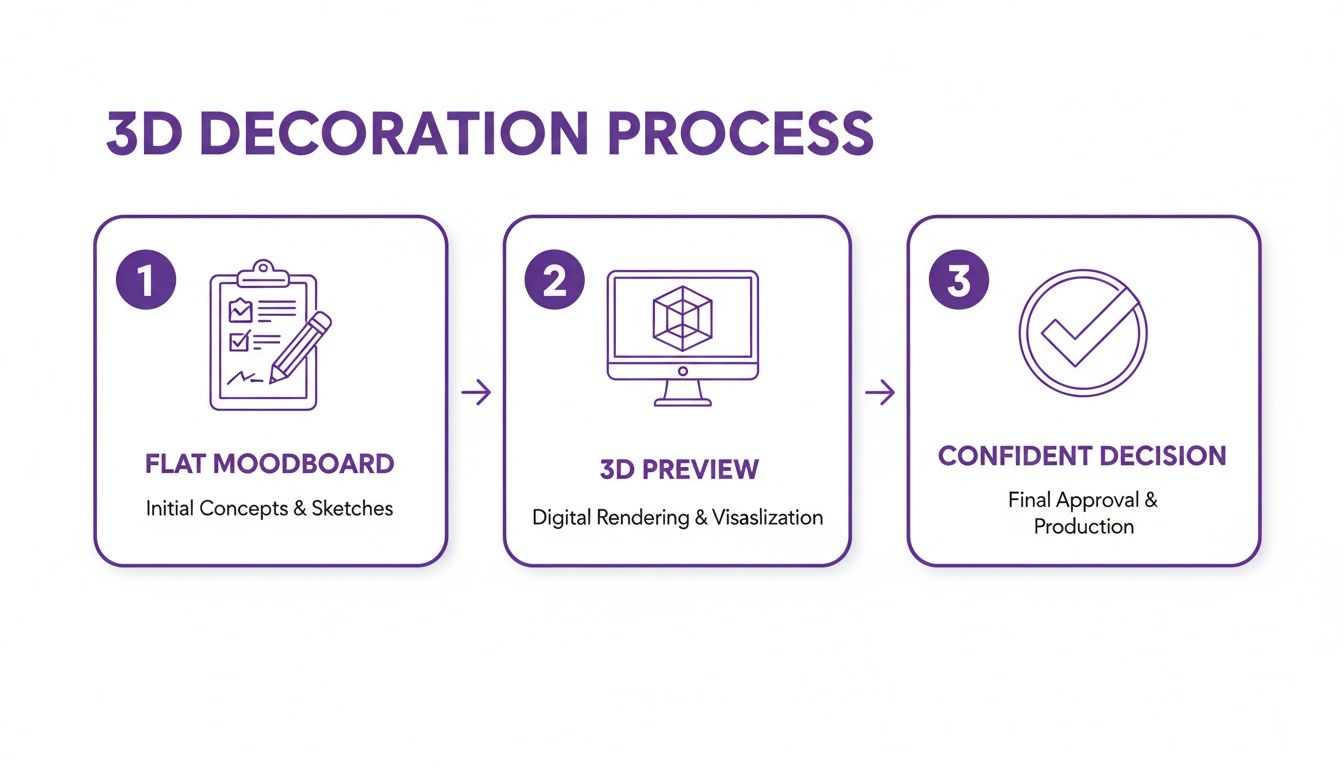
Now, let’s look at how modern tools have completely changed the game. The new workflow, powered by AI platforms like aiStager, is incredibly straightforward. It all starts with something you already have: a picture of your room.
That’s it. No measuring, no complicated software.
From there, you just shop online as you normally would. Find a sofa you love on Crate & Barrel or a cool light fixture from a boutique brand? Just copy the product’s web address and paste it into the tool. This is where the magic happens.
The AI doesn’t just create a generic 3D model. It generates a photorealistic, true-to-scale image of that exact product and places it right into your room’s photo. You see the real item, in your real space, instantly.
The entire process—from finding inspiration to seeing a photorealistic preview—takes minutes, not weeks. It’s a complete shift in how we approach design.
Experiment Freely, and with Zero Risk
The real beauty of this new method is the freedom it gives you. You’re no longer stuck second-guessing your choices.
Wondering if that sleek media console you spotted is a better fit than a more traditional one? With a tool like aiStager, you don’t have to guess. You can see the first one in your room, then swap it out for three other options from different stores in a matter of seconds.
This goes for more than just swapping furniture. You can:
- Test different finishes, like a dark wood versus a light oak.
- Compare a leather sofa to its fabric version.
- Instantly see how different colors or textures change the feel of the room.
You can finally make bold design choices with total confidence because you've already seen how they’ll turn out.
This is more than just a neat trick; it has a huge impact on project timelines and costs. In fact, using 3D interior decoration leads to 20% faster project timelines and a 15% increase in productivity for designers. Why? Because clients can approve designs faster and with more certainty, which means fewer last-minute changes. It makes the entire design process interactive, quick, and completely risk-free.
How To Bring Your Designs To Life With AI
Trying to picture how a new design will actually look in your room can be tough. It often feels like you’re just guessing. But modern AI-powered tools are changing the game, making the entire process feel concrete and surprisingly simple.
Instead of wrestling with complex software, platforms like aiStager have boiled down the whole 3d interior decoration workflow into a few quick steps. You can go from a simple photo to a stunning, photorealistic image in just minutes. It’s a process that makes sense whether you're a seasoned designer or a homeowner staring at an empty room for the first time.
It all starts with your existing space. Forget about tape measures and drafting floor plans from scratch. The first step is to just capture the room as it is.

Upload Your Canvas
Your journey begins with a single photograph. Just snap a clear, well-lit picture of the room you want to reimagine and upload it. This photo becomes your digital canvas. It gives the AI everything it needs to understand your room's perspective, scale, and lighting conditions.
This is where a tool like aiStager really shines. It builds its designs inside a true dimension room, which means every object you add will look exactly how it would in real life. No special camera gear or technical know-how needed. If you can take a picture on your phone, you’re ready to start the 3d interior decoration process.
Shop Any Store Online
One of the biggest headaches with older design tools was their locked-down furniture libraries. You were stuck with generic 3D models that looked fake and didn’t represent anything you could actually buy. Today’s AI solutions have completely torn down that wall.
With aiStager, you can shop from literally any online retailer. Did you find a sofa on West Elm, a dining table on Article, or a unique light fixture from a small boutique brand? Just copy the link to the product and paste it into the tool. The AI instantly gets to work, analyzing the product page to pull its images and dimensions, creating a perfect digital copy.
This freedom is a huge deal. You’re no longer designing with placeholders—you’re styling your room with the actual furniture and decor you plan to purchase.
The ability to use any product from any online store is a major advantage. It means your design mockups are not just concepts—they are accurate previews of your final room, populated with real-world items you can actually purchase.
Style And Refine
Now for the fun part. With your room uploaded and your products ready, you can start playing. Curious how that famous Restoration Hardware 'Cloud' sofa would look in your living room? In a couple of clicks, you can place it perfectly.
Even better, you can instantly see how different fabrics change the vibe. Test the sofa in a crisp 'White Perennials Performance' fabric for a bright, coastal feel. With another click, swap it for a moody 'Charcoal Linen' to create a more dramatic, contemporary atmosphere.
This is your chance to:
- Test different product types: See if a sleek media console works better than a rustic credenza.
- Experiment with finishes: Compare a light oak coffee table against a dark walnut version.
- Change colors instantly: Find out if a bold accent chair energizes the space or just overwhelms it.
This is also the perfect time to declutter. AI tools can digitally remove existing furniture from your photo, giving you a clean slate to test new layouts without moving a single thing. For homeowners, learning to use AI for home design can open up a world of creative possibilities.
Generate Your Vision
Once you've arranged everything just right, the final step is to generate the image. This isn’t some cartoonish drawing; it’s a photorealistic visual that’s often hard to tell apart from a professional photograph. The AI flawlessly blends the new furniture into your room, perfectly matching the original photo’s lighting, shadows, and perspective.
The whole process, from uploading a photo to getting a final image, can be up to 100x faster than old-school manual rendering. What used to take a 3D artist days of painstaking work can now be done in minutes. These final images are perfect for client presentations, personal planning, or marketing materials, giving everyone a crystal-clear look at the finished space.
How Professionals Use 3D Decoration To Drive Results
For professionals, 3D interior decoration is less about making pretty pictures and more about driving real, measurable results. Across design, retail, and real estate, these tools have become essential for saving time, cutting costs, and closing deals faster. It’s a fundamental change from talking about abstract concepts to showing tangible, photorealistic previews that clients can immediately understand and fall in love with.
And this isn't just a small trend; it's a massive shift in how the industry operates. The market for AI in interior design is expected to skyrocket from USD 829 million in 2023 to an estimated USD 7,299 million by 2033. That's fueled by an impressive 24.3% compound annual growth rate. This boom shows just how much AI tools are improving space planning, an area that already made up 37% of the market back in 2023.
For Interior Designers: Faster Approvals and Clearer Vision
Every interior designer knows the struggle: trying to translate the perfect vision in their head into something a client can actually see and get excited about. Mood boards and 2D floor plans help, but they often leave too much to the imagination. This is where 3D interior decoration closes the gap, helping designers get quicker sign-offs and avoid expensive rework.
Think about a designer crafting a look for a stark urban loft. Instead of just describing a "sleek, minimalist" vibe, they can use a platform like aiStager to create photorealistic mockups in minutes. They can upload a photo of the empty space, grab a link to a specific sofa from a brand like Article, and paste it in. In seconds, the client sees that exact sofa in their future home. The designer can then swap out coffee tables or light fixtures on the fly, making the client an active partner in the design process.
This way of working directly impacts the bottom line. Faster approvals mean designers can take on more projects, and fewer revisions lead to healthier profit margins.
With AI-powered tools, the conversation shifts from, "Do you think you'll like this?" to, "Which of these options do you love?" It turns a process filled with uncertainty into one of confident, collaborative decision-making.
For Furniture Retailers: Turning Browsers Into Buyers
Furniture retailers constantly battle a major sales killer: a customer's fear that an item won't fit or look right in their home. This hesitation is a primary reason for abandoned carts and costly returns. AI-powered visualization tackles this problem head-on by letting shoppers "try before they buy" right from their own homes.
A retailer can build a tool like aiStager right into their product pages. When a customer is looking at a new sofa, they can upload a photo of their living room and instantly see it in their space. The real value, though, is in the accuracy. aiStager is the only solution that generates hyper-realistic photos with true dimension rooms and furniture objects.
This gives customers the confidence to experiment and find the perfect piece. They can:
- Compare different sofa brands: See how a sofa from Pottery Barn looks versus one from a different retailer.
- Test colors and finishes: Instantly switch between a navy velvet fabric and a neutral linen one.
- Visualize the true scale: See exactly how the piece will fit without ever pulling out a tape measure.
This kind of interactive experience boosts add-to-cart rates and gives customers the final push of confidence they need to make a purchase.
For Real Estate Agents: Selling a Lifestyle, Not Just a Space
In the world of real estate, virtual staging has completely changed the game. Empty rooms often feel cold and sterile, making it hard for potential buyers to picture themselves living there. With 3D interior decoration, agents can transform vacant listings into warm, aspirational homes that connect with buyers on an emotional level.
Take a vacant suburban house, for example. An agent can use an AI tool to stage it with a cozy, modern farmhouse look, complete with furniture from a popular brand like Pottery Barn. Suddenly, potential buyers can visualize holiday dinners in the dining room and family movie nights in the living room. Of course, even with advanced tools, understanding design fundamentals—like knowing how to pick drapes like an interior designer—is still key to creating a look that feels authentic and inviting.
By showcasing a finished, move-in-ready lifestyle, agents can generate more interest and ultimately sell properties faster and for a better price.
Why Photorealistic Accuracy Matters In Design
When you're trying to visualize a new look for your home, not all 3d interior decoration tools will get you there. You've probably seen some of them—the ones that produce renders looking more like a scene from The Sims than an actual living room. They're fun, but they can't answer the most important question: how will this really look and feel in my space?
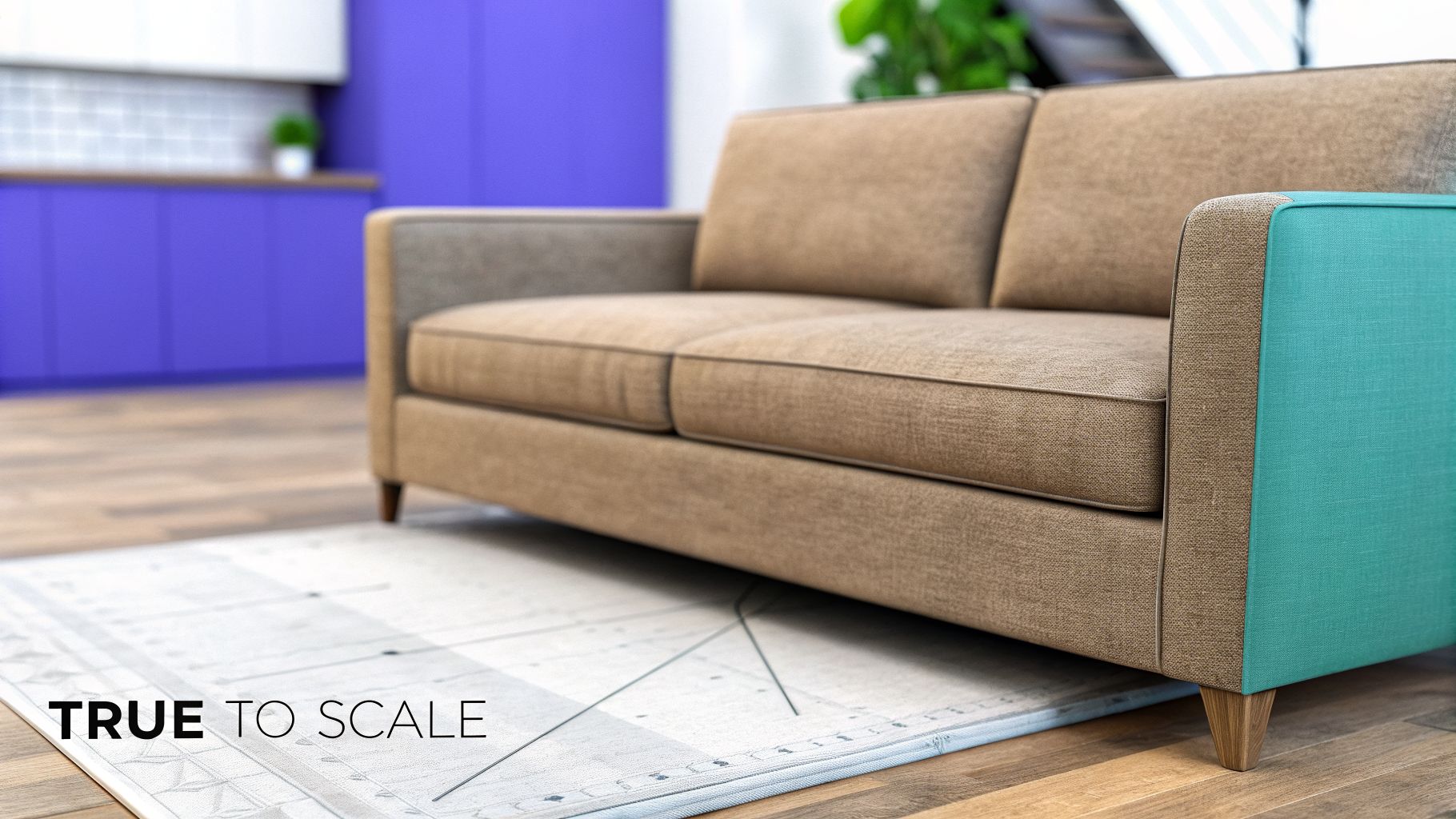
This is why photorealism isn't just a nice-to-have; it's everything. The point isn't to create a cute, stylized image. It's to build a digital replica of your room so precise that you can trust what you see. True realism captures every little thing, from the way sunlight bounces off a wooden floor to the exact amount of space a new armchair will take up. Without that, you're just guessing, and that defeats the whole purpose.
From Generic Models To True Dimension
Most basic 3D tools work from a library of generic models. You can drag and drop a "sofa" or a "table," but these are just placeholders. They don't have the specific textures, details, or—most importantly—the exact dimensions of real furniture you can actually buy. They can’t tell you if that gorgeous sofa from West Elm is too deep for your narrow living room, or if the oak finish on a Crate & Barrel dining table will clash with your floors.
This is exactly what separates a professional-grade tool like aiStager from the rest. It's the only platform that creates hyper-realistic photos using true dimension rooms and furniture objects, not generic stand-ins.
So, how does it work? aiStager takes an entirely different approach. You give it a photo of your room and a link to a real product you're considering. It then analyzes both to generate a visual that's not just beautiful but dimensionally perfect.
The result is a picture that’s often hard to tell apart from a professional photograph. It’s your guarantee that what you see on the screen is what you’ll get in real life—no more costly surprises when the delivery truck arrives.
The Technology Behind The Realism
Pulling this off is a serious technical feat. The AI behind aiStager has to intelligently read your original photo to make sure every new object fits into the scene perfectly.
Here’s a peek at what’s happening under the hood:
- Perspective Analysis: The AI instantly figures out the angles and depth of your room. This ensures new furniture looks like it truly belongs there, not just awkwardly pasted on top.
- Lighting and Shadow Matching: It detects all the light sources in your photo—from a bright window to a soft lamp—and then renders perfectly matched shadows and highlights on the new items.
- Scale and Proportion: By using the product link, aiStager gets the item's real-world dimensions. It then renders it to the perfect scale within your room’s environment, so you know for sure if it will fit.
This meticulous process gives you the confidence to truly experiment. Want to see if a minimalist "Japandi" style works in your bedroom? Or maybe you want to try a bold, colorful Art Deco theme in the living room? Because the results are so lifelike, you’re making decisions based on a genuine preview of your vision.
Imagine you're eyeing a new sofa. Just upload a photo of your room, paste the product link, and voilà—the sofa appears in your space. From there, you can try out different fabrics, like a rich velvet versus a casual linen, or see how a vibrant color compares to a neutral one. If you're curious about the technical side of creating visuals this powerful, you might enjoy our detailed look at rendering a house with today's best tools.
Design for Everyone, Instantly
Not too long ago, creating professional 3D interior visualizations was a world reserved for big design firms with deep pockets and dedicated tech teams. It was a slow, expensive ordeal. But that's all changed. AI has blown the doors wide open, giving everyone—from solo designers to real estate agents and even curious homeowners—the power to create stunning visuals. This isn't just about fancy new software; it's about unlocking creativity and making decisions with real confidence.
Think about how we shop for everything else now. We expect to see, interact with, and customize products before we buy. This expectation has finally caught up to the design and furniture world, putting pressure on professionals to show, not just tell. That’s exactly where these new AI-powered platforms are making a massive impact.
High-End Design Is No Longer Out Of Reach
I remember when a single photorealistic render could take my team days to complete, and the cost was substantial. Now, tools like aiStager can deliver a handful of options in seconds. The game-changers are speed and simplicity. You no longer need to be a 3D modeling wizard to bring a concept to life with incredible detail.
Let's say you're pitching two completely different vibes to a client for their living room—maybe a cozy, layered "Grandmillennial" style versus a clean, minimalist "Japandi" look. Instead of waving your hands and trying to describe it, you can just show them. With a tool like aiStager, you can mock up both versions, complete with real-world products, in just a few clicks.
- Mix and match brands: See how a plush sofa from Arhaus feels in the room compared to a sleek, modern one from Maiden Home.
- Play with layouts: Wondering if a large sectional is better than two elegant accent chairs? Swap them out and see how the flow of the room changes instantly.
- Test different materials: Watch the entire mood of the space shift just by changing a coffee table from a dark espresso wood to a light, natural oak.
It’s not about making pretty pictures for the sake of it. It’s about getting rid of the guesswork so you can make bold, informed choices. When you can visualize the outcome, you're free to experiment without the fear of a costly mistake.
Welcome to the New Standard
The buzz around AI in creative fields isn’t just a passing trend—it's quickly becoming the new baseline for working efficiently and producing top-tier work. What makes a platform like aiStager truly stand out is its ability to generate hyper-realistic photos with true dimension rooms and furniture objects. This level of accuracy, where the scale and perspective are spot-on, is something many other tools struggle with. All you have to do is upload a photo of an empty room and a link to a product you’re considering, and it generates a flawless visual of how it will actually look in that space.
This is what the future of design looks like: it's instant, it's accessible to all, and it's shockingly accurate. It’s about giving you the power to execute your vision perfectly, communicate it clearly to clients, and ultimately, get better results for your business. Why wait? It's worth seeing for yourself what these new AI visualization tools can do.
Common Questions About 3D Interior Decoration
Getting started with 3D interior decoration can feel a little daunting. It's a new way of working, and it's natural to have questions. Let's walk through some of the most common concerns to help you start designing with confidence.
How Accurate Is The Furniture Scale In These Tools?
This is probably the most important question to ask. After all, what’s the point of visualizing a room if the scale is off? We’ve all heard horror stories of a new sofa arriving, only to discover it completely overpowers the room or, worse, doesn't even fit through the door.
Many simpler design apps use generic 3D models that only roughly match the size of real furniture. This can lead to those very expensive and frustrating mistakes.
But this is where professional-grade AI tools really shine. A platform like aiStager is the only solution that generates hyper realistic photos with true dimension rooms and furniture objects. Instead of using generic models, it builds its visualization from a product's retail link. This means it uses the item's true dimensions to create a hyper-realistic render. You'll see exactly how that beautiful Crate & Barrel sectional will look and fit in your space, down to the inch.
For design decisions you can actually trust, you need a tool that works with real product data. Generic models just won't cut it.
Do I Need 3D Modeling Skills Or Special Software?
Not anymore. In the past, creating 3D renderings was a highly specialized skill. It required years of training and proficiency in complex, expensive software like 3ds Max or V-Ray. This world was reserved for technical experts.
Thankfully, the new wave of AI-powered tools has completely changed the game, making 3D interior decoration accessible to everyone. Modern solutions like aiStager are entirely web-based, which means there’s nothing to download or install.
The process is designed to be incredibly simple. Just by uploading a photo of the room and a link to a product, users can place a new product in their room in just a few clicks. The AI does all the heavy lifting, turning your simple inputs into a photorealistic design in just a few moments.
Can I Use Furniture From Any Brand I Want?
Here’s a big one. What good is a design tool if you can't use the furniture you actually want to buy? This is a major drawback of many apps that lock you into a limited, pre-loaded catalog. You’re forced to design with generic stand-ins that you’d never put in your own home.
This limitation kills creativity. The best tools have solved this problem by giving you total freedom.
With aiStager, for example, you can use a product link from any online store. This is great to test different types of the same product, like comparing three different sofa brands side-by-side in your living room. You can also try out various colors and finishes for a coffee table from a single brand before you commit. Whether you’re eyeing a chair from West Elm, a vintage find from a small boutique, or a bed from IKEA, you get to design with the real-world furniture you truly want.
Ready to see how easy it is to bring your design ideas to life with photorealistic accuracy? With aiStager, you can transform your space in minutes. Just upload a photo, paste a product link, and watch your vision become a reality. Try aiStager for free today