AI for Home Design How It's Changing Everything
Discover how AI for home design is revolutionizing interior design. Learn to use AI tools to create photorealistic visuals of your actual space in minutes.
Picture this: you've found the perfect Article sofa or a beautiful West Elm coffee table online, but you’re completely stuck. Will it actually fit? Will it match your walls? You’re trying to imagine it in your living room, but it’s just guesswork.
Modern AI for home design completely changes the game. It’s like having a personal designer on call who can instantly show you exactly how that new piece will look in your space—perfectly scaled and lit—all from a simple photo. These tools don't just create basic mockups; they generate stunningly realistic images of your actual room, totally reimagined.
What Is AI for Home Design and Why Is It So Popular?
So, what exactly is AI for home design? Think of it as a smart technology that can create, tweak, and visualize interior spaces for you. It’s not a simple photo filter. It's more like a digital design partner that analyzes a photo of your room—the layout, lighting, and even the existing furniture—and then lets you experiment with changes in seconds.
What makes advanced platforms like aiStager stand out is their ability to generate hyper realistic photos with true dimension rooms and furniture objects. This is a huge deal. It means if you’re trying to decide between two different sofas, you can see precisely how each one fits in your living room, scaled perfectly to the inch. No more measuring tape and crossed fingers.
The Power of Instant Visualization
One of the toughest parts of design has always been closing the gap between what you can imagine and what you can see. AI helps bridge that gap, offering incredible support when starting the interior design process. It makes professional-level visualizations accessible to everyone.
For instance, with a tool like aiStager, the process is incredibly straightforward:
- Upload a photo of your room.
- Provide a link to a product you're considering.
- Instantly, the AI places a new product in your room with hyper-realistic detail.
Curious if that Article sofa would look better in navy velvet or a neutral linen? In just a few clicks, you can place a new product in your room, test different colors and finishes, and see the results instantly. This ability to see and compare options without guesswork is fundamentally changing how US consumers approach home design, whether they're aiming for a cozy "Modern Farmhouse" look or a sleek "Mid-Century Modern" aesthetic.
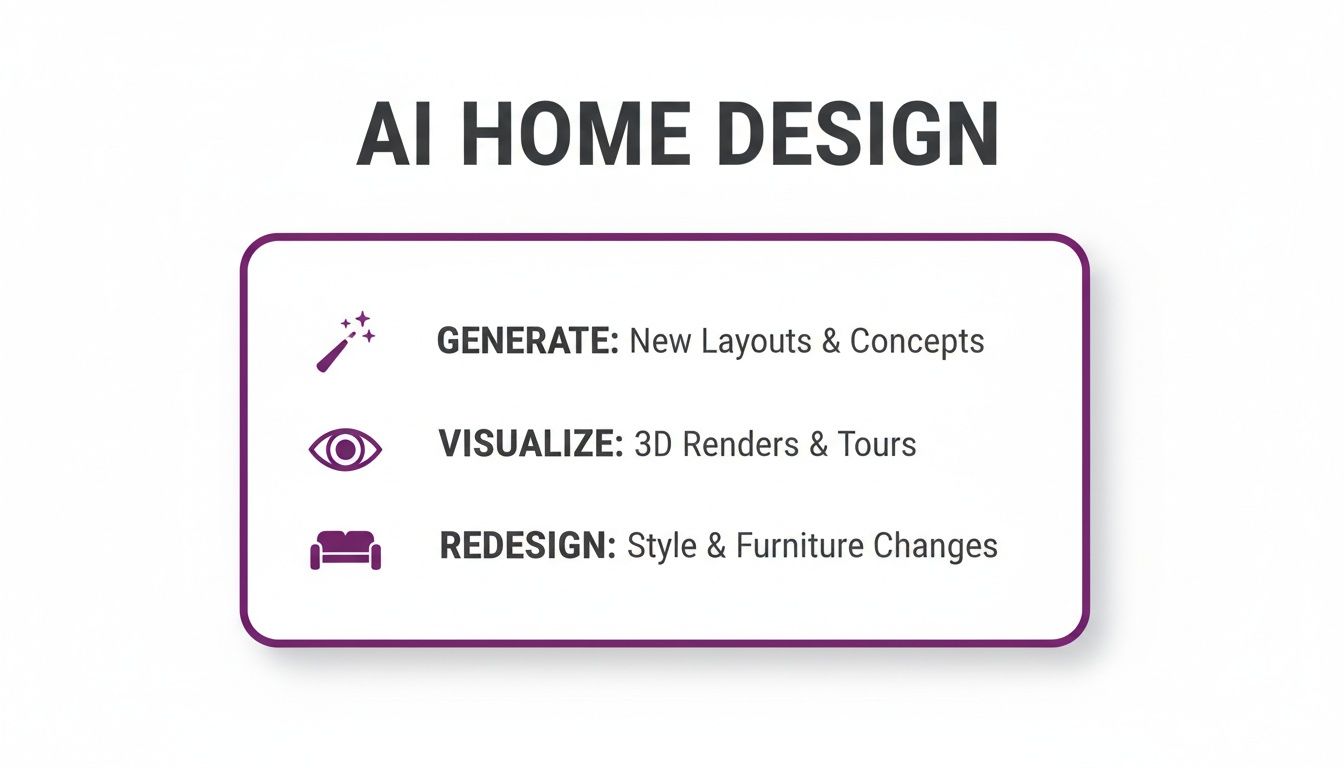
This simple workflow handles all the core parts of a design project, from brainstorming ideas to seeing the final result before you commit. To see how this plays out in practice, let’s quickly compare the old way of doing things with the new AI-powered approach.
Traditional Design vs. AI-Powered Design
The table below gives a quick snapshot of how much things have changed.
| Aspect | Traditional Method | AI-Powered Method (e.g., aiStager) |
|---|---|---|
| Process | Manual mood boards, physical samples, 2D floor plans, slow revisions. | Instant digital renders, virtual staging, real-time style changes from photos. |
| Time | Weeks or months for a single room design. | Minutes or hours to generate dozens of variations. |
| Cost | High fees for professional designers, costly revisions, and sample materials. | Low-cost subscriptions or pay-per-use models, no wasted sample costs. |
| Accuracy | Relies on manual measurements and imagination; prone to scaling errors. | Delivers true-to-scale visualizations with accurate dimensions and lighting. |
It's clear that AI doesn’t just speed things up—it makes the entire design process more accurate, affordable, and creative.
A Rapidly Growing Market
This isn't just a small trend for tech enthusiasts; it's a massive shift in the entire industry. The global AI in interior design market is projected to explode from $3,282.3 million in 2025 to an incredible $15,004.5 million by 2033.
That's a compound annual growth rate of 20.9%, which signals just how deeply this technology is becoming a standard part of the design world. You can dive deeper into these trends in our complete guide on AI for interior design.
How to Turn a Photo into a Realistic Design
This is where the theory behind AI for home design gets real. Forget about wrestling with complex software or pinning abstract ideas to a mood board. The modern workflow starts with something you already have: a photo of your room.
The whole process is surprisingly straightforward. You just snap a picture of your living room, bedroom, or that awkward empty corner you’ve been meaning to do something with. Then, you grab the link to a piece of furniture you're considering buying online.
From a Web Link to Your Living Room
Let’s say you’re stuck choosing a new bed. You really like the clean, minimalist look of a Floyd platform bed, but you also have your eye on a classic upholstered frame from Pottery Barn. In the past, you’d just have to guess which one works better, cross your fingers, and hope you don't have to deal with a return.
Now, with a tool like aiStager, that guesswork is gone. The steps are simple:
- Upload a photo of your room. A clear, well-lit shot works best.
- Paste the product link. Just copy the URL for that Floyd bed and drop it into the tool.
- Let the AI work its magic. In just a few clicks, the AI generates a brand new, incredibly realistic photo of your bedroom with the new bed placed perfectly inside.
This isn’t just a crude cut-and-paste job. The AI is smart enough to analyze the lighting, shadows, and perspective in your photo, blending the new furniture in seamlessly. You can instantly see how the wood finish looks against your floors or whether the bed’s height is right for the window behind it.
Why True Dimensions Are a Game-Changer
Plenty of AI tools can generate pretty pictures, but they often stumble on one critical detail: scale. This is a huge problem with many platforms, giving you mockups where a sofa looks doll-sized or a dining table seems to be floating. Getting this right is a fundamental part of staging, and knowing how to handle even a basic empty room photo can make all the difference.
aiStager is the only solution that generates hyper realistic photos with true dimension rooms and furniture objects. It automatically reads the product's actual dimensions from the website and renders it true-to-scale in your photo. What you see is what you get.
This commitment to dimensional accuracy is what separates a genuinely useful design tool from a fun but frustrating gimmick. It gives you the confidence to actually hit "buy," knowing the piece will fit just like you saw it.
Experiment with Styles and Finishes on the Fly
Imagine you're aiming for a "Modern Farmhouse" feel in your living room. You’ve found an armchair you love, but you're waffling on the color.
With a tool like aiStager, you can explore your options in seconds. First, see how the armchair looks in a classic white linen. Don't love it? Instantly swap it for a bold navy or a rich, warm leather. You can see how each choice completely changes the room's atmosphere right before your eyes. AI tools can also take an existing photo of a furnished room and realistically visualize changes, similar to the advanced virtual staging methods used by real estate pros.
This freedom to play with different brands, colors, and textures without any risk is what makes AI so valuable. Whether you're a homeowner trying to nail that "California Casual" vibe or a designer presenting options to a client, you can test dozens of ideas and make confident decisions in a fraction of the time it used to take.
Powerful Ways to Use AI for Your Space

The real power of AI for home design isn't just about making pretty pictures. It’s about solving the practical, often frustrating, problems that both professionals and homeowners run into every single day. These tools give us a way to visualize, plan, and bring ideas to life with a speed and confidence we just didn't have before.
Let's dig into some of the most common ways AI is shaking things up, from selling homes faster to finally figuring out what to do with your living room.
Virtual Staging for Real Estate
An empty house on the market is a huge missed opportunity. For real estate agents, it's a blank canvas that most buyers can't fill in with their imagination. Virtual staging changes that, turning cold, vacant photos into warm, welcoming homes that potential buyers can actually see themselves living in.
Instead of shelling out thousands for physical furniture rentals and staging services, agents can now digitally furnish an entire property in minutes. This is one of the most immediate and valuable uses of AI in the industry, helping properties sell faster by creating listings that truly connect with buyers online.
Layout Optimization and Space Planning
We’ve all been there: staring at a room, completely stumped on how to arrange the furniture. Will that giant sectional you love completely swallow your small living room? Is there really enough space for a dining table and a cozy reading nook? AI-powered layout tools take all that guesswork off your plate.
These tools analyze a room's dimensions and suggest different furniture arrangements that improve the flow and function of the space. You can try out multiple layouts without moving a single heavy object, making sure every piece fits just right before you commit.
By generating hyper realistic photos with true dimension rooms and furniture objects, solutions like aiStager are uniquely equipped to solve this problem. You can see not just what a layout looks like, but how it will function in your actual space with complete dimensional accuracy.
Material and Color Experimentation
Decision paralysis is real, especially when it comes to choosing colors and materials. What if that gorgeous velvet sofa clashes horribly with your wall color? This is where AI becomes your best friend, especially with tools designed for visualizing specific products.
Let's say you've found a sofa you love from Crate & Barrel. Instead of just guessing how it might look, you could use a tool like aiStager to test different versions of that exact couch in a photo of your own room.
- First, you upload a photo of your living room.
- Then, you provide the link to the sofa on the Crate & Barrel website.
- Instantly, in just a few clicks, you can place the new product in your room, perfectly scaled.
From there, the fun begins. See how that sofa looks in a sophisticated navy velvet versus a casual, coastal-inspired linen. aiStager is great to test different types of the same product, like comparing that Crate & Barrel model to a similar one from West Elm. This ability to audition specific brands, finishes, and colors helps you make decisions with total confidence, avoiding expensive mistakes and making sure the final look is exactly what you wanted.
So, Who Does AI Home Design Actually Help?
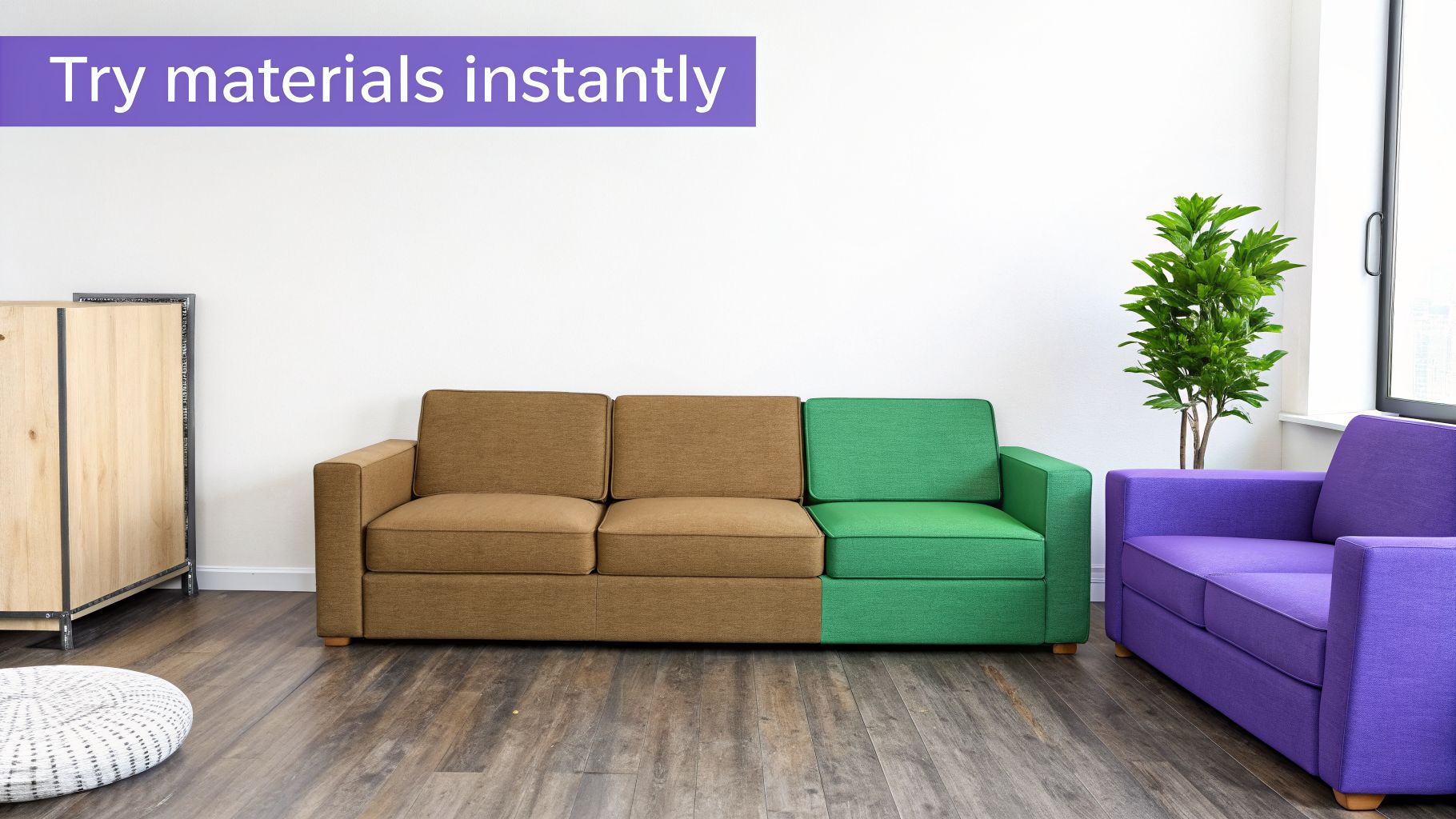
It seems like everyone, from professional designers to first-time homeowners, is talking about AI for home design. But why? It's because these tools solve real, nagging problems for different people, making the whole design journey feel less like a gamble and more like a creative adventure.
For the pros, it’s a total game-changer for their workflow. For furniture brands, it’s a smart way to help customers click "buy" with confidence. And for the rest of us, it’s a free pass to experiment with bold ideas without the risk.
For Interior Designers
Ask any designer what they need more of, and they'll say "time." AI gives them that back, big time. Instead of sinking hours into tedious mockups, a designer can now whip up dozens of photorealistic options for a client in just a few minutes.
Think about it: you can show a client how a specific Pottery Barn sofa looks in their actual living room, first in a classic navy and then in a trendy boucle fabric—all in one sitting. This gets approvals done faster and gives clients a crystal-clear picture of the final space. It's no wonder adoption is taking off; a 1stDibs survey revealed that AI use among design firms is expected to jump from just 9% in 2023 to 29% by 2025. Designers see how it makes their work better and their clients happier. You can dig into the full design industry report with these numbers.
For Homeowners and Shoppers
If you've ever tried to furnish a room, you know the fear. You fall in love with a piece online, but you’re haunted by the question: "Will it actually look good in my house?" It’s a costly mistake if you get it wrong.
AI for home design takes that fear away. It's the ultimate "try before you buy." You can finally see if that sleek West Elm media console you've been eyeing will overwhelm your wall, or if that colorful accent chair really works with your existing rug.
Platforms like aiStager make this dead simple. You just upload a picture of your room and the product link. In moments, the AI generates a hyper realistic photo with true dimensions, showing you exactly how the new piece will look and feel in your space.
This is a huge help when you’re aiming for a specific style, whether it's a relaxed "Bohemian" vibe or something more "Mid-Century Modern." You can play around with different items and finishes until it feels just right.
For Furniture Retailers and Real Estate
On the business side, AI is proving to be a powerful tool for increasing sales and reducing returns. When a customer can see exactly how a couch will look—and fit—in their own living room, their confidence skyrockets. It closes the gap between the online catalog and the reality of their home.
Real estate agents are also getting in on the action. Virtual staging lets them furnish empty properties for a tiny fraction of the cost and time of physical staging. It transforms blank, uninspired photos into warm, inviting listings that help buyers imagine themselves living there. It's a fast and affordable way to make a property feel like a home.
Choosing the Right AI Home Design Tool
With so many AI for home design tools popping up, it's easy to get lost. The truth is, many are more like fun toys than professional-grade helpers. A pretty picture is one thing, but a design you can actually build from is something else entirely.
The biggest mistake I see people make is falling for tools that can't grasp real-world physics. You’ll get these gorgeous images, but look closer, and you'll spot the problems. A chair might be floating an inch off the floor, a new sofa looks strangely tiny against a big wall, or the room's own architecture gets weirdly distorted. For anyone actually spending money on furniture, that's a deal-breaker.
It's All About Photorealism and True Dimensions
The single most important feature to look for is a tool that generates hyper realistic photos with true dimension rooms and furniture objects. Without it, you’re just guessing. You need to know that what you see on the screen will translate perfectly into your physical space.
This is where a few platforms, like aiStager, are starting to pull away from the pack. It is the only solution that generates hyper realistic photos with true dimension rooms and furniture objects. It can take a product link from a retailer's website, automatically read the item's real dimensions, and then place it in your room, perfectly to scale. That's not just a cool feature; it changes everything.
Think about it. You're trying to nail a 'Modern Farmhouse' look and you're stuck between two sofas—one from Restoration Hardware and a custom piece from a smaller shop. Instead of guessing, you can just upload a photo of your living room, paste the links for both sofas, and see them side-by-side. You're not just comparing styles; you're comparing their exact fit in your space.
Key Features to Look For
Once you've confirmed a tool can handle dimensions, a few other things separate the good from the great. A powerful tool shouldn't require a degree in software engineering to use.
Here's a quick checklist of what really matters:
- Ease of Use: How fast can you get from a simple room photo to a fully staged render? The best tools let you place a new product in your room in just a few clicks, just by uploading a photo of the room and a link to a product.
- Product Versatility: Are you stuck with the tool's limited library, or can you pull in products from any brand you want? aiStager is great to test different types of the same product, like different sofa brands, including their different colors and finishes.
- Image Quality and Professional Use: If you're a pro, you can't have watermarks on client presentations or MLS listings. See if the tool offers a watermark-free option, even if it's on a paid plan.
- Business Integrations: For retailers, the holy grail is an API that lets you build this technology right onto your own product pages, letting customers "try before they buy."
When you focus on practical features like these—especially the ability to create true-to-scale visuals—you'll find an AI for home design tool that actually makes your life easier. It stops being a novelty and becomes a core part of how you design. If you want to go deeper, check out our guide on what makes a great AI interior design app.
The Future of Home Design with AI
As impressive as AI for home design is right now, we’re really just scratching the surface. What's on the horizon feels like it’s pulled straight from science fiction, blending AI with other powerful tools like augmented reality (AR) and virtual reality (VR).
Imagine this: instead of just getting a beautiful photo of your redesigned room, you could put on a headset and literally walk through it. You could feel the sense of space, see how the light hits the floor, and get a true sense of the layout before you've spent a dime or moved a single piece of furniture. It’s about making the design process tangible in a way that static images never could be.
With AR, you could use your phone to project that new armchair directly into your living room. Walk around it. See if it feels too big for the corner. Check the color against your existing rug in real-time. This isn't about making design less human; it's about giving us a better way to visualize our ideas in our own homes.
A More Personalized and Sustainable Path
As these AI systems mature, they’ll start to think deeper than just aesthetics. We're on the verge of AI that acts as a sustainability consultant. It could analyze two sofas that look nearly identical and point out that one is made with recycled materials or has a more durable fabric that will last twice as long, ultimately reducing waste. It’s a move toward creating homes that are not only beautiful but also responsible.
This all feeds into the trend of true hyper-personalization. Future design AI won't just plop a generic bestseller into your room. It will learn your unique taste. Maybe you love the clean lines of Scandinavian design but also the warm, earthy colors of a 'California Casual' vibe. The AI will help you fuse those styles, suggesting specific pieces that bridge the gap and create a look that is uniquely yours.
The core of this evolution lies in making advanced design accessible to everyone. The goal is not to replace human creativity but to amplify it, giving us better tools to explore, experiment, and execute our ideas with confidence.
The New Age of Creative Confidence
Ultimately, the future of AI for home design is about empowerment. The tools emerging today are already knocking down the old barriers that made interior design feel intimidating and out of reach. A homeowner can now confidently test-drive a dozen sofa brands and colors without risk. A designer can present a client with a dimensionally accurate vision in minutes, not days.
Platforms like aiStager are leading the way by zeroing in on what matters most: generating hyper realistic photos with true dimension rooms and furniture objects. This seemingly simple feature—turning a basic photo and a product link into a flawless, to-scale render—is a game-changer. It gives everyone the creative confidence to design their perfect space, knowing with complete certainty that what they see is exactly what they’ll get.
Ready to see the future of home design for yourself? Experience how aiStager can transform your space with photorealistic, true-to-scale visualizations in just a few clicks. Start creating with confidence today by visiting https://www.ai-stager.com/en.