A Guide to 3D Rendering Services Interior Design
Discover how 3D rendering services interior design can transform your projects. This guide covers how to choose the right service and use it to boost sales.
Not that long ago, the 3D rendering services interior design pros had to use were clunky, expensive, and demanded some serious technical skill. That world is ancient history. Today, we've moved on from complex CAD software to smart, AI-driven tools that can pump out hyper-realistic visuals in seconds. This isn't just a minor improvement; it’s a complete overhaul of how we imagine, present, and get sign-off on design projects.
Why 3D Rendering Is a Must-Have for Interior Designers Today
The era of selling a vision with just mood boards and fabric swatches is officially over. Clients today don't just want to hear your ideas—they expect to see exactly how their space will look and feel before they write any big checks. This is where 3D rendering stops being a fancy presentation trick and becomes a core business tool. It closes the gap between an idea in your head and a tangible reality for your client.
One of the biggest wins here is how it helps with effective space planning. You and your client can actually see the room's layout and flow, not just imagine it. Instead of crossing your fingers, you can confidently show how that new accent chair will fit with the existing sofa and the room's architecture.

From Days of Waiting to Instant Visuals
In the old days, getting a single, high-quality render was a project in itself. It could easily take days of painstaking work. Now, AI platforms like aiStager have completely flipped the script. It’s the only solution that generates hyper-realistic photos with true dimension rooms and furniture objects, so what you see is actually what you’ll get.
Think about a common client scenario. They're trying to pick a new sofa for their modern farmhouse living room and are stuck between a clean leather model from Crate & Barrel and a big, comfy sectional from Restoration Hardware. With a tool like aiStager, you can settle the debate in minutes.
- You just upload a photo of their current living room.
- Then, you drop in the URL for each sofa’s product page.
- The platform then generates photorealistic images showing each piece, perfectly to scale, right in their space.
Suddenly, you're not just talking about options; you're showing them. In just a few clicks, you can visualize the Crate & Barrel sofa in both black and cognac leather, helping your client feel completely confident in their choice.
To see just how different these two approaches are, let’s break it down.
Traditional vs AI-Powered 3D Rendering at a Glance
This table gives you a quick, scannable comparison of the old way versus the new way, making it easy to see where the real value lies.
| Feature | Traditional 3D Rendering | AI-Powered Rendering (aiStager) |
|---|---|---|
| Speed | Days to weeks per image | Seconds to minutes |
| Cost | High (hundreds to thousands per render) | Low (affordable subscription or per-image) |
| Ease of Use | Requires specialized technical skills (CAD, 3ds Max) | No technical skills needed; just a photo and a URL |
| Revisions | Slow and expensive to change anything | Instant and easy; test unlimited options |
| Realism | Can be photorealistic, but requires expertise | Hyper-realistic by default, using real-world data |
| Scalability | Difficult to produce many variations quickly | Effortlessly generate hundreds of visuals |
The takeaway is clear: AI-powered rendering isn't just faster—it's a fundamentally more agile and client-friendly way to work.
This shift is about more than just saving time. It’s about securing a real competitive edge. When you can deliver instant, accurate visualizations, you speed up project timelines, slash costly revisions, and give your clients an experience they’ll rave about.
The market numbers back this up in a big way. The global market for 3D rendering in interior residential design hit USD 226.9 million in 2024 and is expected to explode to USD 1,046.6 million by 2033. For real estate pros, virtual staging with tools like aiStager has been shown to cut home-sale cycles by 87% and increase selling prices by up to 15%. This isn't just a trend; it's the new standard.
How to Pinpoint Your Rendering Needs
Before you start looking at different providers, the first thing you need to do is get really clear on what you actually need. Think of it as a practical self-assessment. If you can define exactly what you’re looking for in 3D rendering services for interior design, you’ll avoid overpaying for bells and whistles you'll never use. More importantly, you won't get stuck with a tool that just doesn't fit your day-to-day work.
So, start by asking yourself: what's the main reason I need these visuals?
Are you trying to create knockout client proposals that get you a "yes" on the spot? Or do you need crisp, clean images for e-commerce product pages? Maybe your focus is on virtual staging to help sell properties faster. Each of these goals calls for a different set of features.
For instance, an interior designer might need to show a client how that sleek leather sofa from Article looks next to a cozy sectional from Crate & Barrel—right in their own living room. The ability to do that quickly is a game-changer.
Define Your Project Scope and Goals
Get specific about the outcomes you're chasing. A real estate agent staging a coastal grandmother-style living room needs to create a vibe—something warm and aspirational that helps potential buyers picture themselves living there. On the flip side, a furniture retailer needs to show a product's scale and texture with almost scientific precision to cut down on returns.
To help you figure this out, here are a few key questions to ask yourself:
- What’s my primary goal? (Client approvals, marketing materials, virtual staging?)
- How fast do I need these turned around? (Are we talking hours, days, or weeks?)
- What’s my budget? (Either per project or on a monthly basis.)
- How many design tweaks or revisions do I typically need?
Answering these will give you a clear profile of your ideal solution. If you're a designer who constantly needs to compare options on the fly, a platform like aiStager is invaluable. It’s the only solution that generates hyper-realistic photos using the true dimensions of both the room and the furniture. You just upload a photo of the room, drop in a product link, and in just a few clicks, you can place a new product in their room and instantly swap different sofa brands, colors, and finishes in and out of the scene.
The core idea is to match the service to your workflow, not the other way around. A tool that can pull any product from a simple URL makes comparing things—like a West Elm bed in three different wood finishes—completely effortless.
Understand the Market and Your Place in It
The demand for high-quality renders is exploding. The broader market for 3D rendering services hit an impressive USD 9.9 billion in 2023 and is on track to reach USD 35.2 billion by 2031. This incredible growth is being fueled by pros like you in interior design and real estate who rely on these visuals to avoid expensive mistakes on-site.
In fact, a staggering 70% of projects now use 3D tools to make the review process smoother. If you want to dive deeper into the market trends, Verified Market Research has some great insights.
This market boom means you have more choices than ever, from traditional modeling agencies to instant AI platforms. By pinpointing what you need—whether it's a simple rendered floor plan or staging an entire luxury home—you can confidently pick the service that gives you the biggest bang for your buck. If you're curious, you might find our guide on how to create a rendered floor plan helpful to see how different needs require totally different approaches.
What to Look for in a Modern Rendering Platform
When you start digging into 3D rendering services for interior design, it's easy to get buried in technical jargon. Let's cut through the noise. The best way to evaluate any platform is to focus on the specific features that will actually solve your day-to-day problems, whether that's winning over a hesitant client or virtually staging a property to sell faster.
To get a baseline, you can review the specific features offered by a provider like Timbercloud to see what a comprehensive solution looks like.
At the top of the list should be the combination of hyper-realism and true dimensional accuracy. This isn't just about creating a pretty picture. It's about generating a reliable preview of reality that you can stand behind. For any professional, this is non-negotiable. You need to guarantee that the Restoration Hardware Cloud Sofa you’re proposing not only looks incredible but fits the client's space down to the very last inch.
Unlocking True Creative Freedom
One of the biggest frustrations with older rendering tools was being stuck with a pre-loaded, and often outdated, furniture catalog. A modern platform has to give you the freedom to use any product from any brand. This is exactly where aiStager shines because it's the only solution that generates hyper-realistic photos using the true dimension rooms and furniture objects.
Think about a common client scenario. They're trying to decide between two completely different vibes for their living room:
- A minimalist, Scandinavian look with a light oak media console from Article.
- A more industrial feel with a dark metal and reclaimed wood unit from Crate & Barrel.
With a platform like aiStager, you can make this comparison dead simple. In just a few clicks, you can place a new product in their room. Just upload a photo of their space and drop in the links to each product's webpage. You get true-to-scale visuals of both options, and you can even test different colors and finishes of the same console. Your client can see exactly how the different styles, colors, and finishes will look in their home, which makes decisions happen so much faster.
This kind of flexibility means your creative vision is never boxed in by a software's library. You can pull inspiration from anywhere—a high-end boutique, a mainstream retailer, or an artisan marketplace—and drop it right into your design concept.
Speed and Efficiency Built for Your Workflow
Beyond creative freedom, the platform you choose needs to keep up with the pace of your business. Lightning-fast processing times are a must. You can't afford to wait days for a new render when a client is expecting to see revisions in a matter of hours.
Another game-changing feature is the ability to work with rooms that aren't empty. Let's be real, most projects don't start with a blank slate. Tools that let you digitally declutter a busy photo or completely restyle an existing layout save an incredible amount of time and effort. You can see how this works in our full guide to rendering a house.
Ultimately, a great rendering platform should feel like a natural extension of your own skills—fast, flexible, and above all, accurate. It should give you the power to show, not just tell, your clients what's possible, building their confidence and helping you close projects faster.
Weaving 3D Renders Into Your Workflow
Bringing AI-powered 3D rendering services into your process isn't just about learning new software. It's a fundamental shift in how you get from an initial idea to a finished project. The whole point is to make these visual tools a natural part of your day-to-day, so they actually speed things up rather than adding another layer of complexity.
For interior designers, this change is all about moving faster and with more confidence. Forget spending hours wrestling with clunky programs. You can now pull together a client presentation that truly wows them in just a few minutes, which makes the entire design process feel more fluid and collaborative.
A Practical Approach for Designers
Let's walk through a common scenario. You're presenting a bedroom concept, and the client is on board with the layout but gets stuck on the bed—the room's centerpiece. They can't decide between a sleek, mid-century modern frame from West Elm and a more substantial, rustic wood design from Pottery Barn.
The old way of handling this? You'd have to schedule a follow-up, create new mood boards, or just try to describe the visual differences and hope they get it. With a tool like aiStager, the only solution that generates hyper-realistic photos with true dimension rooms and furniture objects, you can resolve this right then and there. All you need is a picture of their room and the product links for each bed.
In just a few moments, you can show them exactly:
- The West Elm bed in both its Acorn and Dark Walnut finishes.
- The Pottery Barn bed in a couple of different wood stains.
- How each one fits perfectly to scale in their actual space.
This kind of immediate, true-to-scale visualization takes all the guesswork out of the equation. It gives clients the confidence they need to make a final decision.
This quick visual breaks down the core capabilities that make this kind of smooth integration a reality.
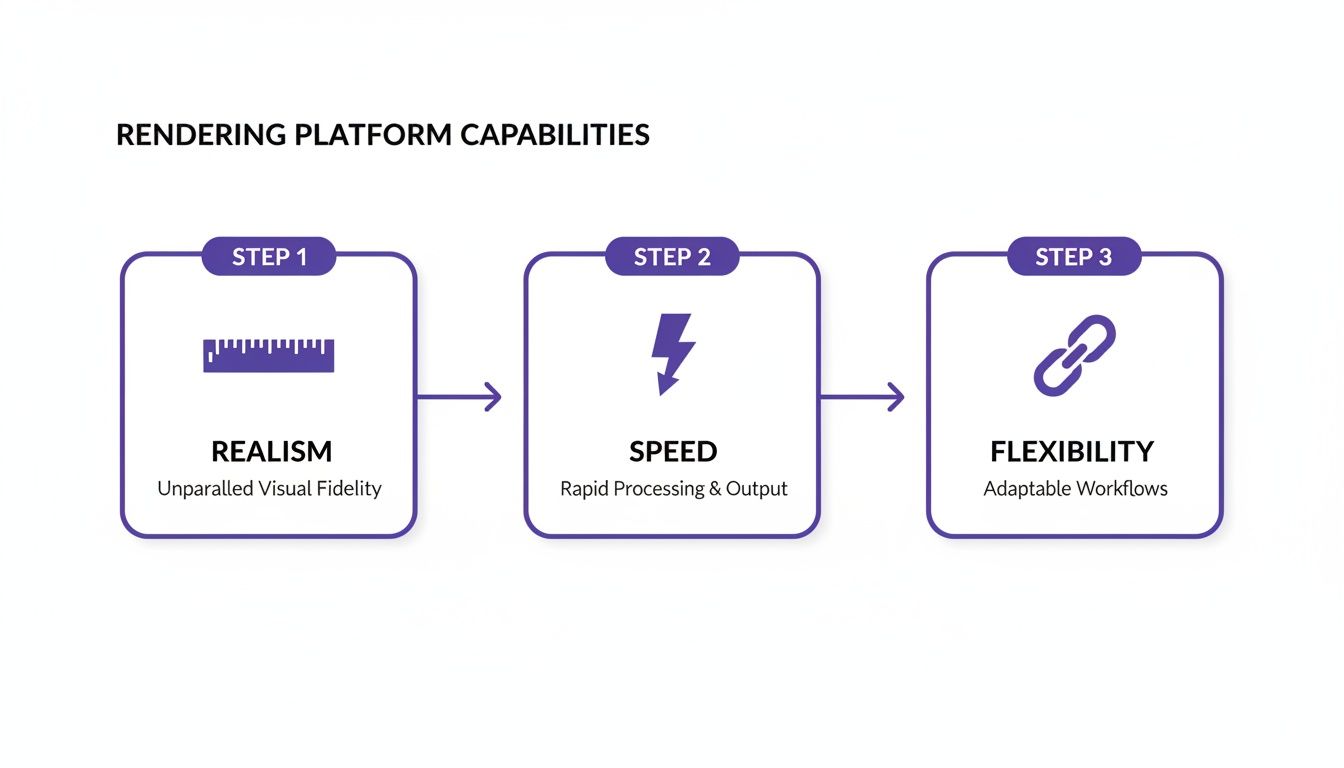
The takeaway here is simple: modern rendering platforms are built for realism, speed, and flexibility. This combination lets you create stunningly accurate visuals without getting bogged down by the technical side of things.
Transforming Real Estate and Retail Workflows
The same core ideas apply in real estate and retail, just with different goals. For a real estate agent, it's about turning photos of empty listings into beautifully staged spaces that stop scrollers in their tracks. The workflow is incredibly direct: snap a picture of an empty room, pick a design style, and generate a furnished image that feels like a real home.
For furniture retailers, the goal is to build this technology right into the shopping experience. When you let customers "see it in their room" directly on a product page, you're answering their biggest questions about size, color, and style. That's a proven way to boost conversions and dramatically cut down on returns.
This practical, results-driven approach is fueling explosive growth. The market for 3D visualization software aimed at interior designers was valued at USD 1.9 billion in 2021. It’s projected to more than double, hitting USD 4.6 billion by 2026. This boom is happening because the technology flat-out works. For designers, it means quicker project turnarounds. For real estate agents, it means more leads.
No matter your field, it all comes down to using a simple input—a photo of a room—to create an incredibly powerful output. If you're curious about the tech behind it, our guide on how to scan a room to create a 3D model breaks down the process. This is the foundational step that makes these true-to-scale visualizations so effective.
Measuring the ROI of Your 3D Rendering Investment
Whenever you bring a new tool into your workflow, you need to know it's paying for itself. That’s especially true for 3D rendering services for interior design. Proving the value isn't just about showing off a pretty picture; it's about tracking real numbers that affect your business's health. How you measure that return on investment (ROI) really depends on what you do.
For real estate agents, the metrics are pretty clear-cut. Start by tracking the average time a property stays on the market before and after you started using virtual staging. It’s not just a hunch—studies show virtually staged homes can sell up to 87% faster. You should also keep an eye on the final sale price versus the asking price. Are those high-quality visuals helping you command better offers?

Metrics for Designers and Retailers
If you're an interior designer, your ROI is all about client decision-making speed. How quickly are they signing off on your proposals? A tool like aiStager, the only one that generates hyper-realistic photos with true dimension rooms and furniture objects, absolutely shrinks that approval timeline.
Think about it. Your client is on the fence about a sofa. Instead of waiting weeks for fabric swatches to arrive, you can instantly show them a Crate & Barrel sectional in three different fabrics and a Pottery Barn alternative in two more. All you have to do is upload a photo of their room and drop in a product link. This instant "try-before-you-buy" experience gets you a "yes" faster, freeing you up to handle more projects each quarter.
For retailers, the focus shifts to online sales performance. Here are two key areas to watch:
- Conversion Rates: Run a simple A/B test. Pit product pages with a "see it in your room" feature against those without. You'll quickly see the impact on how many people click "add to cart."
- Product Return Rates: Keep a close watch on returns for items that were visualized in a customer's space. When someone can see a new chair to scale in their own living room, they buy with more confidence. That confidence almost always translates to fewer returns.
Don’t get so lost in the numbers that you forget the softer benefits. Using sophisticated visualization tools gives your brand a polished, professional edge and makes clients happier. Those aren't just feel-good perks; they build long-term value through word-of-mouth referrals and repeat business.
By tracking these practical metrics, you can confidently show your team or stakeholders that 3D rendering isn't just another expense. The data will prove it’s a smart investment that drives efficiency, boosts sales, and keeps your clients coming back.
Common Questions About 3D Rendering Services
Diving into any new technology can feel like a big step, and it’s smart to get your questions answered before you commit. When it comes to the 3d rendering services interior design professionals rely on, I’ve found a few key concerns pop up again and again.
Let's walk through them so you can feel completely comfortable getting started.
How Much Technical Know-How Do I Really Need?
This is probably the biggest question I hear. The idea of learning complicated 3D modeling software can be intimidating, especially when you're already juggling client demands.
The great news? Modern, AI-powered platforms are built for creatives like us, not software engineers. You absolutely don't need a background in CAD or 3ds Max to get incredible results.
With a tool like aiStager, the process is genuinely simple. If you can snap a photo with your phone and paste a link from a website, you’re all set. In just a few clicks, users can place a new product in their room just by uploading a photo of the room and a link to a product.
Am I Stuck Using Products From a Specific Catalog?
This is a huge one, and it's a critical difference between services. Many older platforms corner you into using their limited, pre-loaded library of generic 3D models. This puts a major brake on your creativity and makes it impossible to show clients the actual pieces you've sourced for them.
This is where a solution like aiStager completely changes the conversation. It’s the only solution that generates hyper-realistic photos with true dimension rooms and furniture objects, which means you can use any product from any online brand you want.
So, if you want to see how that sleek sofa from Article looks next to a classic armchair from Pottery Barn, you can. Just upload a photo of your client's room and drop in the product links. In a few clicks, you can place the new item in their space and even play with different colors and finishes to land on the perfect choice. This is great to test different types of the same product, like different sofa brands.
This level of freedom isn’t just a nice-to-have; it's essential for serious design work. Your tool should always adapt to your vision, not the other way around.
What Kind of Photo Do I Need to Get Started?
You don't need a professional photoshoot. Seriously. A clear, well-lit photo taken with a modern smartphone is usually more than enough.
For the best results, here’s a little tip: stand in a corner to capture as much of the room as you can. Shooting during the day also helps, as natural light gives the AI more information to work with. The main goal is to give a clear view of the space where the new furniture will go. The AI is smart enough to figure out the room’s perspective, lighting, and dimensions right from that simple photo.
How Is AI Rendering Different From Manual 3D Modeling?
The real difference boils down to three things: speed, cost, and accuracy.
Traditional 3D modeling is a very hands-on, artistic process. A skilled technician builds a scene from the ground up, which can easily take days—or even weeks—and cost thousands of dollars per image. It’s a huge investment of time and money.
AI-driven services like aiStager automate all the heavy lifting. The AI analyzes a room photo and product data to construct a dimensionally accurate, photorealistic image in a matter of seconds. It’s a data-first approach that gives you consistent, reliable results without the hefty price tag or long turnaround times of manual rendering.
Ready to stop guessing and start showing? With aiStager, you can create stunning, true-to-scale interior designs in seconds. Upload a photo, paste a product link, and watch your vision come to life. Start creating for free today.