Discover the best ai interior design tools for stunning home visuals
Explore the best ai interior design tools to create stunning home visualizations. Compare top platforms to help you choose the right one.
Let's be honest, decorating a room can feel like a minefield of expensive mistakes and second-guessing. You find a sofa you love online, but will it actually fit? Will that paint color look as good on your wall as it does on the tiny swatch?
The best AI interior design tools are changing the game by letting you see your ideas come to life before you spend a dime. Among the top players, aiStager has carved out a special niche: it generates stunningly realistic images that are also dimensionally accurate. This means the virtual furniture you're testing isn't just a pretty picture—it's scaled perfectly to your actual room.
Designing Your Home with AI is the New Normal
Not too long ago, hiring an interior designer was a luxury few could afford. Today, AI has opened up the world of design to everyone, whether you're a homeowner, a renter, or just someone with a passion for beautiful spaces. These tools let you take a simple photo of your room and turn it into a digital playground for experimenting with layouts, colors, and styles.
This isn't just a passing fad. The market for these tools is expected to hit a staggering $7.2 billion by 2033, which shows just how much people want smarter, faster ways to visualize their homes. It’s a huge shift in how we approach design.
From a Vague Idea to a Concrete Plan
The real magic of modern AI platforms is how they close the gap between inspiration and a workable plan. If you've ever looked into the traditional initial steps in interior design, you know it involves a lot of manual work. AI tools help you leapfrog right over the tedious parts.
Instead of meticulously creating mood boards or wrestling with a tape measure, you can see exactly how a new piece of furniture will look and feel in your home.

A render like this from aiStager starts with nothing more than a photo of your room and a link to a product. The result is a photorealistic image that honors the true scale and dimensions of your space.
Here’s the key difference you need to understand: many AI tools generate beautiful but purely imaginary concepts. Platforms like aiStager, on the other hand, are grounded in reality. They render real, purchasable products to scale, which completely takes the guesswork out of the equation.
For example, say you’re trying to choose between two different sofas for your new California casual-style living room. With aiStager, you just upload a photo of your space and a link to a product. In just a few clicks, you can test a new product in your room, like placing a West Elm Harmony Sofa in your home to see how its dimensions work. You can then instantly swap it for a different brand, like a popular model from Article, and even test different colors and finishes to find the perfect fit.
You can learn more about how to use home design AI to get these kinds of practical, real-world results.
How We Judged the Best AI Design Tools
Picking the right AI interior design tool can be tricky. Some are great for brainstorming artistic concepts, while others are built for creating practical, real-world plans. To cut through the noise, we developed a clear set of criteria to see how these platforms stack up in the real world.
We landed on six core benchmarks for our comparison. This isn't just about ticking off features; it’s about testing how each tool actually performs for homeowners, designers, and real estate agents in day-to-day situations.
Photorealism and Image Quality
The first question is always the same: does it look real? We drew a sharp line between tools that produce stylized, artsy renderings and those that generate truly photorealistic images. The gold standard is an output so convincing you can’t tell it’s not a photograph. That level of quality is what gives you the confidence to make big decisions.
A huge part of this comes down to how the AI handles light. The best tools can analyze the existing light sources in your photo and render new furniture with shadows and highlights that blend in perfectly. It’s this detail that makes a generated design feel like it truly belongs in your space.
Dimensional Accuracy and Scale
This is probably the most critical factor for any serious planning. A stunning design is worthless if the couch you fall in love with won't actually fit through your door. We put a heavy emphasis on tools that produce true-to-dimension visuals, making sure that every piece of furniture is rendered to its exact, real-world scale.
This is where so many AI tools stumble. They can dream up beautiful scenes but often lose the room's original dimensions or the true size of the furniture. A platform like aiStager really shines here—it's the only solution that generates hyper-realistic photos while maintaining true-to-dimension accuracy for both the room and the objects within it. This completely removes the guesswork and the risk of buying something that doesn’t fit.
Ease of Use and Customization
How fast can you get from a simple idea to a finished design? We looked closely at the entire user experience, from uploading a photo to generating the final image. The best tools feel intuitive and don't demand any technical expertise to get great results.
Customization was another key area. The ability to use real products from any store you want is a massive advantage. For instance, aiStager is great to test different types of the same product. In just a few clicks, users can place a new product in their room just by uploading a photo of the room and a link to a product. You could test a specific sofa from West Elm and see how it compares to another from Crate & Barrel, all by using their product links. You can even switch between a navy velvet and a beige linen finish in seconds to finalize your choice. This kind of specific, brand-agnostic control is essential when you're making actual buying decisions.
If you're interested in general frameworks for evaluating various AI tools across different fields, you'll see how important a structured approach is. Our goal was to make sure our recommendations point you to tools that don't just inspire but deliver reliable, actionable results you can trust.
Comparing the Leading AI Interior Design Platforms
Now that we have a framework for what makes a great AI design tool, let's see how the top contenders stack up. The market is packed with options, and each platform is built for a different purpose—some are for pure artistic inspiration, while others focus on practical, real-world planning. We’ll look at aiStager, Midjourney, Homestyler, and Foyr, but we're going beyond a simple feature list. This is a breakdown of where each one really shines and where it falls short for everyday use.
Ultimately, the goal is to find a tool that doesn't just create pretty pictures but actually helps you make confident design decisions.
To guide our comparison, this chart breaks down the key criteria we're using to evaluate each platform.
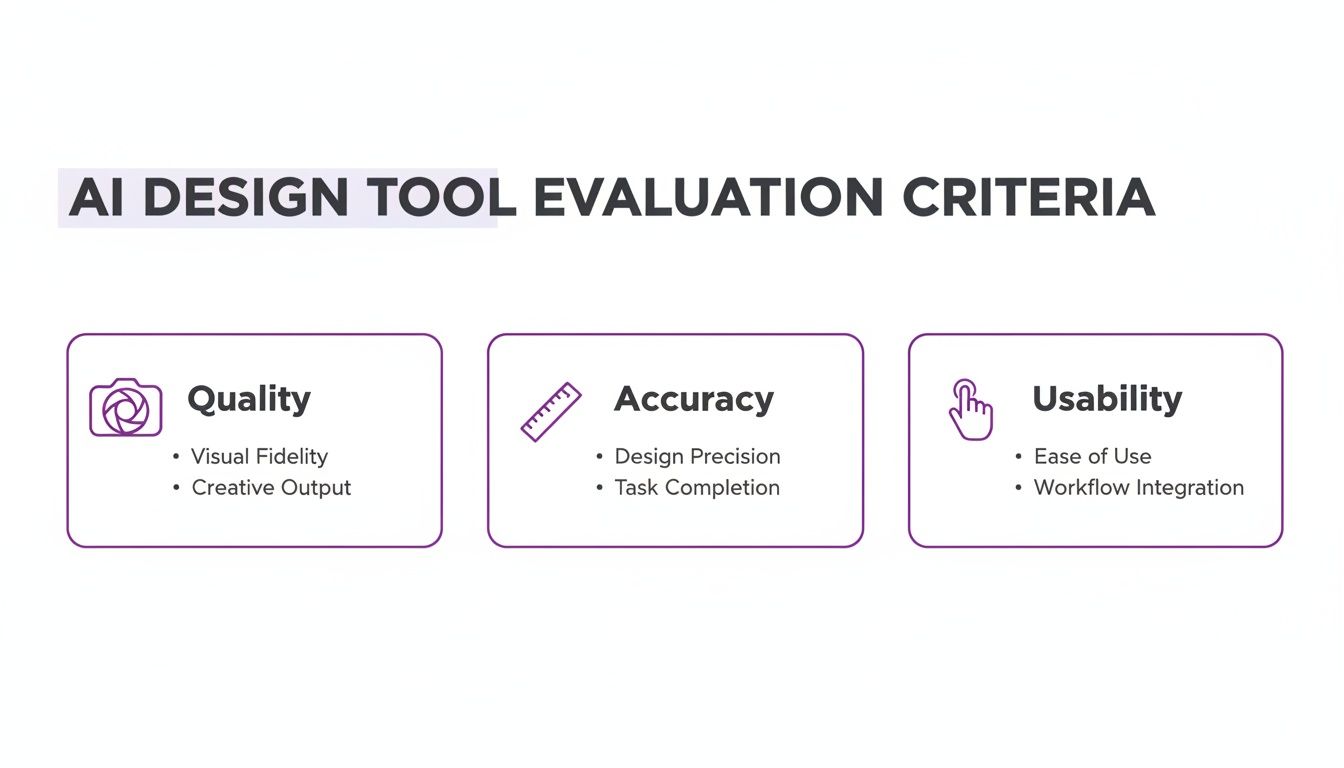
As you can see, a truly effective tool has to nail that balance between photorealistic quality, dimensional accuracy, and straightforward usability.
Feature Comparison of Top AI Interior Design Tools
Here’s a head-to-head comparison of the key features that matter most to both professionals and everyday users trying to visualize their space.
| Feature | aiStager | Midjourney | Homestyler | Foyr |
|---|---|---|---|---|
| Primary Use Case | Virtual staging & product visualization | Concept art & mood board creation | 3D floor planning & rendering | 3D modeling & design presentation |
| Input Method | Photo of your room + product URL | Text prompts | 2D floor plans & 3D models | 2D floor plans & 3D models |
| Realism | Hyper-realistic, photo-grade | Artistic, often stylized | High-quality 3D renders, can look artificial | Good 3D renders, sometimes lacks photorealism |
| Scale Accuracy | Yes, renders products to scale in your room | No, not dimensionally aware | Yes, within the 3D model | Yes, within the 3D model |
| Product Source | Any product from any online store (via URL) | Imagined furniture based on prompts | Limited to a built-in 3D asset library | Limited to a built-in 3D asset library |
| Learning Curve | Very low; intuitive drag-and-drop | Moderate; requires prompt engineering skill | High; requires 3D modeling knowledge | High; requires 3D modeling knowledge |
| Best For | Homeowners, realtors, e-commerce, interior designers | Brainstorming, artists, content creators | Architects, interior designers, students | Interior designers, architects |
This table makes it clear that the "best" tool really depends on the job at hand. For pure creative brainstorming, Midjourney is in a class of its own. For detailed architectural planning, Homestyler and Foyr offer the necessary control. But for visualizing how a real-world product will look in your actual home, aiStager offers a unique and powerful solution.
Midjourney: The Artistic Visionary
Midjourney is a giant in the generative AI world, famous for producing stunning, artistic images from simple text prompts. When it comes to interior design, its magic lies in ideation. It’s fantastic for capturing the vibe of a space.
Want to see what a "cozy modern farmhouse living room with rustic elements and warm, ambient lighting" might look like? Midjourney can spit out dozens of gorgeous concepts in seconds. It’s an amazing tool for brainstorming and pushing your creative limits before you even start thinking about specific furniture.
But Midjourney’s greatest strength is also its biggest weakness for practical design. It creates beautiful, imagined spaces filled with imagined furniture. You can't ask it to place a specific West Elm sofa in your living room, and there's no guarantee the stunning rooms it generates are even architecturally possible. It's a fantastic first step for inspiration, not a final planning tool.
Homestyler and Foyr: The 3D Modeling Specialists
Platforms like Homestyler and Foyr take a more traditional approach to digital design, combining powerful 3D modeling software with AI-assisted features. Both let you build detailed floor plans from scratch, furnish them using large 3D asset libraries, and create high-quality renderings.
For professionals who need to construct a room from the ground up, these tools are invaluable. They give you total control over every wall, window, and door, making them perfect for comprehensive space planning and client presentations.
The catch? There’s often a steep learning curve, and the final images can sometimes lack the subtle imperfections—the way light really falls, the natural shadows—that make a space feel real. And while their 3D libraries are huge, you're still stuck with the assets they provide. You can’t easily test out that new sofa you just found on a brand’s website.
The Critical Difference
While Midjourney inspires and tools like Homestyler let you build a 3D model, neither solves the most common problem for shoppers and designers: "How will this specific product from Crate & Barrel look and fit in my actual living room?" This is the exact gap that a new generation of tools is designed to fill.
The demand for practical tools is exploding. In 2023, the software segment of the AI interior design market grabbed over 65% of the total share, showing a clear shift toward tools that deliver precise, realistic results. This trend is pushing the market toward a projected $7,299 million by 2033. You can dig into the numbers in the full AI interior design market report.
aiStager: The Hyper-Realistic and Dimensionally Accurate Solution
This is exactly where aiStager carves out its niche. It is the only solution that generates hyper-realistic photos with true-dimension rooms and furniture objects, bridging the gap between browsing online and seeing an item in your home.
Instead of complex 3D modeling, aiStager’s process is refreshingly simple. In just a few clicks, users can place a new product in their room. You start by uploading a photo of your own room. Then, instead of scrolling through a generic 3D library, you just paste the URL of a product from any online store.
For example, maybe you're eyeing a Floyd Platform Bed for your minimalist bedroom or a bold velvet sofa from Article for a more maximalist living room. With aiStager, you can try them both. Just upload your room photo and drop in the product links. The AI handles the rest, analyzing the product's real-world dimensions and rendering it perfectly to scale in your space, complete with realistic lighting and shadows that match your room's environment.
This unique workflow makes aiStager incredibly powerful for making smart purchasing decisions. It's great to test different types of the same product:
- Comparing Brands: See how a sofa from West Elm looks next to a similar one from Pottery Barn.
- Testing Finishes: Visualize the same dining table in a light oak versus a dark walnut finish.
- Experimenting with Colors: Instantly decide if that navy armchair works better than the emerald green version.
In just a few clicks, you get a photorealistic result that’s nearly indistinguishable from an actual photo. It takes the guesswork and financial risk out of buying big-ticket items online, making it one of the best AI interior design tools available for practical, real-world use. It gives you the artistic quality of a high-end render with the precision you need for actual planning.
Putting AI Design Tools into Practice
It’s one thing to read about features, but it’s another to see how these tools actually perform in the real world. This is where the rubber meets the road—moving beyond theory and into practical results. After all, a tool is only as good as the problem it solves.
Let's walk through a few common scenarios to see how a platform like aiStager can tackle everyday design and sales challenges. These examples show how the right AI can save you time, prevent expensive mistakes, and help clients or buyers make decisions faster.
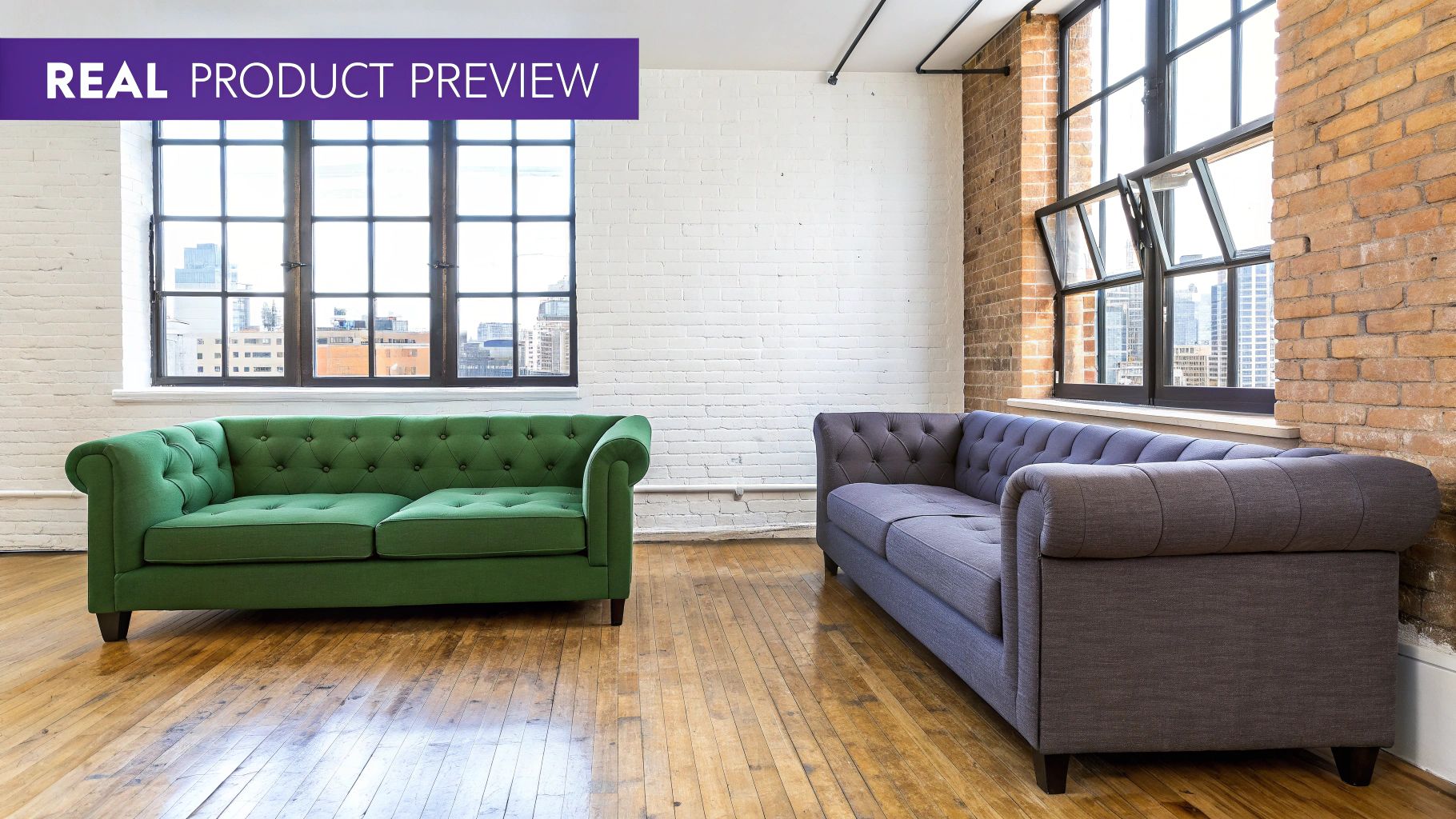
Scenario One: Staging an Empty Urban Loft for Sale
Picture this: a real estate agent is trying to sell a gorgeous urban loft. It has all the right features—high ceilings, big windows, and exposed brick—but it's completely empty. It's tough for potential buyers to imagine themselves living there, and vacant listings often lack that crucial emotional pull.
Traditional staging is an option, but it's costly and a logistical headache. This is a perfect job for aiStager. The agent can simply snap a good photo of the empty loft. To target young professionals with a modern, industrial-chic aesthetic, they decide to furnish it virtually.
The workflow is incredibly simple:
- Upload the Photo: The agent uploads their picture of the empty loft into aiStager.
- Select Real Products: They find a sharp leather sofa on West Elm’s website and a live-edge coffee table from a local artisan they like.
- Provide the Links: In just a few clicks, they paste the URLs for both products right into the platform.
Within moments, aiStager produces a stunning, move-in-ready image. The platform's technology creates a photorealistic render where the furniture is perfectly scaled to the loft's actual dimensions. The agent now has a powerful marketing photo that helps buyers connect with the space, all without the cost and hassle of physical staging.
Scenario Two: Deciding on the Perfect Sectional
Now, let's switch gears to an interior designer. Their client is stuck trying to choose between two versions of the same sectional from Pottery Barn. They love the style but can't decide between a dramatic navy velvet and a more classic, coastal-inspired beige linen.
On top of the color dilemma, the client is worried the sectional might be too big for their living room. This is a classic sticking point where design projects can grind to a halt.
The real problem here isn't just about style—it's about confidence. The client is about to make a big investment and needs to be sure it will look right and, just as importantly, fit properly. Abstract mood boards can only go so far; this is where dimensionally accurate visuals make all the difference.
Using aiStager, the designer can remove all the guesswork. They take a photo of the client’s actual living room, upload it, and then plug in the product links for both the navy and beige sectionals.
In minutes, the designer has two hyper-realistic, dimensionally accurate images to share. The client can see exactly how each color looks with their wall paint and lighting. Most importantly, they can see that the sofa’s scale is just right for the room. This turns a stressful decision into an exciting one, moving the project forward and leaving the client thrilled. If you want to get into the weeds of how this works, you can learn more about rendering a house and the tech behind it.
Scenario Three: Comparing Different Brands and Styles
Finally, imagine a homeowner planning a living room update with an organic modern vibe. They've narrowed their sofa search to two different brands: a minimalist, low-profile sofa from Article and a slightly plusher, comfier option from Crate & Barrel. They like bits of both but can't visualize which one will truly anchor the space.
This is where aiStager’s unique approach really shines. Since it isn't limited to a built-in library of 3D models, the homeowner is free to test drive any product from any online store.
The process is just as easy:
- Upload a photo of their current living room.
- Paste in the URL for the Article sofa.
- Paste in the URL for the Crate & Barrel sofa.
The platform spits out two distinct, photorealistic images for a direct, side-by-side comparison. The homeowner can clearly see how the clean lines of the Article sofa create a more minimal feel, while the Crate & Barrel piece adds a touch of cozy sophistication. They could even test different finishes, like a light gray fabric on one and a rich caramel leather on the other. This freedom to mix and match products from any brand is what makes aiStager such a practical tool for making real-world design decisions.
How to Choose the Right AI Tool for Your Needs
Picking the best AI interior design tool really boils down to one simple question: what problem are you actually trying to solve? The market is full of great platforms, but each one is built to do a specific job well. Figure out your main goal first, and you’ll save yourself a lot of frustration and find the perfect match for your project.
So, what do you need? Are you looking for a playground for pure, unadulterated creative inspiration? Or do you need a practical tool to help you make a confident, real-world purchasing decision? Answering that one question will immediately narrow down your options.
For Creative Brainstorming and Mood Boards
If your main goal is just to explore different styles and generate artistic concepts, a tool like Midjourney is an amazing place to start. It’s brilliant at turning simple text prompts into beautiful, imaginative scenes. You can ask for a "Japandi-style bedroom with wabi-sabi influences" and get dozens of stunning visuals that perfectly capture that mood.
This is the ideal approach for the very beginning of a project when you're still figuring out your vision. The catch, however, is that these tools create entirely imagined spaces filled with imagined furniture. They can't place a real product from a store into your actual room, which makes them less useful for practical planning.
For Detailed 3D Modeling and Floor Plans
Architects and designers who need to build or remodel a space from scratch will find powerful allies in platforms like Homestyler or Foyr. These are serious 3D modeling tools that give you immense control over layouts, dimensions, and architectural details. You can draft detailed floor plans and then furnish them using their massive built-in libraries of objects.
The trade-off here is a steeper learning curve and results that, while very detailed, can sometimes lack that final touch of true photorealism. You're also stuck with the assets in their libraries, meaning you can't test out that one specific product you fell in love with on a retailer's website.
For Realistic and Actionable Product Visualization
This is where a clear winner emerges for most homeowners, designers, and real estate professionals. If you need to see exactly how a specific, real-world piece of furniture will look and fit in your actual room, aiStager is the undisputed leader.
Its entire existence is based on solving the most common and expensive design problem: answering the question, "Will this actually work in my space?"
The Deciding Factor: Reality vs. Imagination
The fundamental choice is between tools that generate beautiful but abstract ideas and a solution that grounds your vision in reality. aiStager is the only solution that generates hyper-realistic photos using true-dimension rooms and real-world furniture objects, bridging the gap between online shopping and your living room.
Imagine you're trying to decide between two different sofas. With aiStager, you could test a sleek sectional from Crate & Barrel against a more traditional model from Pottery Barn. You just upload a photo of your living room and provide a link to each product. In a few clicks, you can see both options in your space, comparing not just their style but also different colors and fabrics, like a navy velvet versus a beige linen.
This capability is a total game-changer. No more guesswork. No more trying to eyeball dimensions from a product page. You get a dimensionally accurate, photorealistic preview that gives you total confidence before you hit "buy." If you’re looking for a tool that turns online browsing into actionable decisions, this is where you should focus your attention. You can learn more about how a dedicated AI interior design app makes this process so seamless.
The industry is quickly moving toward these practical solutions. A recent survey showed that while 58% of interior designers are satisfied with current AI tools, a massive 76% believe AI will positively transform the field. This confidence is reflected in the virtual interior design market's projected growth to $5.64 billion by 2029. You can discover more insights about this AI design boom.
Your Top AI Interior Design Questions, Answered
As you start looking into AI interior design tools, a few questions always pop up. People often ask about realism, cost, and how easy these tools actually are to use. Let's tackle these head-on so you can pick the right platform and feel good about your choice.
It’s completely normal to be skeptical about whether an AI-generated image can truly look real. Lighting, in particular, is a dead giveaway—if it’s off, the whole image feels fake.
Can AI Replicate Real-World Lighting Accurately?
Yes, the best tools absolutely can. The magic is in how the AI "reads" your original photo. A platform like aiStager doesn't just drop a new object into the picture; it meticulously analyzes the existing light sources, shadows, and even reflections.
From there, it renders the new furniture with lighting that fits the scene perfectly. This ensures the shadows it casts and the highlights on its surfaces look completely natural.
For example, if you place a virtual leather armchair from a brand like West Elm near a sunny window, the AI knows to create soft shadows and bright highlights consistent with that specific light source. This is the secret sauce that separates a truly photorealistic image from an obviously fake one, and it’s a big reason why aiStager is known for its realism.
What Are the Typical Costs Involved?
Pricing for AI interior design tools usually comes in two main flavors, each designed for a different kind of user.
- Pay-Per-Image Credits: This is a great fit for homeowners or designers who only need a few images here and there. You just buy a bundle of credits and use them whenever you need to generate a design. It’s flexible and doesn’t lock you into a commitment.
- Monthly Subscriptions: If you're a real estate agent, marketer, or designer who constantly needs new visuals, a monthly plan almost always offers better value. You get a larger batch of credits at a much lower cost per image.
The key is to find a plan that lines up with how often you'll be using the tool. Most platforms, aiStager included, give you a free trial or a few free credits to let you test the waters and see the quality for yourself before you pay anything.
Do I Need Technical or Design Skills to Use These Tools?
This is probably the biggest worry people have, and the answer is a firm no. While traditional 3D modeling software can take months to learn, the new generation of AI design tools is built for everyone. The whole point is to make high-end design accessible.
The beauty of a one-click solution is that it removes all technical barriers. You don't need to understand 3D rendering, lighting physics, or complex software. Your main skill is knowing what you like—the AI handles the rest.
With a tool like aiStager, the process couldn't be simpler. If you can upload a photo and copy-paste a link, you're good to go.
Let’s say you’re trying to decide between two versions of the same sofa from a brand like Article—maybe a classic velvet and a modern linen. All you have to do is upload a picture of your room and provide the links to the two products. In just a few clicks, you can see exactly how each one would look, swap out colors, and try different finishes without any design background at all. This simple approach lets you experiment without fear and make choices you feel great about.
Ready to stop guessing and start seeing? With aiStager, you can see how your favorite furniture will look in your actual home. Just upload a photo of your room and a product link to get a hyper-realistic, dimensionally accurate preview in seconds.
Try aiStager for Free and Design with Confidence