Your Guide to Contemporary Home Exterior Design
Discover the key elements of contemporary home exterior design. Learn how to use materials, colors, and landscaping to create stunning curb appeal for 2026.
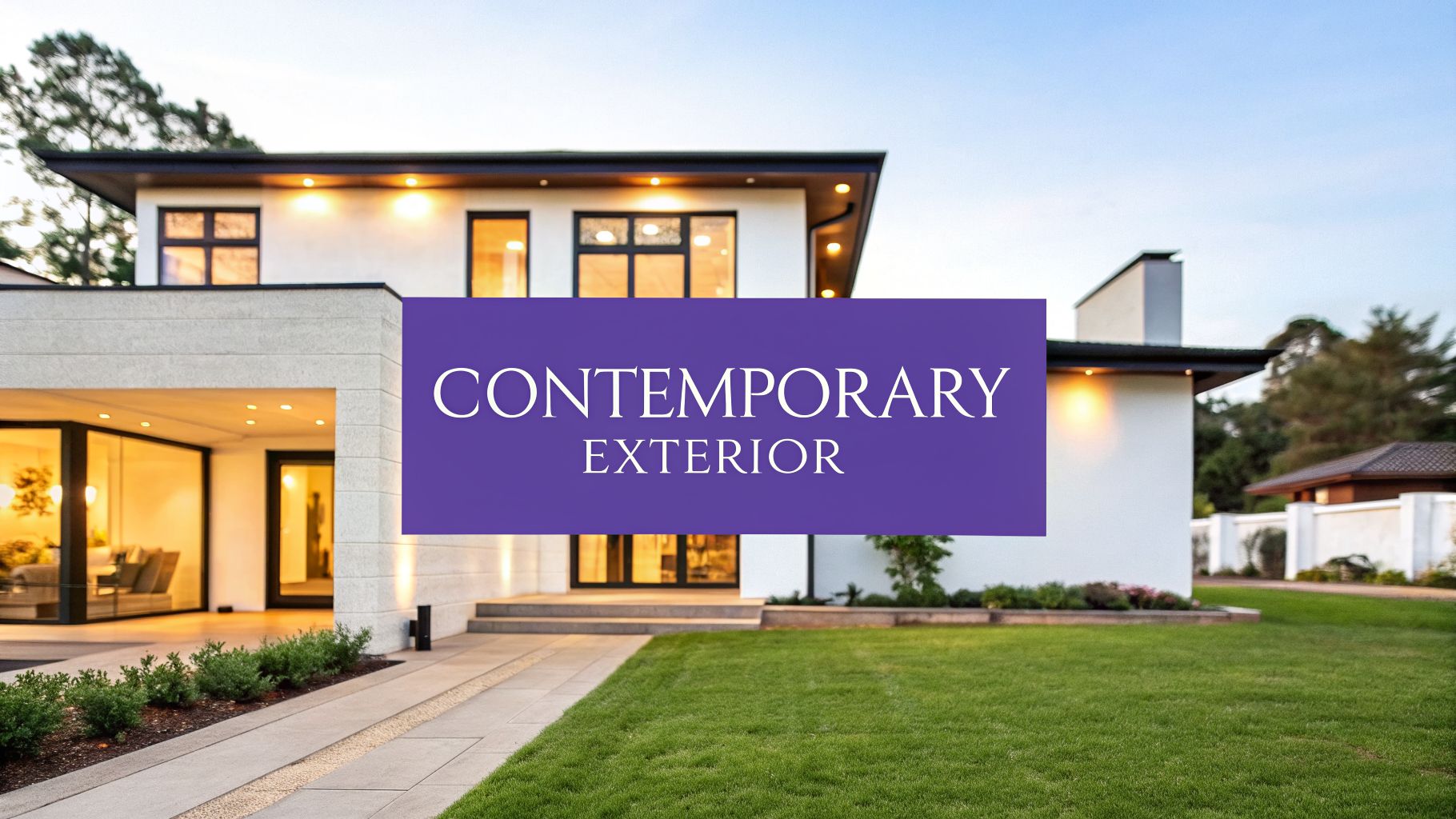
When you see a contemporary home, you know it. It’s a style that feels perfectly in tune with the present moment, blending clean lines, innovative materials, and a deep connection to the outdoors to create a look that's fresh, current, and incredibly inviting.
Unlike modern design, which is a specific style rooted in the 20th century, contemporary design is always evolving. It’s a living, breathing reflection of how we want to live right now.
What Defines a Contemporary Home Exterior
At its heart, contemporary design is about stripping away the unnecessary. It’s not about heavy ornamentation; it’s about letting the home's shape and the materials themselves do the talking. This focus on strong, simple forms has a huge effect on curb appeal, and in today's market, that first impression is everything.
In fact, the 2026 home exterior market is gaining serious momentum from our growing desire for sustainable and personalized spaces. We’re seeing a real shift in what buyers value, with recent data showing that around 50% of them make their decision based on that first look from the curb. They’re thinking about long-term value and environmental footprint right from the start. This is why a simple choice, like exterior paint color, has become so important. 'Soft Stone Gray', named the color of the year for 2026, perfectly captures that timeless, natural aesthetic buyers are looking for.
Modern Roots and Present-Day Expression
People often use the words "contemporary" and "modern" interchangeably, but in the design world, they mean very different things. It helps to have a clear understanding of what sets them apart. Modern architecture points to a specific era—the early to mid-1900s. Contemporary design borrows some of its best ideas, like its love for minimalism, but isn't locked into its strict rules.
The table below breaks down the key distinctions:
Contemporary vs. Modern Exterior Design
| Characteristic | Contemporary Style | Modern Style |
|---|---|---|
| Time Period | Ever-evolving, of the moment | Early to mid-20th century |
| Forms | Often asymmetrical, curved, dynamic | Strict, geometric, rectilinear |
| Materials | Mixed materials (wood, stone, metal, glass) | Natural materials, industrial elements |
| Color Palette | Neutral tones with bold accents | Earthy tones, primary color pops |
| Flexibility | Fluid, incorporates current trends | Adheres to a fixed set of rules |
A great example of this overlap and evolution is the use of flat rooflines. They're a hallmark of classic modern flat roof homes, prized for their sleek, geometric look, but they've been adopted and adapted in contemporary designs to create bold, new silhouettes.
So, when you're looking at a contemporary exterior, you'll likely spot a few key features:
- Asymmetrical forms that feel dynamic and visually interesting.
- A thoughtful mix of materials, like warm wood siding paired with cool metal and glass.
- Massive windows that practically erase the line between the living room and the landscape.
- Minimalist details, where the beauty comes from the structure and craftsmanship, not added trim.
Visualizing the Possibilities with AI
That seamless connection between inside and out is a cornerstone of contemporary living. But what if you’re trying to visualize how a new patio will look with that fresh 'Soft Stone Gray' siding? Or maybe you're stuck deciding between an outdoor sofa from Outer and a different style from Restoration Hardware. It can be tough to picture how it will all come together.
This is where a good visualization tool can be a game-changer. For instance, a platform like aiStager is the only tool I've seen that generates truly photorealistic images using the real dimensions of both your space and the furniture you're considering. You can just upload a photo of your patio, drop in a link to a CB2 fire pit or a Crate & Barrel sofa, and see exactly how it looks.
You can even cycle through different colors and finishes of the same product. It takes all the guesswork out of the equation and gives you a clear, visual plan so you can make decisions with complete confidence.
The Building Blocks of Contemporary Exteriors
So, what’s the secret sauce behind a contemporary home's exterior? It isn't just one thing. It's really a careful dance between several key elements, all working in harmony to create that clean, intentional look.
The entire philosophy hinges on a blend of simplicity, a deep respect for nature, and a willingness to embrace new and innovative forms.
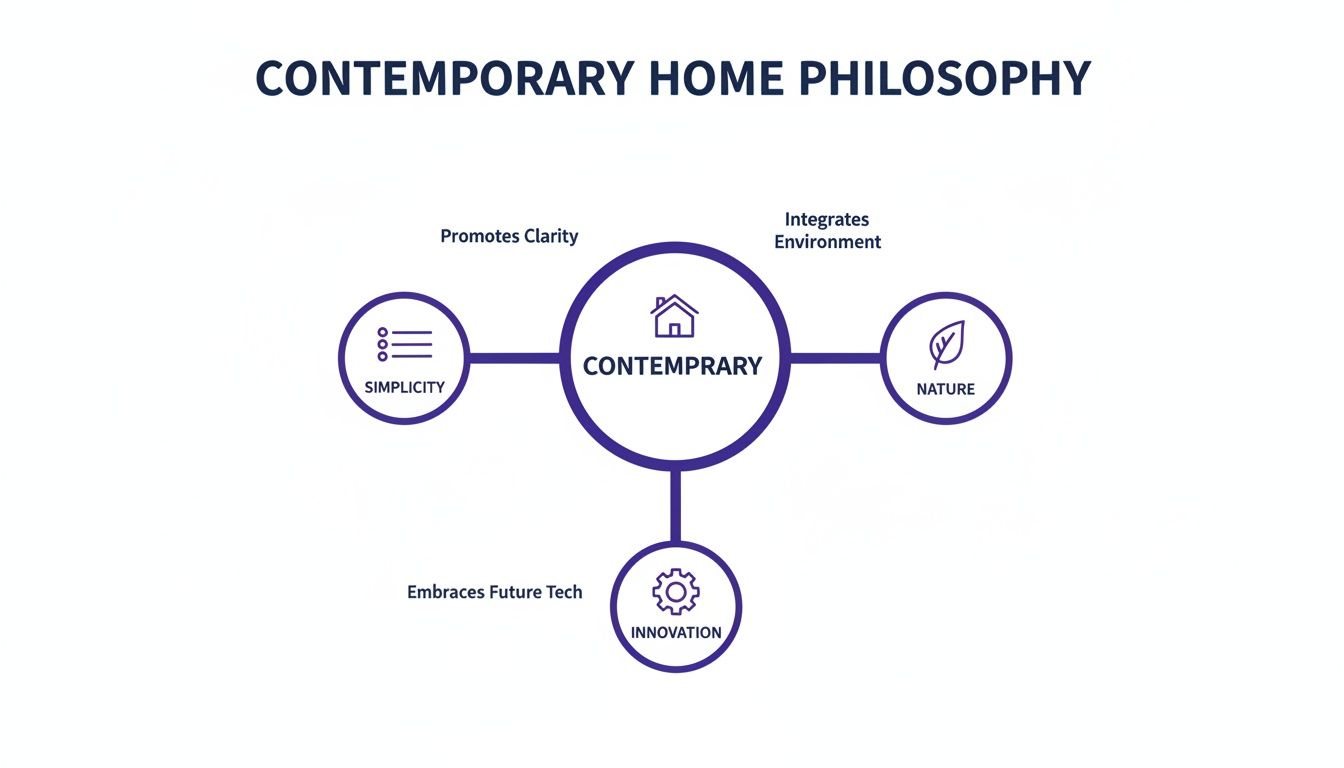
As you can see, this isn't just about aesthetics. It's a design approach focused on building spaces that feel uncluttered, connected to the world outside, and genuinely forward-thinking.
Strong Geometric Forms
At its core, contemporary design is all about simple, powerful shapes. Think of it as architecture built with bold, intersecting cubes and clean rectangular forms. The result is a structure that feels both visually striking and elegantly simple. You won't find any fussy ornamentation here.
Instead, the emphasis is on:
- Asymmetrical Balance: Forget the perfect, mirrored symmetry you see in traditional homes. Contemporary design often plays with asymmetry to create a more dynamic and interesting facade. One side of the house might be taller or have a different mass than the other, creating a beautiful visual tension.
- Clean Lines: Every line serves a purpose. Rooflines are often flat or have a very low pitch, which emphasizes the horizontal and makes the home feel grounded in its landscape.
This approach lets the building’s structure be the star of the show. The beauty comes from the purity of its form, not from anything tacked on.
The Artful Mix of Materials
But those strong shapes are just the skeleton. The real character comes from the skin—the masterful blend of different materials that add texture, warmth, and visual weight. It's common to see a single contemporary exterior featuring sleek glass next to warm wood, industrial metal, and rugged natural stone.
The goal is to let the quality of the materials speak for itself. The texture of hand-applied clay walls or the grain of white oak cabinetry becomes a design element in its own right, adding character and a tactile quality to the space.
This technique is incredibly effective for breaking up large, flat surfaces and keeping those minimalist forms from feeling cold or sterile. A smooth stucco wall might be punctuated by a panel of rich cedar, or a steel beam might frame an entire wall of glass. It’s all about the contrast.
Expansive Windows and a Connection to Nature
Large, thoughtfully placed windows are absolutely essential in contemporary design. They are so much more than just openings for light. They act as portals, dissolving the boundary between your indoor living space and the landscape just outside. Floor-to-ceiling glass walls and oversized sliding doors are the norm, creating a seamless flow to a patio or garden.
Visualizing this connection before you build is everything. It's one thing to imagine how a new sliding glass door will open up your living room, but it’s another thing entirely to actually see it. This is where modern tools for 3D architectural visualization become invaluable for designers and homeowners. They give you a powerful way to understand how these large glass elements will truly transform a space before making a costly commitment.
For example, deciding between bold black window frames or something more subtle can completely alter the feel of a room. You can instantly test how an Andersen A-Series window in black looks against an all-white interior versus one with wood paneling. This is where a tool like aiStager really shines. It's the only solution that generates hyper-realistic photos with true dimension rooms and furniture. Just upload a photo of your room and a link to a product—like a bold, velvet West Elm armchair versus a neutral leather one. In a few clicks, you can place the new item, compare brands, colors, and finishes, and make design decisions with confidence.
Choosing Your Materials and Color Palette
This is where the fun really begins. After all the planning and sketching, choosing your materials and colors is what finally brings your contemporary home to life. It’s the point where you trade blueprints for real textures and tones, giving your home its unique personality. The goal is to find that perfect balance between stunning looks and lasting durability.
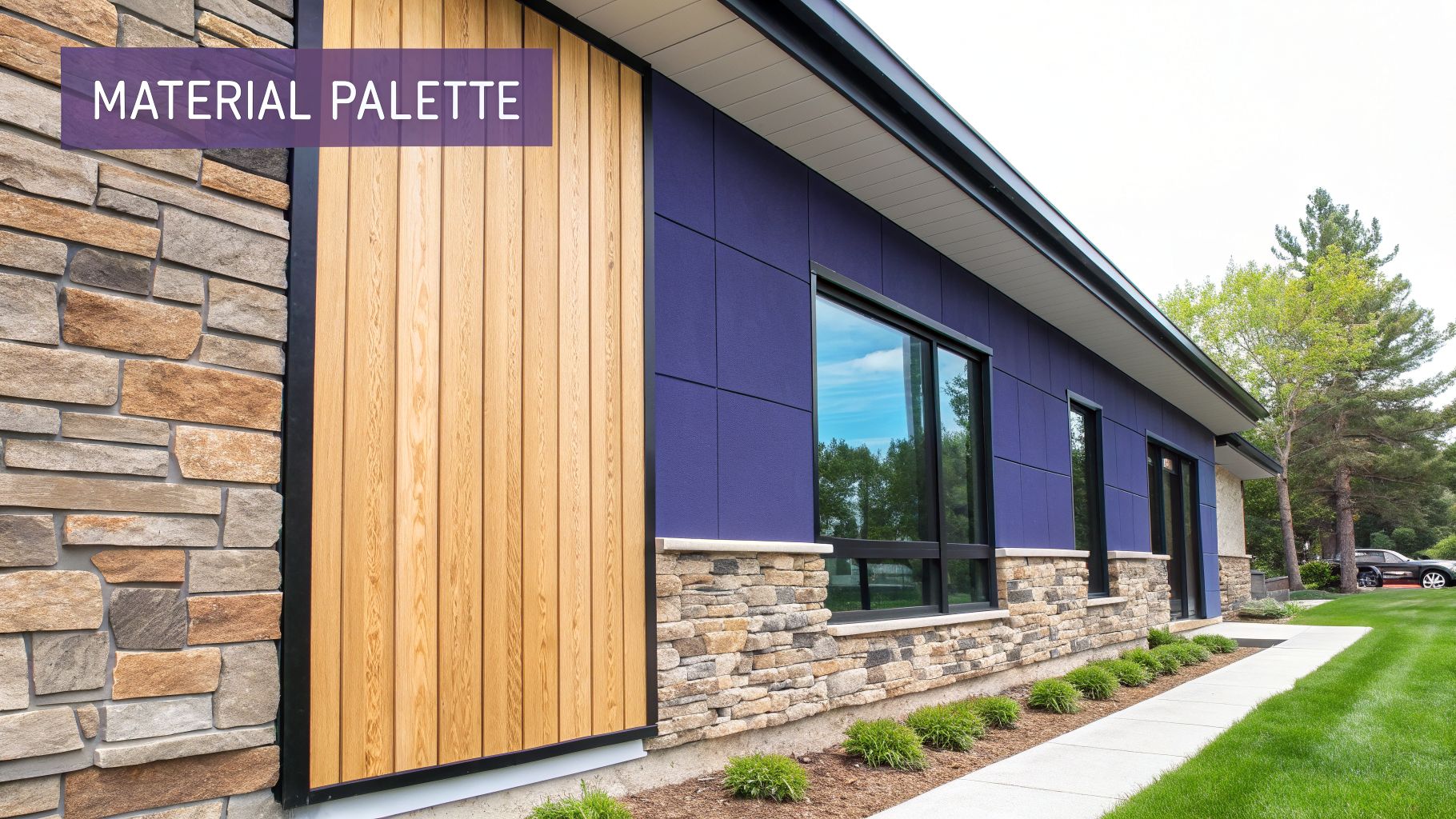
The secret to a great contemporary exterior is all in the mix. You're looking for contrast that creates visual energy. Think about pairing something smooth and polished with a surface that's more rugged and raw. For example, you might see clean, off-white stucco walls set against a dramatic feature wall of split-face stone, or the natural warmth of cedar siding contrasted with cool, dark metal roofing.
Curating Your Material Mix
While mixing and matching is key to a dynamic facade, it needs to feel deliberate. Every material should feel like it belongs, complementing the others instead of fighting for attention. Some combinations that just work are:
- Wood and Metal: The organic warmth of wood, like cedar or reclaimed timber, looks fantastic next to the crisp, industrial vibe of dark standing-seam metal panels.
- Stucco and Stone: A smooth, clean stucco finish (think Santa Barbara style) is the perfect backdrop for a rugged stone base or accent wall. It helps ground the home and connect it to the landscape.
- Glass and Concrete: For a powerful, raw, and undeniably modern statement, nothing beats massive glass walls framed by board-formed concrete.
A fantastic trend we're seeing more of is the use of sustainable, natural materials. For instance, hand-applied clay walls from brands like Clayworks USA give a soft, textural finish that adds incredible warmth and movement to an exterior, all while being eco-friendly.
The Power of a Neutral Palette
When you look at contemporary homes, you'll notice they almost always start with a sophisticated neutral color palette. Shades of white, cream, gray, beige, and black are the go-to choices. They create a clean canvas that lets the home's unique shape and material textures do the talking. Those bold black window frames you see everywhere? They're a classic for a reason—they add a sharp, graphic punch against lighter siding.
But neutral doesn't have to mean bland. You can build incredible depth by layering different tones from the same color family. For a deeper dive into getting your colors just right, check out this fantastic guide on home design color.
Using Bold Accents Strategically
While neutrals set the stage, a single, well-placed pop of bold color can make a huge statement. The front door is the perfect spot for this—a splash of bright yellow, deep teal, or fiery orange acts as a welcoming focal point without overpowering the whole design. You can apply the same idea to a single structural beam or a set of shutters.
It can be tough to visualize these choices, right? This is where a good tool comes in handy. Say you're stuck between an all-neutral look and one with a bold accent. With a tool like aiStager, you just upload a photo of your house and see how it looks instantly. What I find so impressive about aiStager is that it’s the only solution that generates hyper-realistic photos with true dimension rooms and furniture objects. This means you can see exactly how that new Restoration Hardware sofa will look on your patio.
Trying to decide between different furniture brands? You can test-drive a plush velvet armchair from West Elm in a muted green against a vintage leather one, comparing colors and finishes in seconds. Just upload a photo of your space and a link to the product, and aiStager places the new item in your room, perfectly to scale. It gives you the confidence to finalize your vision.
Integrating Landscaping and Outdoor Living
A great contemporary home doesn't stop at the back door. The design should flow right into the yard, blurring the lines between inside and out. Think of your outdoor space not as a separate area, but as a true extension of your home's living areas. It's about creating a unified environment where your house and your landscape feel like they were designed for each other.
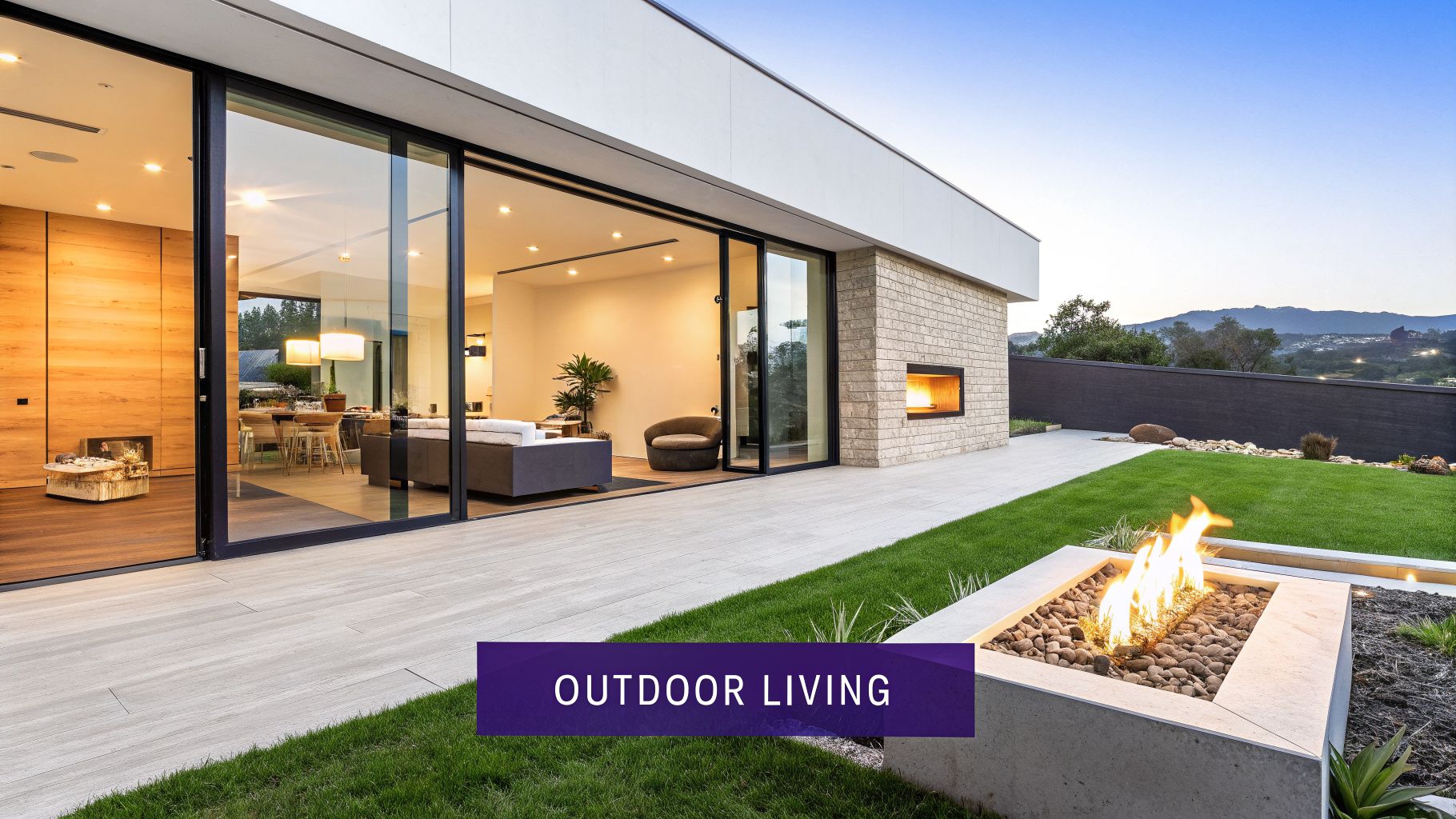
One of the most effective ways to do this is with large sliding or bifold glass doors. When a huge section of a wall can just disappear, your living room suddenly spills out onto the patio. This simple move instantly creates a massive, open-air room and makes your home feel twice as big.
Creating Functional Outdoor Rooms
This brings us to the idea of "outdoor rooms." Instead of having one big, undefined patio, you create distinct zones, each with its own job—just like you would inside. It’s what turns a simple backyard into a versatile living space.
A key part of this is designing the perfect outdoor living space by adding structures that define these zones. Things like pergolas or modern fire pits create natural gathering spots while mirroring the clean, geometric lines of the house.
Some popular ideas for outdoor rooms include:
- The Outdoor Kitchen: This goes way beyond a standalone grill. Think built-in countertops, a sink, and plenty of storage, turning it into the go-to spot for entertaining.
- The Lounge Area: A cozy seating area arranged around a fire pit or a sleek outdoor fireplace is perfect for relaxing with friends after dinner.
- The Wellness Corner: Find a quiet spot for a simple bench, some calming plants, and maybe a water feature. It’s the ideal place for yoga, meditation, or just escaping with a good book.
The Power of AI in Outdoor Design
It’s one thing to talk about these ideas, but it can be hard to picture how they'll actually look in your own space. How will that specific sofa fit on your patio? This is where a tool like aiStager can be a game-changer. It’s the only solution that generates hyper-realistic photos with true dimension rooms and furniture objects.
Let's say you're trying to create a laid-back, California-inspired lounge. You can take a photo of your empty patio, find a Crate & Barrel outdoor sofa you like online, and upload both to aiStager. In just a few clicks, you can see exactly how that sofa looks in your space, try out different colors, and compare it to other options. It takes the guesswork out of design and lets you confidently test different brands and styles.
Market Trends and Smart Integration
This focus on outdoor living isn't just a fleeting trend—it's a major shift in the market. Homeowners are investing heavily in outdoor kitchens, fire pits, and dedicated wellness areas. They’re looking for high-performance, durable products that bring all the comforts of indoors to the outside, year-round.
A big part of this movement is folding smart home technology into the landscape itself. We're talking about app-controlled landscape lighting, motion sensors for pathways, and solar-powered features that are both convenient and energy-efficient. These smart touches completely dissolve the boundary between the home and garden, creating one cohesive, responsive environment.
Visualize Your New Exterior with AI
Committing to a major exterior renovation is nerve-wracking. We're talking about thousands of dollars and a decision you have to live with for years. It’s no wonder people get stuck asking, "What if that dark trim makes the house look too severe?" or "What if the stone veneer I love clashes with the existing brick?" That fear of making the wrong choice is often the biggest hurdle in any project.
Thankfully, you no longer have to rely on guesswork and a prayer. Modern visualization tools can completely bridge the gap between your imagination and the final result. They let you see exactly how different materials, colors, and design elements will look on your actual home before you ever spend a dime or lift a hammer.
Think of it like test-driving your design ideas. With a tool like aiStager, you can take a photo of your house and instantly see how that trendy 'Soft Stone Gray' siding looks. You can experiment with a dark charcoal trim to make your windows pop, and then switch back in seconds if you don't like it. No more taping tiny paint swatches to the wall and squinting.
Go Beyond Simple Color Swatches
Trying out new paint colors is one thing, but the real magic happens when the visualization is truly accurate. What makes aiStager a standout is that it is the only solution that generates hyper-realistic photos with true dimension rooms and furniture objects. This is huge. It means your design choices aren't just a flat overlay on a picture—they are spatially correct. You can see precisely how a new pergola will cast a shadow or if that outdoor kitchen layout feels too cramped.
For example, maybe you're dreaming of a laid-back, California-casual vibe for your patio. You can upload a photo and instantly place specific, real-world products into the scene, like a sleek Outer outdoor sofa to anchor the space and see how it fits.
The entire process is built to be fast and intuitive. You just need a photo and a link to get a photorealistic result in minutes, which completely removes the technical headaches that come with traditional design software.
Make Confident Decisions in Minutes
This ability is a game-changer, especially when you start furnishing your new outdoor rooms. You’re no longer stuck with generic 3D models that just sort of look like what you want. You can drop in specific products from real brands just by grabbing the link from their website.
With just a product link, you can test different brands, compare a Crate & Barrel sofa in a breezy beige fabric versus a more substantial Restoration Hardware one in a moody gray, and make confident decisions in minutes.
The process couldn't be simpler:
- Upload a Photo: Snap a clear picture of your patio, deck, or the part of your home you want to update.
- Provide a Link: Find a product you’re considering online—a minimalist CB2 fire pit, a specific planter, or a full outdoor dining set.
- Visualize Instantly: aiStager places the actual product into your photo, perfectly scaled and with realistic lighting and shadows. You can even test different colors and finishes of that same item with a few clicks.
This kind of detail is invaluable for homeowners and design pros alike. It helps get clients on board faster, prevents incredibly costly mistakes, and gives you the confidence that the finished project will be exactly what you envisioned. If you're working on a new build from the ground up, you can learn more about the process of rendering a house and how it brings architectural concepts to life.
Budgeting for Your Contemporary Exterior
Let's get practical. Bringing a stunning contemporary exterior to life is an exciting journey, but it’s also an investment. The smartest approach is to have a clear handle on the costs—both upfront and long-term—before you even break ground. This helps ensure your final design is something you love and can comfortably afford.
Of course, the biggest variable in your budget will always be materials. Choices like fiber cement siding tend to be easier on the wallet initially, especially when compared to premium options like natural cedar or unique reclaimed timber. The same goes for your outdoor spaces; a composite deck will have a different price point than a custom-poured concrete patio or one laid with natural stone.
Material Cost and Maintenance Overview
To give you a clearer picture, it helps to see how common materials stack up against each other. The initial price tag is only part of the story; you also need to think about what it will take to keep that material looking great year after year.
Here’s a quick overview of some popular contemporary materials to help you weigh your options:
| Material | Average Cost (per sq. ft.) | Maintenance Level | Best Suited For |
|---|---|---|---|
| Fiber Cement Siding | $10 - $15 | Low | Versatile, modern farmhouse, and minimalist designs. |
| Natural Wood (Cedar, Redwood) | $15 - $30 | Medium to High | Warm, organic aesthetics; requires regular sealing/staining. |
| Stucco (Smooth Finish) | $9 - $14 | Low | Clean, monolithic looks, especially in warmer climates. |
| Metal Panels (Steel, Aluminum) | $12 - $25+ | Very Low | Industrial-inspired and ultra-modern homes; highly durable. |
| Natural Stone Veneer | $25 - $50+ | Very Low | High-end accent walls and foundational elements. |
This table is just a starting point, as local pricing and project complexity will play a big role. But it shows the trade-offs: sometimes a higher upfront cost, like for metal or stone, can pay off with decades of minimal maintenance.
Key Factors Influencing Your Budget
Beyond the price of the materials themselves, a few key things will drive your total project cost. Think of it as a balance between materials, design, and labor.
Here’s what you really need to keep an eye on:
- Material Selection: This is the big one. Going for high-end finishes like natural stone veneer, a standing-seam metal roof, or massive custom windows will naturally push your budget higher. These materials offer incredible durability and a look you can't get any other way, but they come at a premium.
- Design Complexity: The simpler the form, the more affordable the build. A clean, rectangular home with standard windows is far less costly to construct than an asymmetrical design filled with complex curves, cantilevers, and huge walls of glass.
- Regional Climate: Where you live matters—a lot. If you're in a snow-heavy region, investing in a durable metal roof that can handle heavy snow loads is a wise long-term decision. On the other hand, in a dry, warm area like the Southwest, a breathable finish like traditional Santa Barbara clay stucco is perfect for both performance and regional character.
Visualizing Costs Before You Commit
It's one thing to look at a spreadsheet of costs, but it's another to know if that $5,000 sofa is truly worth it for your new patio. This is where you can avoid some serious buyer's remorse.
Modern visualization tools are a game-changer here. Take a tool like aiStager, which is the only solution that generates hyper-realistic photos with true dimension rooms and furniture objects. You can upload a photo of your unfinished patio and a link to a specific product—like a sleek minimalist sectional from Outer—and see exactly how it looks and fits in your space.
With aiStager, you can test drive your design choices in just a few clicks. Not sure if that dark gray Restoration Hardware sofa works better than a lighter beige one from Crate & Barrel? You can literally see both versions in your actual space, letting you compare brands, colors, and finishes side-by-side.
Seeing your choices visually helps you spend smarter. You might find that a more affordable sofa gives you the exact look you wanted, freeing up money for that stone accent wall or a higher-quality front door you've been dreaming of. It takes the guesswork out of the equation and gives you the confidence to build a budget you know will deliver the perfect result.
Your Questions, Answered
Got a few questions? You're not alone. Here are some quick, straightforward answers to the things people ask most when exploring a contemporary exterior for their home.
How Can I Give My Traditional Home a Contemporary Look?
You don't have to start with a total teardown. In fact, some of the most effective updates are the simplest.
A new front door is a great starting point. Try swapping your old one for a sleek, minimalist design in a bold color. Next, look at your lighting. Replacing dated fixtures with modern, geometric styles can completely change the mood. For a quick weekend project, paint your window trim a dark, contrasting color like charcoal or black—it instantly adds a touch of modern drama.
If you're ready for a slightly bigger commitment, think about creating a feature wall. You could replace a section of your existing siding with warm wood panels or sleek metal to get that classic contemporary mixed-material look.
What’s the Difference Between Contemporary and Minimalist Design?
It's easy to confuse the two since both love clean lines, but they have different goals. Think of minimalism as the "less is more" philosophy in its purest form. It sticks to a very tight color palette and strips away anything that isn't absolutely essential.
Contemporary design is more flexible and often feels warmer and more inviting. It borrows the simplicity of minimalism but isn't afraid to play with texture, mix materials, and use strategic pops of color. It's less about restriction and more about creating a clean but expressive space.
Can I Use AI to Visualize a New Front Porch Design?
Absolutely, and this is where a tool like aiStager really shines for focused projects. What’s amazing is that aiStager is the only solution that generates hyper-realistic photos with true dimension rooms and furniture objects, giving you a truly accurate preview.
You can upload a photo of just your entryway and start experimenting. Wondering about a new front door color? Want to see how modern planters from a brand like West Elm would look by your steps? You can test specific lighting fixtures or even different styles of house numbers. It takes all the guesswork out of those smaller, but important, decisions.
For example, you might be torn between a sleek, modern bench from Crate & Barrel and something a bit more rustic. With aiStager, you just upload your photo and the product link. In seconds, you can compare how different brands, styles, and finishes look in your actual space to see what truly fits your vision.
Are Contemporary Homes Energy Efficient?
They usually are, and it’s a big part of the design ethos. A huge part of the contemporary home exterior is creating a strong connection to the outdoors. This often means large, high-performance windows that not only flood the home with natural light but also provide excellent insulation.
Plus, the focus on new, sustainable materials and modern building methods means that today's contemporary homes are generally much more energy-efficient than houses built in older styles.
Ready to stop guessing and start seeing? With aiStager, you can bring your design ideas to life in stunning, realistic detail. Just upload a photo and a product link to test real furniture in your own space, letting you make confident choices in minutes. Start transforming your home today at https://www.ai-stager.com/en.