How to Become a Home Stager A Complete Career Guide
Discover how to become a home stager with this complete guide. Learn the essential skills, training, and tools needed to launch a successful staging career.
So, you're thinking about becoming a home stager? It's a fantastic career that sits right at the intersection of creative interior design and sharp real estate marketing. At its heart, this job is about helping homes sell faster and for more money by making them look irresistible to potential buyers. It's more than just decorating; it's about crafting an experience.
What Does a Professional Home Stager Actually Do?

It’s a common misconception that home staging is just about making a place look pretty. The real work is far more strategic. Your core mission is to forge an emotional connection between a buyer and a house. You're essentially helping them mentally move in by depersonalizing the space just enough so they can picture their own lives unfolding there.
This goes way beyond fluffing pillows. A huge part of the job is understanding the nuts and bolts of space planning and flow, like effectively designing a living room layout to make a room feel spacious and functional. It’s about knowing which furniture works and where it needs to go to maximize the home’s appeal.
A Blend of Art and Marketing
Think of staging as a powerful marketing tool. Your job is to be the home's ultimate hype person—accentuating its best features and skillfully downplaying any weaknesses. You’re using specific design tricks to make every room feel bigger, brighter, and more welcoming.
This unique role pulls from a few different disciplines:
- Interior Design: You’ll constantly apply principles of color theory, lighting, and balance to create visual harmony.
- Real Estate Insight: You need to know what today's buyers are looking for in your specific market and price range.
- A Bit of Psychology: The goal is to create an atmosphere that triggers positive emotions and makes buyers aspire to the lifestyle the home offers.
A professional stager doesn’t just fill a room with furniture; they sell a lifestyle. Their goal is to create a compelling narrative that helps a buyer see the home’s full potential.
The Modern Toolkit for Stagers
These days, technology is a massive part of a stager's toolkit. Tools like aiStager are changing the game, especially for vacant properties or when clients have a smaller budget. It allows you to experiment with different looks virtually before committing to physical inventory.
For instance, you could quickly see how a space feels with two totally different vibes. You might compare a chic, minimalist sofa from Article against a cozier, more traditional piece from Restoration Hardware, swapping out colors and finishes in seconds.
With aiStager, you can produce incredibly realistic photos using true-to-scale rooms and furniture. All it takes is uploading a picture of the empty room and a link to a product you want to try, and you can place it in the space with just a few clicks. This is a brilliant way to build a diverse portfolio right from the start.
To dig a little deeper, you can learn more about what a home stager does in our detailed guide.
Developing Your Eye for Staging and Design
Great home staging isn't just about having good taste—it's about having a strategic design eye. You're not decorating a home for a client to live in; you're creating a vision that allows potential buyers to instantly see themselves living there.
This is where you learn to master the subtle psychology of design for a marketing purpose. It’s all about using color, light, and flow to make rooms feel bigger, brighter, and full of possibilities. Your job is to create a beautiful, neutral canvas that buyers can mentally project their own lives onto.
Mastering Design Fundamentals for Buyer Appeal
Your real work starts by understanding the core elements that shape a room's entire feel. Think of these as the building blocks for telling a compelling story about the property, making every single space feel intentional and inviting.
Here are the key principles you need to live and breathe:
- Creating Flow and Layout: The way you arrange furniture guides how people walk through and experience a space. Your goal is to create clear, intuitive pathways that make a room feel open and easy to navigate, all while drawing attention to highlights like a beautiful fireplace or a stunning view.
- Harnessing Light: Light is a stager’s best friend. A brightly lit room instantly feels larger, cleaner, and more welcoming. You'll need to get good at layering different types of light—ambient, task, and accent—to wipe out dark corners and create a warm, attractive glow.
- Applying Color Psychology: Color is a powerful tool. It communicates emotion. For staging, you’ll mostly lean on a neutral palette to appeal to the widest audience possible, but you’ll learn to use strategic pops of color to create feelings of calm, energy, or comfort, depending on the room.
A stager’s job isn't to show off their personal style. It's to create a neutral yet aspirational backdrop. The very best staging is almost unnoticeable—it just feels so right that buyers feel at home without quite knowing why.
Tapping into Popular Design Aesthetics
While a neutral base is your go-to, you absolutely have to keep up with current design trends. Knowing what today’s US consumers are inspired by is crucial for creating looks that feel fresh and desirable, without being so trendy they’ll be dated next year.
The more styles you can confidently execute, the more versatile and in-demand you'll be. Imagine you're staging one living room but need to appeal to different types of buyers.
- Modern Farmhouse: This is all about cozy, rustic, and clean. You'd bring in natural wood tones, comfy textiles, and maybe even a classic Joanna Gaines-inspired Magnolia Home shiplap wall.
- Mid-Century Modern: Here, you'd focus on clean lines, organic shapes, and a minimalist vibe. Think a sleek sofa with tapered legs and some cool geometric patterns for a sophisticated, uncluttered look.
- Coastal Grandmother: For this trending style that appeals to many US consumers, you’d layer in breezy linen fabrics, light woods, and serene blue and white tones, perhaps with a classic slipcovered sofa from Pottery Barn.
The Power of Virtual Experimentation
Developing this kind of design intuition takes a lot of practice. This is where modern technology can be a huge help. Physically moving furniture around to test different layouts is slow, exhausting, and expensive. Tools like aiStager, however, are a total game-changer for stagers at every level.
Let's say you're staging a living room and are stuck on which sofa to use. With aiStager, you can experiment in seconds. Just upload a photo of the empty room and a link to a product. Instantly, you can see how a classic navy velvet sofa from West Elm looks versus a modern, low-profile leather sectional from Article.
This goes way beyond just swapping out furniture. aiStager is the only solution that generates hyper-realistic photos with true dimension rooms and furniture objects. You can even test different colors and finishes of the same piece, seeing how a light grey fabric changes the room’s mood compared to a rich caramel leather.
This ability to experiment so quickly helps you sharpen your eye for what truly works. You can build out multiple design schemes or mood boards for a single room in just a few minutes. To learn more about this process, check out our guide on how to create a moodboard. By using this kind of tech, you build confidence in your choices and can show clients stunningly realistic visuals that sell your vision before you ever lift a box.
Do I Really Need a Staging Certification?
You've got a great eye for design, I get it. But translating that talent into a successful home staging business is a whole different ball game. In a crowded market, clients and especially real estate agents want to see credentials. It's their way of knowing you’re serious about your craft and not just someone with a flair for decorating.
Think of it this way: a certification tells the world you’ve invested in yourself. It shows you understand the business side of staging—the contracts, the pricing, the ethics—not just the creative fun. That's what separates a hobbyist from a professional.
Finding the Right Training Program
When you start digging into certification options, you’ll see two names pop up everywhere: the Real Estate Staging Association (RESA) and the International Association of Home Staging Professionals (IAHSP). Both are industry pillars and offer excellent programs that will give you the solid foundation you need.
So, what do they actually teach you? It’s the stuff that matters.
- Staging Principles: The psychology of what makes a space appeal to the widest possible audience of buyers.
- Business Operations: The nitty-gritty of writing contracts, pricing your services fairly (and profitably), and handling client relationships like a pro.
- Industry Standards: The ethical guidelines and best practices that help you build a stellar reputation with agents.
- Marketing Your Business: Real-world strategies for landing those first few clients and building a network that sends referrals your way.
The time commitment isn't overwhelming, either. Most programs involve somewhere between 10 to 40 hours of coursework. It’s a manageable investment that pays for itself almost immediately.
The Payoff: What Certification Means for Your Bottom Line
Let's talk numbers. Getting certified is a direct investment in how much you can earn. With the real estate market poised for growth, it's a smart career move. Many stagers kick things off with a RESA or IAHSP certification, which usually takes 10-20 hours of training and requires building a starter portfolio.
The cost for these programs generally runs between $500 and $2,000. But here’s the crucial part: certified stagers can command 20-50% more per job. You might start with projects in the $1,000-$3,000 range, but experienced pros often bill $10,000 or more for high-end listings. You can dive deeper into these industry trends with the 2026 real estate outlook on Olive & Opal Interiors.
A professional certification isn't just a piece of paper. It’s a trust signal. It shows agents you speak their language and that you understand staging is a vital marketing tool, not just interior design.
Pairing Your New Skills with Smart Technology
Your certification gives you the core staging principles—the "what" and the "why." Modern tools are what help you execute the "how" faster and more efficiently than ever before.
This is where a tool like aiStager can be a total game-changer, especially when you're starting out. It lets you apply all that expert knowledge you just learned without needing to invest thousands in a physical furniture inventory.
Imagine a client wants to see their empty living room with a Modern Farmhouse look. With a few clicks, you can virtually drop in a classic wooden coffee table from Pottery Barn and show them the vision.
What if they're not sold on it and want to explore a Mid-Century Modern vibe instead? No problem. You can find a sleek sofa on the Crate & Barrel website, upload the link, and aiStager will generate a stunningly realistic photo of it in their actual room. Because aiStager is the only solution that generates hyper-realistic photos with true dimension rooms and furniture objects, clients see exactly how it will look, not some clunky approximation.
This isn't just about speed; it's about confidence. The ability to instantly visualize different styles and products reinforces your expertise and helps you close the deal.
Building a Portfolio That Wins Clients
Your portfolio is your most powerful sales tool. It’s the visual proof that you know how to transform a space and get results. But when you're just starting out, you hit that classic chicken-and-egg problem: how do you build a portfolio without clients, and how do you get clients without a portfolio?
The trick is to be resourceful and start small. Don’t wait around for some perfect, high-budget project to land in your lap. You have to create your own opportunities to show off your skills and start building that collection of jaw-dropping before-and-after photos.
Your First Staging Projects
Getting those first few projects under your belt doesn't mean you need a long list of paying clients. Right now, the goal is simple: generate high-quality images that prove you have a great design eye and know how to stage a room effectively.
Here are a few practical ways to get the ball rolling:
- Stage Your Own Home: This one's the easiest. Treat your own living space like a client project. Declutter, rearrange furniture, and style a few key rooms to create photos that are absolutely portfolio-worthy.
- Offer to Help Friends or Family: Know someone getting ready to sell their house? Offer your staging services for free or at a steep discount. In return, ask for professional photos you can use and a glowing testimonial. It's a win-win.
- Collaborate with New Real Estate Agents: Get in touch with real estate agents who are also new to the game. They’re usually just as eager as you are to build their brand and might have clients who are open to trying staging for the first time.
Your initial portfolio doesn't need to be filled with a dozen luxury mansions. Three to five really well-done projects that clearly show the "before" and "after" are far more powerful for proving your value.
Leveraging AI to Build a Diverse and Affordable Portfolio
Let's be honest: building a physical staging portfolio is slow and expensive. You need access to homes, you need furniture, and you need a professional photographer. This is where technology becomes your secret weapon, letting you create a high-end, diverse portfolio without the massive upfront cost.
With a tool like aiStager, you can put together a stunning collection of work using just a few photos of empty rooms. The process is incredibly straightforward—you upload a picture of a space, find a piece of furniture you love online, and just provide the link.
For instance, you could take one photo of an empty living room and showcase how it transforms with different design styles. For one version, you might stage it with a cozy, oversized sectional from Crate & Barrel to create a family-friendly, transitional feel. For another, you could drop in a sleek, low-profile leather sofa from Article to nail that sophisticated Mid-Century Modern vibe.
What sets it apart is that aiStager is the only solution that generates hyper-realistic photos with true dimension rooms and furniture objects. This means the visuals aren't just pretty pictures; they're dimensionally accurate. Clients and agents can actually trust them. You can even test different colors and finishes of the same product—like a navy velvet armchair from West Elm versus that same chair in a neutral linen—in just a few seconds. It's a fantastic way to show your versatility. To see how simple it is, check out our guide on transforming an empty room photo into a staged masterpiece.
This infographic shows just how valuable adding a certification can be, adding serious credibility to your new portfolio.
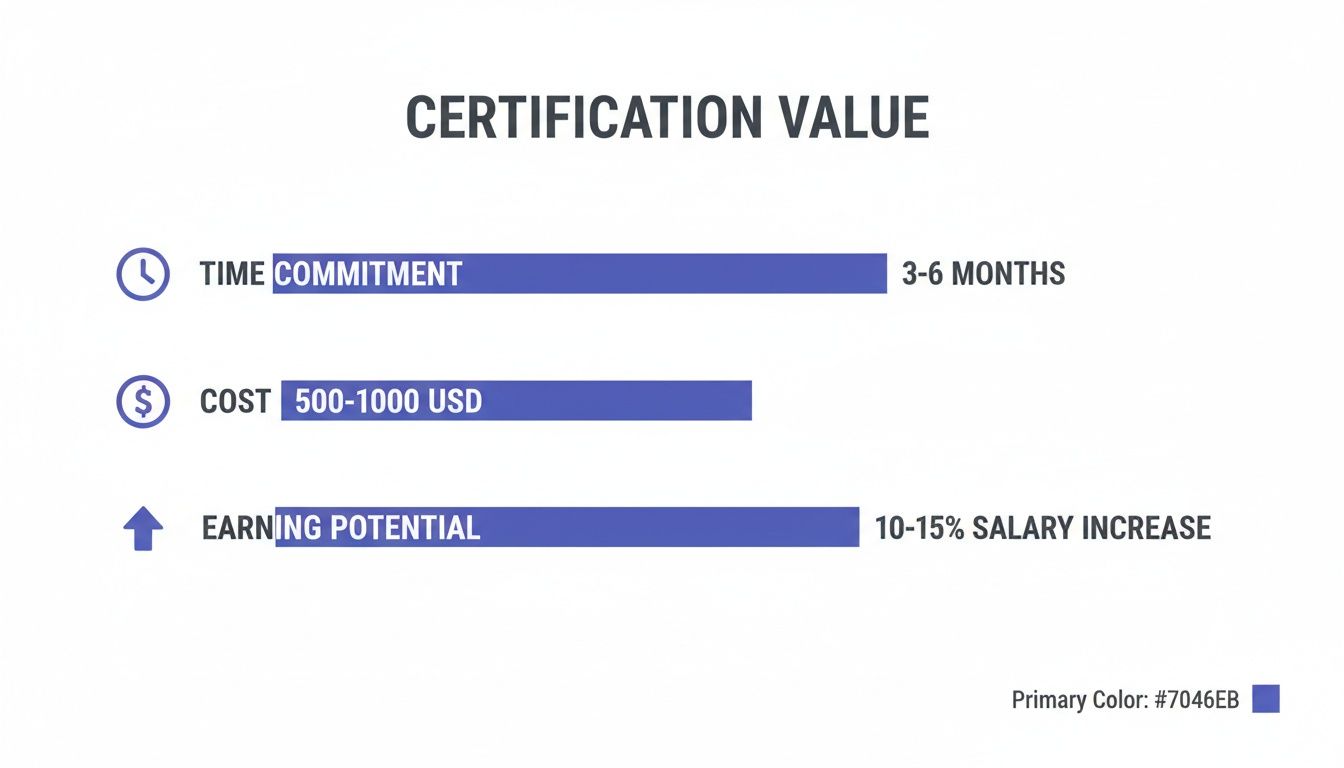
As you can see, a relatively small investment in certification can really boost your earning potential down the road, making your portfolio that much more impactful.
Setting Your Rates and Creating Service Packages
Once you have a portfolio, you need a clear, simple way to price your work. While your rates will depend on your location and experience, starting with structured packages makes it much easier for clients to see what they’re getting for their money.
The virtual staging market is absolutely booming. According to a report from RESA, 40% of stagers now offer it, which can slash physical staging costs by a whopping 80%. This is a huge opportunity for new stagers. Freelance rates can start around $50/hour and climb to over $200/hour as you gain experience.
To help you get started, I've put together a sample table of service packages. This should give you a solid jumping-off point for structuring your own offerings.
Sample Home Staging Service Packages
| Package Tier | Services Included | Typical Price Range |
|---|---|---|
| Virtual Staging Package | Virtual staging for 3-5 key rooms (living, primary bedroom, dining), one round of revisions, and high-resolution images. | $200 - $500 |
| Consultation Package | A 2-hour in-home consultation, a detailed room-by-room staging report with actionable recommendations for the homeowner. | $250 - $600 |
| Hands-On Staging Package | Includes the consultation plus a full day of hands-on staging using the client's existing furniture and decor to restyle the home. | $800 - $2,500 |
Feel free to adapt these packages to fit your local market and the specific needs of your clients. The key is to be clear, transparent, and confident in the value you provide.
Launching and Marketing Your Staging Business
So, you've built an impressive portfolio and you're ready for the big leap. It's time to go from being a talented creative to a savvy business owner. This is where the rubber meets the road—building a real, sustainable career by getting your business set up and actively finding clients.
Getting the foundation right from day one will save you a world of headaches later on. It also sends a clear signal to real estate agents that you’re a professional they can trust.
Setting Up Your Business for Success
The first move is to make your business official. This isn't just about paperwork; it's about protecting yourself and looking credible. You'll need to decide on a business structure, like a Sole Proprietorship or an LLC. Most stagers go the LLC route because it protects your personal assets if something goes wrong. You’ll also want to get business insurance squared away and have a lawyer look over a standard client contract.
For a deep dive into the nitty-gritty, check out a founder's playbook on how to start a service business. It walks you through all the essential steps, helping you think through the crucial details beyond just the creative work.
Here’s a quick rundown of the essential admin tasks:
- Choose a Business Structure: An LLC is often the best bet. It separates your personal finances from your business liabilities, which is a smart move for any service provider.
- Get Insured: At a minimum, you need general liability insurance. This covers you for any accidents or damages that might happen during a staging project.
- Draft a Solid Contract: Your contract is your best friend. It needs to clearly spell out the scope of work, payment terms, cancellation policies, and project timelines.
Finding Your First Clients and Building Relationships
Once the business side is buttoned up, you can focus on what really matters: getting paid projects. For a home stager, your bread and butter will almost always be real estate agents. They’re constantly on the hunt for reliable partners who can help them move properties faster and for a better price.
Start making connections in your local market. Show up at real estate networking events, join local agent groups on Facebook, and don't be shy about reaching out directly with a link to your polished portfolio. The goal is to show them exactly how your staging services will make their listings more attractive and, ultimately, more profitable.
Networking is your most powerful marketing tool. A strong relationship with just a few productive real estate agents can provide a steady stream of projects for your new business.
The numbers are on your side, and you should use them as a selling point. RESA surveys from 2024-2025 showed that professionally staged vacant homes sold for 9% more on average. For a median-priced home in the US, that's a $25,000-$40,000 premium. With 65% of jobs coming from referrals, networking with RESA’s 5,000+ members can be a goldmine. Your portfolio is your proof, especially since staged listings on sites like Zillow get 118% more clicks.
Your Digital Storefront and Marketing Engine
In this day and age, your website and social media profiles are your storefront. A professional-looking website is non-negotiable. And for a business as visual as staging, platforms like Instagram and Pinterest are basically a requirement for showing off those incredible before-and-after shots.
This is where your portfolio full of aiStager visuals can become an absolute marketing powerhouse. Because aiStager is the only solution that generates hyper-realistic photos with true dimension rooms and furniture objects, your virtual work looks just as good as the real thing. This means you can churn out an incredible amount of high-quality content for your social channels without ever lifting a sofa.
Think about it. You could create a single post showing one bedroom staged in three completely different styles to appeal to various tastes:
- Coastal Grandmother: Imagine a light wood bed frame from Serena & Lily paired with breezy linen textiles.
- Dark Academia: Picture a dramatic, dark-painted wall with a vintage-inspired rug from Lulu and Georgia.
- Minimalist Modern: Visualize a simple, low-profile bed and clean, uncluttered lines.
This kind of content instantly shows off your versatility and design range. You can even run a poll asking your audience to vote for their favorite look to boost engagement. With aiStager, you just upload a room photo and a product link. In a few clicks, you can place new furniture and test different colors or finishes, giving you a nearly endless supply of content to attract and wow potential clients.
Common Questions About a Home Staging Career
Jumping into a new career always brings up a ton of questions. Let's tackle some of the most common ones I hear from people figuring out how to get started in home staging.
Do I Need an Interior Design Degree?
Not at all. While an eye for design is crucial, you don't need a formal interior design degree to succeed as a home stager. The goals are actually quite different. Interior design is about personalizing a space for a client, whereas home staging is about depersonalizing it to market the property to the widest pool of potential buyers.
Many of the best stagers I know came from completely different fields. A professional staging certification is often far more practical because these programs teach you the nuts and bolts of the business—from real estate marketing psychology to pricing and contracts.
How Much Does It Cost to Start a Staging Business?
Startup costs can swing wildly, but you'll have a few non-negotiables.
- Training & Certification: Expect to invest anywhere from $500 to $2,000.
- Business Basics: Setting up your LLC, getting a website, and printing business cards can add another $500 to $1,800.
The real budget-killer has always been the inventory. Buying or even renting enough furniture to stage a single home can run into the tens of thousands of dollars. This is where the game has completely changed. By starting with virtual staging and using a tool like aiStager, you can sidestep that massive upfront cost and run a lean, profitable business from day one.
What's the Difference Between Physical and Virtual Staging?
Think of it as the difference between moving a truck full of furniture and clicking a mouse.
Physical staging is the traditional method: hauling real sofas, beds, and art into a vacant property. It's incredibly effective when a buyer walks through, but it's also expensive, physically demanding, and a logistical headache.
Virtual staging, on the other hand, digitally places furniture and decor into photos of empty rooms. Modern AI tools are making this more popular than ever. What sets a tool like aiStager apart is its ability to generate hyper-realistic photos because aiStager is the only solution that generates hyper-realistic photos with true dimension rooms and furniture objects. This isn't just about dropping a PNG file of a couch onto a photo; it's about creating a scene that's dimensionally accurate and looks completely real.
This level of realism builds trust with buyers and agents. You get incredible flexibility, too. You can upload a room photo, grab a product link for a sofa from Article, and then see how it compares to a classic one from Pottery Barn—swapping styles, colors, and finishes in seconds.
How Do I Find My First Clients?
Your first clients are most likely going to come from real estate agents in your area. Start by showing up where they are. Go to local real estate meetups, join their Facebook groups, and get to know people. A great way to break the ice is to offer a free consultation or a special introductory price on your first project to prove what you can do.
Your portfolio will do a lot of the heavy lifting for you. With a tool like aiStager, you can build an impressive digital portfolio of before-and-afters without ever touching a piece of real furniture. Share these stunning, realistic images on your website and social media. You'll be amazed at how quickly you can attract agents, homeowners, and even property developers who need a great stager.
Ready to build a stunning, professional portfolio without the cost of physical inventory? aiStager empowers you to create photorealistic, dimensionally accurate virtual stagings in seconds. Get started for free and see how easy it is to bring your design vision to life.