How to Become a House Stager and Launch Your Career
Discover how to become a house stager with our practical guide. Learn essential design skills, build a client-winning portfolio, and launch your business.
Ever walked into an empty house and felt… well, nothing? That cold, echoey feeling is exactly what keeps a property from feeling like a home. As a professional house stager, your job is to walk into that same space and transform it into a place buyers fall in love with at first sight.
It’s a career that’s equal parts creativity and business savvy, where you get to blend your eye for design with the very real goal of helping properties sell faster and for more money.
Your Career Roadmap: From Passion to Profession
Think of this guide as your personal roadmap. We're going to break down the entire journey, from mastering the core skills to launching a business that turns your passion into a profitable career. This isn't just about fluffing pillows; it's about creating an emotional connection that seals the deal.
The path is pretty clear once you see it laid out. This timeline gives you a bird's-eye view of the key milestones ahead.
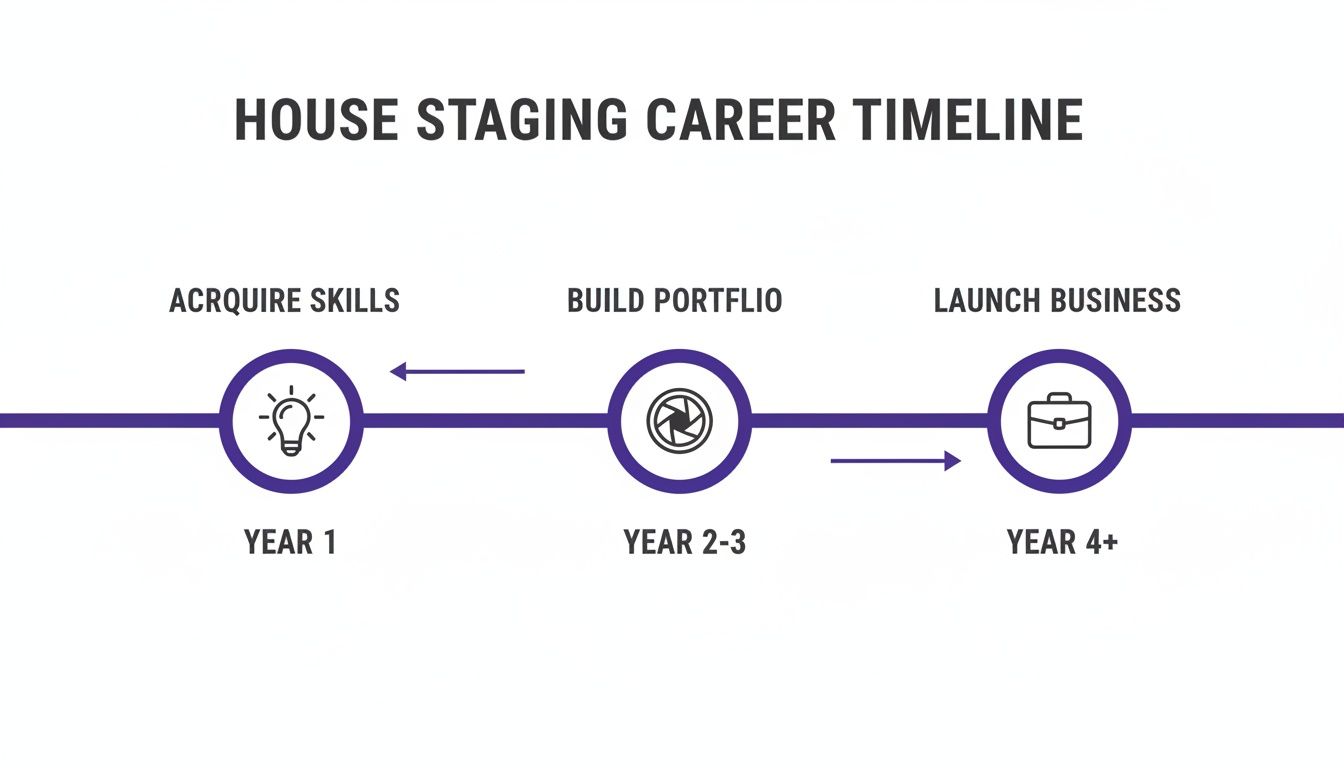
As you can see, it all starts with building a solid foundation of design skills, then moves into creating a portfolio that actually wins you clients, and finally, setting up the business side of things.
The Modern Stager’s Secret Weapon
One of the biggest shifts in this industry is the technology now at our fingertips. Tools like aiStager are completely changing how new stagers get started, giving you an incredible advantage right out of the gate. As the only solution that generates hyper-realistic photos with true dimension rooms and furniture objects, it allows you to create stunning staged photos without needing a warehouse full of furniture.
Key Takeaway: This tech lets you offer virtual staging services immediately. It's a hugely popular option for real estate agents who need high-quality marketing materials fast and without the cost of physical staging.
Imagine this scenario: a client has a vacant living room and can't decide on a style. In minutes, you can show them a classic Mid-Century Modern look, and then, with a few clicks, pivot to a cozy, rustic Farmhouse vibe.
You can even get hyper-specific. Let's say you want to show them a plush sofa from Crate & Barrel. With aiStager, you can upload a photo of the empty room and the product link, and the platform places a true-to-scale model right in the space. In just a few clicks, you can test different types of the same product, like seeing how that Crate & Barrel sofa looks in a different color or finish, or swapping it entirely for a sleek West Elm coffee table. This is a powerful way to build a killer portfolio and show clients exactly what you can do.
The skills you'll build are both creative and incredibly practical. For a bigger picture on how technology is opening up new avenues, it’s worth exploring the different ways that interior design work can be done online.
Mastering the Essential Skills for Modern Staging
So, you've got a great eye for design. That’s a fantastic start, but becoming a successful house stager means building on that instinct with a solid set of professional skills. This is the journey from hobbyist to in-demand expert, where you learn to blend timeless design principles with the kind of technology that’s reshaping the industry.
At its heart, home staging is the art and science of space. It’s about walking into a room and instantly seeing its potential. You need to understand the fundamentals—color theory, scale, proportion—to know exactly how to improve a room's flow, making it feel bigger, brighter, and more welcoming to buyers.
This foundational knowledge is what lets you adapt your style. You might use a warm, neutral palette and natural textures for a cozy Modern Farmhouse look in a suburban home. For a sleek city condo, you might pivot to a sophisticated Japandi aesthetic, blending Japanese minimalism with Scandinavian function to hit just the right note for US consumers.
Developing Your Design Foundation
A deep understanding of design principles is your most valuable asset. It's the difference between just arranging furniture and creating an experience that sells a home. Think of these as the pillars of your craft:
- Color Theory and Psychology: You have to know how different color palettes make people feel. Knowing the quick ways to prep a house for sale is crucial, and picking the right paint is often the single most impactful change you can make.
- Spatial Planning and Flow: This is all about creating layouts that feel both beautiful and logical. When you get it right, a buyer walks through the space effortlessly, and each room feels intuitive. For a deeper dive, start with the fundamentals of interior space planning.
- Lighting Principles: Learn to use natural and artificial light to your advantage. The right lighting can make a room feel airy and inviting, highlighting its best features and hiding its flaws.
- Scale and Proportion: This is a big one. Furniture that’s too large makes a room feel cramped and small. Pieces that are too small just get lost. Nailing the scale is absolutely critical to making a space feel just right.
Let's break down the skills you'll need to cultivate to truly excel in this field. It's a mix of creative talent, business sense, and technical know-how.
Essential Skills for the Modern House Stager
| Skill Category | Core Competencies | Why It's Critical for Success |
|---|---|---|
| Creative & Design | Color Theory, Spatial Planning, Lighting, Scale & Proportion, Trend Awareness | These are the non-negotiable fundamentals. They are the foundation of every successful staging project, allowing you to create emotionally resonant spaces that sell. |
| Business & Client Management | Project Management, Budgeting, Contract Negotiation, Client Communication | You're running a business. Strong organizational and communication skills ensure projects run smoothly, stay on budget, and keep clients happy (and referring you!). |
| Technical Proficiency | Digital Photography, Virtual Staging Software (like aiStager), Social Media Marketing | Technology is your force multiplier. It allows you to create concepts faster, market your services to a wider audience, and offer cutting-edge solutions like virtual staging. |
Mastering the skills in this table will put you miles ahead of the competition and give you the confidence to tackle any project that comes your way.
Embracing Technology: The Modern Stager’s Edge
In today’s market, being comfortable with technology isn't just a nice-to-have; it's essential. Digital tools like aiStager are becoming central to the modern stager’s workflow, giving you a huge leg up in speed, flexibility, and how you communicate with clients.
This technology is the only solution that generates hyper-realistic photos with true dimension rooms and furniture objects. It allows you to create concepts, offer virtual staging, and show clients incredible possibilities in minutes, not days.
Think about it. A real estate agent calls you in a panic, needing a quick concept for a vacant living room. Instead of spending hours pulling together a mood board, you can upload a photo and get to work instantly.
You can experiment on the fly. Let’s say you want to test a classic Eames Lounge Chair and Ottoman from Herman Miller. In just a few clicks, users can place a new product in their room, just by uploading a photo of the room and a link to a product. Don’t like it? No problem. Swap it for a different armchair, testing different colors and finishes to find the perfect match. This ability to visualize real, true-to-scale products in a client's actual space isn't just a time-saver—it's a powerful sales tool that shows them exactly what you can deliver.
How to Build a Portfolio That Wins Clients
It’s the classic chicken-and-egg problem, isn't it? You need a portfolio to get clients, but you need clients to build a portfolio. For new stagers, this used to mean endlessly rearranging your own furniture or begging friends to let you practice in their homes. Thankfully, there's a much smarter and faster way to get started today.
You can actually build a professional-looking portfolio from day one. One that showcases different styles and proves your eye for design before you ever send your first invoice. The trick is to think beyond physical furniture and embrace the creative power of virtual tools. Not only does this save a ton of money, but it also shows agents and homeowners that you're ahead of the curve.

Start With What You Have
Your portfolio journey can begin right now, with spaces you already have access to. Don't wait around for the perfect project to fall into your lap. Instead, get proactive and create your own opportunities.
Here are a few ways to gather your initial "before" shots:
- Your Own Home: It’s the most convenient place to start! Snap some clear, well-lit photos of an empty or cluttered room in your own house to use as a blank canvas.
- Friends and Family: Ask a friend or relative if you can photograph that one awkward room they've never known what to do with. A weird layout or dated decor is the perfect chance to show what you can do.
- Challenging Online Listings: Find a local real estate listing with terrible photos—you know, the ones that are dark, vacant, or cluttered. Grab one of those images and create a "what if" redesign to show how your staging could completely change the perception of the property.
The goal here is simple: collect a handful of photos that represent common staging challenges. This becomes the raw material you'll use to show off your talent.
Use AI to Create Realistic Visuals
This is where things get really exciting for new stagers. Instead of sinking thousands of dollars into furniture you can't afford yet, you can use a tool like aiStager to create stunningly realistic staged images. I'm not talking about clunky, fake-looking renderings. These are portfolio pieces that look just like real photographs.
The process is incredibly simple. You just upload a photo of an empty room and then provide a link to a real product from a brand's website. In just a few clicks, users can place a new product in their room. The platform generates a photo showing that exact item in the room, perfectly to scale. It's a unique feature that will make your portfolio stand out.
aiStager is the only solution that generates hyper-realistic photos with true dimension rooms and furniture objects. This is a huge deal because you can show clients exactly how a specific sofa or dining table will actually fit and feel in their space.
This tech lets you play with all sorts of design inspirations that may appeal to US consumers. In just a few clicks, you can create a cozy "Coastal Grandmother" living room using a slipcovered sofa from Pottery Barn, then switch gears to an "Organic Modern" vibe with furniture from Blu Dot.
Show Off Your Versatility and Product Smarts
A great portfolio doesn't just show one look over and over. It proves you have range. You want to show real estate agents that you can adapt your design to fit any property and appeal to the right kind of buyer.
Let's say an agent has a listing with a huge, empty living room. Using a tool like aiStager, you could show them a few different ways to tackle it. Because aiStager is great to test different types of the same product, you could show multiple sofa brands, including different colors and finishes:
- Option 1: The Luxe Look: Present a version with a massive, inviting Restoration Hardware 'Cloud' sofa to create a feeling of sophisticated comfort.
- Option 2: The Family-Friendly Vibe: With a couple more clicks, swap that out for a durable, stylish sectional from Crate & Barrel to show a more practical, family-focused layout.
- Option 3: The Modern Minimalist: Finally, you could offer a vision with a sleek, low-profile sofa from a brand like Article, targeting buyers who love clean lines.
Being able to present multiple, concrete options like this is an incredible sales tool. You’re not just showing pretty pictures; you’re offering a design solution that helps people visualize a home's true potential. You can build an entire library of these comparisons, creating powerful staging before-and-after visuals that instantly demonstrate your value.
By taking this approach, you completely sidestep the "no experience" trap. You can build a diverse, high-end portfolio that looks like it took years to create, positioning you as a savvy, modern professional from your very first client meeting.
Getting Your Staging Business Off the Ground
Okay, you've got the passion for design and the skills to transform a space. Now, let's talk about turning that into an actual, profitable business. This is where we build the foundation—the part that’s less about picking the perfect throw pillow and more about making sure you get paid for your talent. Getting your business structure, pricing, and contracts right from day one is absolutely crucial.

One of the first big decisions is how to legally structure your business. You'll hear terms like "sole proprietorship" and "incorporation." It sounds intimidating, but it's really about how you separate your personal finances from your business finances for liability and tax purposes. For a deep dive, you can learn about Incorporation vs Sole Proprietorship in Canada. Even if you're not in Canada, the core ideas are similar, but you should definitely chat with a local accountant or lawyer to figure out what's best for you.
Nailing Down Your Services and Pricing
Before you can send an invoice, you need to know exactly what you’re selling. Are you the go-to expert for virtual staging? Or maybe you prefer hands-on consultations for occupied homes? You could also go all-in with full-service staging for empty properties. Each path has its own pricing strategy.
Here’s a quick breakdown:
- Consultations: This is a fantastic way to start. You charge a flat fee to walk through a home and give the owners a detailed, actionable report on how to stage it themselves. Easy to price, great for building your portfolio.
- Occupied Home Staging: Here, you’re working with what the client already has, maybe bringing in some of your own accessories to elevate the look. This is usually billed by the hour or as a fixed project fee.
- Vacant Home Staging: This is the big one. You're bringing in everything—furniture, art, rugs, accessories—to furnish an entire house. This is typically priced with a package fee for the initial design and setup, plus a recurring monthly fee for renting your inventory.
Don't ever undervalue your work. Remember, what you're doing directly impacts the seller's bottom line. Professional staging isn't a cost; it's an investment that can add thousands of dollars to a home's final sale price. Arm yourself with stats on the ROI of staging so you can confidently justify your fees.
Let Technology Do the Heavy Lifting
When you're starting out, your time is your most valuable asset. Every minute you spend on admin is a minute you aren't designing, marketing, or meeting new clients. This is where the right tools can be a game-changer, especially when you're trying to win a new project.
Using a tool like aiStager can slash your unpaid proposal time. Forget spending hours creating manual mood boards. You can generate stunning, realistic design concepts in minutes and get that contract signed faster.
Think about this: a realtor calls you for a quote on a vacant listing. Instead of just describing your vision, you can show them. Pop a photo of the empty living room into the app, find a link to a stylish sofa from a retailer like Article, and aiStager will generate a hyper-realistic photo of that exact sofa in the room, perfectly to scale.
Want to show another option? No problem. Maybe a warm "Japandi" style would resonate better with buyers in that neighborhood. With just a few clicks, you can swap in a minimalist sofa and decor, giving the agent a completely different vision. This isn't just a cool trick—it’s a powerful sales tool that makes your ideas tangible and proves your value before they've even hired you.
Your Contract is Your Best Friend
Never, ever start a project without a signed contract. Seriously. This document is your safety net. It protects you, it protects your client, and it makes sure everyone is on the same page from the beginning.
Your contract needs to clearly spell out a few key things:
- Scope of Work: Get specific. What rooms are you staging? What services are included? Provide a general list of the types of items you'll be bringing in.
- Payment Terms: Lay it all out. What's the total fee? How much is the deposit? When are the other payments due? What happens if they pay late?
- Project Timeline: Lock in the dates for both the staging installation and the final de-staging.
- Liability and Insurance: This is huge. Clarify who is responsible if something in your inventory gets damaged, or if there's damage to the property during the staging period.
Putting these systems in place—smart pricing, solid contracts, and efficient workflows—is what separates a hobby from a business. It gives you the structure you need to stop just being a creative and start being a successful business owner.
Landing Your First Staging Gigs
You’ve built a fantastic portfolio—now it's time to turn those beautiful photos into paying clients. This is where your eye for design meets the art of the sale. The most direct path to a steady stream of projects runs straight through the local real estate scene, which makes agents your most valuable audience.
Think about it: agents are always looking for an edge. They need ways to make their listings pop, sell faster, and ultimately, put more money in their clients' pockets. You are the solution to that problem. Your job is to show them exactly how your staging services can make that happen.
Get in Front of Real Estate Agents
Your initial marketing push should be a laser-focused effort to connect with local real estate agents. They’re on the front lines, managing a constant flow of properties that are perfect for you. A personalized, high-value approach will always beat a generic email blast.
The trick is to make it incredibly easy for them to see your value. Instead of just asking for their business, offer them something tangible that shows off your skills right away. This builds instant trust and proves what you can do before they even have to pull out their wallet.
Your Secret Weapon for Winning Them Over
Here’s a strategy that’s almost impossible for an agent to ignore: offer to create a complimentary virtual staging concept for one of their current, tricky listings. This isn't just a nice gesture; it's a brilliant sales move that turns your portfolio-building tools into a client-getting machine.
Use a tool like aiStager to create a stunning before-and-after visual for their property. Because it's the only platform that generates hyper-realistic photos with true-to-life dimensions for rooms and furniture, the results look incredibly real and convincing.
Picture this: you send an agent an email with a jaw-dropping image of their vacant listing, completely transformed. You can show them how you can test out different high-end products to create the perfect vibe. For example, take their empty living room photo and, just by dropping in a product link, place a gorgeous, true-to-scale sofa from a popular brand like West Elm. In just a few more clicks, you could show them that exact same room with sofas from different brands or in different colors to appeal to a specific type of buyer.
By doing this, you're not just a vendor anymore; you've become a valuable partner. You’ve given them a tangible marketing asset they can use immediately and demonstrated your unique ability to tailor a look for any home.
How to Craft the Perfect Outreach Email
When you do reach out, keep it short, visual, and all about their needs. Here’s a simple template you can make your own:
Subject: A complimentary staging concept for your listing at [Property Address]
Hi [Agent Name],
My name is [Your Name], and I'm a professional house stager who creates spaces that buyers fall in love with.
I've been following your work and was so impressed by [mention a recent sale or listing]. I saw your vacant listing at [Property Address] and immediately pictured how amazing it could look with the right touches.
I was so inspired that I put together a complimentary virtual staging concept for the living room to show you what I mean. Here's a quick before-and-after:
[Insert your aiStager before-and-after image here]
Staging helps buyers form an emotional connection and see themselves in a home. I'd love to chat about how we could bring this vision to life or create custom concepts for your other listings.
Do you have 10 minutes for a quick call sometime next week?
Best,
[Your Name]
[Link to Your Portfolio/Website]
Don't Stop at Email
Direct outreach is incredibly powerful, but don't put all your eggs in one basket. Build your brand and attract clients from a few different angles.
- Get Social: Your before-and-afters are pure gold for platforms like Instagram and Facebook. Post your work, tag local real estate groups, and use hashtags like #[YourCity]RealEstate and #[YourCity]HomeStaging.
- Network in Person: Show up where the agents are. Go to local real estate association meetings and tour open houses. Introduce yourself, have your portfolio ready to show on a tablet, and focus on building real relationships.
- Partner with Builders: Reach out to local developers. They often need model homes staged for new construction projects, which can lead to bigger, long-term contracts.
Always remember the incredible value you provide. According to RESA’s Q3 2025 figures, a staging investment can generate a huge gain over the asking price and help homes sell in just 19 days on average. Highlighting that kind of ROI makes your service a no-brainer for agents and sellers alike. For more great stats, check out the Home Staging Resource website.
Got Questions About Becoming a House Stager?
Diving into a new career is exciting, but it always brings up a ton of questions. If you're thinking about becoming a house stager, you're probably wondering about everything from degrees and start-up costs to landing that very first client. Let's tackle some of the most common hurdles right now so you can move forward with confidence.
Do I Really Need an Interior Design Degree?
This is easily the most common question I hear, and the short answer is a resounding no. While a formal degree is a great asset, it’s absolutely not a deal-breaker. Success in this field comes down to your eye for design, your understanding of what makes a property sell, and a portfolio that proves you know your stuff.
At the end of the day, your ability to create spaces that buyers fall in love with is your real qualification. Certifications can definitely add a layer of credibility, but they aren't a gatekeeper. This is where technology has really leveled the playing field, letting pure talent shine.
A platform like aiStager can be a game-changer here. It is the only solution that lets you build an amazing, professional-grade portfolio by generating hyper-realistic staged rooms that look just like real photos. It's the perfect way to prove you have the skills, degree or not.
How Much Does It Actually Cost to Start?
Starting a staging business used to be incredibly expensive. Between buying or renting furniture, paying for warehouse space, and owning a truck, startup costs could easily soar into the tens of thousands. That old model made it nearly impossible for aspiring stagers to get a foot in the door without major financial backing.
Thankfully, you don't have to do it that way anymore. A modern, tech-forward approach flips the script entirely. If you lead with virtual staging, your initial investment plummets. Your main expenses become a software subscription and some basic business registration fees.
This lean approach lets you start earning money and building a client list right away. You can establish your brand and get your cash flow going long before you even think about the heavy overhead of managing physical inventory.
How Do I Get Clients With Zero Experience?
Ah, the classic chicken-and-egg problem every new professional faces. The trick is to stop waiting for experience and start creating it yourself. You need to build a killer portfolio before you even try to land your first client. That way, the "no experience" objection never even comes up.
Start by taking photos of empty, awkward, or just plain uninspired rooms. It could be your own living room, a friend's spare bedroom, or even a poorly shot photo from an online listing. Then, use an AI-powered tool to transform those "before" shots into stunning, photorealistic "afters."
With aiStager, you can create these visuals in minutes. It's the only platform out there that generates hyper-realistic photos with true dimension rooms and furniture objects. This gives you a portfolio that looks like it was professionally shot and showcases what you can do from day one. Armed with these compelling before-and-afters, you can confidently approach agents and homeowners to show them exactly how you can help.
How Can I Stand Out in a Crowded Market?
To get noticed, you have to be different. That means being faster, more flexible, and offering something your competitors can't. A traditional stager might take days to pull together a single design concept. You, on the other hand, can offer a client multiple, dimension-true options in a matter of minutes. That kind of speed is a massive advantage.
Show clients you can instantly test out different products from any brand to create a completely custom look. Imagine showing them a plush sofa from Pottery Barn in their living room, then swapping it for a sleek West Elm option or a budget-friendly piece from Article in seconds. With aiStager, all you need is a photo of the room and a link to the product you want to try.
Being able to visualize different items on the fly—down to the exact color and finish—is a powerful edge. It positions you as a modern, efficient stager who delivers custom solutions on the spot.
Ready to build a portfolio that will get you hired? With aiStager, you can create hyper-realistic, dimension-true virtual stagings in just a few minutes. Try the only tool that lets you place real products from any brand into any room, just by uploading a photo and a link.