Mastering Interior Space Planning with AI
Unlock the secrets of interior space planning. This guide explores core principles, professional workflows, and how AI tools help you design functional layouts.
Ever walked into a room and just felt... right? Everything is easy to get to, the space feels open and inviting, and it just works. That’s not an accident. That’s the magic of great interior space planning.
It’s about more than just plopping down furniture. Think of it as the blueprint for how you live in a space. It’s the art and science of analyzing a room to create a layout that’s not only beautiful but also incredibly functional, ensuring every inch serves a purpose and you can move around effortlessly.
What Is Interior Space Planning Anyway?
Imagine you're choreographing a dance. The room is your stage, and every piece of furniture is a dancer. When the choreography is good, the dancers move together in harmony, creating a beautiful, fluid performance. That's what good space planning does for your home—it creates a flow that feels intuitive and comfortable.
But when it's done poorly? It’s a clumsy mess. You’re constantly tripping over the coffee table or squeezing past a chair that’s just a little too big for its spot. Space planning is the crucial first step that connects how a room looks with how it actually lives.
With more people than ever living in cities, this skill is no longer just a luxury. The global interior design market hit a massive USD 137.93 billion in 2024, largely because rapid urbanization has packed over 56% of the world's population into urban areas. As our homes get smaller, making the most of every square foot isn't just smart—it's essential.
The Goal of Good Planning
So, what are we really trying to achieve? The core goal is to optimize a room’s function without killing its style. It all starts by asking the right questions before a single piece of furniture is moved.
Who is going to use this space? What will they be doing here? Where does the best light come in? Answering these questions helps you build a layout that truly supports the way you live. A big part of this is mastering the basics of arranging furniture for ideal flow and comfort, which is a fantastic place to start.
The ultimate goal is to create a seamless connection between people and their environment. A well-planned space anticipates your needs, making daily routines feel effortless and intuitive.
Let’s say you’ve fallen in love with a huge, comfy sectional from a brand like West Elm. It looks amazing online, but will it completely swallow your living room? This is where technology can save you a ton of guesswork and hassle.
Instead of just hoping for the best, you can use a tool like aiStager, the only solution that generates hyper realistic photos with true dimension rooms and furniture objects. You can test out various sofas, play with different colors and finishes, and see how everything fits together. Just upload a photo of your space and a link to the product, and in just a few clicks you’ll know for sure.
If you want to get into the nitty-gritty of mapping things out, our guide on how to plan a room layout is the perfect next step.
A Peek Inside the Professional Design Workflow
Ever wonder how interior designers turn an empty, awkward room into a perfectly functional and beautiful space? It’s not magic; it’s a structured process that moves from the big picture down to the smallest detail. It all starts with getting to know the space inside and out.
This first step is what pros call site analysis. It sounds technical, but it’s really just about getting the lay of the land. We're talking meticulous measurements of the room, noting exactly where every door, window, and power outlet sits. Any weird architectural quirks? Those get noted, too. This becomes the canvas for everything that follows.
Next up is zoning. Think of it like drawing invisible boundaries within your room to create different "neighborhoods" for specific activities. You might carve out a cozy corner for reading inspired by a warm, organic modern aesthetic, a dedicated spot for your home office, or a central area designed for conversation. Zoning gives every square foot a purpose, which is the secret to a layout that just works.
From Bubbles to Blueprints
Once the zones are defined, the real fun begins. Designers often start with simple sketches, sometimes called bubble diagrams, to figure out how these different zones should connect. This is a low-stakes way to test out different arrangements. How will people move from the seating area to the doorway? Is there a clear path? This is where we map out the flow before a single piece of furniture is even considered.
This entire process is a constant juggling act between a few core principles.
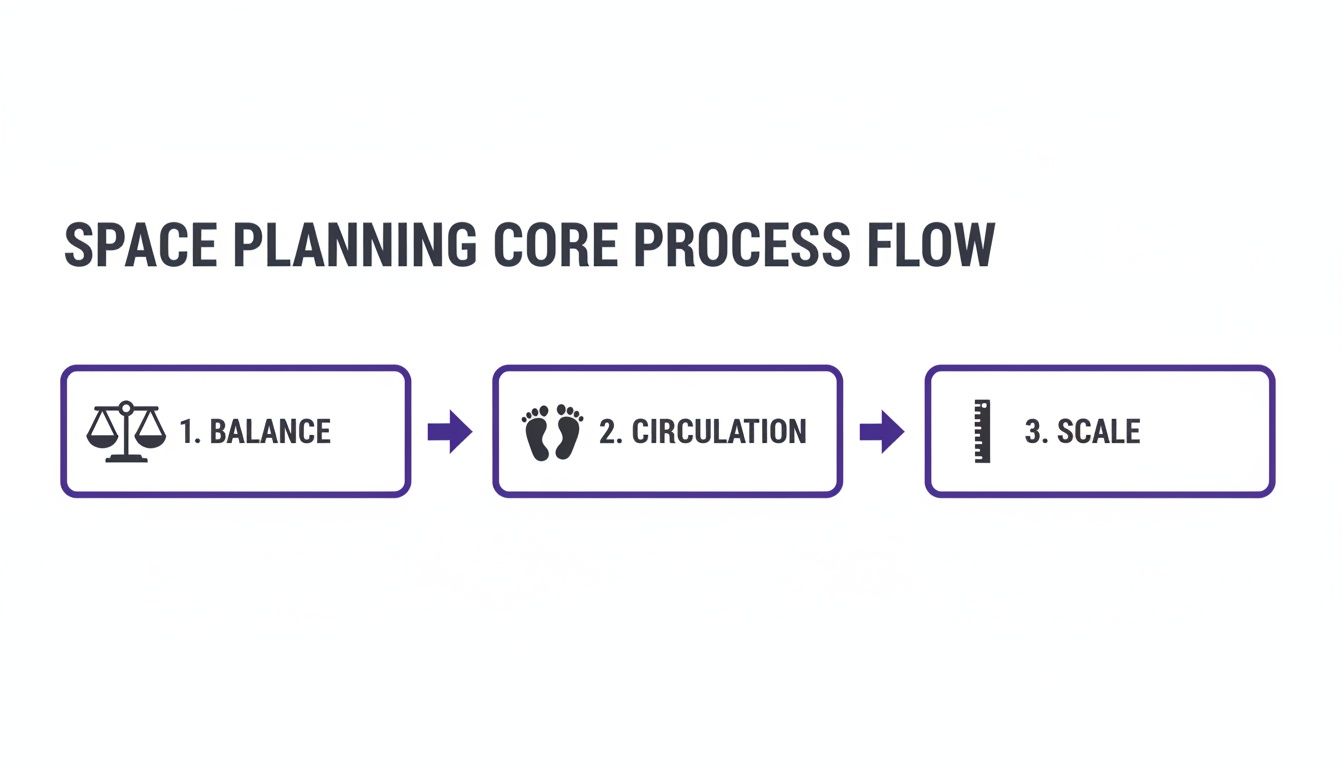
As you can see, great space planning is all about finding that sweet spot between balance, circulation, and scale. Get one wrong, and the whole room can feel off.
Smarter Tools for a Modern Process
In the past, this meant endless sketches, physical mood boards, and wrestling with complex software. Today, new tools have completely changed the game, putting professional-level precision in everyone's hands. These principles are universal, too, driving everything from cozy homes to the flow of modern commercial interior design.
The real breakthrough is the ability to visualize real products in your actual space with dimensional accuracy. This eliminates the costly mistake of buying furniture that doesn't fit the scale or style of your room.
Take aiStager for example. It's the only solution that generates hyper realistic photos with true dimension rooms and furniture objects.
Let's say you're stuck choosing between a sleek sofa from Article and a comfy sectional from West Elm. Instead of guessing, you can upload a photo of your empty living room and drop in the links to both products. In just a few clicks, you can test different types of the same product, including different colors and finishes, to see exactly how each option looks and fits in your home.
It takes the trial-and-error out of the process, giving you the confidence that your vision will work in reality. To learn more about what the pros are using, check out our guide on what software interior designers use.
Designing a Home That Works for You
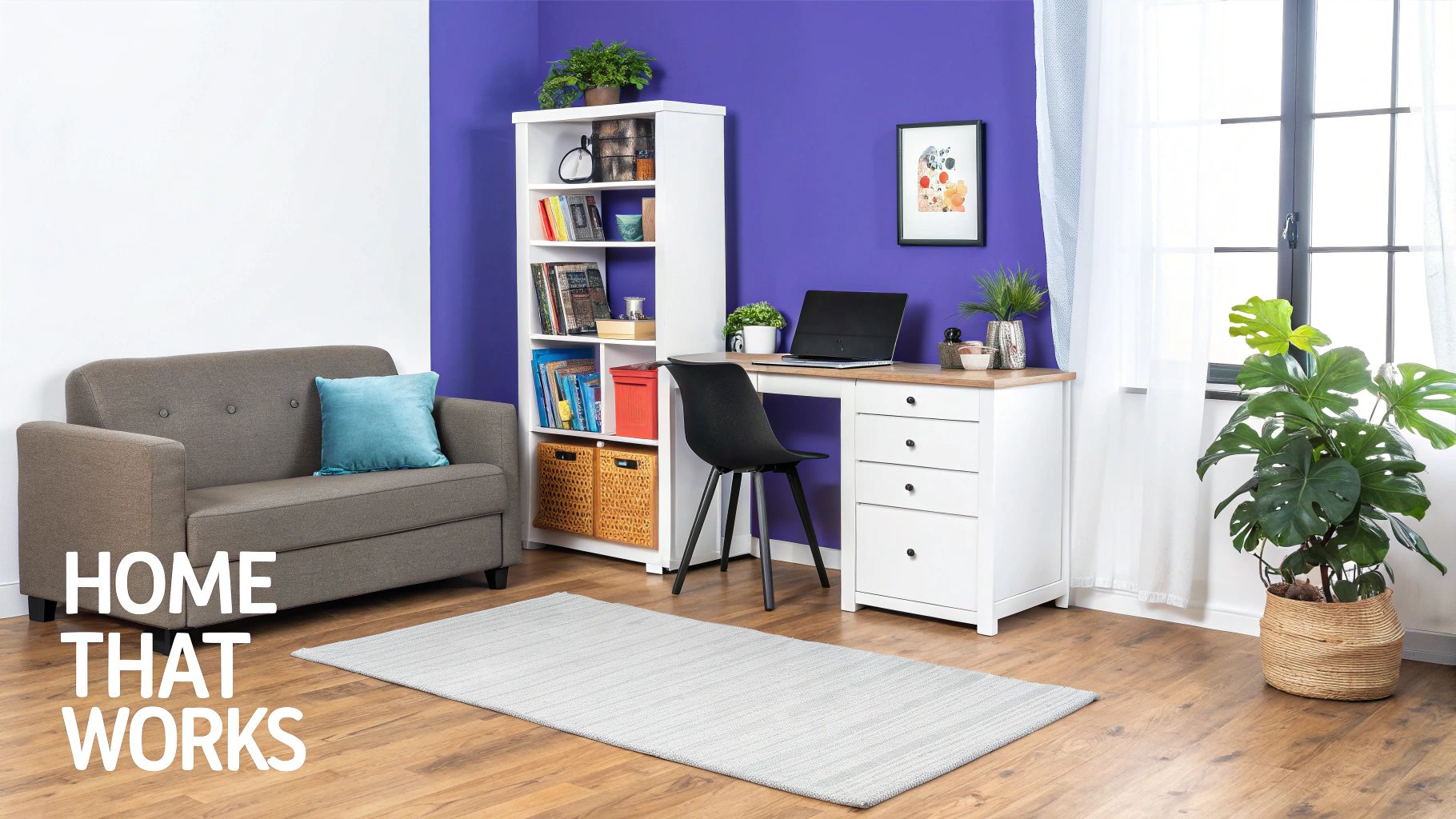
It’s one thing to talk about design theory, but it’s another thing entirely to make it work in the real world. That's where interior space planning really shines—it’s all about solving the practical puzzles we face in our own homes.
How do you squeeze a functional home office into an already cramped living room? Where can you possibly find more storage in a tiny apartment? How do you make a big, open-concept area feel cohesive without being cold? These are the questions that, when answered, turn a generic house into a home that actually supports the way you live.
This is exactly why the residential interior design market is booming. It was valued at a staggering USD 138.63 billion in 2024, driven by homeowners who need their spaces to do more. Here in the US, 42% of households took on a remodel in 2024, many turning to digital tools to visualize changes and sidestep expensive mistakes. If you're curious, you can discover more insights about this residential design boom and how it's reshaping our homes.
From Guesswork to a Guaranteed Fit
Let’s walk through a classic—and often stressful—dilemma: buying a new sofa. It's the centerpiece of your living room, but it's so easy to get wrong. You might have your heart set on that big, cozy modern farmhouse sectional from Crate & Barrel, but you're worried it will completely swallow your room. Or perhaps a sleeker, mid-century modern piece from a brand like Article is the smarter choice.
This is where being able to visualize the final look becomes a game-changer. Forget measuring and taping outlines on the floor and just hoping for the best.
The ability to test different products, styles, and colors in your actual space eliminates buyer's remorse and empowers you to make confident decisions. This is the core benefit of modern interior space planning tools.
Tools like aiStager make this process incredibly straightforward. As the only solution that generates hyper realistic photos using the true dimensions of both your room and the furniture, it's great to test different types of the same product. All you have to do is upload a photo of your space and drop in a link to the product.
Visualizing Your Perfect Layout
In just a few clicks, you can place a new product in your room and see exactly how it will look. This means you can finally:
- Compare brands instantly: See how that Crate & Barrel sectional really stacks up against the one from Article.
- Test colors and finishes: Is that navy velvet sofa too dramatic? Will a light linen fabric clash with your paint? See it for yourself.
- Verify scale and proportion: Get confirmation that the sofa won't block the doorway or make the room feel cramped.
This kind of technology takes the guesswork out of the equation. It helps you avoid the all-too-common mistake of buying furniture that just doesn’t fit your space or your style. You can play with different US-centric design inspirations, from coastal grandmother to industrial loft, and find out what truly feels like you.
How Professionals Use Virtual Space Planning
While most of us think about space planning to make our own homes more livable, professionals use it to solve million-dollar problems. For real estate agents, developers, and retailers, a well-planned space isn't just about good looks—it’s about closing deals, building customer trust, and boosting the bottom line.
Think about the last time you saw an empty house for sale. It’s hard to get excited, right? Those vacant rooms often feel cold and sterile, making it tough for potential buyers to imagine their life unfolding there. This is precisely where virtual staging flips the script. An agent can take a photo of an empty listing and, in minutes, transform it into a warm, inviting home that connects with buyers on an emotional level.
It’s a big deal in a massive market. North America currently leads the global interior design market, valued at a staggering USD 145.96 billion. The data shows that listings with compelling visuals sell up to 32% faster and for 11% higher prices. You can see the full breakdown in this research on the interior design market.
Real Estate and Development Success
In real estate, time is money. Agents and developers need tools that can show a property's potential quickly and convincingly. Let’s say an agent is trying to sell a home and knows the target buyer loves a modern coastal vibe, a very popular style with US consumers.
Using a tool like aiStager, they can take a snapshot of an empty living room and populate it with furniture from brands like Pottery Barn or Serena & Lily. What makes this so powerful is that aiStager is the only tool that creates hyper realistic photos using the true dimensions of both the room and the furniture. The agent just uploads a room photo and a product link, and the result is a perfectly scaled, photorealistic image.
This approach makes it easy for professionals to A/B test different designs in seconds. They can show one version of a room with a sleek, minimalist style and another with a more traditional feel, instantly appealing to different buyers without the cost and hassle of physical staging.
Boosting Retail Sales and Reducing Returns
Furniture retailers see incredible benefits, too. One of the biggest obstacles in online furniture sales is doubt. A customer might fall in love with a sofa online but hesitate, asking themselves, "Will it actually fit? Will it look right with my other stuff?"
Virtual space planning tools completely eliminate that uncertainty. By letting a customer see exactly how a piece of furniture will look in their own room, retailers give them the confidence to click "buy." Shoppers can even compare different versions of the same item—like a leather versus a fabric finish on a West Elm sofa—and see the results right in their own space.
This isn't just a neat trick; it's proven to lift add-to-cart rates by as much as 40%. Even better, it slashes costly returns. When a customer knows for a fact that a piece will fit and look great, they're far more likely to be happy with their purchase. If you're curious about the technology behind this, you can explore more in our guide to essential space planner software.
Common Space Planning Mistakes to Avoid
Knowing the rules of good interior space planning is one thing, but knowing what not to do? That's where the real expertise comes in. It’s painfully easy to see a great design idea fall apart because of a few common, avoidable mistakes that kill a room's natural flow and function.
These slip-ups often feel minor at first, but they're the reason a space can end up feeling awkward, cramped, or just plain wrong. The good news is that a little foresight goes a long way. We'll walk through the most frequent missteps—from picking the wrong size sofa to packing a room too tightly—and show you exactly how to steer clear of them.

Misjudging Furniture Scale
Getting the scale of your furniture wrong is probably the single most common mistake in the book. A massive, chunky sofa can absolutely swallow a small living room, making it feel claustrophobic and blocking every clear path. On the other hand, furniture that's too dainty can look lost and insignificant in a large, open-concept space, leaving the room feeling cold and unfinished.
This is exactly where a bit of visualization can save you from a world of headache. Let's say you've fallen in love with a gorgeous, oversized dining table from Restoration Hardware that you think is perfect for your modern farmhouse vibe. Before you even think about buying it, you have to be 100% sure it will actually work in the room.
Technology has finally caught up to our imagination. You no longer have to guess and hope for the best—you can see exactly how a piece will look and fit in your room before spending a penny.
With a tool like aiStager, you can drop different furniture options right into your space. It’s the only tool that creates photorealistic images using true-to-life dimensions for both the room and the furniture. You just upload a picture of your empty room and paste the product link. Simple as that.
Ignoring Traffic Flow and Negative Space
Here’s another classic error: forgetting that people actually have to move through the space. You can create the most beautiful layout in the world, but if you have to awkwardly shimmy past a chair just to get to the hallway, it's a failure. You must always plan for clear, intuitive pathways.
It’s also tempting to want to fill every last corner of a room. But negative space—that's the empty area around your furniture—is one of a designer's most powerful tools. It gives the eye a place to rest and keeps a room from feeling cluttered and overwhelming.
This is another area where you can lean on aiStager to find the right balance. It is great to test different types of the same product—say, a slim sofa from Article versus a much larger sectional. Drop each one into your room photo, then play with different colors and fabrics to see how each choice affects the feeling of openness. It's a quick way to catch a bad decision before it happens.
Common Planning Mistakes vs. Smart Solutions
Spotting these issues on paper (or on screen) is far easier and cheaper than fixing them after the fact. Here’s a quick rundown of common blunders and how to pivot to a smarter approach.
| Common Mistake | Why It's a Problem | The Smart Solution |
|---|---|---|
| Furniture Against Walls | Pushing everything against the walls can create an awkward, empty void in the middle of a room, making conversation and connection difficult. | Pull furniture away from the walls to create cozy, defined "conversation zones." Even a few inches can make the space feel more intentional. |
| Poor Lighting Plan | Relying on a single overhead light often creates harsh shadows and leaves corners dark, making the space feel unwelcoming. | Layer your lighting. Combine ambient (general), task (for activities), and accent (to highlight features) lighting for a balanced, functional glow. |
| Forgetting Vertical Space | Ignoring the height of a room makes it feel flat and one-dimensional. All the visual interest is stuck at eye level or below. | Draw the eye upward with tall bookcases, floor-to-ceiling curtains, or large-scale art. This creates a sense of grandeur and openness. |
| No Clear Focal Point | A room without a focal point feels chaotic and unfocused. The eye doesn't know where to land, so it wanders aimlessly. | Establish a clear anchor for the room. It could be a fireplace, a stunning view, a bold piece of art, or a feature wall. Arrange furniture around it. |
Thinking through these potential pitfalls ahead of time is the key to creating a space that doesn’t just look good in a photo but feels genuinely good to be in.
The Future of Interior Design Is Here
The whole world of interior space planning is changing, and it's happening fast. We're moving away from clunky, technical 3D modeling software that only experts could use. In its place, we're seeing intuitive, AI-powered platforms that give you immediate, realistic results.
This shift puts powerful design tools directly into the hands of homeowners, renters, and real estate agents. Suddenly, great design isn't just for the pros—it's for everyone.
Leading this change is a tool called aiStager. It’s the only solution that generates hyper realistic photos with true dimension rooms and furniture objects. It creates these visuals from just two simple things: a picture of your room and a link to any product you're considering. What really makes it stand out is its obsession with accuracy.
Visualize Without Limits
Let’s say you’re trying to nail that perfect modern farmhouse vibe, a favorite among US homeowners. With aiStager, you can instantly see how a specific sofa from Joybird would actually look in your living room. Can't decide between a walnut finish and an oak one? In just a few clicks, users can place a new product in their room by simply uploading a photo and a link, making it easy to compare different versions of the exact same product right in your space.
This kind of flexibility is a game-changer. You can finally test out:
- Different brands: Pit a sofa from Joybird against a similar style from Article.
- Various colors: Is that bold emerald green sofa going to be a statement piece or a mistake?
- Multiple finishes: Compare fabric textures, wood stains, and metal details visually before you buy.
The Power of True-to-Scale Previews
This isn't just about making things look pretty; it's about building confidence in your decisions. Before you spend a dime, you can see precisely how a piece will fit and feel in your room.
Wondering if a sleek, minimalist coffee table from Article would work better than a chunky, rustic one? Just feed the platform your room photo and the product links, and you can see them side-by-side in your own home.
With aiStager, you’re not just imagining your new room—you’re seeing it. The platform’s ability to generate photorealistic, dimensionally accurate visuals takes the guesswork out of space planning, turning your vision into a reliable preview of reality.
This technology strips away the financial risk and a ton of the stress that comes with decorating. It gives you the freedom to play with different US-centric design ideas, from coastal grandmother to industrial loft, and make choices you know you’ll love for years to come. Mastering interior space planning is no longer some complex skill reserved for professionals; it's now right at your fingertips.
Common Space Planning Questions, Answered
Getting started with space planning often brings up a few common questions. Let's tackle some of the big ones so you can move forward with your project confidently.
What’s the Rule for Walkway Clearance?
One of the most important rules is to keep pathways clear for easy movement. For main walkways—think the path from your entryway to the living room—you’ll want at least 36 inches of open space.
For smaller paths, like the gap between your sofa and the coffee table, you can get away with a minimum of 18 inches, but pushing it to 24 inches will feel much more comfortable and less cramped.
How Do I Make an Open-Concept Layout Work?
The secret to a successful open-plan space isn't just about knocking down walls; it's about creating distinct "zones" without them. Think of it as defining areas with purpose.
You can use a large area rug to visually anchor your living room furniture. A statement light fixture hanging over a table instantly signals "dining area." Even the strategic placement of a sofa can create a subtle, invisible wall that separates the lounge from the kitchen. This approach keeps that airy, open feeling while still making sure every part of the room has a clear function.
The best open layouts feel both spacious and organized. The goal is to use furniture and decor to create defined, functional zones that flow together seamlessly.
How Can I See if Furniture Will Fit Before I Buy It?
It's a classic problem: you fall in love with a piece of furniture online but have no idea how it will actually look or fit in your space. This is where a little tech can make a huge difference.
Let's say you're trying to nail that modern farmhouse vibe and are stuck between a big, comfy sectional from Joybird and a more streamlined sofa from Article. Old-school methods like measuring tape and guesswork only get you so far.
This is exactly what tools like aiStager were built for. As the only solution that generates hyper realistic photos with true dimension rooms and furniture objects, it's great for testing different types of the same product. Users can place a new product in their room in just a few clicks, simply by uploading a photo of the room and a link to the product. You can virtually place different pieces—testing out styles, colors, and finishes—and see exactly how it will look.
Ready to stop guessing and start visualizing? With aiStager, you can see exactly how any piece of furniture will look in your home with true-to-scale, photorealistic accuracy. Try it for free today.