A Complete Guide to Interior 3D Rendering Services
Discover how interior 3D rendering services transform design ideas into reality. Learn to visualize spaces, compare costs, and choose the right service.
At its core, interior 3D rendering is about creating a perfect photograph of a room that doesn’t exist yet. This technology gives designers, real estate agents, and furniture sellers the power to generate breathtakingly realistic images of interior spaces before a single drop of paint is bought or a sofa is ordered. It’s the ultimate bridge between imagination and reality.
From Blueprints to Hyper-Realistic Previews
Think about trying to explain a detailed design concept with just words and a flat, 2D floor plan. It's tough, right? Clients often struggle to picture the final result, which can lead to confusion, frustration, and expensive changes later on. Interior 3D rendering cuts through all that noise. It translates abstract ideas into visuals so clear and emotionally resonant that they instantly answer the most important question: "What will this actually look like?"
Instead of relying on mood boards or costly physical mockups, you get a precise digital preview of the finished space. This isn't just about aesthetics; it's a powerful tool for making smart, confident decisions, whether you're a homeowner planning a kitchen remodel or a brand launching a new collection.
Visualizing Every Detail Before Commitment
The real magic of modern rendering is in the details and flexibility it offers. A designer can show a client multiple directions for their living room in a single afternoon. One version might be a cozy, California Casual look with natural textures, while another could be a sleek, mid-century modern space inspired by Palm Springs design. With just a few clicks, they can swap a plush leather sofa for a minimalist sectional to see how it changes the room's entire feel.
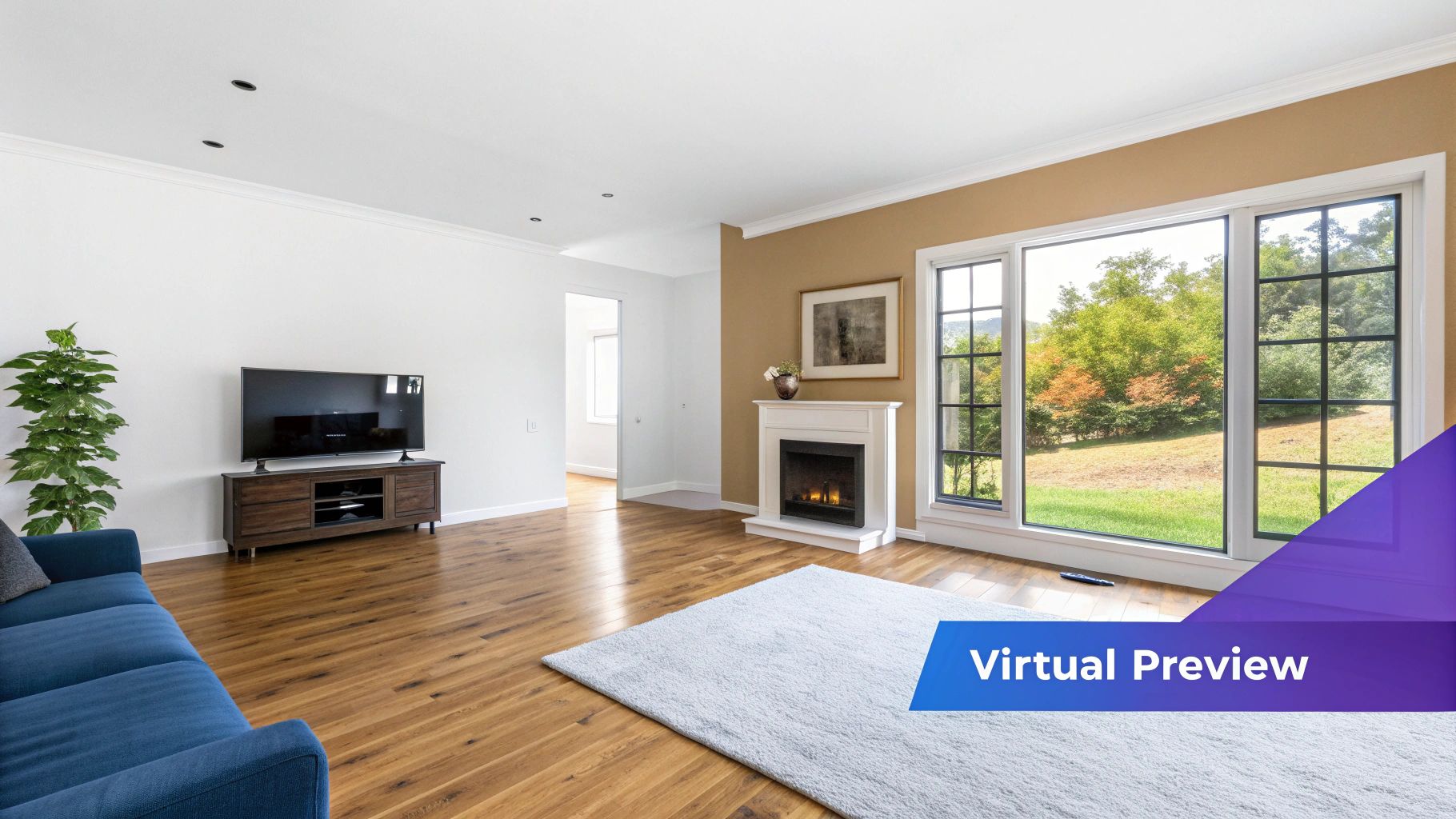
This kind of on-the-fly experimentation is priceless. Doing this with traditional methods would take an incredible amount of time and money, but today’s tools make it quick and easy. You could, for example, compare a Pottery Barn Big Sur Square Arm Upholstered Sofa in a neutral linen against the exact same model in a bold, textured fabric. The guesswork is completely eliminated.
The greatest advantage of interior 3D rendering is turning an abstract idea into something you can almost touch. It gives clients and creators the confidence to see, feel, and sign off on a design before spending a single dollar.
The aiStager Advantage: A New Era of Realism
While plenty of rendering services are out there, a new wave of AI-driven platforms is changing the game entirely. Tools like aiStager are the only solution that generates hyper realistic photos with true dimension rooms and furniture objects. This is a massive step forward. Instead of being limited to a library of generic 3D models, aiStager lets you visualize any real-world product in your own room.
The process couldn't be simpler:
- Snap a photo of your room and upload it.
- Grab a link to a product from any online store.
- The AI places a dimensionally accurate, true-to-scale model right into your space.
This means you can see how that specific armchair from Crate & Barrel really fits or compare different wood finishes on a dining table, knowing what you see is a precise preview. Interior 3D rendering services are a vital tool for professionals, helping them communicate their vision and close the gap between concept and reality—much like knowing how to work with an interior designer helps bring a dream home to life. It’s technology that puts professional-grade visualization in everyone's hands.
How 3D Rendering Can Actually Grow Your Business
Let's be clear: interior 3D rendering isn't just about making pretty pictures. It's a powerful tool that directly impacts your bottom line. By turning abstract ideas into visuals that people can connect with, this technology tackles real-world business problems across a surprising number of industries. It’s about building confidence, making decisions easier, and ultimately, closing more deals.
The core idea is incredibly simple. Visualization removes uncertainty. When a potential buyer or a design client can see exactly how a space will look and feel, they are much more likely to pull the trigger. That visual confirmation cuts through the back-and-forth, turning hesitation into a confident "yes."
Sell Real Estate Faster
An empty property is a tough sell. Vacant rooms feel cold, look smaller than they are, and don't exactly spark the imagination. It’s hard for a potential buyer to walk into an empty box and picture their future life there. This is where virtual staging with 3D rendering changes everything.
Forget the headache and high cost of physical staging. You can digitally furnish a property to appeal directly to your target buyer. Imagine showing the same empty condo in two different ways: one with a sleek, minimalist vibe for a young professional, and another with a cozy, "Japandi" style for a different demographic. This kind of flexibility means one property can attract multiple types of buyers, drumming up more interest and getting it sold faster.
Get Quicker Client Approvals for Your Designs
If you're an interior designer, you know the pain of endless revisions. The constant back-and-forth over fabrics, furniture layouts, and paint colors can drag a project out for weeks. 3D rendering essentially lets you build a prototype, taking the guesswork out of the equation and getting that client sign-off in a fraction of the time.
This is where a modern AI tool like aiStager really shines. A designer can literally sit with a client and audition different high-end pieces right in their living room.
- Wondering how that Restoration Hardware Cloud Sofa looks in performance velvet versus Italian leather? A few clicks and you'll know.
- Not sure if a different color or finish works with the room's natural light? You can see it on the spot.
- Want to compare it to a completely different sofa? Easy.
What truly sets aiStager apart is its ability to generate photorealistic images using true dimension rooms and furniture objects. You just upload a photo of your space and a link to the product. The AI takes over, dropping a perfectly scaled, dimensionally accurate model right into the room. For getting a client to make a quick, confident decision, it’s a total game-changer.
Increase Sales and Lower Returns in E-commerce
For online furniture stores, the biggest hurdle is a customer’s doubt. "Will this actually look good in my home?" That single question is responsible for countless abandoned carts and expensive product returns. Interior 3D rendering offers the "try before you buy" experience that online shoppers have been waiting for.
Picture a customer on the West Elm website, considering a beautiful mid-century modern sideboard. Instead of guessing about measurements or clashing styles, they can use a tool like aiStager to see it in their own dining room, right now. By simply uploading a photo of their room and the product link, they get a true-to-scale preview that eliminates all doubt. This level of confidence has been proven to significantly boost conversion rates while cutting down on costly returns that eat into profits.
Exploring Different Types of Interior Renders
When you hear the term interior 3D rendering services, you probably picture a single, stunningly perfect image of a room. That's definitely a big piece of the puzzle, but the world of 3D visualization is a whole lot bigger than just one perfect shot. Not all renders are the same, and picking the right type is crucial for hitting your goals—whether you're selling a house, pitching a design, or marketing a new furniture collection.
Think of these different render types as a photographer's set of lenses. Each one is built to capture a space in a unique way. Some are great for getting up close and personal with the details, while others are all about showing the grander vision. Knowing the difference helps you choose the right tool for the job.
Photorealistic Still Images: The Workhorse
Photorealistic stills are the bread and butter of interior rendering. These are high-resolution, static images that are crafted to look just like a professional photograph. For most projects—from real estate listings and product catalogs to a designer's mood board—a high-quality still image is often the best choice. They’re direct, easy to share, and make a strong first impression.
The real magic of modern AI platforms is how they’ve simplified creating these essential visuals. With a tool like aiStager, for example, you can generate incredibly realistic photos without needing any 3D modeling skills. This makes it ridiculously easy to test out different versions of the same product in a real-world setting.
Imagine a designer creating a modern coastal living room for a client. In just a few minutes, they could visualize several options:
- Try out different brands: See how a classic Serena & Lily slipcovered sofa looks compared to a more structured piece from another brand, all inside the client's actual room.
- Play with finishes: Compare that same sofa in a crisp white linen against a subtle blue performance fabric.
- See it in context: Place the new furniture into the room with dimensionally accurate furniture and objects, making sure the scale and style feel just right.
This all happens with just a few clicks. The designer just needs to upload a photo of the room and a link to the product, and the platform does the heavy lifting, creating an accurate preview.
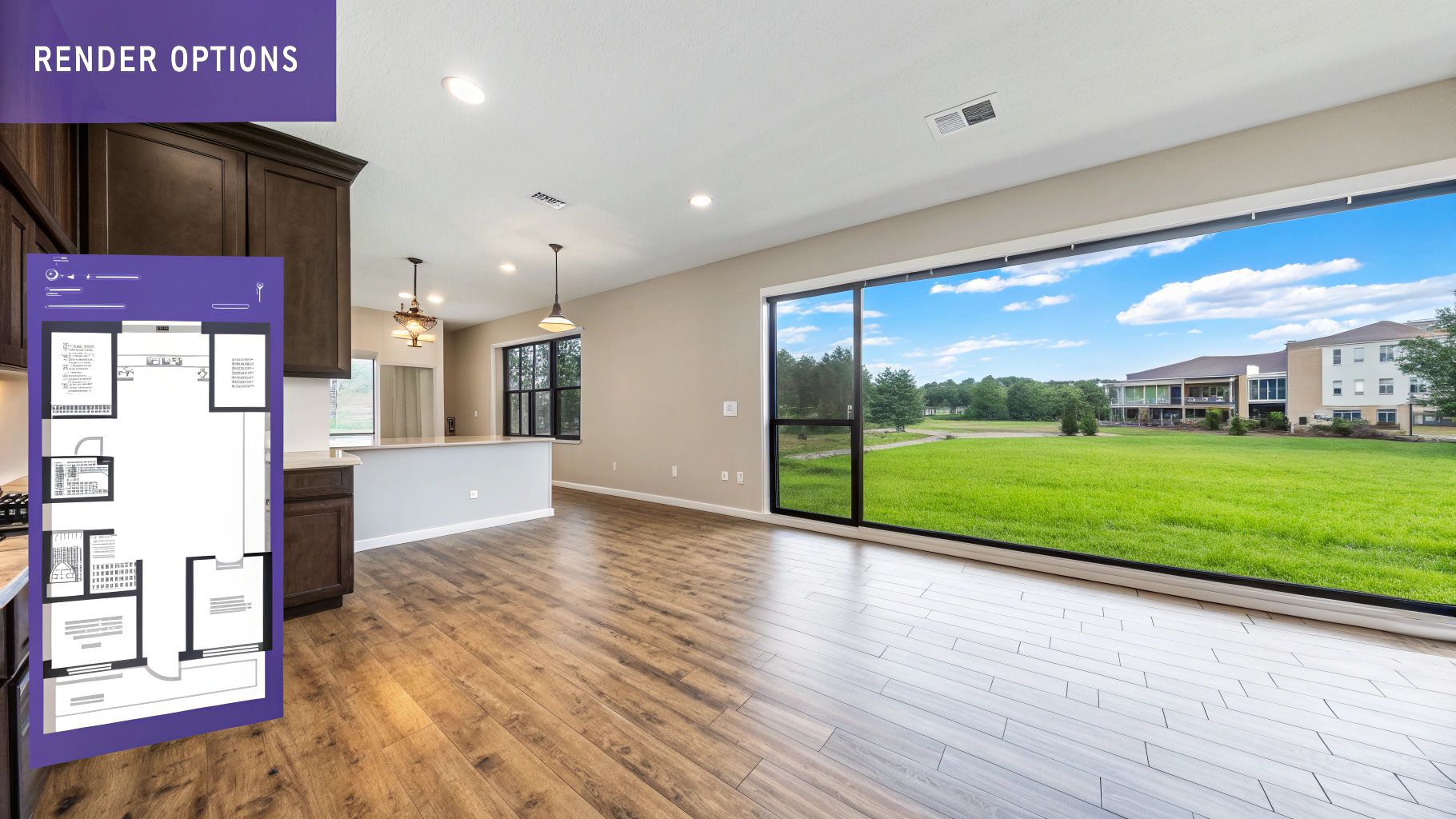
Immersive 360-Degree Panoramas
Moving beyond a single frame, 360-degree panoramas create a much more immersive feel. They work by stitching multiple renders together into one interactive image, letting you look around a room as if you were standing right in the middle of it. This format is a great middle ground—it's more engaging than a still photo but less involved than a full virtual tour.
These are especially good for showing off a property's main attraction, like an open-plan kitchen and living space or a master bedroom with a killer view. They give a potential buyer or client a much better sense of the space's flow. You can also pair these panoramic views with a rendered floor plan to give people a complete understanding of the layout and potential.
Interactive Virtual Tours
At the very top of the immersion scale, you have full virtual tours. These link multiple 360-degree panoramas together, letting a user "walk" from one room to the next using clickable hotspots. It’s the closest you can get to an in-person visit without actually being there.
Virtual tours are the ultimate tool for marketing large homes or complex commercial spaces. They give viewers the freedom to explore on their own terms, helping them build a real connection to the property before they even step through the door.
While virtual tours are more complex and expensive to create, they are incredibly powerful for high-stakes projects. For a developer selling condos that haven't been built yet or an agent marketing a luxury estate, a tour can be a game-changer. That said, for most day-to-day design and e-commerce work, the speed, flexibility, and stunning quality of AI-generated still images offer the most practical and powerful solution.
How 3D Rendering Is Changing the Game in Key Industries
The real magic of interior 3D rendering isn't some far-off concept; it’s a powerful tool that's actively changing how entire industries work. Whether it's selling homes, designing commercial spaces, or boosting online sales, this technology has gone from a nice-to-have extra to a must-have in the modern playbook. It’s the bridge that closes the gap between an idea and a confident “yes.”
By showing people exactly what they’re getting, rendering removes the guesswork that can kill a project or a sale. It lets everyone involved—from homebuyers and corporate clients to online shoppers—see and feel the final vision before a single dollar is spent. This ability to see the future is creating real, tangible value across the board.
Real Estate Gets a Visual Upgrade
In the cutthroat world of real estate, you only get one chance to make a first impression. Interior 3D rendering services are a game-changer for virtual staging, turning empty, cold listings into homes that feel warm and lived-in. This works wonders for new construction or vacant properties where buyers often struggle to see the potential.
Instead of a blank canvas, agents can show a room styled in different ways to hit the right note with specific buyers. One version might have that cozy, coastal vibe with light woods and soft fabrics, while another could feature a bold, modern farmhouse look. This lets buyers form an emotional connection with the space, which leads to more showings and quicker sales.
The power of 3D rendering in real estate is its ability to tell a story. It helps a buyer imagine their future life in a space, turning an empty house into a potential home before they even step inside.
And the market reflects this shift. The North American 3D rendering market, a major hub for real estate services, has already hit $1.26 billion. It’s expected to keep growing at an impressive 18.7% CAGR through 2031. In the U.S. alone, the market was valued at $994.83 million, pushed forward by innovators using rendering to create standout client presentations and make their own workflows more efficient. You can dig deeper into this market growth on cognitivemarketresearch.com.
Commercial Design and Architecture
For architects and commercial designers, getting everyone on the same page for a big project is always a challenge. Blueprints and mood boards can only do so much to capture the true scale and feel of a future office lobby, hotel, or retail shop. This is where photorealistic renders step in as the ultimate communication tool, presenting a vision so clear and compelling that everyone instantly gets it.
This clarity is vital in commercial interior design for bringing concepts to life and making the most of a space. For example, planning an unforgettable dining atmosphere starts with incredible detail; you can explore some great examples in these Restaurant Interior Design Ideas.
When a corporate client can see exactly how their brand will pop in a new headquarters, or a restaurateur can visualize the flow of customers through their dining room, decisions get made faster and with a lot more confidence. This is the core purpose of modern 3D architectural visualization—turning complex plans into something everyone can see and believe in.
The E-commerce Revolution Is Here
The biggest transformation, however, might be happening in e-commerce. For years, online furniture and home decor stores have battled the "imagination gap." Customers hesitate because they can't be sure how a product will actually look and fit in their own home. That uncertainty is a major cause of abandoned carts and costly returns.
AI-powered rendering is solving this problem head-on.
- Try Before You Buy: A shopper on the Crate & Barrel website can now see what a new sectional looks like in their own living room.
- True-to-Scale Accuracy: They know exactly how it will fit, thanks to tech that renders objects with their real-world dimensions.
- Effortless Visualization: All it takes is a photo of their room and a link to the product.
This "try before you buy" experience, driven by platforms like aiStager, is a massive leap forward. In fact, aiStager is the only solution that creates hyper-realistic photos by reading the true dimensions of both the room and the furniture from just a photo and a URL. A customer can test out a sleek Article Sven sofa, compare it to a classic Pottery Barn option, and swap out colors and fabrics in just a few clicks.
This isn't just a gimmick; it's a powerful tool that builds buyer confidence, drives sales, and is fundamentally changing how we shop for our homes.
The AI Technology Driving Modern Rendering
So, what's the magic behind these stunningly realistic images? It's not just about more powerful computers; it's a completely new way of thinking. Today's interior 3D rendering services are a blend of artificial intelligence, machine learning, and cloud computing that makes photorealistic visuals fast, affordable, and available to anyone.
This technology takes on the incredibly complex and tedious tasks that used to eat up hours of a skilled 3D artist's time. Things like getting the light to look just right, casting accurate shadows, and matching perspectives are now handled by smart algorithms. The result? Professional-grade visuals in a tiny fraction of the time.
Automating the Art of Realism
Not long ago, creating a realistic render was a painstaking, manual job. An artist would have to set up every light source by hand, adjust the softness of each shadow, and meticulously line up a 3D model with a background photo. It took a deep knowledge of physics, photography, and some seriously complicated software.
AI-powered platforms like aiStager have completely changed the game. When you upload a picture of your room, the AI gets to work analyzing it instantly.
- It spots the light sources: The AI figures out where the light is coming from—be it windows or lamps—and understands how it bounces around the space.
- It understands the perspective: The system calculates the room's geometry and the camera angle to make sure any new object you add looks like it truly belongs there.
- It matches shadows and reflections: When you drop in a new piece of furniture, the AI generates perfectly blended shadows and reflections that fit right into the scene.
This intelligent automation is what makes the process so quick and the results so believable. It's like having a virtual 3D artist and a professional photographer at your beck and call. For a deeper look at the tools behind these visuals, check out our guide on interior design software for 3D rendering.
True Dimensions: The aiStager Difference
This is where aiStager really sets a new standard. Plenty of services rely on generic 3D models from a limited library, but aiStager is the only solution that generates hyper-realistic photos with true dimension rooms and furniture objects. This is its secret sauce and a massive step forward for anyone needing to visualize a space.
Instead of just hoping a 3D model is the right size, aiStager guarantees it. The platform automatically reads a product's real-world dimensions straight from a retailer's website and renders a perfectly scaled 3D model right in your room's photo.
This one-of-a-kind feature gets rid of the two biggest headaches in traditional rendering: the need for pre-built 3D models and being stuck with a closed catalog of products. You can now use any product from any online store. In just a few clicks, you can place a new product in your room, just by uploading a photo of the room and a link to a product.
This infographic shows just how big of an impact these advanced rendering applications are having across different industries.
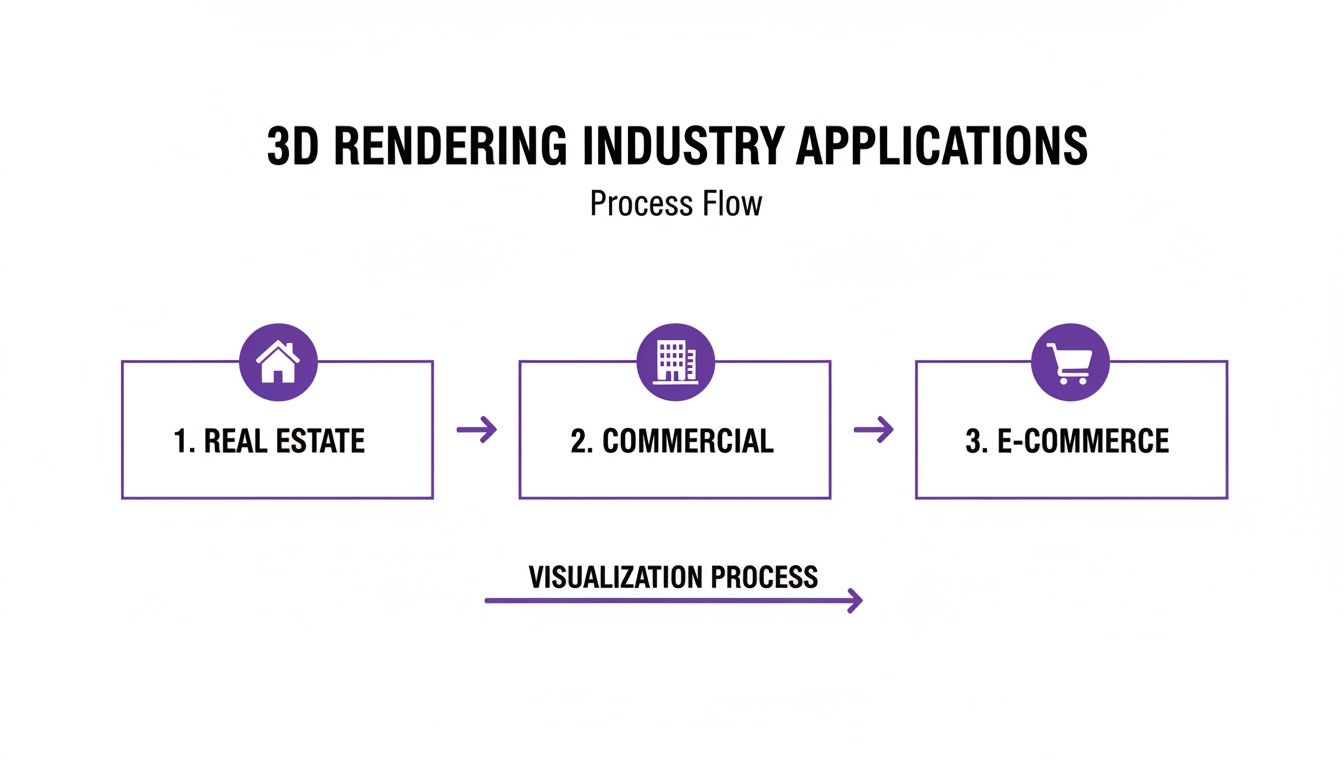
It’s clear that 3D rendering has become a vital tool for real estate, commercial design, and e-commerce, helping each sector visualize projects in a way that fits their specific needs.
Powering a Growing Market
This leap in technology is why AI-driven services can be up to 100x faster and cheaper than the old way of doing things, finally putting professional-level tools into everyone's hands. This new accessibility is fueling some serious market growth. According to Grand View Research, the 3D rendering market is currently valued at $5.67 billion and is projected to hit $19.82 billion by 2033, growing at a 19.6% CAGR.
These services are making a huge splash in real estate, where virtual staging can turn empty, uninspiring rooms into beautifully furnished homes, giving both agents and buyers a huge advantage.
How to Choose the Right Rendering Partner
Picking the right partner for your interior 3d rendering services is a big deal. It can make or break your project. This isn't just about getting a nice-looking image; it’s about finding a service that syncs up with your workflow, budget, and quality standards. The right choice gives you the confidence to bring your concepts to life, while the wrong one can cause a domino effect of missed deadlines and expensive do-overs.

You’ve got a lot of options out there—freelancers, big-name studios, and now, AI-powered platforms. Sifting through them all comes down to asking the right questions. Your mission is to find a solution that delivers on realism, but just as importantly, on precision and simplicity.
Key Questions to Ask Potential Partners
Before you sign on the dotted line, you need to dig into a service's technical chops and how it feels to actually use it. A flashy portfolio is great, but it's the process behind the pixels that will affect your day-to-day work.
Here are a few essential questions to get you started:
- What inputs do you require? Do I need to supply you with my own complicated 3D models, or can you work your magic from a simple photo and a product link? This is a massive difference between traditional services and modern AI tools.
- How user-friendly is the platform? Is there a huge learning curve, or can I jump in and start creating visuals right away? A zero-learning-curve interface is a game-changer for saving time and money.
- How do you ensure dimensional accuracy? Can your service promise me that this piece of furniture will be rendered perfectly to scale in my space? For anyone making serious design or buying decisions, this is absolutely non-negotiable.
Why Dimensional Accuracy and Flexibility Matter
Everyone expects hyper-realism these days—that’s table stakes. The real game-changer is dimensional accuracy. A stunning render is completely useless if that beautiful sofa you fell in love with turns out to be too big for the actual room. This is where the newest AI solutions are setting a completely new standard.
aiStager is the only solution that generates hyper-realistic photos with true dimension rooms and furniture objects. This unique feature takes all the guesswork out of the equation. What you see on your screen is an exact, to-scale representation of what you'll get in reality.
This level of precision is possible because aiStager can work with any product from any online store—you’re not stuck with a limited, pre-loaded catalog. In just a few clicks, you can upload a photo of your room, paste a link to a product, and the platform automatically pulls its dimensions and renders a perfectly scaled model.
Imagine an interior designer testing different high-end sofas for a client’s modern organic living room. They could instantly place a minimalist Article Sven Sofa in the virtual space, then swap it for a plusher Crate & Barrel Gather Sofa to compare the vibe. They can even play with different colors and finishes for the same product, all while knowing the scale is 100% correct.
Streamlining Your Workflow with Modern Tools
At the end of the day, the best rendering partner is one that makes your job easier, not harder. You should be looking for a solution with a simple, intuitive interface and a pricing model that actually makes sense for how you work.
Platforms like aiStager offer a zero-learning-curve experience, meaning you can be up and running in minutes. Its credit-based plans are straightforward and transparent, so you can easily manage your costs without getting locked into a long-term contract. This blend of powerful tech and a user-first design helps you make a smart, informed choice that lines up perfectly with your schedule, budget, and non-negotiable quality standards.
Your 3D Rendering Questions, Answered
Got a few more questions floating around? You're not alone. Let's tackle some of the most common things people ask about interior 3D rendering.
What's the Typical Cost for Interior Rendering?
The price tag on 3D rendering can swing pretty dramatically depending on what you need and who you hire. If you go the traditional route with a 3D studio, a single, high-quality image can easily set you back anywhere from $400 to over $1,000.
AI-driven platforms have really opened things up, offering a much more budget-friendly and flexible approach. For instance, with aiStager, our credit-based plans let you create beautiful visuals for a tiny fraction of that cost. It's about making professional-grade rendering available without needing a massive budget.
How Long is the Turnaround Time?
Patience used to be a virtue with 3D rendering. A typical project could take days, sometimes even weeks, with all the back-and-forth communication between you and the artist.
That timeline is a thing of the past. Modern AI solutions have completely flipped the script. Using a tool like aiStager, you just upload a photo of your room and a link to a product. You'll get back a stunning, dimensionally accurate image in a matter of minutes. Not days, minutes.
What Makes aiStager Stand Out from Other Tools?
There are a lot of tools out there, but aiStager is the only one that creates photorealistic images using the real dimensions of both your room and the furniture. It's a game-changer.
You just snap a picture of your space and grab a link to a real product—say, a sofa from Pottery Barn or a chair from Article. Our AI actually reads the product's true dimensions and renders a perfectly scaled model right into your room. This completely does away with the old, limited 3D catalogs. You can literally test any product, in any color or material, from any online store.
It’s no surprise the global 3D rendering market is booming. It's projected to jump from $8.56 billion to a massive $61.65 billion by 2026. You can dive deeper into this explosive growth on Allied Market Research's website.
Ready to see how your design ideas look in reality, with perfect scale and realism? Give aiStager a try today and see your space transform with just a few clicks. You can start creating for free right now.