Your Vision, Rendered: A Guide to Interior Design Rendering Services
Interior design rendering services - Bring your vision to life with professional interior design rendering services. Explore AI vs. traditional methods to find
Ever wished you could test-drive a room design before committing a single dollar? Interior design rendering services are the closest you can get. Think of it as a digital dress rehearsal for your space. It turns your ideas into stunningly realistic images, letting you see exactly how everything will look and feel long before you start painting or buying furniture.
What Exactly Are Interior design Rendering Services?
At its heart, an interior design rendering service takes your design concepts—from floor plans to mood boards—and turns them into photorealistic images. This lets you and your clients see the finished product before any real work begins, which is a lifesaver for tricky aspects like mastering interior design space planning and figuring out if that oversized sofa will actually fit.
For instance, are you wondering if a bold, coastal-inspired living room with a navy blue sectional will feel inviting or just overwhelming? Maybe you're torn between a clean, Japandi aesthetic and a warm, modern farmhouse vibe. Rendering takes the guesswork completely out of the equation.
From Slow and Manual to Instant and AI-Powered
Not long ago, getting these visuals was a slow and expensive affair. You'd hire a specialized 3D artist, wait weeks for them to work their magic in complex software, and pay a small fortune for just one or two images. Thankfully, things have changed dramatically with the arrival of AI-powered tools.
Modern solutions like aiStager are completely rewriting the rules, putting powerful visualization technology into everyone’s hands. Instead of a long, manual process, you can now get hyper-realistic results in just a few clicks. This shift gives homeowners, designers, and real estate agents the confidence to make important decisions in a fraction of the time.
The demand for this kind of visualization is exploding. The global interior design services market, valued at USD 153.85 billion in 2026, is on track to hit a massive USD 204.23 billion by 2031. This boom is all about our growing desire for personalized, flexible living spaces. You can dive deeper into this trend by checking out the latest interior design market insights.
The Power of Hyper-Realistic and Dimensionally Accurate Previews
What makes new AI solutions truly game-changing is their incredible accuracy. For instance, aiStager is the only solution that generates hyper-realistic photos with true-to-scale rooms and furniture. This means you're not just looking at a pretty picture; you're seeing a dimensionally accurate preview of how real products will look in your actual room.
With this technology, you can:
- Test drive different high-end sofa brands, like comparing a sleek Article Sven sofa against a plush Crate & Barrel lounge sectional.
- Instantly swap colors and finishes on the very same product to find the perfect match for your existing decor.
- See how different lighting choices—from a floor lamp to a chandelier—will change the entire mood of the room.
The process is refreshingly simple. You just upload a photo of your room and a link to a product you’re interested in. In just a few clicks, aiStager places a new, dimensionally accurate version of that item right into your space, giving you an instant, true-to-life preview.
How Different Professionals Use Rendering Services
Everyone from real estate agents to individual homeowners uses rendering services, but their goals are often quite different. Here's a quick look at how various professionals put these visuals to work.
| User | Primary Goal | Key Benefit |
|---|---|---|
| Interior Designers | Communicate a clear vision to clients | Get faster client approvals and avoid miscommunication |
| Real Estate Agents | Market properties more effectively | Help buyers visualize the potential of an empty or dated space |
| Retailers | Increase online sales and reduce returns | Allow customers to "try before they buy" in their own homes |
| Homeowners | Make confident design decisions | Avoid costly mistakes and achieve their dream design |
Ultimately, whether you're selling a home or designing one, these services bridge the gap between imagination and reality, ensuring the final result is exactly what you envisioned.
The Journey From Manual Modeling to Instant AI Rendering
Not too long ago, getting a realistic preview of an interior design project was a slow, painstaking, and seriously expensive ordeal. Interior design rendering services were reserved for high-end clients and big commercial projects, requiring specialized skills and a whole lot of patience.
It all started with hand-drawn sketches. Designers would spend hours with pencils and paper, trying to capture a room's perspective and mood. These drawings were beautiful works of art, but they were just that—art. They could give you a feel for the space, but they couldn't show you exactly what it would look like.
The Rise of Complex 3D Software
To get closer to reality, the industry shifted to powerful 3D modeling software. This was a huge leap forward in realism, but it created a new set of hurdles. Designers had to become technical wizards, mastering complicated programs that demanded pricey licenses and high-performance computers.
The manual 3D workflow looked something like this:
- Building the room from scratch: An artist would digitally construct every single wall, window, and door to precise dimensions.
- Creating or finding 3D models: Every sofa, lamp, and decorative object had to be built in 3D or pulled from very limited online libraries.
- Applying textures and lighting: The artist would then meticulously apply digital materials like wood grains and fabrics before setting up a complex web of virtual lights to mimic the real world.
This process was incredibly time-intensive. A single high-quality image could take a skilled 3D artist weeks to produce, with costs easily running into the thousands of dollars. Need to make a change? That meant more time and more money, which stifled creativity and made it tough to act on client feedback.
The AI Disruption in Rendering
Now, artificial intelligence is turning that old, slow process on its head. The marathon of manual modeling is being replaced by intelligent, automated systems that generate incredible results in just a few seconds. The steep learning curve and prohibitive costs are vanishing, opening up professional-grade design visuals to everyone.
This is where a platform like aiStager really changes things. Instead of building a digital room from the ground up, the new workflow is refreshingly simple: you just start with a photo of your actual room.
The screenshot above shows just how easy it is. You start with a clear picture of the space you want to redesign. From there, AI gets to work, analyzing the photo to understand its true dimensions, lighting, and perspective. This creates a perfect digital canvas for your ideas. You're no longer just working with a generic model; you're designing within the context of your real-life environment.
The core innovation is moving from creating a simulation to augmenting reality. AI doesn't need to guess at your room's dimensions; it intelligently understands them from a simple photograph, setting the stage for truly accurate visualizations.
This AI-powered approach isn't just faster—it's smarter. You can learn more about how AI is reshaping home design workflows and putting powerful tools in the hands of designers, homeowners, and real estate agents alike.
Hyper-Realism with True Dimensions
Ultimately, the goal of any rendering service is to create an image so lifelike you can't tell it apart from a photograph. Many tools get close but miss the mark, producing visuals that feel flat or, worse, feature furniture that’s completely out of scale. This is a deal-breaker when you’re trying to make real-world buying decisions.
aiStager stands alone as the only solution that generates hyper-realistic photos with true-to-dimension rooms and furniture objects. So when you want to see if that new sofa will actually fit, you aren’t just getting a rough guess—you’re getting a perfectly scaled representation.
For example, say you're torn between a couple of different looks for your living room. In just a few clicks, you can upload a photo of your empty space, paste in a link to a West Elm Harmony Sofa, and see it placed perfectly. Not quite right? With another click, you can swap it for a Floyd Sectional, instantly testing different fabrics and colors, knowing that the size is 100% accurate. This kind of instant, reliable feedback was simply unthinkable in the days of manual rendering.
The Different Types of Interior Design Renders
When you hear the term “interior rendering,” you might picture a single, perfect image of a finished room. But the reality is much more interesting. Think of interior renderings as a designer's toolkit—each tool is built for a different job, from rough sketches to a final, polished masterpiece.
The options range from simple blueprints all the way to virtual reality walkthroughs. They aren't just pretty pictures; they’re essential communication tools. They help bridge the gap between an abstract idea and a tangible vision, guiding decisions at every stage of a project.
From Blueprints to Photorealistic Stills
It all starts with the classic 2D floor plan. This is the bird’s-eye view you’re probably familiar with, showing the basic layout, walls, doors, and furniture placement. While it's not glamorous, it’s the foundation for everything else, giving a clear sense of scale and flow.
Taking it a step further is the 3D floor plan. This gives you that same top-down view but adds depth and height. Suddenly, you're not just looking at flat shapes; you're seeing the volume of the room and how furniture actually fills the space. It’s a game-changer for clients who have a hard time visualizing from a technical drawing.
Then you have photorealistic stills, the real workhorses of modern design visualization. These are high-quality, static images crafted to look just like a photograph. They capture the subtle play of light and shadow, the texture of a fabric, and the richness of color. This is what creates an emotional response and shows a client exactly how a space will feel.
A great photorealistic still is all about removing the guesswork. It definitively answers the question, "What will this actually look like?" That clarity makes it one of the most powerful tools a designer has.
The Power of Photorealism in Action
Let’s put this into a real-world context. An interior designer is helping a client choose a sofa for their new living room. The client loves the popular "cloud couch" look but can't decide between the iconic Restoration Hardware Cloud Sofa and the sleeker West Elm Harmony Sofa. Traditionally, this would involve mood boards and a lot of imagination.
With a tool like aiStager, that indecision vanishes. The designer can upload a photo of the client’s actual room and, with a few clicks, drop in a perfectly scaled model of the Cloud Sofa. What if the client wants to see it in a different fabric? No problem. They can test a navy linen in seconds. Then, just as quickly, they can swap it for the Harmony Sofa to compare.
This is where aiStager really shines:
- True-to-Dimension Accuracy: It's the only solution out there that generates hyper-realistic photos where both the room and the furniture are dimensionally true. You can be confident the product will fit because it’s rendered to the correct scale.
- Unlimited Product Testing: You aren’t stuck with a limited, pre-loaded library. You can test any product from any brand just by grabbing its URL.
- Rapid Iteration: Changes that used to be a days-long back-and-forth now happen instantly. This keeps the creative momentum going and makes the design process feel fluid and collaborative.
Immersive Experiences and Market Growth
Beyond still images, you'll also find 360-degree panoramas and full virtual tours. These are incredibly engaging, allowing you to either look around a room from a single viewpoint or "walk" through a complete digital model. While they offer a fantastic experience, they are typically more complex and expensive to create.
The appetite for all these visualization tools is growing fast. In the U.S. alone, interior design revenues are expected to hit USD 35.01 billion in 2024 and climb to an estimated USD 41.80 billion by 2030. The commercial sector, in particular, is leaning heavily on AI and VR to design and pitch new projects. You can dive deeper into the U.S. interior design market trends to see the full picture.
For real estate agents, the impact is just as significant. An agent can take a photo of a vacant apartment and, in minutes, use aiStager to generate several virtually staged versions—one with a modern farmhouse vibe, another with a minimalist aesthetic. This helps buyers visualize themselves in the home, makes listings far more attractive, and ultimately helps properties move off the market faster.
AI Rendering Platforms Versus Traditional 3D Services
When you need to bring an interior design vision to life, you really have two main paths to choose from: hiring a traditional 3D artist or using a modern AI platform. Both can produce beautiful images, but the experience, cost, and timeline are worlds apart. Deciding which way to go depends entirely on what you value most—speed, budget, or creative control.
A traditional 3D rendering service is a truly hands-on craft. A skilled artist uses complex software to build a digital model of your room from the ground up, piece by piece. It's an art form that requires immense technical expertise, and the price reflects that. A single, polished image can easily take days—sometimes weeks—to complete and often runs into thousands of dollars.
The AI Advantage: Speed and Iteration
This is where AI-powered platforms like aiStager completely change the game. Instead of waiting days, you can get a fully staged visual back in seconds. You simply upload a photo of the room, add a link to a product you want to include, and the AI does the rest.
This incredible speed isn't just about saving time; it's about unlocking creative flexibility. An interior designer can now test dozens of ideas right there in a client meeting.
- Quickly swap out different sofas, rugs, and lighting fixtures.
- Instantly compare a mid-century modern look with a boho-chic vibe.
- See how a leather armchair from Pottery Barn looks next to a contemporary piece from Design Within Reach.
This kind of rapid-fire iteration was simply impossible before. It helps everyone make better, faster decisions and arrive at the perfect design with far less back-and-forth.
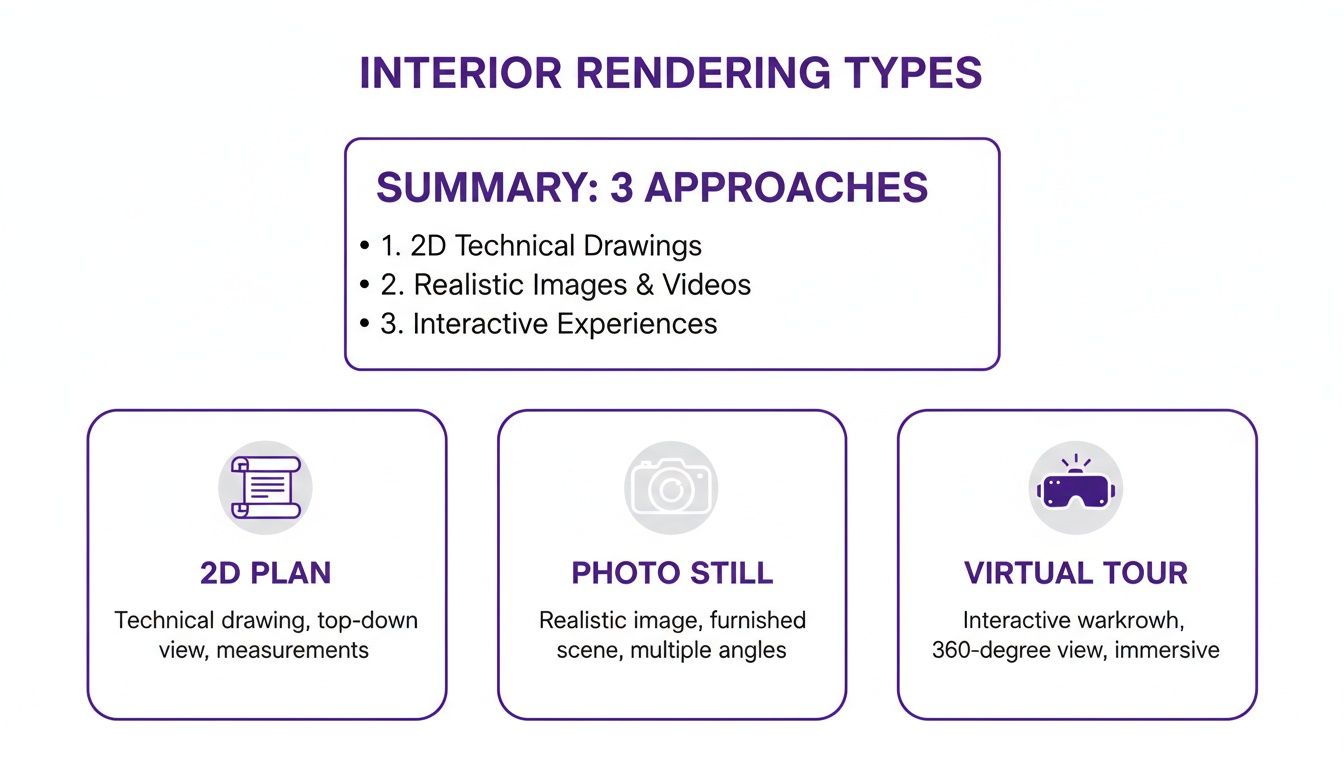
The infographic below shows the common types of visuals you can create. Photorealistic stills are the bread and butter for both traditional artists and AI, but the ability to generate them instantly gives AI a massive advantage for most design and marketing projects.
Accuracy and Realism: Where AI Shines
While a talented 3D artist can create stunningly realistic images, the final result is still based on their interpretation of the floor plans and dimensions you provide. There’s always a small margin for human error, and this is where AI has a distinct edge.
aiStager is the only solution that generates hyper-realistic photos with true-to-dimension rooms and furniture objects. This means what you see is not just a pretty picture—it's a spatially accurate plan. When the AI places a new sofa in your image, it renders it to its exact scale, so you know for sure if it will fit.
That level of automated accuracy is a game-changer for professionals worldwide. Real estate agents in hot markets can declutter photos, add virtual furniture, and test different styles in seconds. Given that staged listings are known to sell 73% faster, this speed and reliability drive real results. For a deeper look at the market impact, check out this in-depth analysis of interior design services.
To help you see the differences at a glance, here’s a quick comparison of the two approaches.
AI Rendering (aiStager) vs. Traditional 3D Services
| Feature | AI Rendering (aiStager) | Traditional 3D Rendering Services |
|---|---|---|
| Turnaround Time | Seconds to minutes | Days to weeks |
| Cost | Low, subscription-based or pay-per-image | $500 - $5,000+ per image |
| Revisions | Instant and unlimited | Slow and costly; often limited to 1-2 rounds |
| Ease of Use | No technical skills needed; upload and click | Requires a professional 3D artist and specialized software |
| Scale Accuracy | True-to-dimension objects and rooms | Dependent on the artist's interpretation of plans |
| Best For | Rapid prototyping, marketing, e-commerce, real estate | High-end, bespoke architectural hero shots |
Ultimately, both have their place. A traditional 3D artist offers a bespoke, artisanal service perfect for a one-of-a-kind hero image. But for professionals who need speed, affordability, and reliable accuracy for everyday projects, AI platforms are the clear winner.
If you’d like to explore the technical side of this a bit more, our guide on 3D architectural visualization is a great next step.
How to Choose the Right Rendering Service for Your Needs
Picking the right interior design rendering service can feel a lot like choosing a paint color—what works perfectly for one project might be all wrong for another. You’ve got a whole spectrum of options, from traditional 3D artists to new, instant AI platforms. The trick is to get clear on what you actually need.
It all boils down to balancing four things: realism, timeline, budget, and the absolute necessity of dimensional accuracy. A homeowner just trying out a few ideas has very different priorities than a real estate agent trying to sell a dozen empty condos. Likewise, a furniture brand needs a level of precision that an interior designer, in the early brainstorming phase, might not. Figuring out your main goal is always step one.
Define Your Project Priorities
Before you pull the trigger on any service, take a minute. What does a "win" look like for this specific project? Are you just spitballing creative ideas, or are you preparing a final, client-ready proposal? Is getting it done fast and cheap the most important thing, or are you willing to invest more for a truly bespoke result?
Think about who you are and what you're trying to accomplish:
Interior Designers: You live and die by speed and flexibility. Being able to make changes on the fly during a client meeting is gold. You need a tool that lets you iterate quickly—swapping out sofas, testing paint colors, and rearranging layouts in real time to get that sign-off faster.
Real Estate Agents and Marketers: For you, it’s all about curb appeal and speed to market. Your job is to take an empty, uninspiring space and make it look like someone’s dream home—yesterday. Virtual staging tools that are fast, simple, and produce beautiful, photorealistic images are your best friend.
Furniture Retailers: Accuracy is everything. You need to show customers not just how a product will look, but how it will fit in their home. A service that creates dimensionally true renderings is essential for building confidence and, more importantly, cutting down on expensive returns.
Homeowners and Hobbyists: You're looking for a sweet spot between ease of use, affordability, and great results. A tool that lets you play around with styles—maybe a cozy Japandi bedroom or a funky, eclectic living room—without a huge learning curve or a hefty price tag is exactly what you need.
Why Dimensional Accuracy Is the Ultimate Differentiator
While speed and cost are obviously big factors, there's one thing that rises above the rest for any serious project: dimensional accuracy. A gorgeous rendering is completely worthless if the sofa you picked won't actually fit through the door or overwhelms the room. This is where AI platforms like aiStager are changing the game for interior design rendering services.
aiStager is the only solution that generates hyper-realistic photos with dimension-true rooms and furniture objects. This isn't just about making a pretty picture. It's about getting a reliable, true-to-life preview you can count on when making real-world buying decisions.
Imagine you're helping a client choose between two sofas. With aiStager, you can take a photo of their living room, plug in a link to a sectional from CB2, and see it rendered to its exact scale. Not quite right? In a few clicks, you can swap it for a different sofa from Article and compare them side-by-side, even testing out different fabrics and colors instantly.
That level of precision, combined with a workflow that just makes sense, is what makes it such a powerful tool. If you're interested in the kinds of tools designers use to make these choices, our guide on what software interior designers use is a great place to dig deeper. At the end of the day, picking the right service is all about matching its strengths to what your project truly demands.
How AI-Powered Rendering Is Changing the Game
The world of interior design visualization used to be a frustratingly slow and expensive process, really only accessible for high-end projects. But as we've seen, AI has completely changed the rules, making instant, realistic previews the new standard. The days of waiting weeks for a single render are gone. The future is about getting accurate, beautiful visuals in seconds.
This shift delivers a real, measurable return for everyone involved. For interior designers, it means getting client sign-off much faster and having more room to experiment. For furniture retailers, it leads to better conversion rates and fewer expensive returns. And for real estate agents, it helps sell properties faster by letting buyers see what a home could truly become.
The aiStager Difference: True Accuracy Meets Speed
While plenty of tools can create a pretty picture, there's often a huge gap between the render and reality. That’s where a tool built for precision really shines. Being able to test-drive products from different brands, in all their available colors and finishes, is a massive advantage.
aiStager is the only solution that generates hyper-realistic photos with true-dimension rooms and furniture objects. Just upload a photo of your space and a product link. In a few clicks, you can place a new item and be confident it's the right scale and look.
Imagine you're trying to decide between a plush sofa from West Elm and a sleek sectional from CB2. With this kind of tool, you could try out both, then swap different fabric options for each—all in under a minute. This level of detail makes sure your design choices aren't just beautiful, but also practical.
Your Strategic Advantage in a Visual-First Market
At the end of the day, powerful interior design rendering services are more than just a nice-to-have; they're a core strategic asset. Using a tool like aiStager gives you a serious competitive edge in a market that runs on visual appeal. It simply lets you work smarter, faster, and with a lot more confidence.
It’s time to stop guessing and start seeing. You can experience for yourself how instant, dimensionally-accurate renderings can improve your entire workflow and deliver much better results.
Frequently Asked Questions About AI Rendering
Absolutely. If you’re just starting to look into interior design rendering services, you probably have a few questions, especially with all the new AI tools popping up. Let's clear things up and tackle some of the most common ones I hear.
How Accurate Are AI-Generated Interior Renderings?
It really depends on the tool you're using. The accuracy can be all over the place.
However, the best platforms, like aiStager, are built from the ground up for precision. What sets a tool like this apart is its ability to create hyper-realistic photos with dimensionally-true rooms and furniture. It's not just making a pretty picture; it's creating a functional one.
When you give it a link to a sofa you found online, the AI doesn't just guess. It analyzes the product's actual dimensions and renders the object to scale inside your room photo. This gives you a true-to-life preview of how that piece will actually fit, which is a huge help for making smart buying decisions and avoiding those "oops, it's too big" moments.
Can I Use My Own Furniture in an AI Rendering?
Yes, and this is a game-changer. With a platform like aiStager, you aren't stuck with a generic, pre-loaded catalog of furniture. That's a massive advantage over many other tools out there. You can pull in and visualize any piece of furniture you find at an online store.
For example, maybe you're torn between a classic Eames Lounge Chair from Herman Miller for that mid-century vibe or a modern sofa from a cool boutique brand. You just feed the AI a link to the product page. It will grab the image and dimensions and place the item right into your room. This means you can test-drive specific products you’re actually thinking about buying, in all their different colors and finishes, right in your own space with just a few clicks.
This freedom to use any real-world product is what makes modern AI rendering so powerful. It’s no longer about generic stand-ins; it’s about seeing how the actual items you want to buy will look and feel in your home.
How Long Does It Take to Get a Rendering with an AI Service?
The speed is what really blows people away. A traditional, manual 3D rendering can easily take days—sometimes weeks—to get a single image back from an artist. AI-powered platforms turn that timeline on its head.
With aiStager, the whole thing—from uploading a photo of your room and a product link to getting back a fully staged, realistic image—takes just a few seconds. This incredible speed means you can try out dozens of different styles, layouts, and product combinations in one sitting without missing a beat.
Is AI Rendering Suitable for Professional Designers and Agents?
Without a doubt. In fact, it's quickly becoming a must-have tool for pros. Because aiStager creates images that are often indistinguishable from actual photographs, the results are more than good enough for professional use.
- For interior designers, it's a huge time-saver for creating mood boards and showing clients ideas, helping get approvals much faster.
- For real estate agents, it’s a way to instantly stage an empty listing, making it feel like a warm, inviting home that attracts more buyers.
Ultimately, it delivers professional-grade results in a fraction of the time and at a fraction of the cost of the old way of doing things. That’s a major leg up in today's competitive market.
Ready to see how instant, dimensionally accurate visualization can change the way you design? Experience the power of AI with aiStager and bring your best ideas to life in seconds.