Master Plans Architecture A Complete Explainer for 2026
Explore master plans architecture from concept to execution. This guide covers goals, components, process, and how AI tools like aiStager accelerate buy-in.
You may be looking at a site plan, a parcel map, or a development brief and thinking a simple question: how do all these pieces turn into a place people want to use?
That question sits at the center of master plans architecture. A master plan is not just a drawing of roads and buildings. It is the logic behind the place. It decides what happens first, what waits until later, what supports everything else, and how design choices affect budget, operations, leasing, and daily life.
For developers, brokers, property managers, and design teams, this matters because large projects fail in predictable ways. Roads get placed before the traffic pattern is understood. Buildings go up before utilities are sized correctly. Public spaces become leftovers instead of assets. Stakeholders approve an abstract vision, then resist the details when the proposal finally becomes real.
A good master plan prevents that drift. It gives a long-view framework that still leaves room for change.
The Blueprint for Future Growth
A large project without a master plan is like building a hotel by choosing the lobby furniture first. You might pick something attractive, but you still do not know where the elevators go, how guests move through the building, or how service staff operate behind the scenes.
The same logic applies to a campus, mixed-use district, housing community, industrial site, or waterfront redevelopment. Before anyone argues about facade materials or a leasing office interior, someone has to answer bigger questions. Where do cars enter? Where do pedestrians feel safe? Which parcels produce revenue first? Which open spaces create long-term value instead of becoming maintenance burdens?

Why the first decisions matter most
Early planning choices lock in later costs. If a road is misplaced, every building frontage may suffer. If stormwater, power, or pedestrian circulation are treated as afterthoughts, the project team spends the next phase correcting what should have been solved at the start.
That is why master planning works as a future-growth blueprint. It gives a shared logic for land use, circulation, infrastructure, public realm, and implementation.
A useful way to think about it is this:
- A building design asks, “What should this structure be?”
- A master plan asks, “How should this whole place work over time?”
Those are different questions. They require different decisions.
Why many organizations still struggle
Even advanced institutions do not always handle this well. A survey of institutional leaders found that nearly 50% have a recent master plan, 20% have no plan at all, and only 56% expect their current plan to be substantially implemented. The same survey found that over 90% want better integration between strategic planning and master planning (Baker Tilly and BHDP campus master planning survey).
That combination tells a clear story. Many organizations understand planning matters, but they still struggle to connect vision to execution.
Key takeaway: A master plan is not valuable because it looks polished in a presentation. It is valuable when it helps people make coordinated decisions over several years.
For real estate professionals, this has a practical payoff. A coherent plan supports cleaner approvals, more credible budgeting, and easier conversations with lenders, tenants, residents, and public agencies. It reduces the number of “we’ll solve that later” decisions, which usually become the most expensive ones.
What Is an Architectural Master Plan
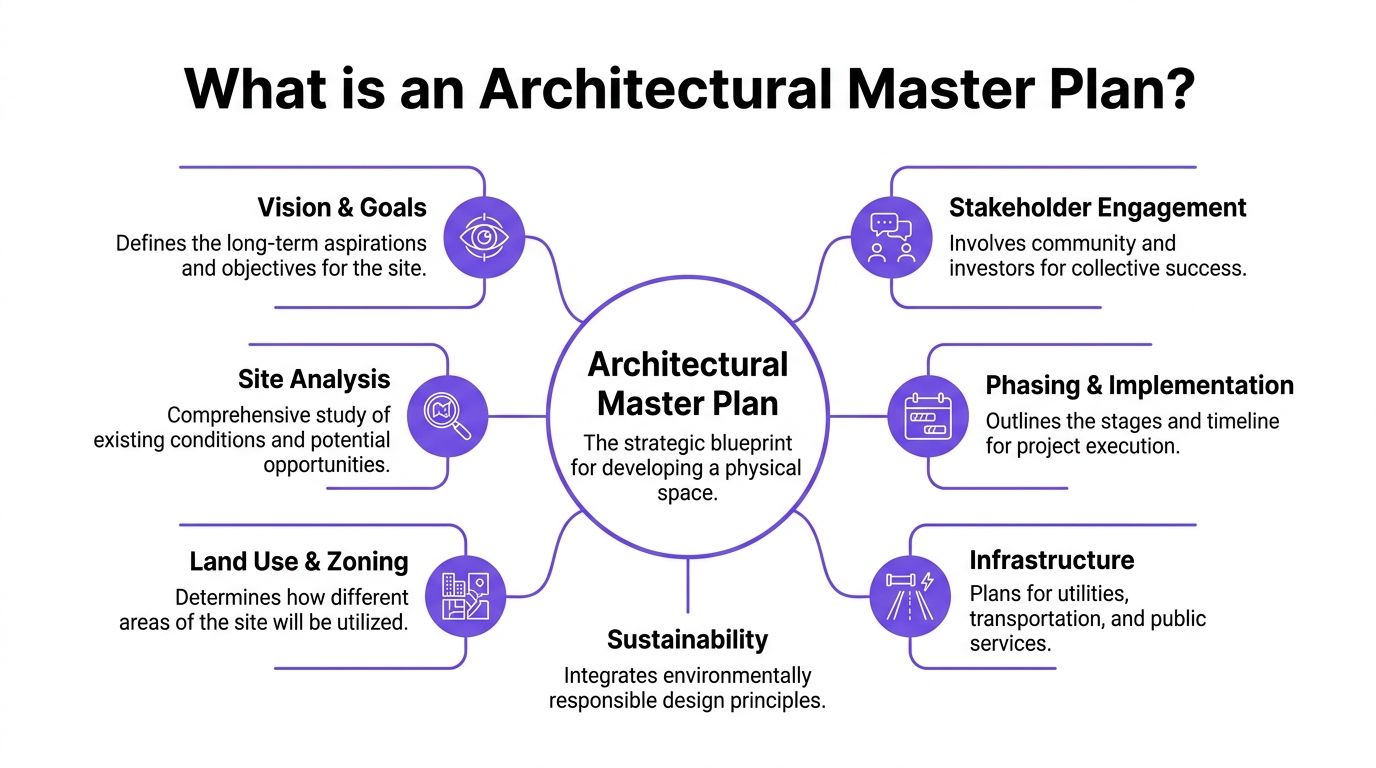
An architectural master plan is the business plan for a physical place. It does not specify every bolt, wall assembly, or fixture. It sets the long-term direction for how a site grows, changes, and performs.
Most master plans in architecture look ahead five to ten years, and full updates are recommended every five to ten years so the plan stays useful as conditions change (guide to the master planning process).
What a master plan does
A master plan gives decision-makers a framework for questions like these:
- Growth direction where future buildings, additions, or redevelopment should happen
- Budget logic which improvements come first and which can wait
- Spatial priorities how open space, access, density, and services relate to each other
- Coordination how separate projects still feel like parts of one place
If you are a developer, this is the difference between owning a collection of parcels and building a coherent district. If you are a broker or leasing team, this is the difference between marketing one finished building and explaining a believable long-term story for the whole site.
What a master plan is not
People often confuse a master plan with detailed construction documents. They are not the same.
Here is a simple comparison:
| Document | Main purpose | Level of detail |
|---|---|---|
| Master plan | Sets long-term structure and priorities for the site | Strategic |
| Building design package | Defines how a specific building gets built | Detailed |
| Construction documents | Instruct contractors on exact execution | Highly detailed |
A master plan might show where a residential block belongs, how it connects to a park, and when it should be phased. It usually does not tell a contractor the exact millwork details for a unit kitchen.
Why revisions matter
The best master plans are not rigid. They are stable in vision and flexible in tactics.
That flexibility matters because planning and strategy often drift apart. Nearly 50% of recent campus master plans align poorly with strategic goals, according to the same planning guidance noted above. That is one reason updates are recommended on a regular cycle, rather than treating the plan as a one-time deliverable.
A strong master plan should survive changing market conditions without losing its core logic.
For non-experts, one practical test helps. If a plan can explain to three very different audiences, such as an investor, a planning official, and a future resident, why the place is organized the way it is, then the plan is probably doing its job.
The Core Components of a Master Plan
A master plan works because several systems are designed together. If one system is ignored, the others stop making sense.
Imagine planning a dinner service in a restaurant. The menu matters, but so do kitchen circulation, table layout, staffing routes, storage, and timing. A site works the same way.
Land use and zoning
Land use answers the question, “What belongs where?”
One area may be residential. Another may hold retail, offices, civic uses, or green space. The point is not just separation. The point is placing uses so they support each other.
A simple example: a neighborhood green in the center of housing can become a daily amenity. The same green space shoved behind service drives often becomes dead leftover land.
Zoning adds the rulebook. It governs what can be built, how tall it can be, how close it sits to property lines, and what activities are allowed. Developers often think of zoning as a constraint, but good master planning uses it as a design tool. It helps the team understand where density is feasible and where lower-intensity uses make more sense.
Circulation and access
Circulation is how people, vehicles, bikes, deliveries, and services move through the site.
On this point, many readers get confused. A road plan is not the same thing as a circulation plan. A circulation plan asks broader questions:
- Where do visitors instinctively enter?
- Which route feels safe at night?
- How do residents move without crossing loading zones?
- Where do service vehicles go without disrupting the public realm?
If circulation is poor, even a beautiful development feels awkward. People avoid parts of it. Retail struggles. Leasing tours become harder because every movement through the property reveals friction.
Infrastructure and utilities
Infrastructure is the invisible layer that decides whether the visible layer works. Water, power, drainage, data, lighting, and waste systems are rarely glamorous, but they shape cost and feasibility from day one.
A useful analogy is the wiring behind a home office. You can buy a desk, monitor, and chair, but if there are no outlets where you need them, the space fails in use.
Modern site analysis has become much more precise. In master planning, teams now combine LiDAR scanning, drone photogrammetry, and GIS to map topography and existing infrastructure with sub-centimeter accuracy, and this can reduce redesign iterations by 30% to 50% in large-scale projects (site model workflow for master plan models).
That matters because utility mistakes are expensive to fix after roads, foundations, or site systems are already in place.
Phasing and timing
Phasing is one of the most important ideas in master plans architecture, and one of the least understood.
Phasing means deciding what gets built in what order.
A good comparison is furnishing a new apartment. You do not start with niche decor pieces. You start with essentials that let the home function. In a development, that often means access, utilities, and the first buildings that establish identity or revenue.
A phased plan often separates:
- Enabling work such as roads, grading, and utilities
- Early wins such as a first residential block, amenity, or anchor tenant space
- Follow-on phases that expand value once the place has momentum
Practical rule: If Phase One cannot stand on its own operationally and financially, the larger plan may be too optimistic.
The pieces must reinforce each other
A park location affects circulation. Circulation affects retail frontage. Retail frontage affects parking, utilities, and service access. Nothing sits alone.
That is why experienced planners spend so much time on coordination. The site is a system, not a collage.
The Architectural Master Planning Process
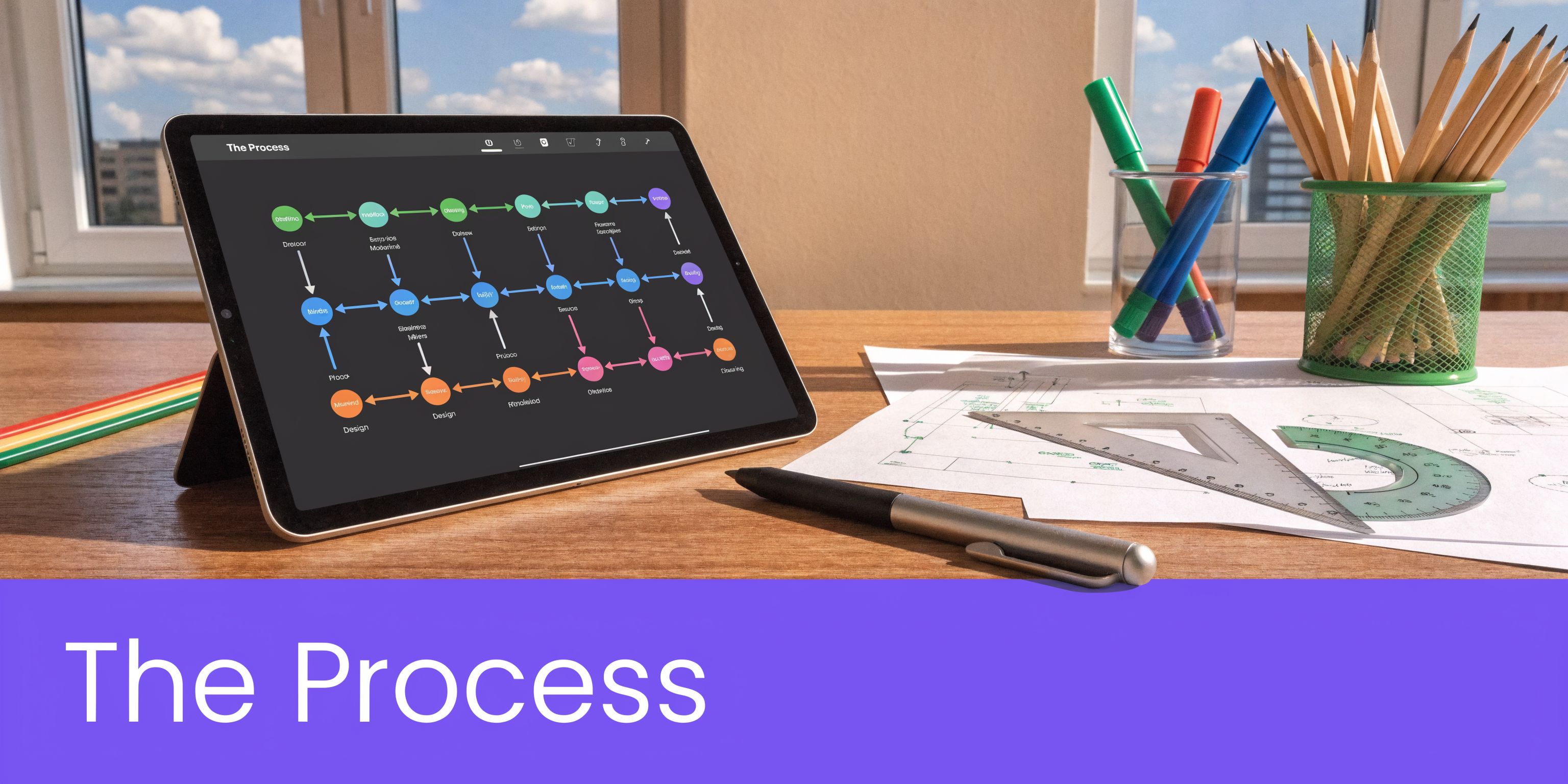
Master planning is not a single burst of creativity. It is a sequence of decisions that moves from facts to options to a durable framework.
Research and analysis
Every solid plan starts with observation. The team studies the site, surrounding context, existing buildings, access points, utility capacity, environmental conditions, and user needs.
Engagement also begins here. A municipality may bring in agencies and community groups. A private developer may involve lenders, brokers, operators, and future tenants. Different voices care about different things, so the planner has to separate preferences from actual constraints.
For readers who want a practical overview of how aerial surveys support this early work, this guide to drones in engineering is a useful companion because it shows how site capture supports design and technical decision-making.
Deliverables in this phase often include:
- Base maps showing existing conditions
- Constraint diagrams identifying setbacks, utilities, slopes, or access issues
- Opportunity studies highlighting where value can be added
- Stakeholder summaries that clarify goals and concerns
Vision and goal setting
Once the team knows the site, they define what success looks like.
Defining success sounds simple, but projects often become fuzzy at this stage. “Create a vibrant district” is not enough. A useful vision connects spatial choices to business and community outcomes.
A team might decide that the project should prioritize walkability, phased revenue generation, adaptive reuse, family-friendly public space, or a stronger identity for a mixed-use corridor. Those are not just slogans. They shape later tradeoffs.
Concept development
This phase is where alternatives are tested. One concept may place density near transit. Another may preserve more open space. A third may front-load infrastructure to support later expansion.
The biggest change in recent years is speed. Computational design tools now use procedural geometry to generate and evaluate thousands of master plan scenarios. This can cut exploration from months to hours, and studies cited in the framework report outcomes up to 25% more optimal on metrics such as density and traffic flow than purely manual methods (framework for generating a thousand master plans).
That does not remove human judgment. It improves the quality of choices human teams can compare.
A related discipline worth understanding is BIM. If you want a clearer view of how data-rich models support coordination after concept work, this article on https://www.ai-stager.com/blog/bim-for-architects offers a good overview.
Here is the video resource that helps make the process more concrete:
The final master plan
The final output is not just one pretty image. It is usually a package of coordinated guidance.
That package may include:
| Element | Why it matters |
|---|---|
| Illustrated site plan | Shows the long-term spatial structure |
| Land use diagrams | Clarify what goes where |
| Mobility plans | Explain roads, paths, transit, parking, and service access |
| Phasing plan | Tells the story of implementation over time |
| Design guidelines | Keep future buildings and spaces coherent |
| Infrastructure strategy | Connects vision to practical delivery |
A good final plan gives the team enough direction to act, without pretending the next several years will unfold exactly as predicted.
Tip: The strongest plans are specific about priorities and flexible about sequencing. Markets shift. Construction costs move. User demand changes. The framework should absorb that reality.
Securing Buy-In with Modern Visualization Tools
A master plan can be technically correct and still fail in the room.
That usually happens during approvals. Planning consultants and architects present diagrams, sections, and phased maps. The technical team follows the story. The non-experts often do not. Investors start asking what the place will feel like. Sales teams want something they can show buyers. Community stakeholders want proof that the proposal will improve daily life, not just look neat from the air.
That is where visualization matters.

Exterior plans are not the whole story
Most master planning content focuses on exterior views. That makes sense because district planning is often shown from above. But people do not buy, lease, approve, or emotionally connect to a place from an aerial view alone.
They connect to rooms, lobbies, amenity spaces, kitchens, work lounges, and furnished living areas. They want to know whether a unit feels bright, whether a sofa fits, whether a finish palette feels premium or cold, and whether a concept will appeal to the target market.
That gap is becoming more obvious. One industry analysis notes that interior visualization is underserved in master planning content, even though the virtual staging market is projected to grow from $1.2B in 2023 to $4.5B by 2030, and AI tools that produce photorealistic interiors can work up to 100x faster than CAD workflows (architectural rendering content gap and virtual staging demand).
Why interior testing changes approval conversations
Consider a developer planning a residential building within a larger mixed-use master plan. The site plan may already be strong. The public realm may be well designed. But when the sales team starts talking to prospective buyers, a familiar friction appears.
People ask questions like:
- Will the sectional block the window wall?
- Does the dining area still work with a larger sofa?
- Would this unit feel warmer in a Modern Farmhouse style or cleaner in a Japandi direction?
- Will this finish package feel upscale enough for the asking price?
Traditional 3D workflows can answer those questions, but they often take too long for fast-moving decisions. That slows approvals and makes every iteration feel expensive.
Modern AI interior visualization changes that dynamic because teams can test specific product choices inside a real room image instead of discussing abstractions.
A practical example
Take a staged living room in a future condo building. A team may want to compare an Article sofa against a West Elm alternative. They may also want to test the same sofa in different colors and finishes, such as a warm oatmeal fabric versus a charcoal performance weave.
If the visualization tool can place those products in the actual room at true dimensions, the conversation changes. Buyers can see whether the room still breathes. Leasing teams can judge whether the furniture style fits the target demographic. Design teams can review whether the palette supports the broader brand story of the development.
That is much more useful than saying, “Trust us, the room will feel spacious.”
People approve what they can understand. They reserve judgment on what they have to imagine.
What to look for in a visualization workflow
For planning and real estate teams, not every render workflow solves the same problem. The most useful systems for buy-in do a few things well:
- They work from real room photos so the context feels believable.
- They use true dimensions so fit and scale are not guesswork.
- They allow product swapping so teams can compare one sofa, chair, or table with another.
- They support finish variation so walnut, black oak, boucle, leather, and linen can be tested quickly.
- They move fast enough for meetings because slow iteration kills momentum.
If you want a broader look at how image-making supports communication across projects, this overview of https://www.ai-stager.com/blog/3-d-architectural-visualization is a useful companion.
Why this matters financially
Stakeholder buy-in is not only a design concern. It affects timing, confidence, and downstream decisions.
When a buyer, tenant, or review committee can grasp a space clearly, the team can move from debate to choice. That affects pre-leasing, finish package selection, furniture procurement, and marketing alignment. It also reduces the risk of presenting a concept that sounds attractive in theory but disappoints when someone finally sees it at room scale.
In master plans architecture, that matters because every phase depends on confidence in the next one. If the first residential block lands well, the later phases become easier to defend. If the first product looks vague or mismatched to the market, trust weakens early.
Master Plan Best Practices and Common Pitfalls
Some master plans age well. Others look outdated almost as soon as the ink dries. The difference is rarely visual polish alone. It usually comes down to flexibility, realism, and how well the plan reflects actual community and market conditions.
Best practices that hold up
The most durable plans usually share a few habits.
Build flexibility into the structure
A strong plan is firm about key systems and loose about details that may need to change.
Street hierarchy, open-space logic, access, and infrastructure corridors often need stability. Exact tenant mix, unit layout preferences, or amenity programming may need room to evolve. If a plan locks down too much too early, later adaptation becomes painful.
Design from existing conditions, not wishful thinking
Some teams still begin with a beautiful top-down concept and only later ask whether the land, context, and surrounding community support it. That sequence creates avoidable conflict.
Plans improve when they start with what is already there. Existing buildings, mobility patterns, neighborhood habits, and local identity should shape the proposal instead of being treated as obstacles.
Treat communication as part of the design work
Many planning failures are communication failures. The design team understands the logic, but the wider audience never fully sees it.
That is why diagrams, phased narratives, and realistic visual material matter. The clearer the proposal, the easier it is to align lenders, city staff, operators, and future occupants around it.
Useful test: If a non-expert cannot explain the plan back to you in plain language, the plan may still be too abstract.
The shift toward adaptive reuse
Current best practice is also moving away from default greenfield thinking. In the last year, 78% of new EU and US master plans incorporated building in place or adaptive reuse strategies, which can reduce embodied carbon by 40% to 60% (ZGF on community-centered planning and adaptive reuse context).
That shift matters for more than environmental reasons. Retrofitting existing structures often preserves neighborhood memory, supports social continuity, and shortens the emotional distance between “the old place” and “the new project.”
For developers, adaptive reuse can also create more credible stories for approvals. People tend to respond better when a plan shows respect for what exists, especially in areas with cultural or civic significance.
Common pitfalls to avoid
Not every planning mistake is technical. Many are judgment errors.
- Overbuilding the first phase: If Phase One tries to solve everything, the project may carry too much cost and complexity too early.
- Ignoring operations: Beautiful public space can fail quickly if maintenance, service access, and staffing are not considered.
- Treating zoning as paperwork: Zoning shapes massing, use, and timing. It belongs in the design conversation early.
- Forgetting interior experience: A district can read well on a site diagram and still underperform if the actual spaces feel generic or mismatched to the market.
- Assuming conditions will stay fixed: Demand shifts. Construction markets move. Tenant expectations evolve. A rigid plan can become fragile fast.
A more resilient mindset
The best planners now think in layers. They preserve what is worth keeping, repair what is failing, and add new value where it belongs.
That mindset creates places that feel intentional rather than imposed. It also serves real estate better. Buyers, tenants, and communities respond to projects that feel rooted, legible, and adaptable.
Bringing Your Vision to Life
A master plan succeeds when it does three things at once. It sets a long-range direction, organizes practical decisions, and makes the future understandable to the people who must approve, fund, sell, lease, or live in it.
That is why master plans architecture is more than land diagrams and phased arrows. It is the discipline of turning uncertainty into coordinated action. Land use, circulation, infrastructure, zoning, and phasing all matter, but they only become powerful when they work together as one story.
The planning process also works best when teams stop treating communication as a final presentation step. Clear diagrams, realistic scenarios, and believable interior previews help people judge the proposal on something closer to reality. That can remove a surprising amount of friction from approvals and marketing.
For teams that want to sharpen their early-stage communication, this guide to https://www.ai-stager.com/blog/free-software-for-architectural-drawing offers another helpful entry point into the broader toolset around architectural representation.
The strongest projects are not the ones with the most dramatic renderings or the biggest promises. They are the ones that connect vision, budget, timing, and lived experience without losing coherence as the project evolves.
If you want to turn abstract plans into room-level visuals people can respond to, aiStager is built for that job. It lets you upload a room photo and a product link, then generate hyper-realistic, true-dimension interior images in just a few clicks. Teams can test different versions of the same product, compare sofa brands, swap colors and finishes, and show stakeholders what a space could feel like before costly decisions get locked in.