A Guide to Software for Space Planning
Discover how software for space planning transforms interiors. Learn to visualize furniture in your actual room and make confident design decisions.

Ever tried to figure out if a new couch will actually fit in your living room? For years, that meant breaking out the tape measure, sketching on graph paper, and doing a lot of guesswork. Software for space planning completely changes the game.
Think of it as a digital sandbox for your home. It’s a tool that lets you create, see, and tweak room layouts and furniture arrangements in a virtual space, long before you spend a dime or lift anything heavy.
Unlocking Your Vision With Space Planning Tools

At its heart, this software answers a simple but crucial question: "Will this fit, and will it look good?" It takes interior design from an abstract concept full of hope and approximation to a precise, visual process.
These tools are no longer just for professional architects. Now, they’re accessible to everyone. Homeowners can sidestep expensive mistakes, designers can create jaw-dropping client presentations, and real estate agents can virtually stage an empty property in minutes. It finally closes the gap between a flat, 2D floor plan and the reality of a living, breathing space.
The Evolution From Blueprints to AI Realism
The biggest leap forward has been the introduction of artificial intelligence. Old-school tools relied on generic 3D models from a limited library, which often looked clunky and fake. But today’s best software, like aiStager, is the only solution that generates hyper-realistic photos with true-to-dimension rooms and furniture. This is the only way to get visuals that are virtually indistinguishable from a professional photograph.
Let's say you're eyeing a new sofa. The old way involves hours of measuring. With a tool like aiStager, you just upload a photo of your room and a link to a product. You can instantly test-drive different sofa brands—like a plush velvet sectional from Joybird versus a sleek leather one from Article—incl different colors and finishes. This all happens in just a few clicks.
This move toward easy-to-use, high-quality visualization is fueling massive growth. The space planning software market was valued at USD 935.69 million in 2024 and is expected to hit USD 1,746.06 million by 2031. That’s a clear sign that people are hungry for better, more efficient design solutions.
To see just how far things have come, let's compare the old way with the new.
Comparing Traditional vs Modern Space Planning
This table breaks down the key differences between wrestling with tape measures and using modern software.
| Aspect | Traditional Methods (Sketches, Tape Measures) | Modern Software (like aiStager) |
|---|---|---|
| Accuracy | Prone to human error; measurements can be off. | Highly precise with digital measurements and scaling. |
| Speed | Slow and manual, requiring hours of drawing and redrawing. | Instantaneous; generate multiple layouts in minutes. |
| Visualization | Relies heavily on imagination and 2D sketches. | Creates photorealistic 2D and 3D visuals. |
| Flexibility | Making a change means starting over from scratch. | Edits are easy and instant; swap items with a click. |
| Collaboration | Difficult to share and get feedback on static plans. | Shareable digital files allow for seamless collaboration. |
| Cost | Can lead to costly mistakes (e.g., buying wrong-sized furniture). | Prevents expensive errors by visualizing before buying. |
The takeaway is pretty clear: modern software doesn't just make the process faster, it makes it smarter and safer for your wallet.
Why Digital Space Planning Matters
Ultimately, these tools solve the biggest problem in design: uncertainty. They give you the confidence to experiment with different ideas, whether you're drawn to a cozy California casual look or a bold, eclectic style that feels a little risky on paper.
Now, you can place a new product in your room in just a few clicks, just by uploading a photo of the room and a link to a product. The AI does all the heavy lifting—calculating scale, lighting, and perspective—to give you a perfect preview. This isn't just a convenience; it's a fundamental shift in how we approach design. To get the full picture, it helps to understand What Is Space Planning for Modern Office Design and see how these same principles apply in both our homes and workplaces.
Key Features of Modern Space Planning Tools
When you start digging into software for space planning, it’s easy to get buried in a mountain of feature lists. Of course, the basics like 2D floor plans and 3D models are non-negotiable. But where today’s best tools really shine is in their ability to create visuals that don't just represent your space—they make it look real.
The goal has moved beyond clunky, blocky models and into the world of photorealism. We’re talking about digital renderings so convincing they're nearly impossible to tell apart from actual photos. That’s the kind of quality that gives you the confidence to make those big design and purchasing decisions.
From Basic Floor Plans to Lifelike Visuals
At their core, these tools start with a simple 2D, top-down view of a room, almost like a digital blueprint. This is your foundation for mapping out walls, doors, and windows to get the layout, flow, and measurements just right.
From that blueprint, most software can pop out a 3D model. This helps you get a much better feel for the room’s scale and depth. The catch? The quality of these 3D visualizations varies wildly from one tool to another.
A huge part of this is the furniture library. For years, these libraries were stocked with generic, unbranded 3D models that were sort of like the real thing. They were helpful, sure, but they could never show you exactly how that specific sofa you’ve been eyeing would look in your living room.
This limitation is precisely where the newest generation of software makes its biggest impact. The focus has shifted from approximation to absolute accuracy, bridging the gap between a digital idea and physical reality.
The AI Advantage: Hyper-Realistic and Dimensionally Accurate Rendering
The game-changing feature in today’s top-tier software is the use of artificial intelligence. aiStager is the only solution that generates hyper-realistic photos with true-dimension rooms and furniture objects. This is what truly sets it apart—delivering this level of real-world accuracy with such little effort.
Instead of being stuck with a limited, pre-built catalog of 3D models, you get total freedom. Let's say you've fallen for the perfect Cloud Sectional from Restoration Hardware or a cool floor lamp from Crate & Barrel. With aiStager, you don’t have to hunt for a "similar" item in a library.
You just upload a photo of your room and drop in the product link. In just a few clicks, users can place a new product in their room.
- It analyzes your room’s photo to understand its specific dimensions, perspective, and lighting.
- It pulls the product’s real dimensions and visual details right from the retailer's webpage.
- It then renders a photorealistic image of that exact product, scaled and lit perfectly, right inside your room.
This means you can test-drive different versions of the same product in seconds. Wondering if the leather or fabric version of that sofa looks better? Want to compare the charcoal velvet to the ivory linen finish? You can generate multiple variations instantly, making visual comparisons that used to be impossible without buying the item first. You can learn more about how to use an AI interior design app to make this whole process a breeze.
Practical Applications and Industry Growth
This kind of power has real-world benefits across many fields. Modern space planning tools help you do more than just see what fits; they help you implement smart design principles. For instance, you can focus on creating the best home office layout by testing desk placement, lighting, and ergonomics to build a space that’s productive and comfortable.
The demand for these sophisticated tools is booming, especially as companies rethink their office spaces. In fact, the global market for space management software is projected to jump from USD 1.76 billion in 2024 to USD 3.26 billion by 2029. This growth is all about the increasing need for data-driven insights to make smarter, more efficient use of physical space. You can explore more findings about this expanding market on GlobeNewswire.
Your First Project with AI Design Software

Diving into new tech can feel like a big leap, but today’s space planning software is refreshingly straightforward. Forget about steep learning curves or wrestling with complex 3D modeling programs. The whole point is to make the process fast and intuitive, letting you see your ideas come to life in minutes, not hours.
Let's walk through a real-world scenario to see how simple it is. Imagine you want to refresh your living room, and the big decision is finding the perfect sofa. The old way involved a lot of measuring tape, guesswork, and hoping for the best. The new way is a fun, visual conversation with your space.
Step 1: Upload a Photo of Your Room
It all starts with a single, clear photo of your living room. You don't need any special equipment—your phone will do just fine. Just snap a picture with decent lighting that shows a good view of the area you want to redesign.
When you upload this photo to a platform like aiStager, it becomes your digital canvas. The AI immediately analyzes the image to understand the room’s dimensions, scale, and lighting. This is the foundation that ensures everything you add later will look right and be accurately sized. You can see a deeper dive into how this technology works in our guide on how to scan a room in 3D with just your phone.
Step 2: Find a Product You Love Online
Now for the fun part. You’ve been browsing online and found a sofa you love. Maybe it's a classic leather piece from Pottery Barn that would give the room a timeless feel. Or perhaps you're after a more modern vibe with a minimalist sofa from a boutique brand like Blu Dot.
In older design software, you'd have to search a limited library for a generic 3D model that just kind of looks like your sofa. With an AI tool, all you need is the web address of the product page. You simply copy the link to the exact sofa you’re considering.
The magic of modern software for space planning is that you’re no longer stuck with a pre-built catalog of generic furniture. The entire internet is your showroom.
Step 3: Let the AI Do the Work
With your photo uploaded and the product link ready, you’re about to see your idea take shape. In a tool like aiStager, you just paste the URL. In seconds, the AI does a few incredible things:
- It reads the product data: It grabs the manufacturer's official dimensions, colors, and materials straight from the product page.
- It builds a true-to-scale model: It generates a lifelike digital version of the sofa, scaled perfectly to your room's measurements.
- It renders the image photorealistically: The AI places the sofa into your photo, automatically adjusting for your room's specific lighting and perspective to create a seamless, completely believable image.
The result isn't a clunky, video-game-like rendering. As the only solution of its kind, aiStager delivers a hyper-realistic photo with true-dimension rooms and furniture objects. It genuinely looks like the sofa is already sitting in your living room.
Step 4: Experiment and Iterate in Clicks
This is where your creativity really takes over. The first version is just a starting point. Now you can play around with different options to find what works best.
- Compare different products: Wondering if a different style might look better? Grab the link to a plush velvet sectional from Joybird, paste it in, and compare it side-by-side with the first option.
- Test colors and finishes: Love the Pottery Barn sofa but can't decide on the leather? Instantly see what it looks like in dark brown, caramel, and black to see which one pops against your wall color.
- Complete the look: A sofa is just one piece. Find an area rug you like online, copy its link, and place it under the new sofa to see how it ties the room together.
In just a few minutes, you can create dozens of different looks, exploring styles from cozy modern farmhouse to sleek mid-century modern. This simple, hands-on process takes all the guesswork out of design, giving you the confidence to make buying decisions you won't regret. It’s a powerful approach that puts professional-grade tools into anyone's hands.
How the Pros Win with Space Planning Software
For professionals in design, retail, and real estate, the right space planning software isn't just another tool—it's a serious competitive advantage. It closes the gap between what a client imagines and a tangible vision they can get excited about, which ultimately speeds up decisions and drives sales.
Each of these fields uses this technology to solve their biggest, most persistent challenges. Whether you're an interior designer trying to get a client to sign off on a proposal or a real estate agent trying to make an empty listing feel like home, the goal is the same: communicate a vision clearly and convincingly. Modern AI-powered software makes this happen with incredible speed and realism.
Interior Designers: Nailing the Perfect Proposal
For any interior designer, getting that client approval is the name of the game. We’ve all been there—the old process of mood boards, sketches, and long-winded descriptions often leaves too much to the client's imagination. That ambiguity can lead to endless revisions and painful delays. This is where hyper-realistic visualization completely changes the conversation.
Imagine you're presenting a concept to a client who loves Japandi style, a blend of Japanese and Scandinavian design. Instead of just showing them fabric swatches and a floor plan, you can show them a photorealistic image of their actual living room, perfectly styled with a sleek, low-profile sofa from Article.
A tool like aiStager makes this incredibly simple. You just upload a photo of your client’s room and drop in a link to the product.
- Test Variations Instantly: In just a few clicks, you can place a new product in their room. Show them how that Article sofa looks in a safe, neutral fabric versus a bold color. They can decide in minutes, not days.
- Compare Brands Side-by-Side: Is the client torn between two similar pieces? Place a sofa from Article and another from Room & Board right into their room to compare the scale and style.
- Build Unshakeable Confidence: When clients see exactly how the final space will look, you remove all the uncertainty. That's how you get a "yes" faster.
This level of detail, generated in just a few clicks, makes your proposals far more compelling and professional, dramatically shortening the entire design cycle.
Furniture Retailers: Slashing Returns and Boosting Sales
For anyone in furniture retail, the question "Will it fit?" is a constant hurdle. Customer hesitation leads directly to abandoned carts, and a wrong guess results in expensive returns. Embedding a virtual try-on tool right on your product pages is a powerful way to solve both problems.
Let's say a customer is eyeing a large sectional on your website. They love the design but are worried it will completely overwhelm their living room.
By integrating aiStager, you give that customer the power to upload a photo of their space and instantly see how that specific sectional will look. Because it's the only solution that renders true-dimension rooms and furniture objects, the images are hyper-realistic and accurately represent size and scale.
The customer can then play around with different configurations and finishes, confirming it's the perfect match before they even think about adding it to their cart. This kind of tech is causing a massive shift in retail. The market for advanced retail space management applications was valued at a whopping USD 3.9 billion in 2024 and is on track to hit USD 9.32 billion by 2032. You can find more details on this rapidly growing market at Global Growth Insights.
Real Estate Agents: Selling Homes Faster
An empty room might be a blank canvas, but for most potential buyers, it’s just an intimidating, empty box. People really struggle to visualize how their own furniture will fit or how a space could ever feel like home. Virtual staging solves this problem in a flash.
Real estate agents can use space planning software to turn photos of empty listings into beautifully furnished, inviting homes. This is absolutely critical for creating an emotional connection with buyers online, which is where almost every property search begins today.
Here's how it works in practice. An agent has a listing with a fantastic open-concept living area, but it's completely vacant.
- Upload a Photo: The agent snaps a clear picture of the empty room.
- Choose a Style: They select a design aesthetic that will resonate with buyers, like a warm and inviting organic modern look.
- Furnish Virtually: The software populates the room with the right furniture—a comfy sectional, a rustic coffee table, and a cozy area rug.
- Publish Stunning Listings: In minutes, the agent has a set of photorealistic images that showcase the property’s true potential, attracting more views and helping it sell faster.
This ability to instantly stage a home helps properties stand out in a crowded market and gives agents the edge they need to sell listings more quickly and often for a higher price.
The software's application varies significantly depending on the professional using it. The table below breaks down how each role gets the most out of these powerful tools.
Software Applications by Professional Role
| Professional | Primary Goal | Key Software Benefit |
|---|---|---|
| Interior Designer | Gain fast client approval and reduce revisions. | Creates compelling, photorealistic proposals that build trust. |
| Furniture Retailer | Reduce returns and overcome customer hesitation. | Provides virtual "try-on" to confirm fit and style pre-purchase. |
| Real Estate Agent | Sell properties faster and for a higher price. | Turns empty listings into attractive, emotionally resonant homes. |
| Homeowner | Visualize a redesign before committing. | Allows for easy experimentation with furniture and layouts. |
Ultimately, no matter the user, the core benefit is the same: these tools replace guesswork with certainty, helping professionals and their clients make better, more confident decisions.
How to Choose the Right Space Planning Software
Picking the right software for space planning can feel like a huge task, but it really boils down to one simple question: what do you need the final image to do for you? Some tools are fine for sketching out basic floor plans, while others produce clunky, unrealistic 3D models. But if your goal is to make confident, real-world decisions, the choice hangs on realism and accuracy.
The best software doesn’t just give you a rough idea of a layout; it delivers a crystal-clear vision of how a space will actually look and feel. It needs to be simple to use, produce stunning visuals, and—most importantly—give you the freedom to design with the real products you’re thinking of buying. This is where the gap between old-school tools and modern AI really shows.
Defining Your Core Needs
Before you even start comparing features, take a moment to pinpoint your primary goal. Are you a homeowner trying to avoid a thousand-dollar furniture mistake? A designer building a killer client presentation? Or maybe a retailer trying to help customers visualize products in their own homes to boost sales? Each of these scenarios has a different finish line.
This decision tree can help you figure out what to prioritize based on your specific role.
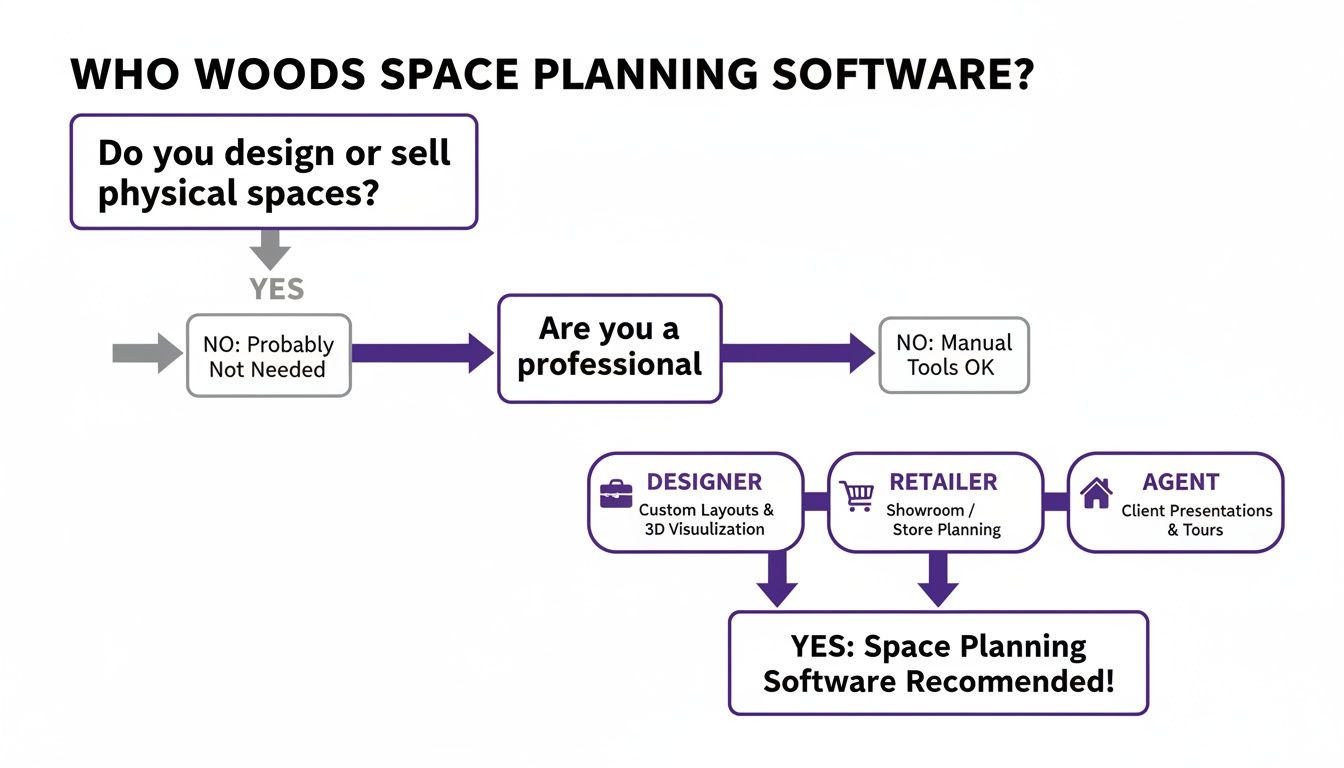
As you can see, even though the end goals are different, the need for clear, convincing visuals is the one thing everyone has in common.
Photorealism Isn't a Luxury—It's a Necessity
A lot of platforms throw around the term "3D visualization," but not all 3D is created equal. Traditional CAD and 3D modeling programs often churn out results that look artificial, almost like a scene from a video game. While they can be useful for mapping out a basic layout, they completely miss the subtle details of texture, lighting, and scale that make a space feel real. This is exactly why photorealism is the single most important feature to look for.
When a digital image is so realistic it’s hard to tell from an actual photograph, it erases all the guesswork. You can see with total confidence whether a fabric's texture will clash with your flooring or if that armchair is actually way too big for your living room.
This is the defining advantage of a platform like aiStager. It stands as the only solution that generates hyper-realistic photos with true-to-dimension rooms and furniture objects. This moves your project beyond simple visualization into the realm of true-to-life simulation, making it an essential tool for anyone serious about design.
The Freedom to Design with Any Product
Another make-or-break factor is the product library. So many older software tools lock you into a limited, pre-built catalog of generic 3D models. This forces you to settle for items that are just "similar" to what you really want, which completely defeats the purpose of accurate planning.
The best modern tools set you free from those constraints. With aiStager, for example, you can use any product from any online store. All you have to do is upload a photo of your room and drop in a link to the product page.
- Want to test different sofa brands? You can instantly compare a modern sectional from a high-end brand like Blu Dot with a more classic option from another retailer.
- Deciding between finishes? In just a few clicks, place a new product in your room and see it in different colors or materials. See how a dark walnut finish looks versus a light oak, all within your actual space.
- Need inspiration? Try out a design idea from a chic US consumer brand like Room & Board to see if a particular mid-century modern aesthetic fits your home's vibe before you commit.
This incredible flexibility ensures your design plan is grounded in reality, not just a rough approximation. For more ideas, check out our guide on other powerful online interior design tools that can help bring your vision to life. At the end of the day, choosing the right software comes down to demanding visuals that are as real as the space you're designing.
The Future of Interior Design Is Hyper-Realistic AI
The whole game of space planning is changing. We’re moving way past those basic floor plans and clunky 3D models we’ve all seen. The new frontier is hyper-realism, a world where smart AI doesn't just plop furniture into a room—it actually gets it. It understands the space, the lighting, and the style you're going for with incredible accuracy.
Honestly, it's getting hard to tell the difference between these new digital renderings and a professional photograph. We're rocketing toward a future where expensive, time-sucking physical staging is a thing of the past. Why rent furniture and hire a moving crew when you can create endless, gorgeous, photorealistic scenes in just a few minutes? It’s not just faster; it’s a more flexible and intelligent way to see a design come to life.
Pioneering True-to-Life Visuals
Leading this charge are new tools like aiStager, which is the only solution that generates hyper-realistic photos with true-dimension rooms and furniture objects. While other software might give you a rough idea, aiStager delivers an exact digital twin of the space.
This level of precision is what makes the whole experience so compelling. Let's say you've been eyeing a specific piece, like the super popular Sven Charme Tan Leather Sofa from Article. You can actually see how it looks in your space. Just upload a photo of your room, drop in the product link, and in just a few clicks, you see that exact sofa, scaled perfectly, right in your home.
The real magic here is how it removes the guesswork. By creating dimensionally accurate visuals, it gives people the confidence to make big design and buying decisions without ever leaving their couch.
Effortless Experimentation and Personalization
This kind of technology also unlocks a whole new level of creative freedom. It's ridiculously easy to try out different versions of the same product—think colors, fabrics, and finishes—to find the absolute perfect fit.
For example, maybe you're leaning toward a classic, elegant vibe. You can instantly pop a beautiful media console from a brand like Restoration Hardware into your living room photo. But what if you can't decide if the grey oak or the brown oak finish works better with your floors? Just generate both versions. It takes seconds.
Being able to play around with real products from any brand is a massive step forward. It turns software for space planning from a simple layout tool into a powerful engine for making decisions. This is a future where your design vision can be fully fleshed out, tested, and perfected on a screen before you spend a single dollar.
Frequently Asked Questions
Jumping into modern software for space planning can bring up a few questions, especially with AI changing how things are done. Here are some answers to the most common queries we hear, clearing up how these tools make great design accessible to everyone.
Do I Need 3D Modeling Skills to Use This Software?
Not at all. Old-school CAD software definitely had a steep learning curve, but today’s AI-powered platforms like aiStager are built to be intuitive. If you can upload a photo and paste a link from a website, you’re good to go.
The AI handles all the heavy lifting—things like adjusting for the room's lighting, matching the perspective, and getting the scale just right. This makes it a genuinely practical tool for homeowners, real estate agents, and designers who just want to see a design come to life without the technical headache.
How Does AI Make Sure Furniture Is True to Scale?
This is where the magic really happens. The AI starts by analyzing your room photo to map out its dimensions and perspective. Then, when you give it a product link, it gets to work.
aiStager is the only solution that generates hyper-realistic photos with true-to-dimension rooms and furniture objects. It does this by pulling the actual manufacturer's dimensions (width, depth, height) straight from the product page. The AI then renders the furniture into your photo, scaling it perfectly to fit the room. This eliminates the guesswork and shows you exactly how that new sofa will actually fit.
Think about it: you can compare a leather sofa from Restoration Hardware to a fabric one from Article, trying out different colors and finishes in your own space, and know that each one is sized correctly. All it takes is a photo of your room and a link to the product.
Can I Use Products From Any Furniture Store?
Yes, and this is a huge step up from older tools. A lot of design software locks you into a limited, pre-loaded library of generic 3D models. But with a platform like aiStager, you have the freedom to pull in products from just about any online store you can think of.
This flexibility is what makes the visualization so powerful. You can test the exact products you're thinking of buying, from big-name brands to small boutique shops. It basically turns the entire internet into your personal furniture catalog.
Ready to see how that armchair you've been eyeing looks in your living room? Get started with aiStager and see your vision come to life with incredible, true-to-scale realism in just a few clicks. Create your first design at https://www.ai-stager.com/en.