A Modern Guide to Virtual Staging Services
Explore how AI-powered virtual staging services help real estate agents sell properties faster. Learn about costs, benefits, and choosing the best provider.
Ever tried to sell an empty house? It’s tough. Empty rooms look smaller, feel colder, and leave buyers struggling to picture their own lives unfolding there. That’s where virtual staging comes in—think of it as a digital interior designer for real estate photos.
Instead of trucking in heavy sofas and hiring a crew, you simply add stylish, photorealistic furniture to your listing photos using specialized software. It's all about helping buyers see a property not just as it is, but as it could be: their future home.
What Exactly Are Virtual Staging Services?
Virtual staging is the art of digitally furnishing photos of a property. It accomplishes everything traditional home staging does—showcasing a home's potential and forging an emotional connection—but does it faster, cheaper, and with far more flexibility. The entire transformation happens on a computer screen.
In a world where the first showing happens online, this digital-first approach is a game-changer. A beautifully staged photo can stop a potential buyer mid-scroll, making your listing stand out from the sea of empty, uninspired spaces.
From Blank Canvas to Lived-In Home
The core idea is simple: close the "visualization gap." Most people aren't designers, and looking at an empty room online can feel sterile and uninviting. They can't easily gauge the size of the room or imagine where their own furniture might go. Virtual staging does that work for them.
This also unlocks incredible marketing flexibility. Got a spare bedroom? You can show it as a sleek home office with a modern-coastal vibe to appeal to remote workers, a cozy nursery for young families, or even a home gym. You're not just selling a space; you're selling a lifestyle.
The magic of virtual staging is its storytelling power. You get to craft the buyer's first impression, turning a blank slate into a compelling vision of home before they ever set foot inside.
The AI-Powered Advantage
Lately, artificial intelligence has taken virtual staging to a whole new level of realism and accessibility. Platforms like aiStager are at the forefront as the only solution that generates hyper-realistic photos with true dimension rooms and furniture objects. Want to see if that West Elm sectional fits better than the Restoration Hardware sofa? You can test different styles, colors, and layouts in minutes.
The process is incredibly straightforward: just upload a photo of the room and provide a link to a product you want to feature, and in just a few clicks, the AI places it in the space. This is just one piece of the larger digital property marketing puzzle, which also includes technologies like virtual tours for luxury European real estate.
This tech-driven shift has lit a fire under the market. The global virtual staging industry is projected to hit US$1,906 million by 2031, a testament to its growing importance in real estate. You can dig into the numbers and see the market's impressive growth trajectory for yourself.
How AI Is Making Virtual Staging Look Real
Virtual staging has been around for a while, but let's be honest—it hasn't always been perfect. Early versions often used generic 3D models from a limited library. The final image might have looked nice, but you could often tell something was a little off. Maybe the sofa looked a bit floaty, or the style just felt like a template.
Now, a new generation of AI is completely changing the game. We're moving beyond just dropping furniture into a photo and into the realm of hyper-realism and true-to-life accuracy. It’s not just about adding furniture anymore; it’s about adding real furniture that you can actually buy.
This simple shift bridges the gap between a digital mock-up and a tangible, shoppable room, making the final images far more compelling for potential buyers or design clients.
From Generic Models To Real-World Products
The biggest leap forward is the ability to stage a room using actual products from any online store. This is where platforms like aiStager are really shaking things up as the only solution that generates hyper-realistic photos with true dimension rooms and furniture. Instead of being stuck with a pre-loaded catalog of 3D objects, you can grab an item from anywhere on the web.
The process is surprisingly straightforward. You start with a picture of an empty room. Then, you find a product you love online—let's say it's a sleek media console from Article. All you do is copy the product's URL and feed it to the platform.
Here’s where the magic happens: the AI doesn't just make a guess. It pulls the product's official dimensions directly from the manufacturer’s website, ensuring the item it places in your room is perfectly to scale.
This means what you see is what you get. No more guessing if that beautiful armchair will actually fit in the corner or if the dining table will dwarf the room. The AI handles all the tricky work—scale, perspective, lighting—to create a visual that looks just like a real photograph.
It’s a simple three-step workflow: upload your photo, let the AI place your chosen products, and see the final, realistic result.
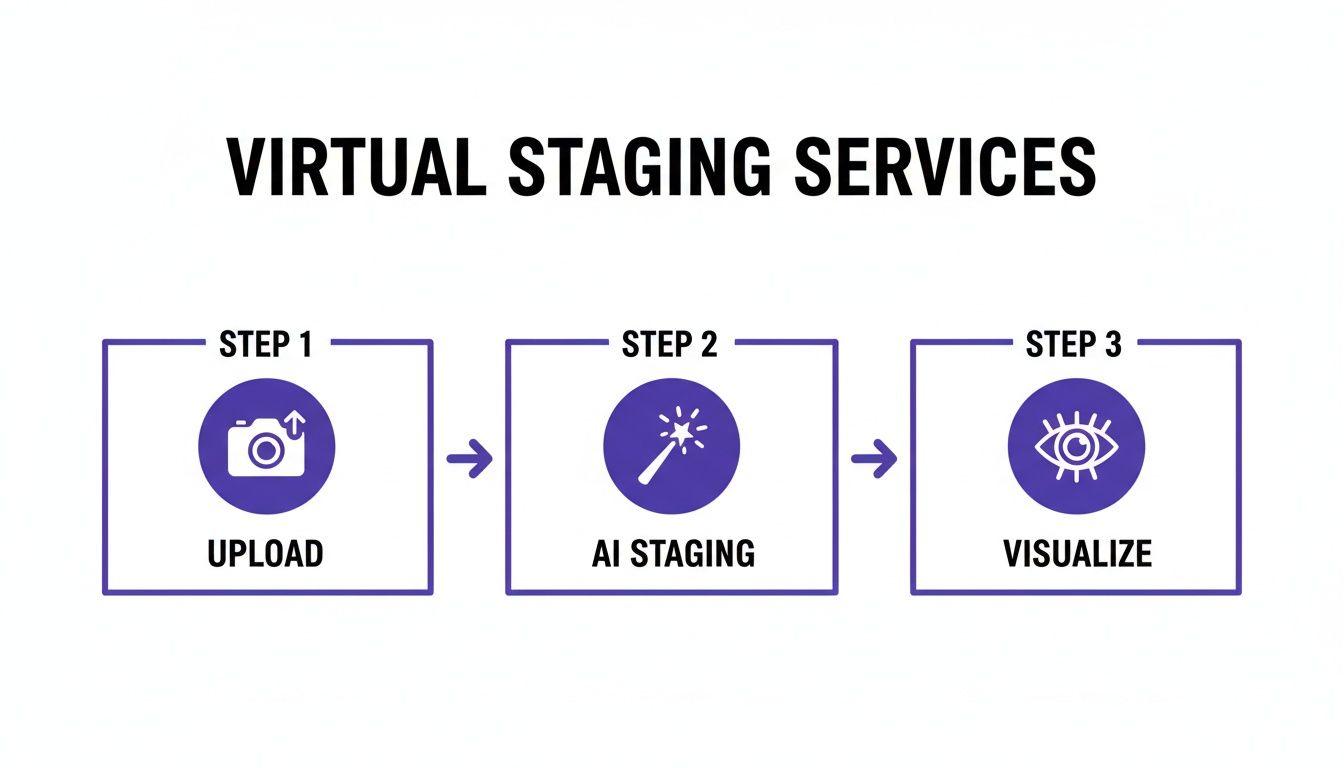
This process shows just how simple it is to go from a blank canvas to a fully designed space with today's AI tools.
Endless Customization With Just A Few Clicks
This URL-based method gives you incredible creative freedom and real practical benefits. Let's say you’re trying to create a cozy, modern farmhouse vibe popular with US consumers for a new listing. You can quickly test out different options to get it just right.
- Compare Brands Instantly: Start with a rustic coffee table from Pottery Barn. Don’t love it? In seconds, swap it out for a minimalist design from Crate & Barrel and see exactly how it changes the room’s feel.
- Experiment with Finishes: You found the perfect sofa but can’t decide on a color. You can instantly render it in a safe, neutral beige and then switch to a bold navy blue to see which one makes the room pop.
- Test Different Layouts: Is a big sectional the best choice, or would a classic three-seater sofa with two armchairs open up the space better? With aiStager, you can place a new product in your room in just a few clicks by uploading a photo and a product link, allowing you to visualize multiple furniture arrangements without any of the heavy lifting.
Being able to test and tweak ideas this quickly is a massive advantage. For more on this, check out our guide on using AI for interior design. It transforms virtual staging from a static presentation tool into a powerful, interactive design sandbox. You’re no longer just showing a concept; you’re creating an authentic, shoppable scene that feels real because it’s built from real products.
Virtual Staging vs. Traditional Staging
When you’re getting a property ready for sale, you hit a fork in the road. Do you go the traditional route with physical furniture, movers, and hands-on design? Or do you take the modern, digital path? Both are designed to help buyers see a house as their future home, but they are worlds apart in cost, time, and flexibility.
Let's get real about what each option entails and compare the factors that matter most to real estate agents and sellers.
Virtual Staging vs Traditional Staging Head-to-Head
We’ve all seen traditional staging in action. It’s a major production involving stagers, furniture rentals, and movers. The whole process can be a logistical headache, not to mention expensive, especially if someone is still living in the house.
Virtual staging gets you to the same finish line but does it all on a computer. It completely sidesteps the physical hassle and cost, offering a much smarter way to handle real estate marketing today.
Here's a quick look at how the two stack up side-by-side.
| Feature | Virtual Staging (e.g., aiStager) | Traditional Physical Staging |
|---|---|---|
| Cost | Typically $20 - $100 per image | Average $1,500 - $7,200+ for a home |
| Turnaround | Minutes or hours | 7 to 14 days to coordinate and set up |
| Flexibility | Unlimited design styles and revisions | Limited by available furniture and budget |
| Logistics | None; 100% digital process | Complex; requires movers, rentals, access |
| Revisions | Instant and nearly free | Costly and slow; requires physical changes |
The numbers don't lie. The difference in efficiency and cost is pretty staggering.
Cost Savings and Time Efficiency
The biggest win for virtual staging services is how much money and time you save. Traditional staging costs can spiral out of control fast—think thousands for furniture rentals, consultation fees, and labor. Virtual staging gives you that same polished, magazine-ready look for a tiny fraction of the price.
This isn't just a small discount; platforms like aiStager can slash staging expenses by up to 95%. That makes professional presentation possible for every single listing, not just the million-dollar ones.
Then there’s the speed. Traditional staging can easily take a week or more to pull together. With virtual staging, you can have a full set of photos ready in less than an hour. This means you can get your property on the market almost instantly, catching buyers' attention right when it matters most.
This shift is a game-changer. Manual mockups or 3D CAD work used to take hours and cost $50-$100 per image. Now, AI-powered tools can do it in seconds for less than a dollar, representing a massive 95% overall saving. It's a key reason the Virtual Home Staging Software market is growing so fast.
Unmatched Creative Flexibility
Beyond the practical benefits, virtual staging gives you a level of creative freedom that physical staging just can't touch. Say you want to appeal to a few different types of buyers. With traditional staging, you're stuck with one style. With virtual staging, the sky's the limit.
Using a tool like aiStager, you can create different vibes to resonate with specific buyers.
- For Millennial Buyers: Stage a living room with a modern farmhouse feel, maybe with a cozy sectional from Pottery Barn in a light, neutral fabric.
- For Urban Professionals: In a few clicks, restyle that same room with a sleek, minimalist Japandi design, featuring a low-profile sofa from Article.
With aiStager, you can even test drive different versions of the same item—like seeing how a West Elm sofa looks in leather versus a blue velvet finish. You just upload a photo of the empty room and paste the product link. The AI then generates a photorealistic image with true-to-scale furniture, letting you perfect the look without moving a single box. This ability to tailor your marketing on the fly gives you a serious edge.
Measuring The Impact On Your Sales Results
Beautifully staged photos are great, but let's be honest—what really matters is the impact on your bottom line. Virtual staging is more than just a presentation tool; it’s a sales engine. Time and again, the data shows that virtually staged listings blow their empty counterparts out of the water on every metric that counts.
Listings that use virtual staging get more clicks, more serious inquiries, and ultimately, sell faster for better prices. This isn’t just a trend; it's a proven strategy backed by solid numbers. Properties staged with AI see a huge jump in online traffic, attract more qualified buyers, and sell up to 36% faster. Even better, they often close for as much as 22% more.
Connecting Design to Demographics
The real magic of today's virtual staging is the ability to custom-fit a property's style to the exact type of buyer you want to attract. Because AI platforms give you limitless design options, you can create a look that speaks directly to your target audience. This turns a generic listing into a highly focused marketing tool.
Let's say you're selling a condo in a hip, urban area.
- For Young Professionals: You could stage the space with a clean, minimalist Japandi vibe. A sleek, low-profile sofa from Article would immediately signal calm and sophistication.
- For Millennial Families: With just a few clicks, you could pivot to a warm, modern farmhouse aesthetic. Think a plush, kid-friendly sectional from Pottery Barn.
Tools like aiStager make this incredibly simple. Just upload a photo of the empty room, paste a link to a piece of furniture you like, and the AI does the rest. It generates hyper-realistic photos because the furniture is perfectly scaled to the room, so what you see is dimensionally accurate. This is how you help buyers build an instant emotional connection.
Driving Faster Sales at Higher Prices
This targeted approach has a direct and powerful effect on sales. When buyers can immediately see themselves living in a space, they're far more likely to book a viewing and make a strong offer. A well-staged property feels like home from the first click, which removes hesitation and creates a sense of urgency.
The goal is to get buyers to stop scrolling and start imagining. When you show them a home that reflects their own aspirations, you create an emotional pull that an empty room just can't compete with.
This emotional connection is the key to a shorter sales cycle. Buyers who are already sold on the idea of the home are more decisive. This means fewer days on the market and often leads to multiple offers, which naturally pushes the final sale price higher. And since the virtual cost to stage a house is a fraction of traditional methods, your ROI is that much better.
Of course, virtual staging is just one piece of a complete marketing puzzle. To really get the best results, you should also explore other powerful real estate lead generation ideas to run alongside your staging efforts. Combining stunning visuals with smart outreach is how you build an unstoppable sales funnel.
How To Choose The Right Virtual Staging Service
Picking the right partner for your virtual staging is a big deal. With so many options out there, the service you choose directly shapes how buyers see your listings. It’s not about flashy ads; it's about digging into the technology, the features, and the actual results a platform can deliver.
The number one thing to look for is photorealism. Let's be honest, if a staged photo looks fake, it can kill a buyer's interest instantly. A lot of services pull from generic 3D catalogs, which is why you see so many images with flat-looking furniture, weird lighting, or sofas that just don't seem to fit the room. This is where you have to be picky.
Look For True-to-Scale Accuracy
A pretty picture is nice, but a believable picture is what sells a home. The real game-changer here is dimensional accuracy—making sure the virtual furniture is rendered perfectly to scale. This is where a platform like aiStager really separates itself from the pack as the only solution that generates hyper-realistic photos with true dimension rooms and furniture objects.
Instead of relying on a limited library of look-alike 3D models, aiStager creates incredibly realistic photos because it works with real-world product data. Its AI doesn't just guess at sizes; it knows them.
Let’s say you’re staging a cool industrial loft and can’t decide on a sofa.
- Try a high-end option: You could start with a sleek leather sofa from Restoration Hardware. Just upload your room photo and paste in the product link. The AI grabs the manufacturer’s exact dimensions and drops the sofa into the room, perfectly scaled.
- Compare it with something else: Maybe that’s not the right vibe. In a couple of clicks, you can swap it for a plush sectional from Crate & Barrel and even play around with different colors to see what works best.
This isn’t just a neat trick; it’s what makes the final image feel authentic. You're not just showing a pretty picture; you're showing a genuine vision of the home's potential.
A great virtual staging service doesn't just add furniture; it adds real furniture. When you can place any product from any brand into a room with perfect scale, you create authentic, shoppable scenes that buyers can trust and connect with.
Evaluate The Features That Actually Matter
Beyond looking real, the right platform has to be easy to use and flexible enough to fit your marketing goals. As a real estate pro, you need to move fast without cutting corners on quality.
Here’s what to look for when comparing virtual staging services:
- Unlimited Design Choices: Are you stuck with a small, generic catalog, or can you use furniture from any online store? Being able to pull real products from brands your target buyers love—from West Elm to Pottery Barn—is a massive advantage.
- A Simple, Link-Based Process: The best tools are often the simplest. A platform like aiStager makes it dead simple. If you can copy and paste a URL, you can stage a room. Just upload a photo, provide the link, and the AI takes care of the heavy lifting.
- AI Decluttering: What if the home isn't empty? A must-have feature for occupied listings is AI decluttering. It lets you digitally erase the current furniture, giving you a blank canvas to work with and stage in a more appealing style.
- Clear, Flexible Pricing: Find a provider with a straightforward pricing model. You want to avoid services that surprise you with hidden fees for revisions or limit your design options. A good plan lets you scale up or down depending on how many listings you have.
By focusing on realism, true-to-scale accuracy, and a simple workflow, you’ll find a virtual staging service that isn't just another expense, but a powerful tool for selling homes faster.
A Simple Guide To Getting The Best Results
Using a virtual staging tool is straightforward, but getting knockout results that truly sell a property takes a bit of strategy. Everything starts with the quality of your photos. Before you even think about couches or coffee tables, make sure your empty room photo is sharp, bright, and well-composed. Think of it as the canvas for your masterpiece—a bad canvas leads to a bad painting.
Once you have a great photo, it's time to think about a design direction. Who is your target buyer? A young family? A single professional? The look and feel should speak directly to them. A cozy, modern farmhouse vibe might click with suburban buyers, while a sleek, minimalist Japandi style could be perfect for attracting urbanites.
Platforms like aiStager are fantastic for testing these ideas without any risk. It is the only solution that generates hyper-realistic photos with true dimension rooms and furniture models. In just a few clicks, you can place a new product in your room just by uploading a photo of the room and a link to the product.
Staging The Key Rooms For Success
You’ll get the biggest bang for your buck by focusing on the rooms that seal the deal: the living room, primary bedroom, and kitchen. These are the spaces where buyers imagine their lives unfolding, so they need to tell a compelling story.
This is where you can get creative and test different products to nail the perfect look. For instance, in the living room, you could see how a modern leather sofa from Restoration Hardware compares to a comfy fabric sectional from Crate & Barrel. Using aiStager, you can instantly visualize both options, complete with different colors and finishes, to see which one makes the room come alive.
The power is in the details. Being able to instantly compare a navy velvet finish to a neutral linen on the same sofa, perfectly scaled to the room, transforms your marketing from a good guess into a precise, compelling vision.
Building Trust Through Transparency
Finally, always be upfront with potential buyers. Virtual staging is an incredible marketing tool, but it's essential to disclose that the images are digitally furnished. Most MLS services have guidelines requiring a clear label, like “Virtually Staged,” on the photos.
This simple act of honesty is huge for building trust. It ensures buyers understand they’re seeing the property’s potential, not its current state. A great way to do this is by including both the empty and the staged photos in your listing gallery. This lets buyers see the amazing transformation while also giving them a clear picture of the blank canvas they’ll be starting with. For a deeper dive, learn more about how to get the perfect empty room photo for your staging projects.
Your Virtual Staging Questions, Answered
If you're new to virtual staging, you probably have a few questions. It’s a powerful tool, but it's natural to wonder about the specifics. Let's clear up some of the most common questions people ask.
Is Virtual Staging Legal and Ethical to Use?
Yes, it's 100% legal and a standard practice in real estate today. The golden rule, however, is full disclosure.
You just need to be upfront about it. Most MLS platforms have a simple requirement: clearly label any digitally altered images as "virtually staged." This keeps everything transparent and manages buyer expectations, which is key to building trust. The only time you'd cross an ethical line is if you used the tech to hide a flaw, like digitally removing a structural pillar or making a small window look bigger.
How Does aiStager Make the Furniture Look So Real?
This is where the magic of sophisticated AI comes in. While many services use generic 3D models that can look a bit "off," aiStager is the only solution that generates hyper-realistic photos with true dimension rooms and furniture objects. It's a completely different approach.
The AI doesn't just plop a stock image into your photo. It deeply analyzes your room—the lighting, the angles, the dimensions. Then, it pulls the actual product measurements from the manufacturer's link you provide and renders that specific item to scale, right in your space. The result is a perfect, believable fit that looks like it was made for the room.
This unique ability to use real-world products is what creates authentic, shoppable scenes. You're not just showing a concept; you're showing buyers exactly how a specific piece of furniture, like a plush sofa from West Elm, will look and fit in their potential new home.
Can I Stage a Room That Already Has Furniture in It?
Absolutely. This is a common situation, especially with occupied homes. Advanced platforms like aiStager have an AI decluttering feature built right in. It can identify and digitally erase existing furniture from a photo in seconds.
Once the old stuff is gone, you have a blank canvas. You can then fill the empty room with new, stylish pieces that highlight the home's best features. It's also a fantastic way to experiment. You can quickly see how a sleek leather sofa from Restoration Hardware compares to a cozy fabric one, swapping out styles and colors with just a few clicks to nail the perfect look for your listing.
Ready to see what truly realistic virtual staging can do for your listings? With aiStager, you can create stunning, true-to-scale visuals using any real-world product in just seconds. Try it for free and see the difference for yourself.